

Culture & Community | Education & Youth | Fashion | Hamden | Arts & Culture | Eli Whitney Museum & Workshop
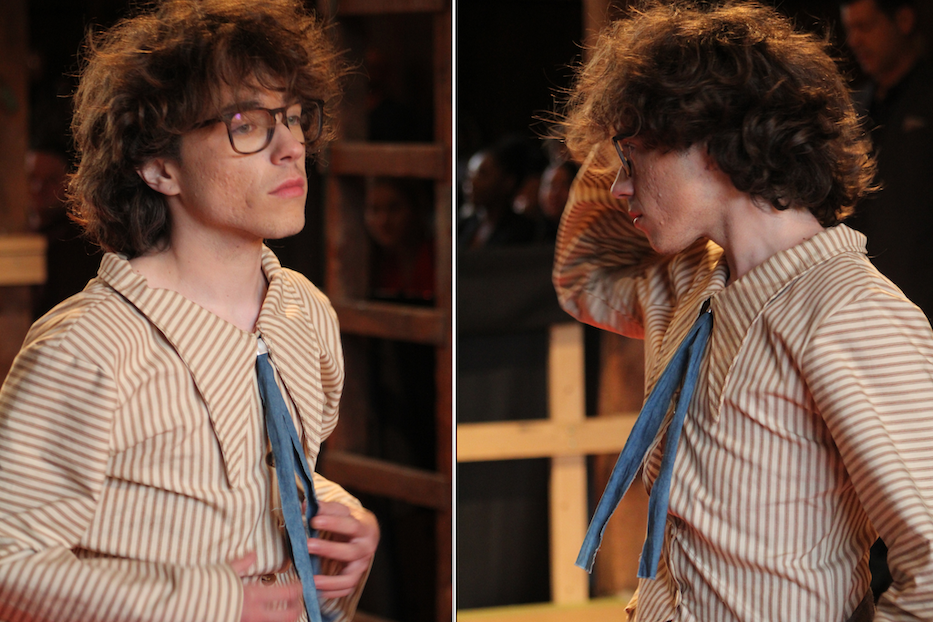
Strand hits the runway. Abiba Biao Photos.
Dressed in a white and yellow striped shirt with ash grey trousers, young artist Emilio Strand turned the center of an old barn into a glamorous and sustainable runway. The sleeves, slightly oversized, extended to his fingertips. His navy blue denim tie, rough at the edges, popped against his shirt. He put his hands in his hair, giving off a nonchalant expression, then struck a pose before turning to walk back. All eyes were on him.
Trashionistas, environmentalists, fashion designers and champions of sustainability rolled out the red carpet last Saturday, as the old barn owned by the Eli Whitney Museum & Workshop transformed into a sartorial extravaganza for “Rescued Runway,” a zero-waste fashion show and celebration of eco-friendly design from designers across three generations. A collaboration between Trash to Fashion and the Eli Whitney Museum & Workshop, the event followed an exhibition and zero-waste workshop and gala at Bregamos Community Theater last year.
The show featured work from New Haven designers Tea Montgomery (of Threads By Tea), Donald Carter, and Desirée Upchurch, as well as first-time designers Molly McGurk and Leo Smolinski, both seniors at James Hillhouse High School and the ACES Educational Center for the Arts (ECA). Following the show, a discussion amongst designers took place across the street at the Eli Whitney Museum's Carter Studio, moderated by CT Public Radio’s Catherine Shen.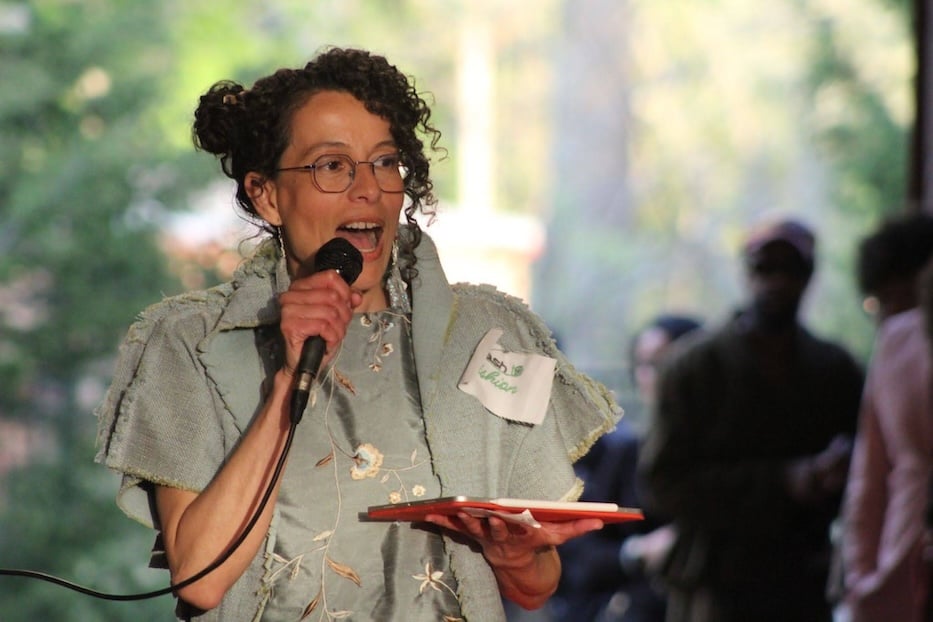
Self-described "Trashionista" Rebekah Fraser, who founded Trash To Fashion last year.
“All of our events are about environmental action and arts and community building,” said Trash to Fashion Founder Rebekah Fraser, who is also a writer and visual artist, in a phone call on Sunday. “I really want people to have the lived experience of repurposing or upcycling materials. Our events are kind of like the gateway drug to someone incorporating, repurposing, and re-fabricating into their lifestyle.”
The event, she added, had an attendance of around 100 viewers, with a grant from the NewAlliance Foundation through which she was able to compensate models. Meanwhile, she worked to make everything about it zero-waste, including water served in glass bottles, food served on compostable plates and with bamboo napkins, and silverware from Goodwill. Food scraps from meals provided by the Big Green Pizza Truck were placed in compost bins provided by the locally-owned composting company Peels & Wheels.
Fraser's vision came to life over and over again throughout the night, thanks to upcycling-savvy designers who looked to used and would-be discarded materials for their designs, some as a matter of habit and others for the first time (Fraser has spoken before about the harm that fast fashion, and the broader textile industry, is wreaking on the environment). In total, designers had roughly 73 bolts of rescued upholstery fabric to choose from, collected from a shop based in Litchfield. The scraps were sorted and stored in the Eli Whitney Museum.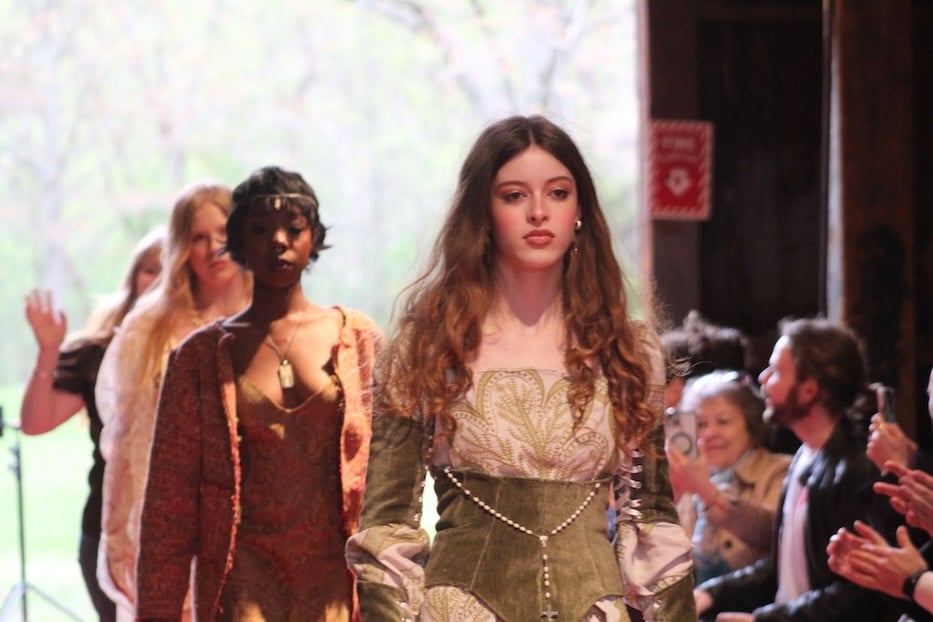
Rana Roosevelt: A passion for fashion.
Strutting down the runway in an olive green and white maxi dress was artist Rana Roosevelt, who is currently finishing her freshman year at Yale University. The dress, which featured a square neckline and long sleeves, felt like something that could have come right out of a Renaissance Faire—but with a serious fashion flair that made it equally worthy of a gala or party. In the center, a white beaded rosary dangled over a velveteen bodice, over which a pattern of lush leaves stretched across the fabric.
For Roosevelt, who modeled clothes fashioned by McGurk, the show represented a chance to get beyond the Yale bubble while doing something that she loves, and learning more about sustainable fashion. A double major in art history and visual art, Roosevelt also serves as illustrations editor at the Yale Daily News, and models for the student-led fashion and art collective Maison at Yale. She likes modeling for the “sense of community” that it fosters, she said.
“I'm an artist when I study art history, and I also am really into creating clothes, but I also like to model them,” she said. “So I just like to be able to fully round out my perspectives on things that I'm passionate about.”
It gave her a chance to meet fellow young people like Strand, a visual arts student who is headed to Rutgers University in the fall. As he prepares for college, Strand said that this experience has opened him to pursuing modeling and other creative tasks during his undergraduate studies.
“I was excited, but I was also so nervous,” Strand said, describing the inner monologue he had while walking. "I was like, ‘Don't look at anybody, Look at people. Look and then walk.’ I've never did anything like this before, so, yeah. It was really exciting and it was really nice to be a part of this.”
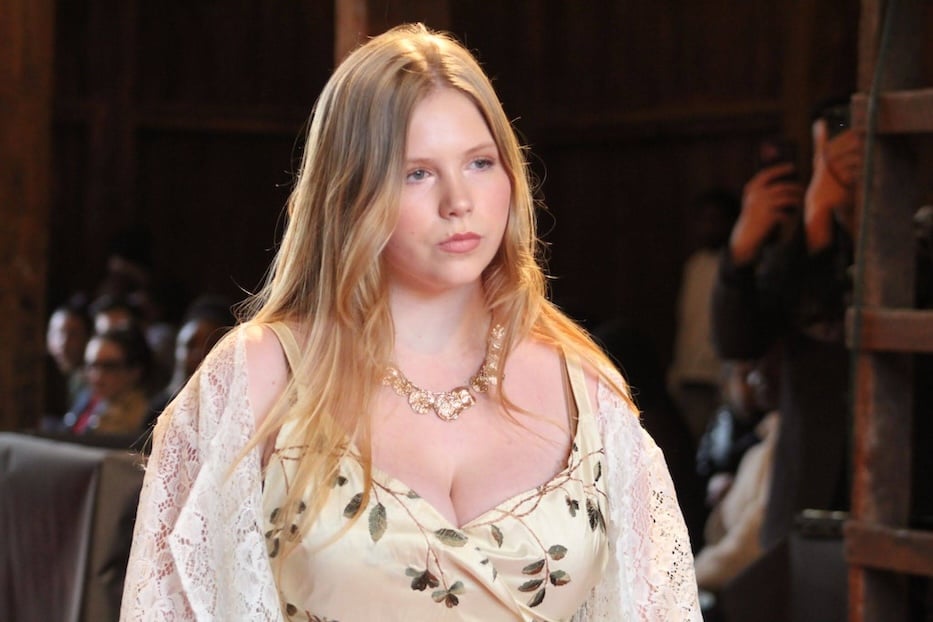
Fellow Hillhouse and ECA senior Aviva Robbins graced the runway with a lemon chiffon mini dress, the luminous fabric patterned with branches and green leaves that felt right on time for spring. As she walked, a long white lace cardigan billowed behind her, falling to her knees. A golden, crinkled disc statement necklace sat above the dress’ scoop neckline, a reference to the designer Yves Saint Laurent. She completed the outfit with wedge flip flops.
Robbins heard about Rescued Runway from McGurk, who extended the invitation to model. It didn’t take long for her to make a decision.
“Because I lived very close to her, it was very easy to get my measurements and keep having me back for fittings to make sure it fit,” she said.
While it was her first time modeling, Robbins pointed out the similarities it shared to acting and theater, which she studies at ECA.
“Once I got here, it was like, instantly, everyone around me was so immersed, even if they were new themselves, like I was,” she said, reflecting on the runway experience. “And so, it was pretty easy to dive in deep myself. There wasn't a whole lot of instruction per se, but I think that was good because it allowed people to flow the way they thought they should flow.”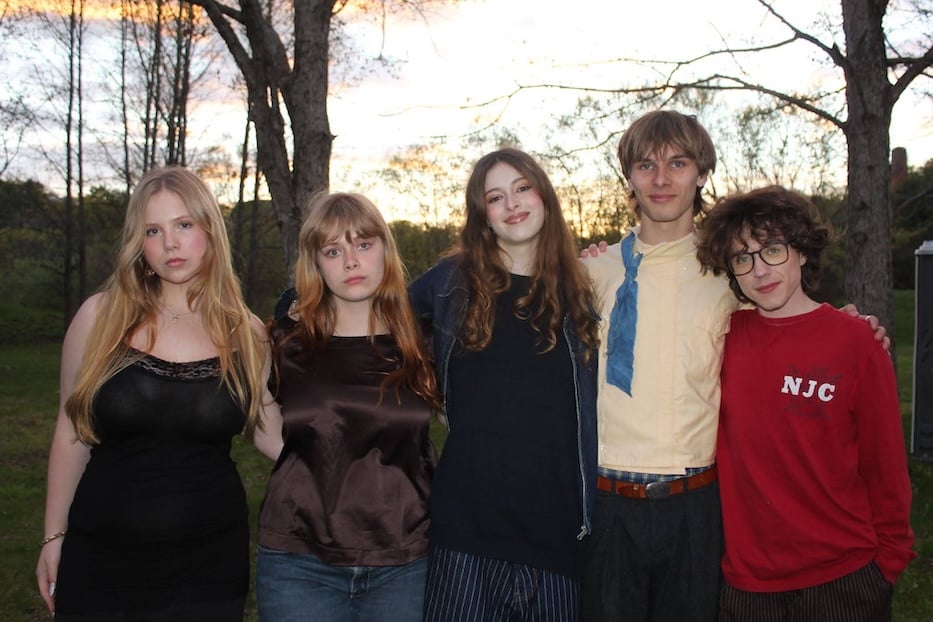
Aviva Robbins, Molly McGurk, Rana Roosevelt, Leo Smolinski, and Emilio Strand.
For McGurk and Smolinski, the creative process behind the designs was freeflowing and unfettered. Smolinski first sorted through the fabric with McGurk on a Facetime call and the two rated the fabric together.
“I think it just kind of started there, like, looking at the fabric and sort of envisioning what it could go for,” he said.
After getting measurements of the models, the two got to work on a month-long process designing, creating, fitting and altering the outfits. They learned along the way, both said, from realizing how time- and labor-intensive slow fashion can be to realizing that the process of alteration is its own chapter of the design process. It helped that both had taken fashion design at ECA before the show, learning from ECA alum (and former Project Runway contestant) Emmett McCarthy.
“I didn’t know how to make a shirt before this,” Smolinski said.
“He knew how to do this. He’s done this before,” McGurk pushed back. “‘Not much,’ but he made his own bag. He made his own pants. He made his own pants from scratch. He's being humble.”
After graduation, the two plan to continue their creative pursuits in college. McGurk intends to pursue fashion design at The New School, Parsons School of Design in their combined BA and BFA dual degree program in New York. Smolinski will study art history and studio art at Yale. He added that he also plans to sharpen his tailoring skills using the makerspace at the Yale Center for Engineering, Innovation and Design and joining Maison at Yale.
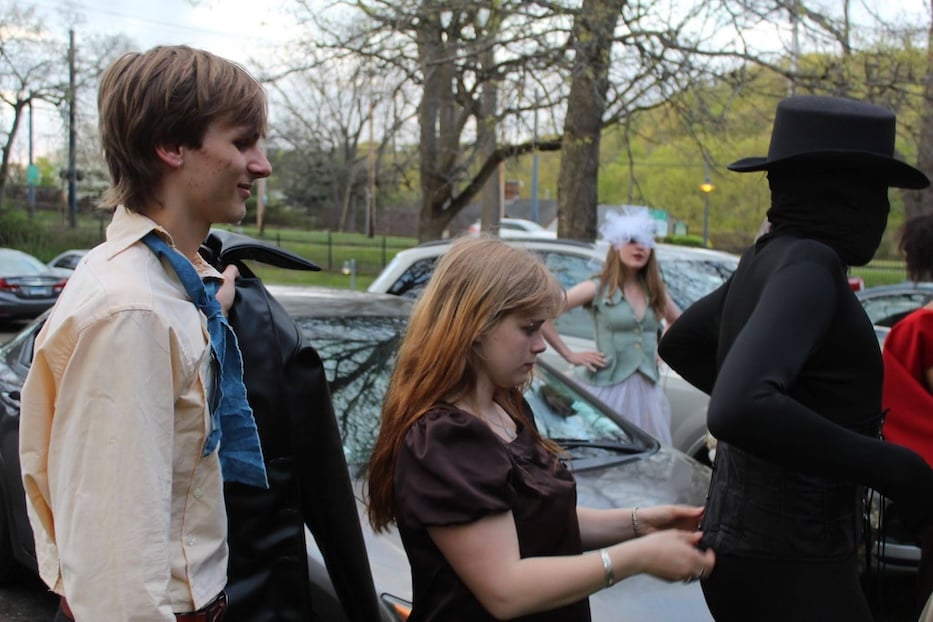
As the teen designers spoke about their process, they paused mid-thought to jump into action. Something had come undone on Donald Carter's outfit, and there were just minutes to spare as he transformed from designer into model, two hats that he often wears at the same time, and with extraordinary grace. McGurk tied the corset of a model preparing to walk as Smolinski stood behind, holding Carter's leather trenchcoat. Finally, the corset was tightened, and the crisis was averted. Carter's sleek, all-black ensemble look was complete.
It felt, in the moment and after the night had ended, like a testament to the intergenerational community Fraser is building within the Trash to Fashion movement. Not only was Carter's work the final look of the night: he designed Fraser's outfit, a long coat and pants that shimmered as the sun went down.
In a follow-up phone call Sunday, Fraser expressed gratitude for community and regional partners that make Trash to Fashion’s work possible, including partner and lead sponsor Goodwill of Southern New England, the Greater New Haven Green Fund, Whole Foods, Hull’s Art Supplies & Framing, and the Community Foundation for Greater New Haven.A big ethos behind Trash to Fashion, she explained, is making community events free and accessible to the community. She expressed excitement in continuing to host workshops educating people how to repurpose fabric.
“To me, that's really us doing the work,” Fraser said. “Teaching people how to do it [adopt zero waste habits], creating things in community, and then celebrating together.”