

Culture & Community | Dance | Arts & Culture | Shubert Theatre
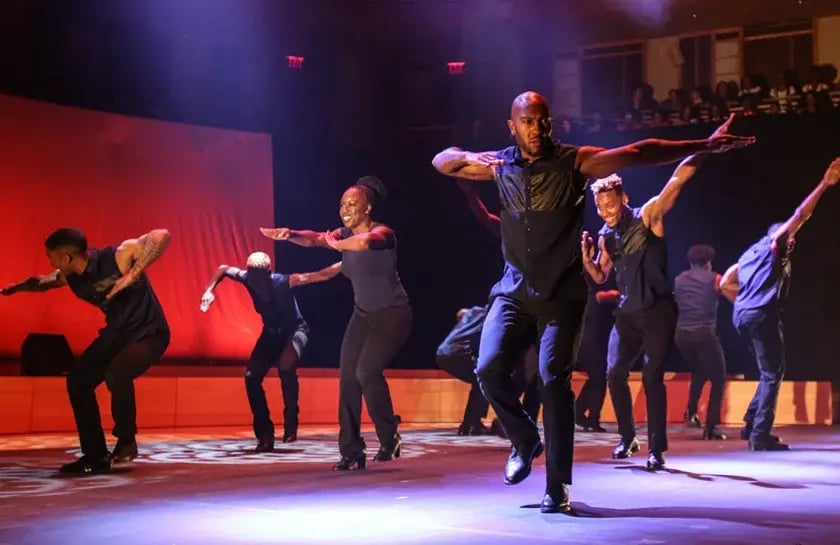
Image courtesy of the Shubert Theatre.
As drums floated over the stage, it was as if thunder was coming right down from the heavens, stronger and more controlled with each powerful strike. Muscular arms pounded the taut drumskins, spreading percussive joy through the Shubert Theater. Shields and sticks alchemized into instruments. Bells tinkled on ankles. Chests heaved. Bodies swirled in mid-air.
Dancer Nya Christian dipped bravely backwards with the fury and agility of a panther and the spirit of Josephine Baker. As she arched her back and remained steady, her fingertips dusted the stage with both confidence and exquisite balance. It was a sight to behold.
Step Afrika!, the international dance phenomenon founded in 1994, has C. Brian Williams, Howard University, the Soweto Dance Theatre and the Black fraternity Alpha Phi Alpha, Inc. to thank for its presence on the world stage. But last weekend, its gratitude was directed to the audience at the Shubert Theatre—who reflected it back, in spades, during a stunning performance in the heart of downtown New Haven.
“We take it [dance] to new places and expand on tradition,” Williams said, adding that the ensemble currently employs 17 full-time, benefitted artists—a creative feat in any economy, and certainly in this one. Prior to the performance, the Shubert hosted educational programming around the show at the Stetson and Mitchell Branches of the New Haven Free Public Library.
Saturday, that energy was on display from the moment a person walked into the theater until the last standing ovation of the night. Ahead of the opening act, the shade-sporting DJ Sparkz—both a dancer and a host—mixed and spun catchy sounds steeped in Amapiano and Afrobeats. It set the tone for a performance: the turntables were centerstage, the area around them backlit in blue. Three drums—a djembe on either side and a doudoun in the middle—stood in front, momentarily unoccupied.
Patience and anticipation filled the space. Attendees grooved in the dark, some seated and some making their way in. Shoulders bounced. Fingers snapped. It felt, for a moment, like being transported to a new planet, the beat was just that good. And then, the lights dimmed.
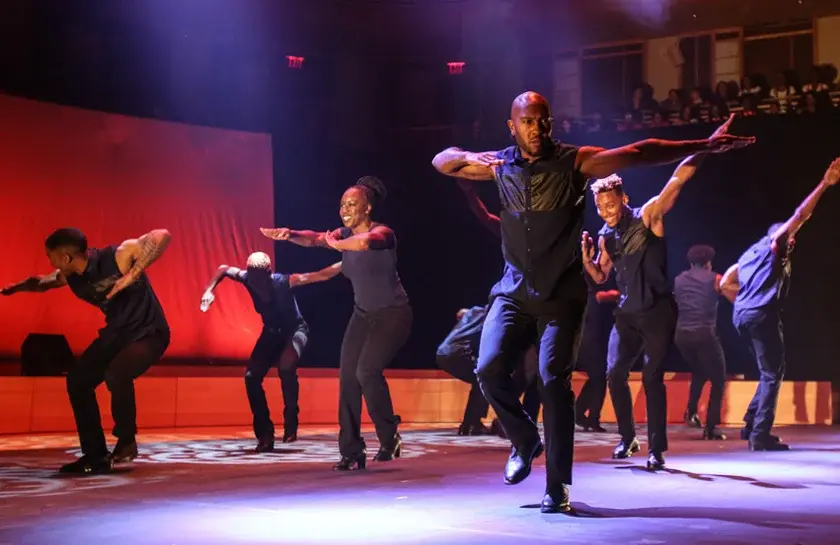
A spotlight appeared, casting a long, triangular glow onto the stage. In a soft, smoky cloud, a dancer appeared to kick off the show. Then more steppers appeared, dressed in plaid shirts that gave them synchronicity even before they started moving. Shoulders shook. Hands clapped in harmony so much that even the audience joined in. The crowd soaked up the moment like raindrops to a flower.
Step Afrika! does not mimic a style: it creates one that is an homage to many different threads of the African diaspora, and the percussive traditions that have sprung therefrom. As the company showed clearly from the stage, Williams has established dominion in the realm of stepping, and in doing so cultures have been intertwined, stories are artfully told, youth are educated, innovation is experienced and traditions are well preserved.
Take, for instance, a battle scene that occurred between male and female steppers during the performance. Over the stage and in the audience, the air buzzed with playful antagonism, tension even. A simultaneous three-person split gained instant applause from the audience. Within seconds, the other steppers were pushing back, as forceful, rhythmic stomps and gravity-defying leaps filled the stage.
There was a triple flip in two directions, somehow simultaneous. The baritone—“Roof! Roof! Roof! Roof!”—echoed deeply in the dark, suggesting a win. The intensity was thick, adrenaline high, and the audience brought into a tradition that tapped into hundreds of years of cultural tradition.
By the third round, it was challenging to even decide who would win the step challenge. Palms slapped chests with abandon. Fingers snapped. Hands clapped behind legs. Pop! Pop! A stampede of rhythms and cadent pauses held the audience captive.
Stepper Pelham Warner Jr., who has been with the company for close to a decade, evoked the spirit of togetherness including the audience in the oasis.
“When I say ok you say alright,” Warner said. And so, the audience, now a part of the performance-now infused with it followed orders.
“Okay Okay!” Warner shouted.
“Alright Alright!” the audience shouted back.
“Alright Alright!”
“Okay Okay!”
“Okay Alright!”
“Alright Okay!”
In the haze of unity, Warner returned his attention to the steppers, ready to announce the winners of the final round. Warner complimented both groups. “But we step best when we step together,” he said, standing between them. It was a tie. Sure enough.
Step Afrika! is a bridge for certain. An amalgamation of genres, tones, and histories, all presented with stunning authenticity. After seeing the performance live, no doubt some students may want to transfer to universities where stepping is customary, or learn more about the practice. Alumni will recount the best portions of their college days; the youth may desire to become a part of this legacy. Step Afrika! is movement for the mind, heart and spirit.