

Culture & Community | Arts & Culture | Theater | Public Health | Mental Health | Survivors of Society Rising
Photos courtesy of the David Geffen School of Drama at Yale.
The cross-talk is building all at once, as if a swarm of bees has come loose from its hive, and is racing toward the peer support specialist, Anastasia, in the center of the room. One attendee, Sasha, is fed up with the side effects of her psych meds, and needs to get it off her chest. Another, Olga, so clearly has a story to tell, but hesitates as though there is a wall between her body and the eyes in the room. A third, Xavier, emphasizes that he’s only there because “my fucking parole officer sent me here.” The voices rise around each other, dizzying and barbed.
“Okay!” Anastasia yells, and suddenly a person can feel the urgency of every story humming around her. “Stop! Shit! One mic! Please! One mic!”
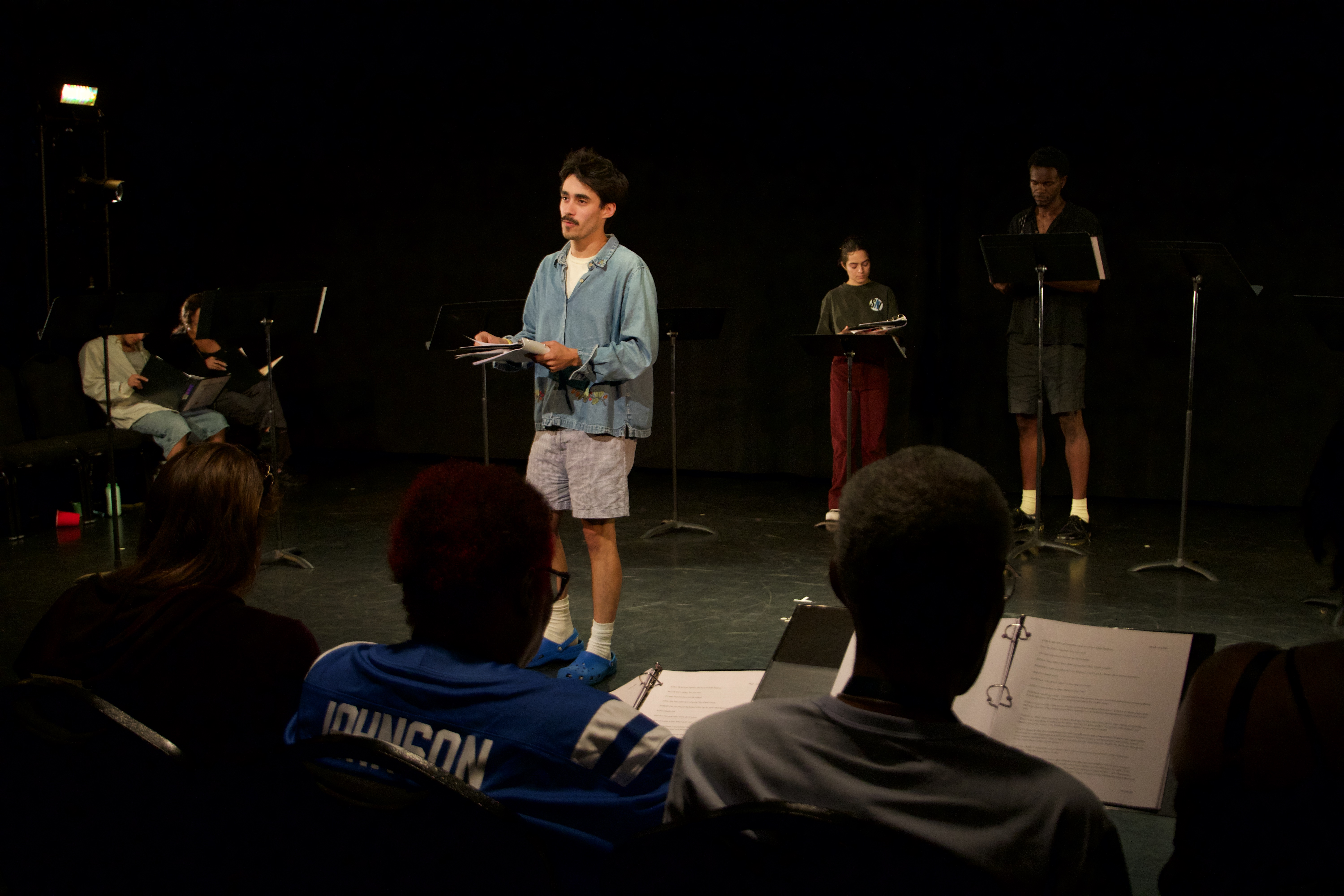
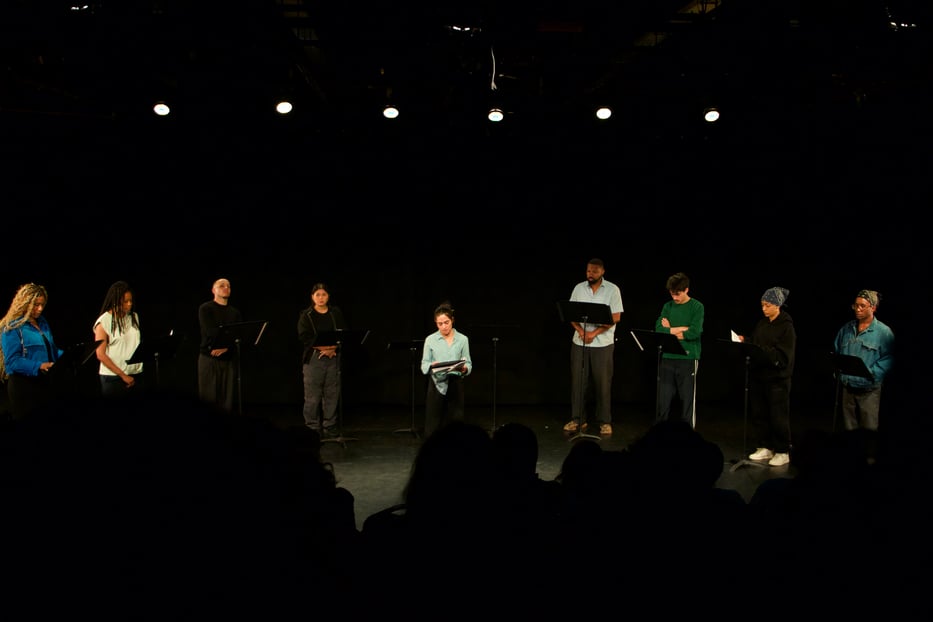
That sense of deep and intimate truth-telling—and frustration at systems that are profoundly broken—is at the heart of The Shape of Reality, a collaboration between Survivors of Society Rising and graduate students at the David Geffen School of Drama at Yale (DGSD) that premiered earlier this summer at the Off-Broadway Theater in downtown New Haven.
Part-testimony and part staged reading, the work is intended to teach people about the heavy stigma, and relative dearth of societal support, surrounding substance use disorder, addiction recovery and mental health. It received support from the Yale Program for Recovery & Community Health (PRCH), Connecticut Department of Mental Health and Addiction Services (DMHAS), and the Connecticut Mental Health Center (CMHC). In this specific iteration, it was directed by graduate student Hannah Fennell Gellman.
“We get to bring awareness to certain things, but most importantly, we’re creating an emotional bond [with the audience],” said Shannon Smith, a member of Survivors of Society Rising whose character, Davina, came to life thanks to DGSD student Henita Telo. “When people from the outside world look in, they think we’re [people in recovery] monsters. We’re not.”
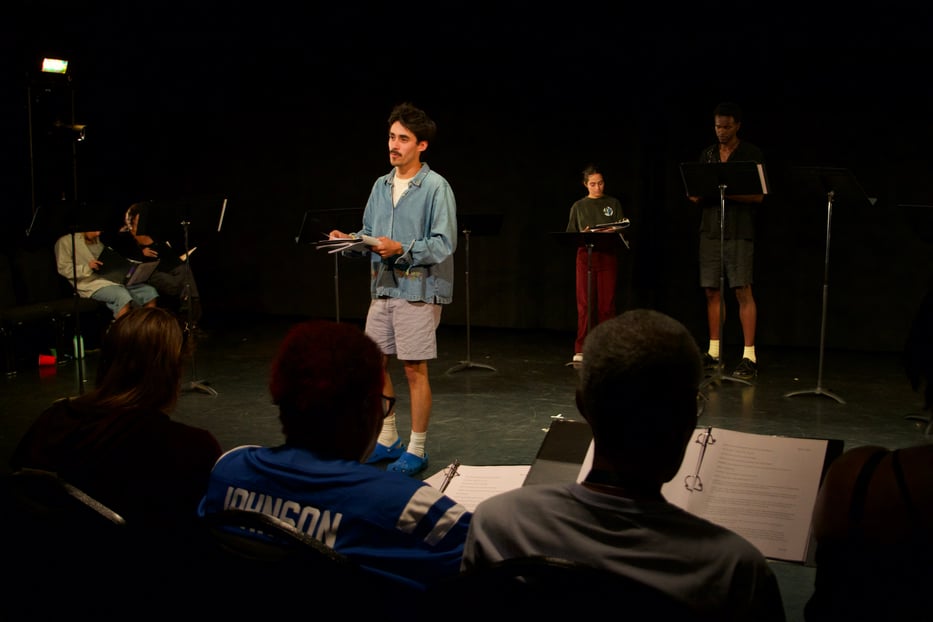
Francisco Morandi Zerpa, written by Survivor Richard Youins, as Ezra. Photos courtesy of the David Geffen School of Drama at Yale.
“This has been the most amazing collaboration,” said Lucile Bruce, a longtime member of the Citizens Community Collaborative and co-founder of Survivors of Society Rising (Youins and Al Gamble are the other founders) who helped revive the group after a pandemic-era pause, and served as the associate producer on the show. “This is the best of America, honestly. Doing something new. Making something new.”
Like previous performances from Survivors, a program of Yale PRCH that foregrounds artmaking in the lifelong process of recovery, characters’ stories are drawn directly from the lived experience of troupe members. Some, like Youins, have been in the group since its founding; others, like Smith, are newer to the process. This iteration, which invites DGSD students to take on Survivors’ writing, has been in the works for roughly two years.
Set between a recovery group, a corner store, and never-quiet sidewalk outside the shop, The Shape of Reality tells the story of Anastasia (a compelling Fabiola Andújar, written by Survivor Tammy Imre), a peer recovery support specialist who has become a beloved fixture in the community, but sometimes struggles to shoulder her own heavy baggage. From the corner where much of the action takes place, she checks in on her people, often putting her own needs aside for those in her orbit.
Around her, characters emerge from the woodwork: there is the cautious Olga (Jasmine Brook, written by Survivor Vernette Bond), manic and gossipy Sasha (Tyler Clarke, written by Survivor Cheryl Mmrl Rabe), who is “going through an identity crisis right now,” perennially-sulky and sharp-edged Xavier (Shawn Bowers, written by Survivor Mark P. Griffin) and Anastasia’s situationship OG (Mark Yarde, written by Survivor James Harvey). The last two are nursing a tension thick enough to cut through with a knife.
There’s Lil Cuz (Sboniso Thombeni, written by Survivor James Harvey), who doesn’t seem so little at all, Robert Claude (Jeremy Fuentes, written by Survivor Mark DeBrady), and Davina, who often articulates the nuances of recovery when people need to hear them most (“I may be clean, but I still need support” could be an alternate title to the show). Through all of it, there is the sage Ezra (Francisco Morandi Zerpa, written by Survivor Richard Youins), a kind of moral compass for the community who has seen decades of change, and insists that there must be a better way forward. Or in his words, “Ain’t no formula! It’s a daily process, man!”
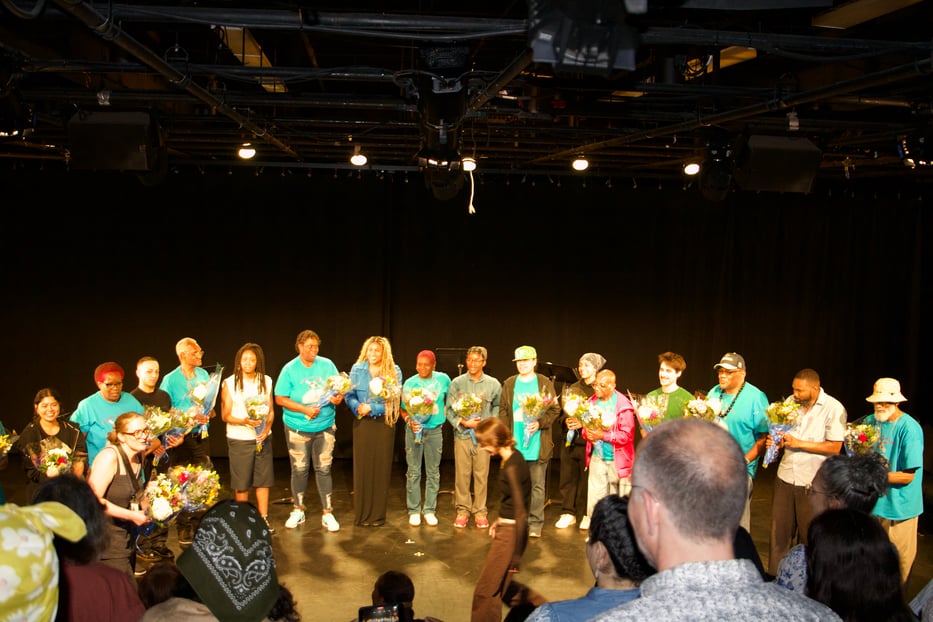
Survivors of Society Rising (in the blue shirts) with student actors. Photos courtesy of the David Geffen School of Drama at Yale.
In this world, as in the audience’s real one, there are constant hurdles, often tied to a threadbare safety net, inherited and generational trauma, and heavy reliance on law enforcement rather than systems focused on long-term repair (there is a jud.ct.gov joke that absolutely lands). Many of the characters have done jail time and are trying to avoid recidivism, but don’t have the support systems that they so desperately need (access to stable housing and employment, for instance).
Substances, particularly opiates, seem like they are everywhere. It’s a reminder of the way that the pharmaceutical industry, law enforcement, and even municipal and state leaders often frame substance use disorder as a moral failing for which people should be locked up, rather than a structural issue for which folks might receive wrap-around care and support.
On stage, these characters shine—as do the Survivors who have inspired them. When Anastasia and Queen (DGSD student Rebecca Rivera, written by Survivor Deborah D. Jackson) take time to remember their mothers, they feel instantly, warmly familiar, letting their memories bloom in full, vibrant color. When Queen later cries that “I am too young to have this much on my plate right now,” a listener can feel the grief and overwhelm echo in their ribcage.
When Sasha recounts how many part-time jobs she’s held down, from waitressing to exotic dance, it’s a reminder of how the gig economy—particularly for folks in recovery, or with a record of any kind—does not give people enough to survive, let alone thrive. When Ezra notes how much the neighborhood has changed, it’s suddenly a story that is close to New Haven, where some version of this work is playing out in real time.
And when, during the summer premiere, Yarde-as-OG gently palmed a baggie of fine powder, musing to himself “maybe a little bit wouldn’t hurt” and “if I only try one more time,” someone in the fourth row let out a mournful, drawn-out kind of tsk tsk, like the low bellow of an animal. A person could feel it: that rising anxiety that he might use again, and a near-physical urge to rush the stage, and keep him from doing so. In the front row, several of the Survivors shifted uneasily in their matching blue shirts, making clear how close this was to home.
The setting, meanwhile, is an unspoken character throughout. This is New Haven, but it’s also Bridgeport, and Waterbury, and Hartford, and thousands of other American cities struggling with substance use, food security, affordable housing, access to functioning public transportation, and a judicial system that is disproportionately punitive, particularly towards Black people and non-Black people of color.
Minimal as it is, the stage feels like a stretch of Congress Avenue in the city’s Hill neighborhood—which neighbors have referred to at times as a social service dumping ground—where a methadone maintenance clinic sits near a police substation and across from an elementary school. When Ezra mentions a former community center, a listener can close their eyes and see the long-shuttered Barbell, which just recently reopened as the Trowbridge Recreation Center. When he references community gardens, Arthur Street’s gently-tended Field of Greens jumps to mind.
It’s an argument, although never spoken aloud, for more robust funding and support behind programs like Elm City COMPASS (Compassionate Allies Serving Our Streets) and EMERGE, which provide on-the-ground support meant to keep people in recovery and out of prison. And likewise, it’s a call to the city and the state to put more dollars behind recovery, mental health services, compassionate and judgement-free medical care, and comprehensive emergency support, from food aid to transportation to housing.
It is unclear what afterlife, or afterlives, of the show will have—although it is exactly the kind of work that should live on at high school assemblies, community theater productions, and conferences on addiction recovery and support. Youins, a longtime member of Survivors of Society Rising who has worked on collaborations with Theater of the Oppressed NYC and Long Wharf Theatre, praised the process for bringing such stories to the stage with empathy and nuance.
“I’m trying to grow and be like Ezra,” said Youins, a musician, researcher, and peer support specialist at Fellowship Place who grew up in the Ashmun Street Projects at a time when neighbors looked out for each other, more than he believes they do now. “Thinking about, who is influencing me? Who nurtured me? Whose shoulders do I stand on?”