

Culture & Community | Arts & Culture | Visual Arts | Westville | Third Space
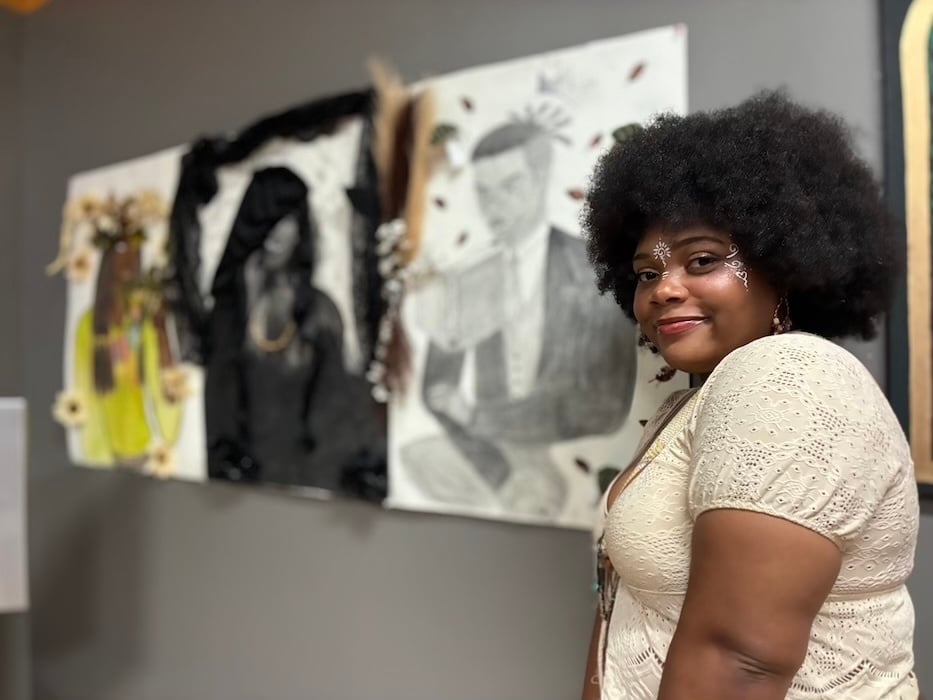
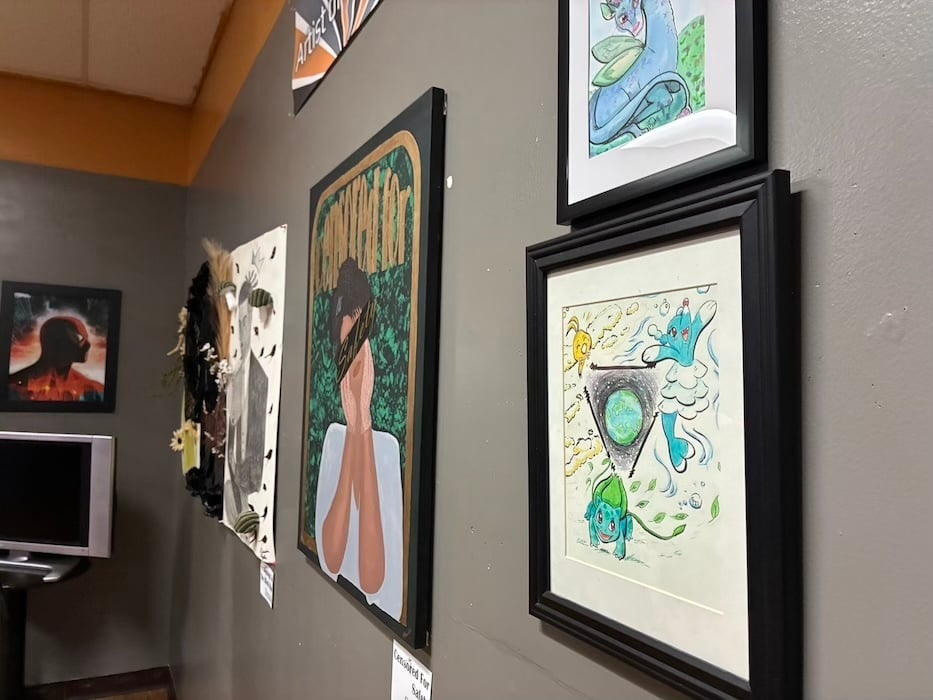
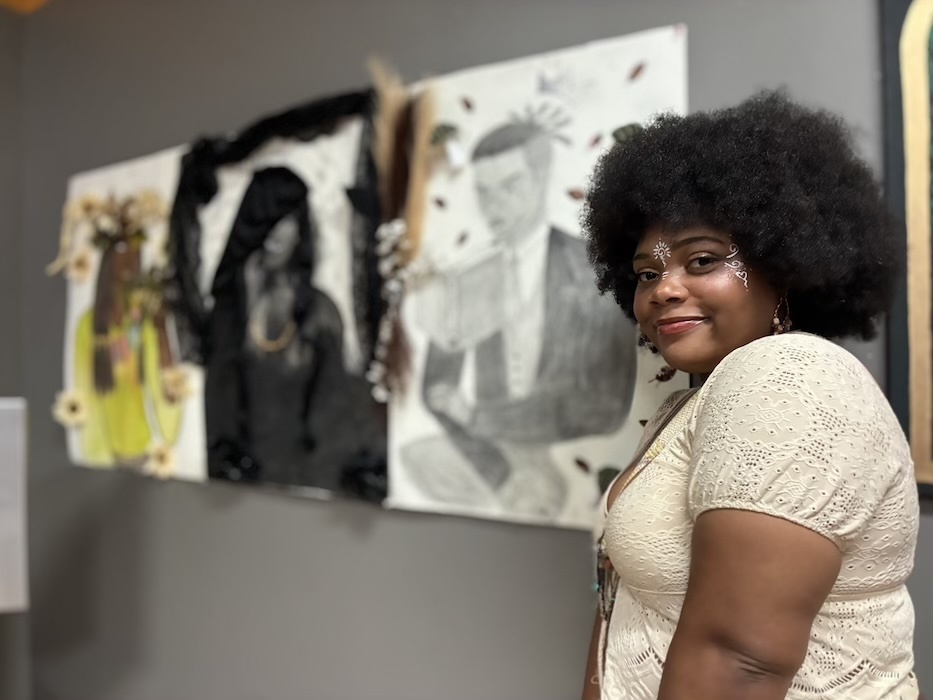
Top: Artist Zymarie Taylor. Bottom: Works by Sydney Williams and Ery Ayala. Lucy Gellman Photos; all work by the artists.
A Black woman, her hair done up into an elegant coiffure, raises her gloved hands to her face, her head tilted to the left ever so slightly. At first, everything seems soft: she wears an ice blue dress, the fabric draped softly over her shoulders. Her skin glows beneath the light. Even the background, a green-and-black patchwork, is cozy, like something a person could sink back into.
But something is off: the words Censored For float over her head in blocky gold letters. Where her eyes should be, a thick black band bears the word Safety, written in gold, cursive-like text that heightens the dissonance of it all.
The piece, Sydney Williams’ Censored For Safety, is one of a handful of works now on view at Third Space New Haven, where a celebration of the third cohort of The Rooted Collective is on view through September 13. The vibrant, community-focused brainchild of artist Alana Ladson, the collective brings together women, femme and nonbinary artists of color over six weeks of intentional artmaking.
During this time, they receive funding for showing up and making work—an acknowledgement that art is intellectual labor. The show features artists Williams (who also runs Third Space with her partner, Mike Brown), Ery Ayala, Zymarie Taylor, Quiana Stanley, and Dyme Ellis. Together, they hail from New Haven, Hamden, and Naugatuck.
“It’s nice to have this space,” said Ladson, an artist and educator who launched the collective in 2023 with a $10,000 “Artists Corps” grant from the Arts Council of Greater New Haven and National Endowment for the Arts. “It feels calming and freeing … it’s a place where I can kind of loosen my grip on things. I’m so used to just powering through and it’s a reminder that I don’t always have to.”
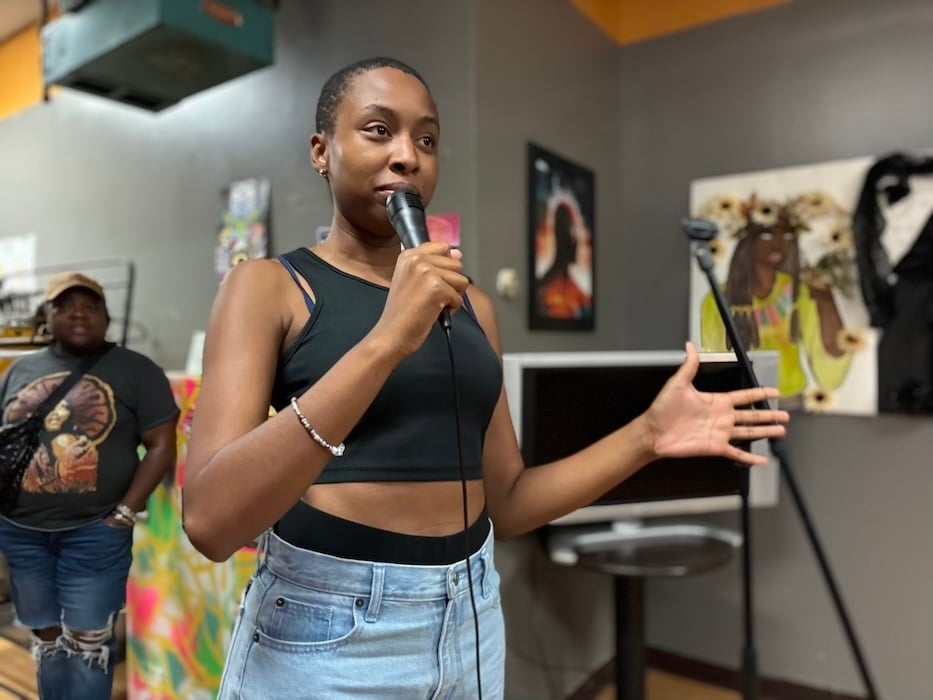
Alana Ladson: Creating the space for artists to simply exist and make, beyond the demands of consumerism.
Since its birth in 2023, the collective has continued to evolve, and found new sources of funding to stay afloat. After Rooted’s first year, which included five artists and three separate exhibitions across New Haven, a second cohort took shape in 2024, with support from the Connecticut Office of the Arts. That group, which also comprised five artists, held its culminating show at the Dixwell Community “Q” House.
Then in December of last year, after several transitions in her own life, Ladson launched applications for a third cohort. Since launching The Rooted Collective in 2023, she too has grown as an artist and professional: Ladson made the leap from Music Haven to Solar Youth to the Huneebee Project to the Girl Scouts of America, where she currently works as a program coordinator for arts activities. In all of her roles, the same mentorship that she brings to Rooted’s work has been central.
She’s also become one of the artists featured in the HeART of Healing, an initiative of the Cornell Scott-Hill Health Center that works with New Haven and Connecticut-based artists to enliven the walls, offices and patient rooms of its healthcare facilities in the city. Other artists include Faustin Adeniran, Eric March, Jasmine Nikole, Ricardo Gutiérrez and Chris Ferguson among several others.
Even in that time of personal change, Ladson knew that the collective was at the heart of who she was and is as an artist. So this year, she was thrilled to receive a $2,000 Neighborhood Cultural Vitality Grant from the City of New Haven, which allowed her to continue paying artists as sources of funding dried up and became smaller and more competitive.
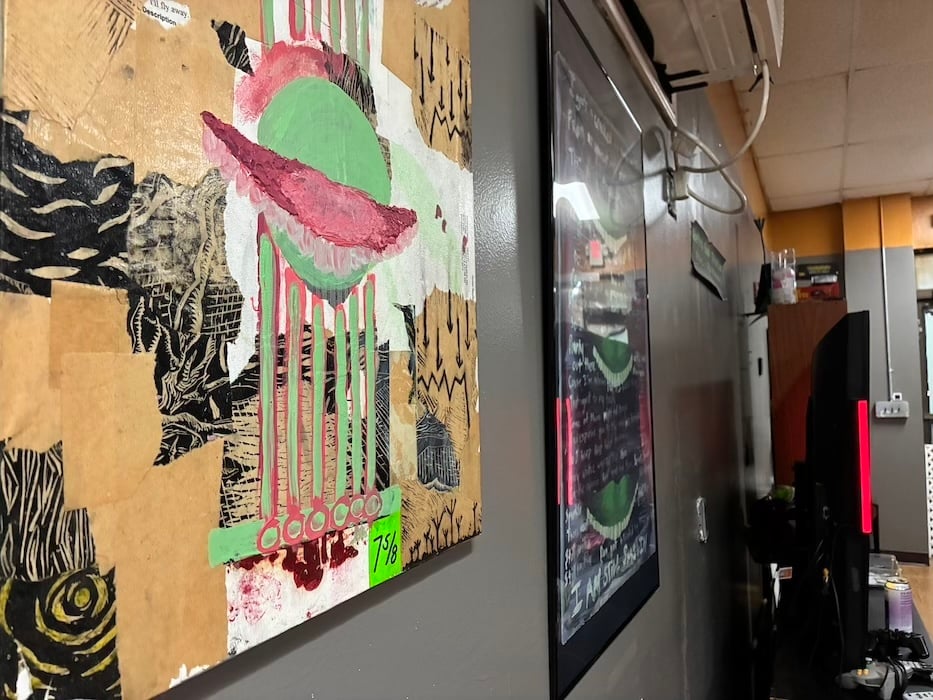
Work by Quiana Stanley.
That compensation is a fundamental part of the program, she said: artists deserve to be paid for their labor, including and especially when they’re taking time to create work that is made first and foremost for themselves.
“Artists should get paid!” she said in an interview at an opening reception at Third Space Saturday night. “Our work is very important. Artists are visionaries because they’re documenting what’s happening in this time.”
For her, she added, that’s even more critical for Black artists and artists of color more broadly, who are often expected to create, exhibit, and exist in historically white spaces without the support they need. To be in a room each week with five other member-makers may have been healing for them, she acknowldged—but it helped her take a breath, too.
At an opening reception Saturday evening, that sense of community was contagious. Taylor, who grew up in New Haven and has been creating art for as long as she can remember, glided over to a multi-media triptych, and began to describe each of the figures she had carefully created within its frame. Across the piece, done on white posterboard, Taylor had added leaves, feathers, dried flowers, lengths of fabric, and a flower crown.
On the right, a figure leaned forward, his brows knitted in concentration as his eyes focused on the words printed inside a levitating book. Large, wire-rimmed glasses surrounded his eyes, slipping down just enough to rest on the bridge of his nose. On the spine of the book floating before him, Taylor had printed the word Expression in thick white letters.
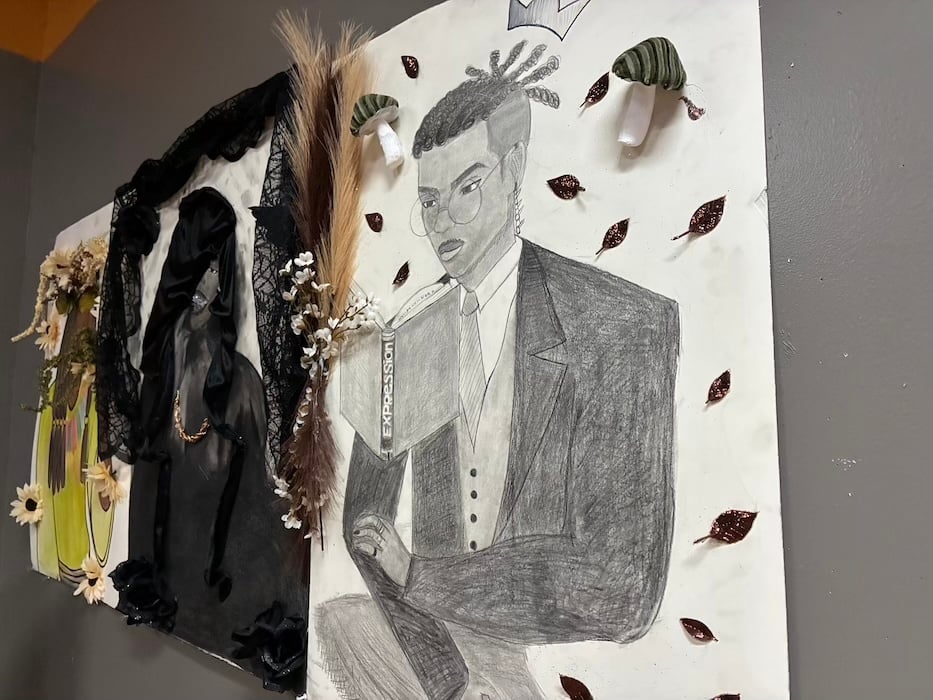
Zymarie Taylor's work.
Everything about him was immaculate: the starched, collared shirt, dark fitted blazer, a narrow tie fitted into his vest and Basquiat-like crown hovering above his head. Beneath it, Taylor drew his locs pulled back into a high, cropped ponytail, accentuating shell-shaped earrings below.
“You’re not supposed to know that he’s a witch,” she said matter-of-factly, with a wry little smile. Beside him, a more vampiric-looking figure cocked his head to the side, one spindly finger raised to his lips as he smiled, and a row of gemstone-like upper teeth appeared. Around his head, Taylor had fixed layers of black fabric, adding texture to the scene. A hippie, in a loose yellow blouse with a flower crown, completed the triptych.
If she had to choose, Taylor said, she would most quickly identify with the hippie, but “I’ve definitely been each one.” When she was young, growing up in New Haven’s Quinnipiac Meadows neighborhood, Taylor started making art because she was inspired by the work her older sister was creating. “I haven’t stopped,” she said. The Rooted Collective gave her a space to be in community with other artists.
“I feel very much so included now,” she said to fellow artists during a short speaking portion of the night. “I didn’t really have a space [to create] and you created one.”
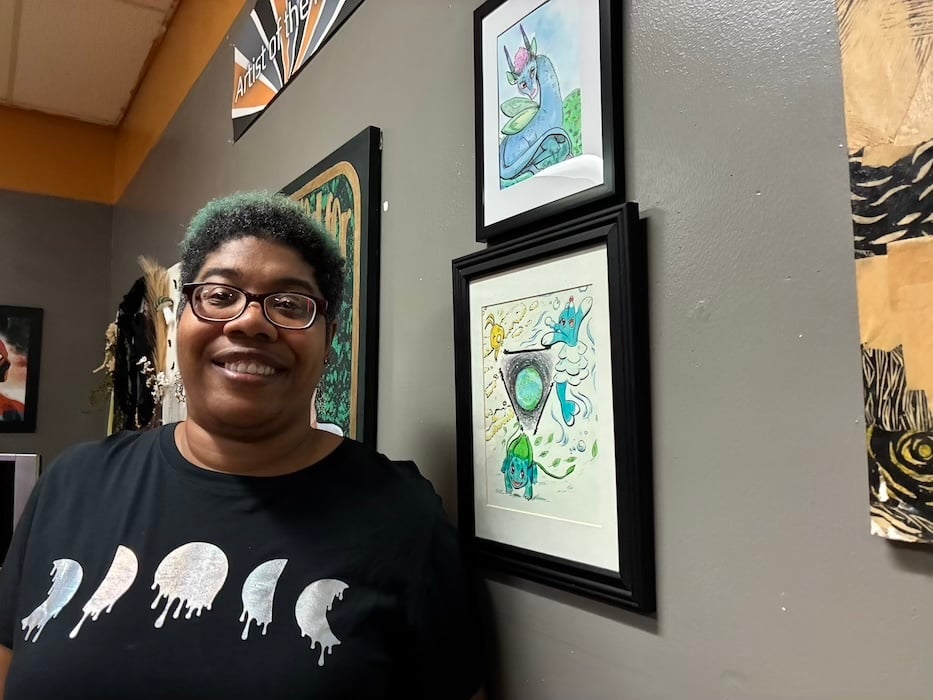
Ery Ayala: Rooted as a powerful affinity space.
That was true for several of the artists in the show, some of whom are the “onlies”—the only Black people, and also the only out nonbinary people—in their workplaces. Ayala, who teaches art in Waterbury, lauded Ladson’s work in creating an intentional, caring community of practice for artists to feel seen, heard, and appreciated—and to have space to simply talk issues through with each other.
While they’ve taught art since 2006, the collective marked the first real affinity space they’d experienced. “Without this space, I wouldn’t have been able to meet other nonbinary folks of color,” they said.
Walking over to their pieces, Ayala described a soft spot that they have for fan art, especially for items like Pokémon that were popular in the early 2000s. In the two images, daintily framed pieces they chose to exhibit at Third Space, a clover dragon turned toward the viewer, its furry blue neck winding up and around. A violet tuft of hair, shaped like trifolium from which the dragon draws its name, erupted from the crown of its head. Beneath it, grass sprawled out in every direction, like a mellow carpet of green.
“And these—” Ayala pointed to the three small figures below, all frozen mid-movement. In the center of the page, a globe spun on its axis, surrounded by a triangle shaded in color and dotted with stars. “Earth, sea and sky.” Even from the page, it seemed like the figures might spring right out of the piece and join the evening of gaming at Third Space.
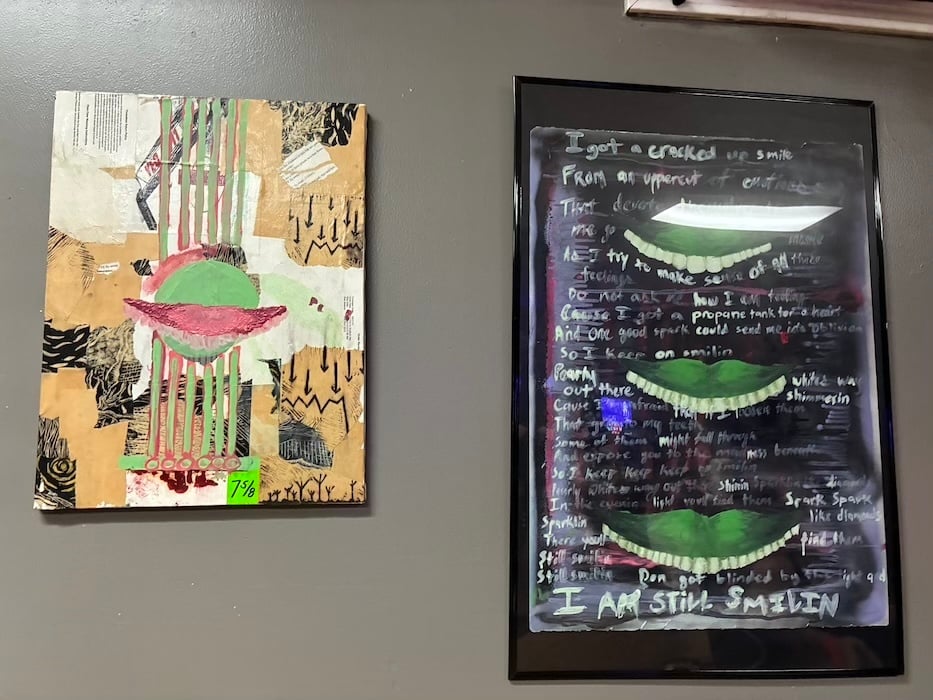
Stanley's work on display. The artist said that they are now inspired to create a new body of work.
Taking in the work by other artists in the cohort, Quiana Stanley slowly made their way back to two canvases they had created, the beginning of a series that they hope to continue beyond the collective’s time together.
In one piece, eye-catching in its use of black and green, Stanley had illustrated an original poem that started with the lines “I got a cracked up smile / From an uppercut of emotions,” the white letters visible even from halfway across the room. Amid lines that continued down the page—“As I try to make sense of it all … Do not ask me how I am feeling … ‘Cause I got a propane tank for a heart”—Stanley had rendered three almost-matching sort of smiles, teeth pearly white beneath three pairs of Elphaba-green gums.
“It kind of expressed a feeling that I couldn’t put words to in a normal way,” Stanley said. “I think a younger version of me was going through a lot but didn’t know how to express it or push through.”
The collective, they added, appeared like a creative oasis at exactly the right time. Earlier this year, they were going through “a very chaotic time in my life,” including a transitional housing situation. But they knew that if they could make it to the next Rooted Collective meeting, they would be okay. “My head was spinning and these people held me down.”
They added that they now know never to underestimate the power of community members, many of whom sent the information about the collective Stanley’s way. They shouted out curator Juanita Sunday for being especially supportive, and making sure they had a seat at the table.
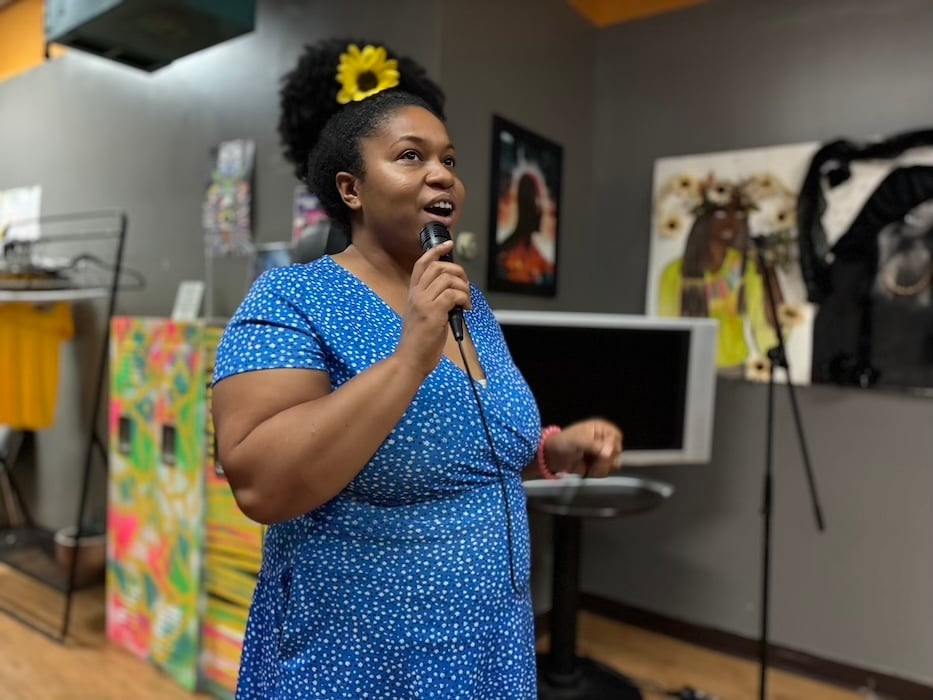
Sydney Williams, who spoke about moving beyond imposter syndrome and having the space to finish a project during the collective's time together.
For Williams, who spent Saturday buzzing around the space and popping outside to check on her Blake Street neighbors, Rooted’s work was equally transformative. In Censored for Safety, one of her largest pieces yet, Williams was able to both contend with the idea of censorship and privacy, and push back against the impostor syndrome that sometimes gets in the way of her creative work.
“I wanted to do something big and bold and I was afraid I wasn’t going to have time to finish,” she said. Instead, it was the beginning of a series of miniatures that she plans to begin working on imminently.
Inspired by the Czech painter Alphonse Mucha, whose Art Nouveau posters remain part of visual culture hundreds of years after his death, Williams channeled an era of both glitz and celebrity that seemed bygone, and completely of this moment in which she (and by extension we, her viewers) are living.
In the piece, a Black woman leans forward into her hands—each encased in long, delicate tan gloves, their surface luminous—her eyes concealed with the word Safety written in gold script. Her skin is radiant; a jewel-encrusted pin rests neatly in the hair styled artfully on top of her head. Against the cool blue of her dress, a green-and-black background looks almost like wallpaper, making the piece feel like an off-kilter snapshot from a jazz lounge.
“For those who are performers or creators, there’s almost like a dual-edged message,” she said in a phone call after the opening reception. Sometimes, she sees performers censor themselves for their own personal safety, because images are so widely and quickly circulated, consumed and repurposed in an age of social media.
But she also sees censorship “done under the guise of safety,” when really it has more to do with narrative and creative control that the performer doesn’t always have a say over. The work gave her an opportunity to hold that balance, and translate it to canvas.
“This gave me an opportunity to really sit down and be an artist,” she said. “This is a huge a-ha moment for me and it’s really inspiring. I have a ton of ideas that I want to get out.”
For Ladson, that invitation to experiment is also part of the point. In her own work as an artist, she doesn’t always have the space to simply make art that isn’t intended for a consumer need, or an upcoming festival or pop-up vending event. That’s what makes the collective so special. An artist can simply be rooted in place, getting that exposure to good soil that helps them grow as they do their thing.
“Y’all have really uplifted me, encouraged me,” she said, addressing the group during a short series of remarks. Through a “rough time” in her own life, she knew that members of the cohort had her back—and she had theirs, too.
“I love the art” that comes out of the group’s six weeks together, she added, nodding to a video installation from Ellis that is both completely unique, and meshes with all of the other work in the show. “What I love about it is it’s all so different, but somehow it still all fits together.”
The Rooted Collective's third cohort exhibition is on view at Third Space New Haven, 410 Blake St #5, throughSeptember 13.