

Culture & Community | Education & Youth | Educational Center for the Arts | Arts & Culture
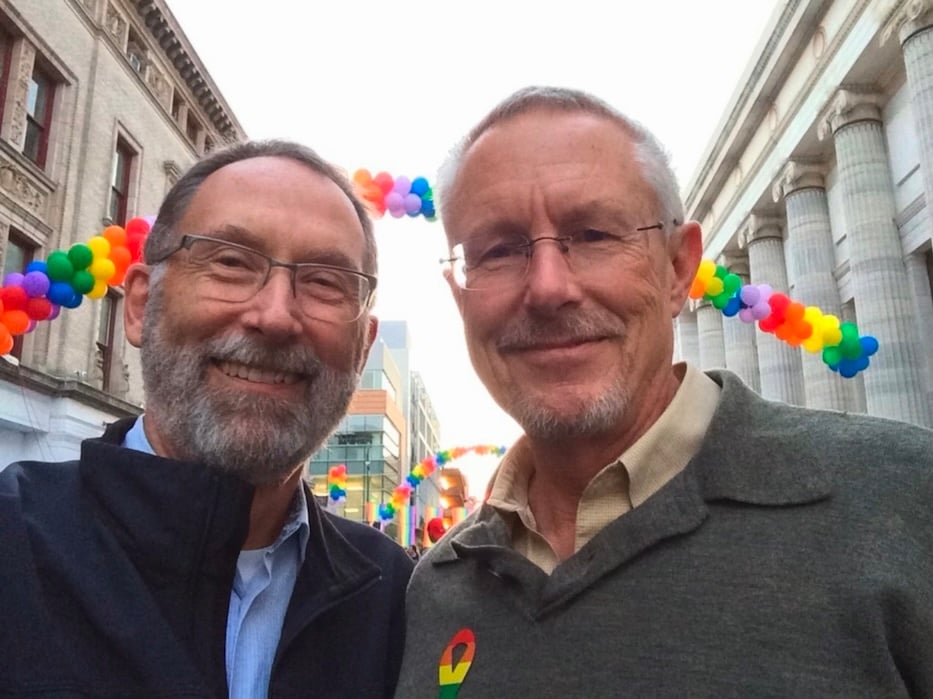
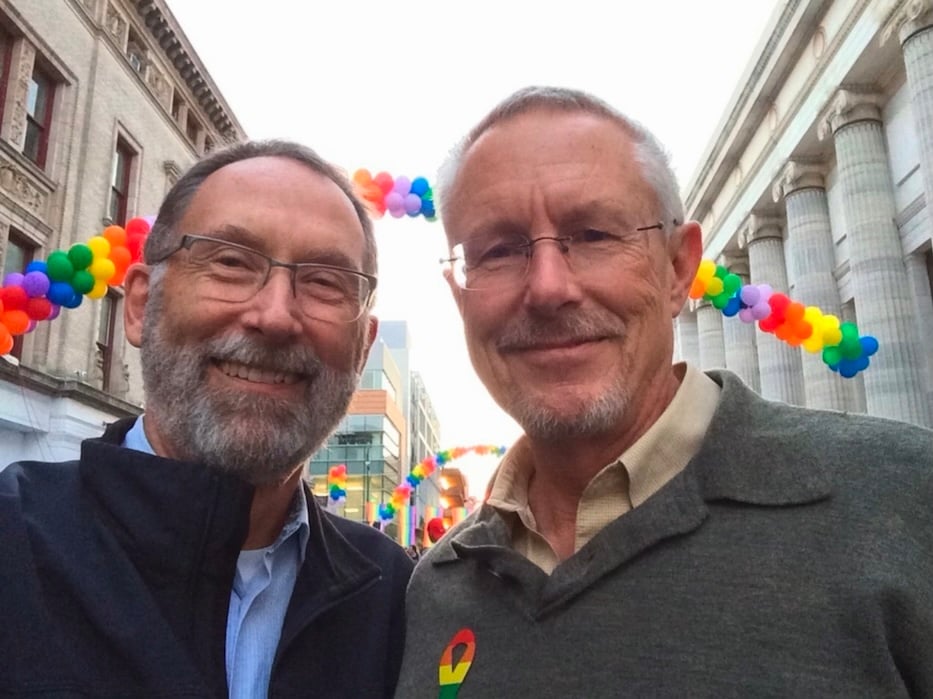
Bob Parker and his husband, David Carter. Contributed Photo.
In his first years as principal at ACES Educational Center for the Arts (ECA), Bob Parker had a daily ritual. For the first few months of every school year—sometimes more—he would stand outside, greeting each student that walked through the doors. He would stay out there, morning after morning, until he knew the name of every young person in the building.
He never lost that sticktoitiveness and warmth, from a tenure that helped grow Audubon Street to his own life as a dedicated dad and husband, champion of the arts, and spiritual leader in and outside of his church.
Parker, who served ECA for a total of 36 years, including two decades as its director, passed away in late 2024 at the age of 74. A year and a half after his death, friends, family, former colleagues and ECA alumni gathered in the school’s arts hall to honor his legacy, and announce the launch of a new fund for artists in his name. The Bob Parker Community in the Arts Fund, which lives at the Community Foundation for Greater New Haven, will name its first recipients in late spring.
The Arts Council of Greater New Haven will be the fund’s fiscal sponsor. In its first year, a panel including ECA Principal Stefanie Savo, Assistant Principal Amy Christman, Arts Council of Greater New Haven Executive Director Hope Chávez, Community Foundation Director of Development Sharon Walsh Cappetta, and Parker’s husband, David Carter, will choose the recipients.
Chávez said that it is currently unclear how many recipients there will be and how much each grantee will receive. In the interest of full transparency, the Arts Paper is a program of but is editorially independent from the Arts Council of Greater New Haven.
Following the announcement, students sat for a performance from The Voice winner Javier Colón, who regaled them with not only songs, but tales of a childhood in Stamford and a series of artistic leaps of faith. The afternoon doubled as a celebration of Black History Month, which ECA has worked to celebrate more fully in the last few years. More on that below.
“He would do a thing where he went out to the center of the Arts Hall and he would say ‘It’s not about you, it’s about me,” remembered Parker’s son, the Rev. Geoff Parker, joining over Zoom from his congregation in Falmouth, Maine. At the time, it was a way to get students to quiet down and listen to each other. “I think what he was trying to say was, ‘It’s not about you, it’s about us.’ We have to grow into that awareness and appreciation … that give and take.”
“It’s trading fours in jazz,” he added, and a few music students in the front rows smiled, feeling Parker’s legacy still. “It’s yes-and-ing in theater. It’s listening.”
.jpg?width=933&height=636&name=Bob%209%20(1).jpg)
Contributed Photo.
The fund’s story, in many ways, is also the story of Parker’s extraordinary life and impact on New Haven, particularly in the arts. Parker was born in Albany, Georgia in the 1950s and 60s, coming of age in a city that was pivotal to the Civil Rights movement (he was just 12 when the Freedom Singers began to use music as a tool of resistance, so maybe it’s no surprise that he ended up in the arts).
From the time he was born, “he was a survivor,” remembered his husband, David Carter. Parker entered the world with a heart defect, from which he was not expected to live beyond early childhood. But his parents, and Parker himself, were determined: he underwent several surgeries as a kid, and later also as an adult. In the final years of his life, doctors were often astonished to meet him, because they’d never known a person with the same condition to live into their 70s, much less past midlife.
His heart, it turned out, was as wide open to the world, and particularly to its young artists, as it was unexpectedly strong. After Parker’s education brought him to Connecticut in the early 1970s—first to Southern Connecticut State University, and later to Wesleyan for his graduate work—he landed at ECA in 1977, with a grounding in the arts that made him a sharp and empathetic educator. It was the beginning of a love affair with ECA that would last for the rest of his life.
For 36 years, he worked in different roles at the school: theater teacher, director and principal, and later director of communications for ACES. No matter how hectic things became around him, he remained calm, focused on the students in the building’s halls, studios and music rooms. “He was a connector,” Carter remembered, with a knack for bringing people together that was only outmatched by his patience.
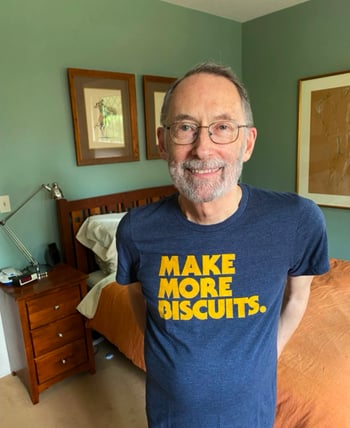 During his time there, Parker helped grow ECA’s cultural footprint, including a rebirth of the Little Theatre at 1 Lincoln St. where both classes and performances now take place. He was also singularly dedicated to his work, recalled Geoff Parker—so much so that he would make the trek into work even on snow days, just to be in the building. Geoff, who attended NMS for music classes across the street, remembered how ECA became an extended family, from the space itself, a former synagogue that became a tiny conservatory, to students and staff who were his babysitters.
“I think of him as an island of calm in the storm, so that we could focus solely on our art,” remembered Saul Fussiner, an ECA alum who grew up in New Haven, studied theater at the school, and then returned to teach several years later (he’s now the chair of the creative writing department). “I hope to be the person for my students that Bob was for us.”
He lived his whole life with that kindness, poise, and grace, Carter said. When the two met through a mutual friend in 1986, they were both divorced gay dads, Parker with his son, Geoff, and Carter with his daughter, Melora. As they worked to blend their families in the next months, years, and decades together, Carter saw how Parker lived fully and vibrantly, not just for himself but for the people around him. That included, without fail, his students.
Ingrid Schaeffer, who now chairs the school’s drama department, remembered first meeting Parker during those early years, when she was just a wide-eyed high school student trying to find her way into the arts. The first time the two met, she had just stepped into her audition at ECA, singing along to a Julie Andrews record. She didn’t have the presence that she does now; by her own estimation, she bombed. Parker didn’t give up on anything that easily.
“He asked me to come back with something of my own,” Schaeffer remembered, and she did. Months later, as a student at ECA, she realized that she had found her people. With a smile, she remembered walking down Audubon Street covered in “a costume of dangling tampons,” dancing to a song by the Beatles.
It was silly and outlandish—and also so quintessentially ECA, in the way that the school has become a safe haven for hundreds of weird art kids (said with love, from a professional weird art kid) over the years. Decades later, she works to give her theater students the same permission to be themselves, while also grounding their time together in a conservatory-level education.
Educator Nazorine Paglia, who attended ECA in the 1990s and returned to teach in its dance department, echoed that deep love and respect for Parker as she spoke. When she came to the school after starting dance in East Rock, Paglia was still a relatively recent arrival to New Haven, after coming to the U.S. from Haiti with her family in 1985.
It was Parker who welcomed her into ECA with open arms, and remained a mentor and a champion of her work for years. The school, in turn, became her springboard into professional dance and higher education in the performing arts, from the California Institute of the Arts to Sarah Lawrence College to the Martha Graham School in New York City.
“When I first came to this country, I arrived with hope, but also a lot of uncertainty,” she said. “At a moment when it would have been able to overlook me, Bob chose to see me … Bob taught me that education is about dignity, not assimilation.”
“I found my voice,” she continued. “I found my place. I carry that responsibility forward in how I teach.”
An Ode To Educators
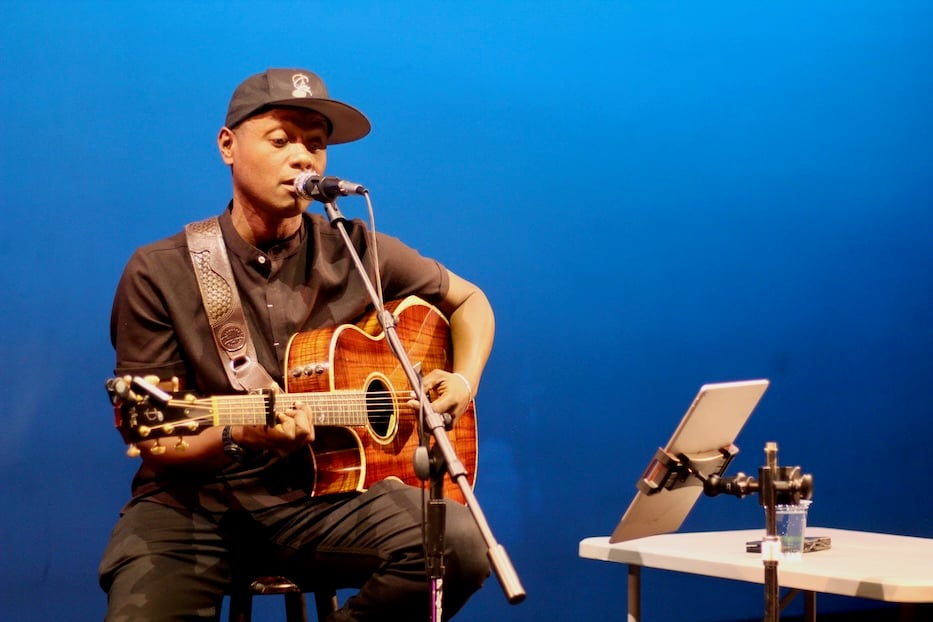
Javier Colón. Lucy Gellman Photo.
As he sat down with a guitar and loop pedal to perform, Colón showed in real time the transformative impact that educators like Parker can have, giving the afternoon a sense of coming full-circle. Born and raised in Stratford, Colón grew up in a household that was proudly Dominican and Puerto Rican, aware of the way music could be a heartbeat before he even had the words for it.
As a kid, he spent years listening to his dad, the late Pablo de Jesús Colón Hijo, work as a Spanish-language DJ on the Bridgeport AM station WCUM, also known as Radio Cumbre. He sang around the house, and had started playing the piano by the time he was seven. But it wasn’t until his mom Migdalia, a tenacious matriarch from Salinas, Puerto Rico, offered to pay him to attend a summer arts program that he ever thought about performing.
It turned out that he liked singing outside of the house, Colón said with a smile between slowed-down, soulful covers of “Someone Like You” and “Free Falling,” his vocals looped and lushly layered. For the first time, he also looked to performance as something that a person could do professionally, taking his cues from the slightly-older, very cool assistant to the camp’s drama coach.
But when he finished the program and entered the seventh grade that year, it didn’t occur to him that it would shape the cultural trajectory of his life. That was, until he met another educator, choir director Sandy Spadaccino, who asked him to stay after class.
She had singled out his voice on the first day of class, and wanted to nurture it. She informed him that he would be singing for the eighth grade girls later that day.
At first, Colón demurred. When it became clear that he couldn’t simply wiggle out of it, he slipped into the nurse’s office, said he didn’t feel well, and asked that his mom pick him up. Spadaccino, who taught for almost four decades before her passing in 2010, intercepted the call and reassured her that her son was just fine. And he was: Colón nailed it. Spadaccino had known that he could.
When he had sung for the girls and lived to tell the tale, Spadaccino tasked him with another assignment: recording the National Anthem for the school’s morning announcements.
“I’m so, so grateful to her,” he said. Years later, he was honored to invite Spadaccino to his home, to celebrate with his family after he had signed a deal with Capitol Records in 2002.
Spadaccino was, in many ways, his gateway to performance. By eighth grade, “I was comfortable onstage,” participating in small cabarets and talent shows. By high school, he had chosen to seriously pursue music over baseball, another one of his passions. So when he got a call his junior year to perform in Roger Miller and William Hauptmann’s Big River, a musical retelling of the adventures of Huckleberry Finn, he said yes.
Colón played Jim, a formerly enslaved man whose storytelling skills carry the play. At the time, he didn’t know that he would return to the show in the same role over a decade later, in 2017, with a new and fuller understanding of the character. He didn’t know that it would bring him together with the musician Ian McHugh, with whom he formed the band EmcQ. Or that it would inspire him to pursue music at the Hartt School at the University of Hartford.
But he trusted the person who had made the call, that former drama assistant from sixth grade arts camp.
That person was Eric Nyquist, now principal of the Regional Center for the Arts in Trumbull. Nyquist, who for years served as the director of fine and performing arts in the Hamden Public Schools, had a way of connecting people too, not unlike Parker (including last week, as he sat dewy-eyed in the audience listening to Colón’s story). Here, he was a knitter of artistic worlds: Big River led to EmcQ, which ultimately put Colón on the radar of the The Derek Trucks Band (now the Tedeschi Trucks Band).
The Derek Trucks Band, with whom Colón toured for two years, led to a deal with Capitol Records, and two albums that Colón released between 2003 and 2006. When his contract with Capitol ended prematurely, it led to Colón’s appearance on The Voice, where he gained recognition for his ability to flow between genres and ultimately walked away with a new contract with Universal Republic Records (Colón is no longer with the label).
“This all stems back to the sixth grade, doing this thing that I didn’t want to do, that my mom forced me to do,” Colón said after taking a beat to perform his own song, “Echo.” “You have to do everything, anything that comes your way. You just never know where these opportunities might come from.”
He added that for him, it always comes back to the power of two educators, Nyquist and Spadaccino, and their ability to see something in him that he’d not yet realized. There have been, of course, many more teachers along the way, both in and outside of the classroom. But they remain singular in his journey as an artist.
It echoed something that Savo had said earlier in the afternoon, while noting how the fund keeps Parker’s vibrant legacy alive in New Haven. Savo, who joined ECA as principal last year, noted how fully Parker lives on in the educators that he inspired, and in turn in the generations of students that they teach every day. Now,
“The creation of the Bob Parker Fund is a profound gift to ECA, and one that honors Bob's life, his love for the arts and his deep belief in community,” she said. “This fund supports artists and arts organizations in New Haven, helping to strengthen creative spaces and build meaningful connections. Most importantly, it ensures that Bob's legacy continues by uplifting the arts and the people who make them thrive."