

Boricua pride | Culture & Community | Arts & Culture | Puerto Ricans United, Inc.
Magaly Cajigas Photo.
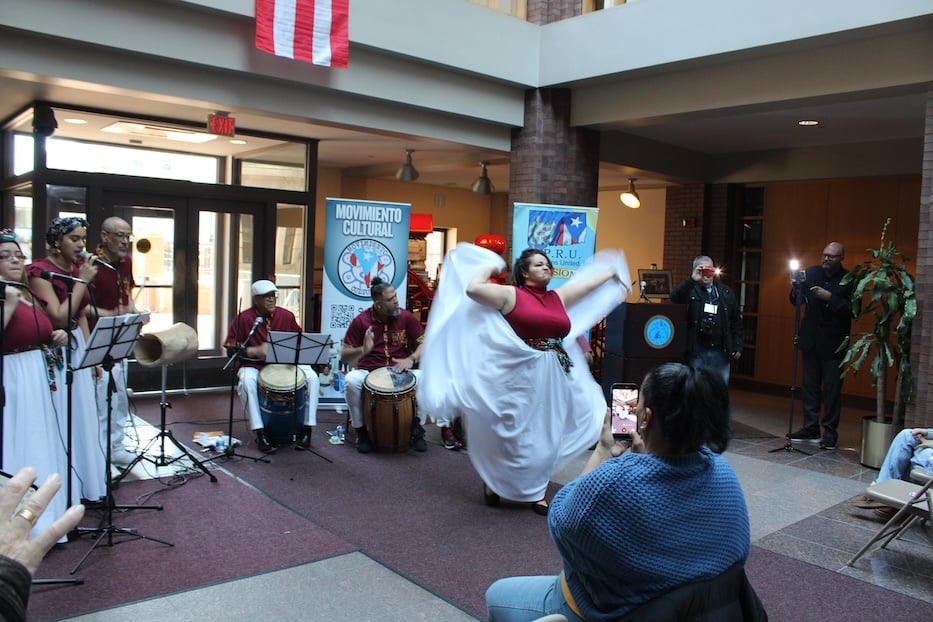
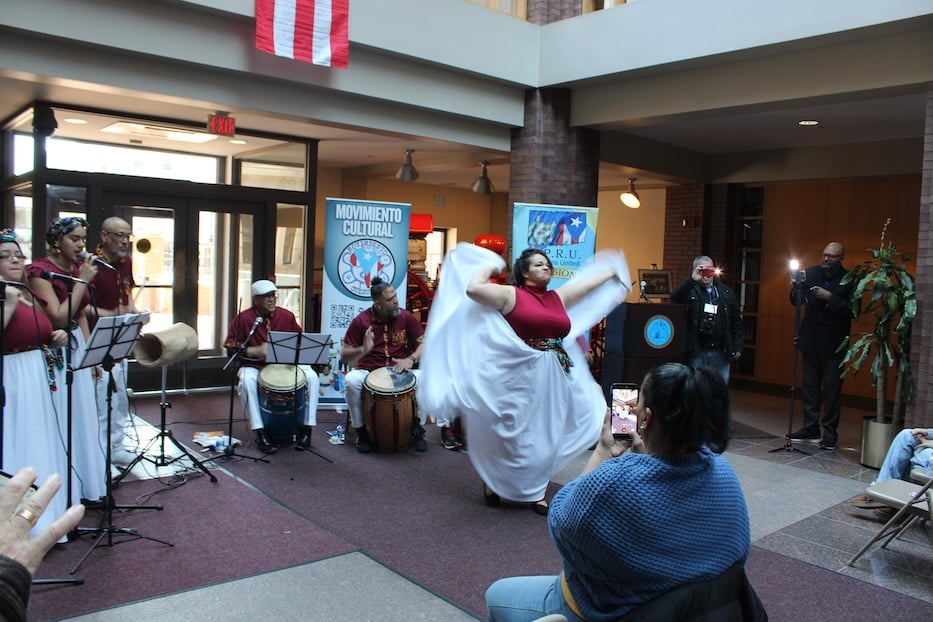
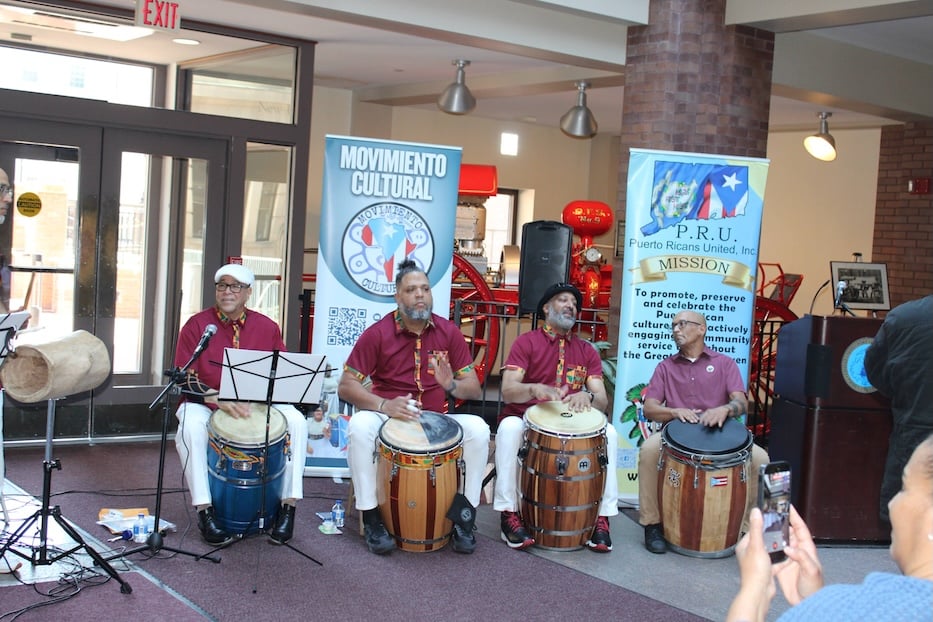
Drums rolled through the vast, first-floor atrium of City Hall, making their way from the floor to the ceiling as an audience leaned in, and the words to "De Bandazo" made the air feel thick, electric. Beside a podium, drummers hammered out a seis corrido rhythm that closed the gap between Puerto Rico and Connecticut, between 1873 and today. As she glided to the center of the room, pulled by the sound, Brendalíz Cepeda bowed to the drummers, and then began to move.
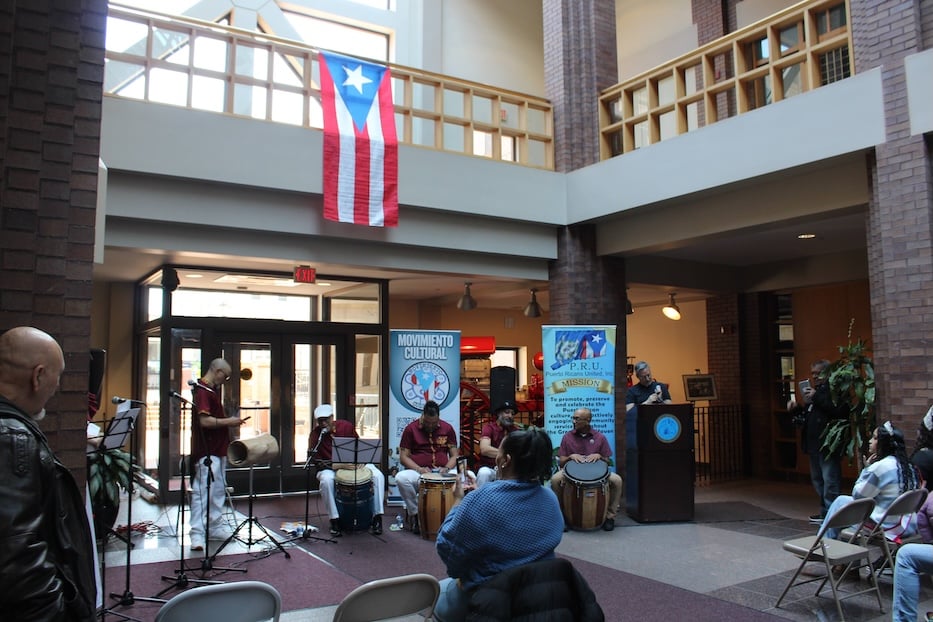
The sound filled City Hall earlier this month, as members of Puerto Ricans United, Inc. (PRU) and Movimiento Cultural Afro-Continental (MCAC) held a now-annual commemoration of the abolition of slavery in Puerto Rico, tracing the vibrant history and culture of the island's people from before colonial contact to today. Throughout, several members of PRU stressed the importance of recognizing the day, and learning its full, bittersweet history to better inform the present.
"This is a commemoration, not a celebration," said artist, activist and public health organizer Juancarlos Soto, who hails from Cayey, Puerto Rico and was last year fêted by PRU for his contribution to arts and culture. "We do not celebrate the 'mercy' of a Spanish crown that, in 1873, finally chose to recognize our ancestors' humanity—only to demand three more years of forced labor as a so-called transition. Our ancestors were declared free, yet still bound to their former enslavers. That freedom came with conditions. And those conditions were unjust."
Magaly Cajigas Photo.
Each year, the event falls on or near March 22—the day in 1873 when the Spanish National Assembly officially ratified the end of slavery in Puerto Rico. As Soto noted, it did not mark the end of the social and economic disenfranchisement of Puerto Ricans, which continues today: before "earning" their freedom under the new law, enslaved people were still forced to work for three additional years. Meanwhile, the Spanish Crown payed their enslavers 35 million pesetas—that's roughly $240,000—to compensate them for lost labor.
In other words, enslavers received money for what Spain (and they) saw not as humans deserving of freedom, but as living property that propelled lucrative and backbreaking industries like the sugarcane trade. Meanwhile, formerly enslaved people had "nothing but the clothes on their backs and the scars on their souls," Soto noted—setting them up for generations of economic struggle that continues today.
After the end of that three-year period, Puerto Rico’s nineteenth-century elite—a wealthy, land-owning, mostly European ruling class—forced poor sustenance farmers to take over much of the labor that enslaved people had been forced to do, in a system that was designed to keep poor people poor and consolidate wealth. In 1898, the island suffered another blow when the U.S. took military control following the Spanish-American war and Treaty of Paris.
In the 128 years since, and under commonwealth status (meaning that Puerto Ricans are considered American citizens, but do not have the right to vote) the island has seen decades of failed U.S. promises, government corruption and chronically underfunded systems, made all the more urgent as a changing climate means stronger, more devastating hurricanes and a power grid that fails frequently, often with deadly consequences.
"We honor the 30,000 ancestors who walked out of the fields and into a world that was still trying to find new ways to bind them," Soto said, later adding that he can see how the words still ring true today. "We honor this truth: that freedom is never a gift from a government. It is a fire—kept alive in the hearts of people who refused to be broken."
In the spirit of that commemoration, Soto also recognized the long, often under-taught history of struggle and resilience among Puerto Rican people, and particularly Black, Latina and Indigenous Taíno women whose names should be common, and instead are sometimes lost to history. He took time to recognize Josefa Antonia Falú, who was often known by the name Mama Toña.
Magaly Cajigas Photo.
Born into bondage in Añasco, a town on the west coast of Puerto Rico, Falú "lived in a world where her thoughts were considered dangerous and her literacy was treated as a crime," Soto said. In secret—and under the threat of severe punishment—she learned to read and write from a literate, educated daughter of enslavers, who she was tasked with caring for. Meanwhile, she "saved every cent" that she could, Soto remembered—because she could not imagine her future generations having to suffer the same fate.
Her vision and steadfast dedication paid off: she was able to buy her son, Julián's, freedom. He went on to help build the Puente Dos Hermanos in San Juan. "And every time someone crosses that bridge today, they are walking on the foundation of a mother’s sacrifice, and the dream of a better future that Mama Toña carried," Soto said.
In an email after the event, MCAC founder Kevin Diaz added praise for Brendalíz Cepeda, a fourth-generation bomba dancer who leads the group Bomba de Aqui in Holyoke, Mass. and had joined MCAC for the event. Cepeda's grandfather, the late Rafael Cepeda, was "one of the foremost performers of the bomba and plena," according to the National Endowment for the Arts.
Generations later, she's making sure the tradition lives on, with education in both the Holyoke and Springfield schools, and master classes that teaches once a month in West Haven, at Viva Dance and Fitness Center for the Arts. Performing with MCAC, she joined a group of dancers and drummers that spans three generations in the same spirit, with culture-bearers and educators like Diaz and young students of the craft who are still starting out, like former Miss Puerto Rico of Greater New Haven Miriam Magalis Cruz.
Diaz added that the day felt both emotional and gratifying: he inaugurated the commemoration day event at City Hall two decades ago, when he was the director of FLECHAS (Fiestas de Loiza en Connecticut en Honor al Apostol Santiago), a position through which he also brought bomba education into many of the city's schools.
Years later—and after many iterations, including at Fair Haven School and Casa Otoñal in New Haven's Hill neighborhood—he's thrilled to see it living on.
"It brings me great pride to see how the event has continued to grow and carry on over the years by people I mentored back then," he said.