
Culture & Community | Arts & Culture | New Haven Reads | Literacy
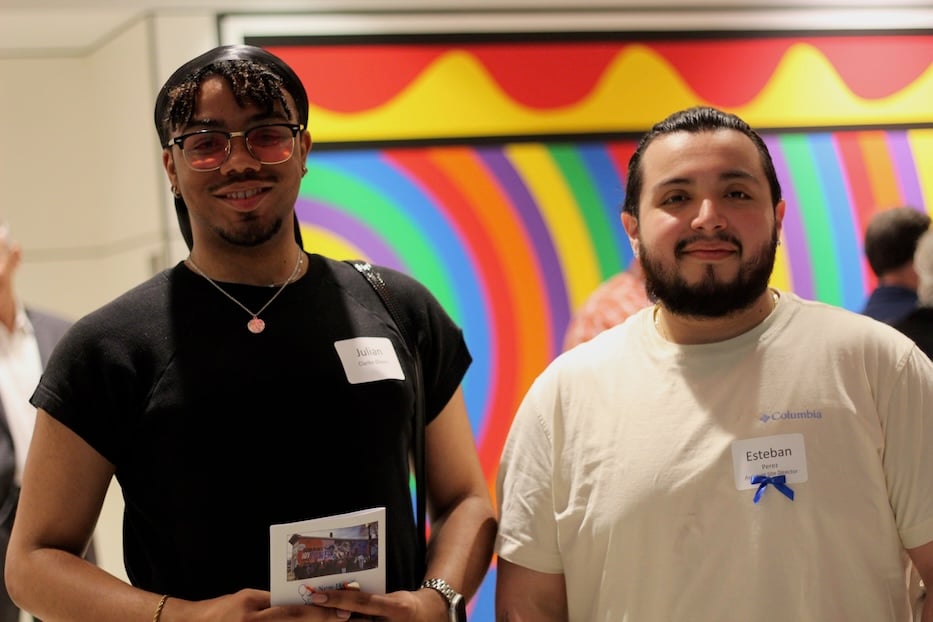
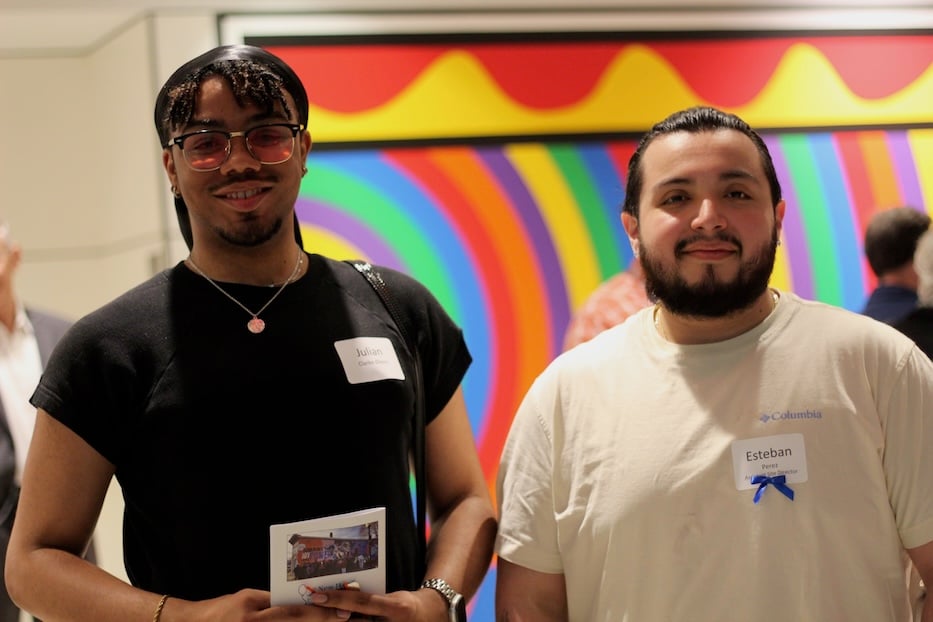
Julian Clarke-Dixon and Esteban Perez, both former students who returned to be a part of the organization. Lucy Gellman Photo.
When Julian Clarke-Dixon walked through the front door of 45 Bristol St. for the first time, he didn’t want to be there.
Around him, the office buzzed with activity. Students read aloud to their tutors, young voices rising and falling through the space. The phone rang off the hook. To a young Clarke-Dixon, it felt like an extension of school, after an already-long school day.
Then he met tutor Gary Wilson, and embarked on an educational journey that would change his life.
Clarke-Dixon, now a college graduate with a background in communications, is one of over 10,000 students who have gone through New Haven Reads, a literacy locomotive that this month turns 25 years old. Last Thursday, hundreds of students, alumni, and supporters celebrated that anniversary at the Yale School of Management, taking the time to center the sheer amount of learning that has happened in a quarter of a century.
The event raised $62,000 for the organization, which this year has a general operating budget of $1,509,958 to support its 24 full- and part-time staff members, and provide free literacy tutoring to 457 kids between pre-kindergarten and high school. That support is critical: next year, New Haven Reads is projecting a $1,375,866 budget, with a significant deficit due to shrinking foundation support.
Monday, Executive Director Kirsten Levinsohn said that the organization did not plan to eliminate any positions in the next year, even with a tighter budget. But she acknowledged that it comes at a time when New Haven Reads needs more dollars, and not fewer: the city’s students are still struggling in literacy and math, for which organizations like New Haven Reads and the New Haven Tutoring Initiative (NHTI) provide an educational lifeline.
Through the work of NHTI (on which it is a founding partner), New Haven Reads reaches an additional 304 students across eight organizations.
“For two and a half decades, New Haven Reads has been showing up day after day to support, coach, mentor, encourage, and yes sometimes cajole, and laugh with children all across the city,” Levinsohn said, adding that the model works: 100 percent of NHR students show growth in reading, and the majority advance nearly a full grade level each year. “We’ve helped open doors to brighter futures for children with extraordinary, often untapped, potential. Because reading changes everything.”
The nonprofit’s model, which now spans learning hubs in Dixwell, Science Park, and Quinnipiac Meadows, reaches back to a book-based dream that took root in 2001. That year, then-Mayor John DeStefano approached Christine Alexander about piloting a year-long literacy initiative across the city. At first, the organization was a collection of books in Alexander’s garage, which grew into a book bank at the Chapel Square Mall downtown and then a permanent site at 45 Bristol St. that is still in operation today. In the spring of 2018, seven years after Alexander died after a battle with breast cancer and 16 after she had started the nonprofit, the corner of Bristol and Ashmun Streets was named in her honor.
In two and a half decades, the organization has been able to give away three million books and tutor 10,000 students, with the help of 14,000 volunteers and dozens of dedicated staff. In a city where the majority of third graders are still reading below grade level, that work is never done: New Haven Reads currently has roughly 100 students on the waitlist for one-on-one tutoring, with another 33 waitlisted for its kindergarten literacy program, and 16 for pre-kindergarten.
As they mixed, mingled, and shared remarks Thursday, multiple attendees—many former students themselves—made the pitch for giving both financial resources and becoming a tutor with the organization, which requires as little as one hour per week. During that time, students are able to hone their reading skills, build vocab and reading comprehension, and practice phonics and phonemic awareness while working one-on-one with a tutor. The curriculum is based in the Science of Reading, which is also the foundation of Connecticut’s “Right to Read” legislation.
In the interest of full disclosure, this reporter is a weekly tutor and can objectively say that if you want an infusion of joy and an encyclopedic knowledge of Elephant and Piggie, now is your chance to do it.
“The mission of New Haven Reads is so important and so viable, and so much needed in our community,” said longtime tutor Stacy Spell, a retired police detective and West River neighborhood booster who led Project Longevity for eight years, and has tutored on and off for 21. “If I were to have my druthers, I would take a third of this room and make you all volunteers. Because there’s always a need! New Haven Reads has been around for 25 years, and in those 25 years, there’s still a need for children to learn to read.”
For Spell, it is a mission that’s as personal as it is professional. In the still-early days of New Haven Reads, he met Alexander when he walked through the doors of 45 Bristol St. with his then-young son Noble, then a fifth grader at the Foote School. Noble was struggling in math, “and daddy couldn’t help him,” Spell said, his voice catching warmly on the memory. He hadn’t ever imagined that his family would need an organization like NHR, and suddenly he was so grateful that it existed.
Around them, the Bristol Street office was controlled chaos: parents lined up, waiting to talk to Alexander about their kids. The phone rang incessantly. Alexander fielded questions by the handful, taking one right after the other. And Spell, who could see how miraculous and overwhelming it all was, asked how he could help. Already, he understood that there was something life-giving and unique about the organization’s work, in part because he saw a link between illiteracy, crime, and recidivism during his time in law enforcement.
“And she said, ‘You can fill out an application, and you can become a volunteer tutor!’” From the audience, laughter bubbled up from the seats and filled the auditorium. And that was that. Spell stepped in to fill the gap, and fell in love with the mentorship in the process. For over two decades now, he has made it a point to go once a week for at least two hours. In the past year, it has also become a way to honor Noble, who passed away unexpectedly last year.
From that first interaction at Bristol Street, Spell saw a ripple effect that kept going. After getting the help in reading and math that he needed, Noble returned to New Haven Reads as a tutor, inspiring his sister Symphony and his aunt Brenda to become tutors as well. Currently, Spell has two grand-nieces and a grand-nephew who are enrolled in the program.
“We want to open up a new world,” he said. “Because when you have the ability to read Huckleberry Finn or Tom Sawyer or whatever, it changes your life! Being able to go into the pages and find adventure, find that joy. It opens the lives of our children to a better future.”
That resonated for former students like Clarke-Dixon and Esteban Perez, the latter of whom is now the assistant site director at NHR’s Quinnipiac Meadows site, located inside Bishop Woods Elementary School. As a student at the former Christopher Columbus School in Fair Haven (it is now FAME, or the Family Academy of Multilingual Exploration), Perez can still remember what it was like to have trouble reading. Now, he tries to be that supportive presence for kids in whom he sees his younger self.
Clarke-Dixon nodded knowingly as Perez spoke about his own experience last Thursday. A student at New Haven’s Augusta Lewis Troup School when he began tutoring sessions—he later transferred into the Branford School District—Clarke-Dixon wasn’t sold on New Haven Reads from the beginning. “As a kid, you’re like, ‘Oh my God, they’re taking my time away.’”
But at some point, he began to build an educational bridge with his tutor, Dr. Gary Wilson. Wilson, who passed away in 2020, was a pioneering geneticist who trained at the University of Chicago. To Clarke-Dixon, though, he was just one of the first people to express interest in Clarke-Dixon’s academic growth, and eventually his path to a college education.
“He was like a second father to me,” Clarke-Dixon said. “I don’t think I would be where I am today without the gift of meeting him.”
So when Clarke-Dixon had a community service requirement his freshman year of college, he knew exactly what to do. He came back to New Haven Reads as a tutor.
“Reading is the gateway to all knowledge,” Mayor Justin Elicker had said earlier in the evening, and the words echoed as attendees trickled out into the cool April evening, holding shiny anniversary-themed bookmarks that glinted beneath the streetlights. “And when you think about the impact of 10,000 students having the kind of support they need to access reading, we will never truly know the difference that we as a community have made.”