


Books | Culture & Community | LEAP | Arts & Culture | Dixwell Community Q House
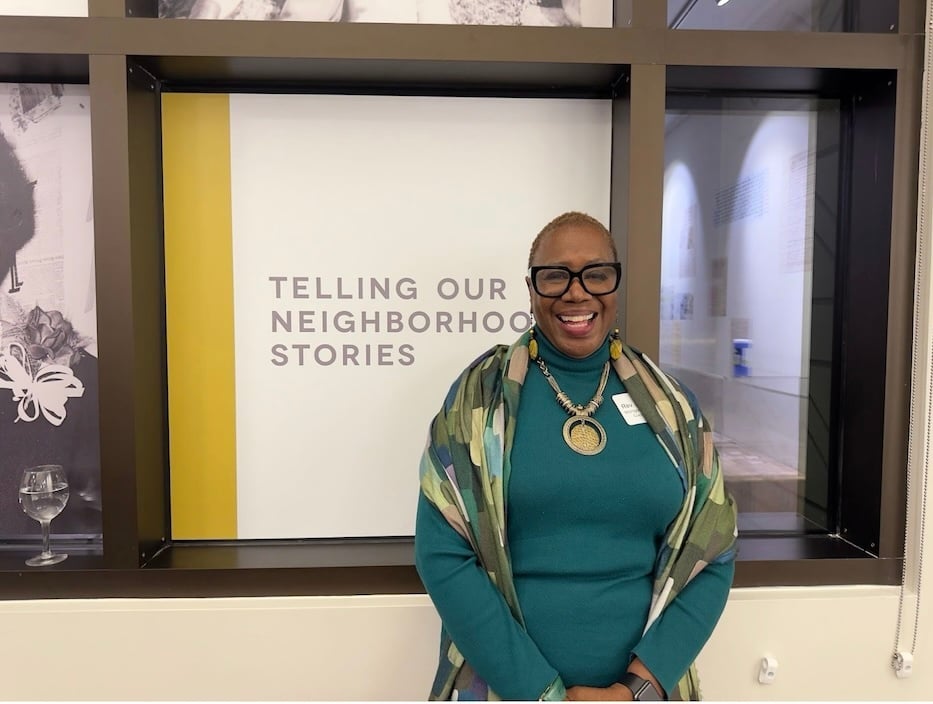
Cooper at the event. Solé Scott Photo.
Inherited trauma is not talked about enough in the Black community.
But when is enough, enough? And how can people find a path to healing?
That question took center stage at the Dixwell Community “Q” House on a recent Thursday, as the Rev. Dr. Odell Montgomery Cooper and Yale University’s Deborah Stanley-McAulay co-hosted a dinner and dialogue as part of the 31st annual LEAP Year Event. Part dinner discussion and part fundraiser, the evening raised over $600,000 for Leadership, Education & Athletics in Partnership (LEAP), which provides after-school activities to hundreds of students across New Haven.
For Cooper, it doubled as a chance to talk about her work in trauma-informed care and healing, including her second book, Letters To My Son and decision to start Interruptions, a “Healing Ministry” and (as of last year) nonprofit organization that has continued to grow. The book is addressed and dedicated to her late son Jonathan, who was killed in a case of mistaken identity in April 2016, when he was just 25 years old. One year later, on what would have been his 25th birthday, she suffered a near-fatal brain aneurysm, and realized that she needed to heal herself if she wanted to live.
In the decade since, Cooper has shared her story hundreds of times, in rooms with fellow bereaved parents, mental health practitioners, faith leaders, and international scholars, including at the Vatican. In the process, she has helped put many of them on their own path to healing, and encouraged hundreds of people to break through silence and stigma around grief, death, and the "interruptions" in their own lives.
“Be wise about your choices, find the help that you need because healing is possible,” Cooper said as an intimate audience filled the room at the Q House to hear about her own healing journey, and hard-won decision to found and grow the New Haven-based nonprofit Interruptions. “We are meant to feel good, not feel bad.”
Before dinner, a reception unfolded in the building’s gymnasium, usually home to spirited activities from LEAPers who call the space a second home. This evening, the scene was more like a night at the Met Gala, with the purpose of paying it forward. Throughout the reception, various speakers glided onto the stage to give thanks to the audience, receive recognition, and emphasize the significance of investing in children’s education and after school activities.
“I am a big supporter of LEAP, I love what they do in this community and how they invested in young people and the development of leadership in young people,” said Karen DuBois-Walton, president and CEO of Community Foundation for Greater New Haven, at one point during the evening.
It comes at a critical time for the organization, which lost roughly $1.5 million in federal funding last year, forcing it to pause its Leaders In Training (LIT) initiative and at one of its seven sites for free after-school programming at King Robinson School in Newhallville, where it was serving about 100 kids. With increased support from many individual contributors and a state grant through NHPS, both programs have started back up again this spring. LEAP’s total budget for this year is about $6.9 million.
“While we did experience cutbacks in previous years due to federal funding reductions—a challenge many nonprofits continue to face—we have stabilized our programming for FY 26,” Communications Coordinator Tristan Reeder wrote in an email after the event. “We’ve been able to maintain year-round services, grow and improve key areas like literacy, swimming, and outdoor programming, and continue investing in our tiered youth employment and leadership pathways.”
As guests headed to their various LEAP Year dinners at the Q House and in people’s homes across New Haven, Cooper and Stanley-McAulay gathered an intimate group of 12 upstairs, where a serious discussion of inherited trauma began. Stanley-McAulay, who is the associate vice president of employee engagement and workplace culture at Yale, is an advisor on Cooper’s nonprofit, Interruptions.
When it was time to begin, 12 guests sat around a table, the mood more like Sunday dinner than a buttoned-up fundraising event. Only this time, the dinner guests had come to listen—and speak candidly—about their own lived experiences and healing journeys. As they introduced the evening, both Cooper and Stanley-McAuley emphasized the importance of honoring the room as a safe space, meaning that attendees’ comments stayed inside the group. It is for that reason that only Cooper’s story is shared here.
“To know that healing is possible, we have to break through our own missing stigmas that prevent us from healing,” Cooper said.
That approach is central to Interruptions’ mission, including Cooper’s newest book, Letters To My Son, and a deck of “Passed Down” discussion cards that she released last year. In the book, Cooper speaks directly to her son Jonathan, telling him about the journey she’s been on—for herself, for his sister, and for so many others grappling with their grief—since his passing and her aneurysm a year later. Initially, the process of writing to him daily was so heavy that she put the book down for six months. She ultimately picked it back up because she knew how important telling the story was.
The cards, meanwhile, are meant to get people talking with prompts like How do you carry yourself when you leave the house?, and discussion categories that range from finance to emotional wellness. Cooper explained that she believes, as do many of the faith leaders and mental health practitioners with whom she has worked, that sharing one’s story—and knowing when to ask for help—can be part of the healing process
“We’ve been providing hope and healing to people,” Cooper had said on WNHH weeks before, and the words echoed as attendees warmed to each other Thursday. After losing her son in 2016, Cooper encountered a world that was asking her to move on—professionally, spiritually, socially—entirely too quickly. When she suffered a near-fatal brain aneurysm on his birthday a year later, it was her body’s way of pushing back.
Three years later (and with the help of a creative village, she is quick to add) she started Interruptions as a piece of theater (it became a film in a Covid-19 pivot) and podcast series. It has since grown into two books, interviews, a peer-to-peer discussion series and roundtables on generational trauma. Cooper, alongside many of New Haven’s faith leaders, has now implemented that program in 14 of the city’s churches, where it has served over 300 people.
“I didn’t want my voice to be about losing a son to gun violence,” she explained in an interview on WNHH-LP’s “Arts Respond” program earlier this year. “I want to be able to help people deal with traumatic interruptions in their lives. Just interruptions, period. Whether you get a new job, you have a new baby, you get married, changing states—anything that disrupts the flow of your life and you have to deal with it … I want to teach people how to deal with them, versus avoiding them and letting them fester.”
“I just wanted to be able to reach people and tell my story,” she added.
And Thursday she did, pausing at times to regulate her own emotions, and check in on others in the room. At times, the mood seemed heavy: one attendee stepped out for a moment, and returned in tears, turning her face down so as not to draw attention to herself. Cooper, stopping for a moment, offered the woman an embrace. There was a quiet understanding between the two as their eyes connected.
Another woman burst into tears, and Cooper wrapped her arms around the young lady. Cooper later explained that the woman was a close friend to her son, a bright-eyed Metropolitan Business Academy grad who had moved to New York City in 2010. As she extended that grace again and again, she normalized emotions like grief and sorrow, noting how important it can be to mourn publicly, speak out, ask for help, and cry.
Before the end of the night, Cooper also introduced a version of her “Passed Down” cards to get the room talking. As the cards made their way out onto the tables, attendees read from and interacted with them, sharing personal experiences until half a dozen stories wove through the room. Cooper soaked it all in, guiding attendees through the questions.
“My voice has been … it’s been a blessing to see the impact that I have,” Cooper had said on WNHH weeks before, and the words rang true as attendees got to know each other. She noted that both Interruptions and her most recent book, in which she speaks to and shares stories with Jonathan, is part of that. So are events like the LEAP dinner. “Our journey is similar to someone else’s. Our names are just different.”
Lucy Gellman contributed reporting. To listen to Rev. Dr. Odell Montgomery Cooper on WNHH-LP's "Arts Respond," click on or download the audio above.