

Culture & Community | Education & Youth | Arts & Culture | Wilbur Cross High School
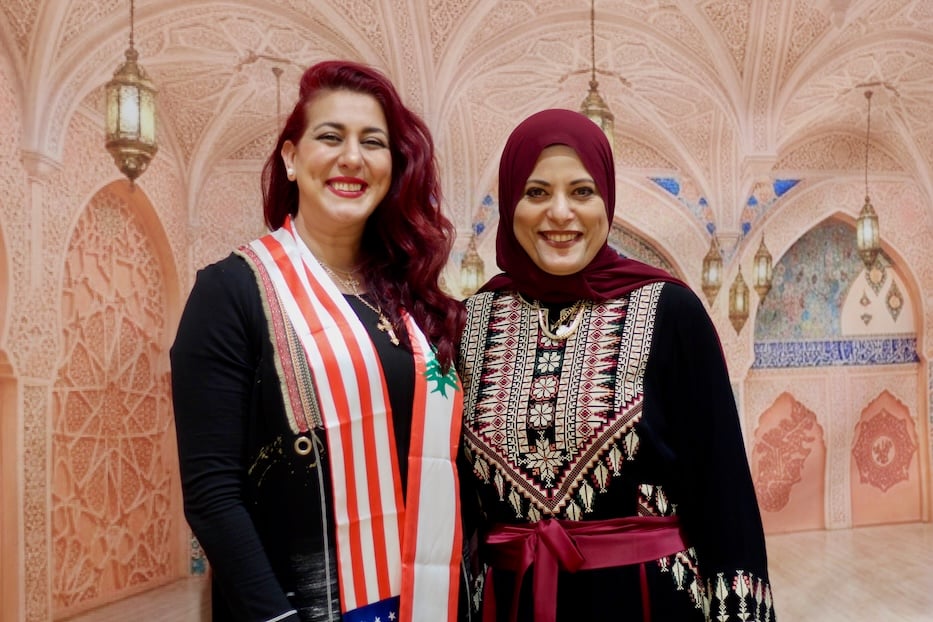
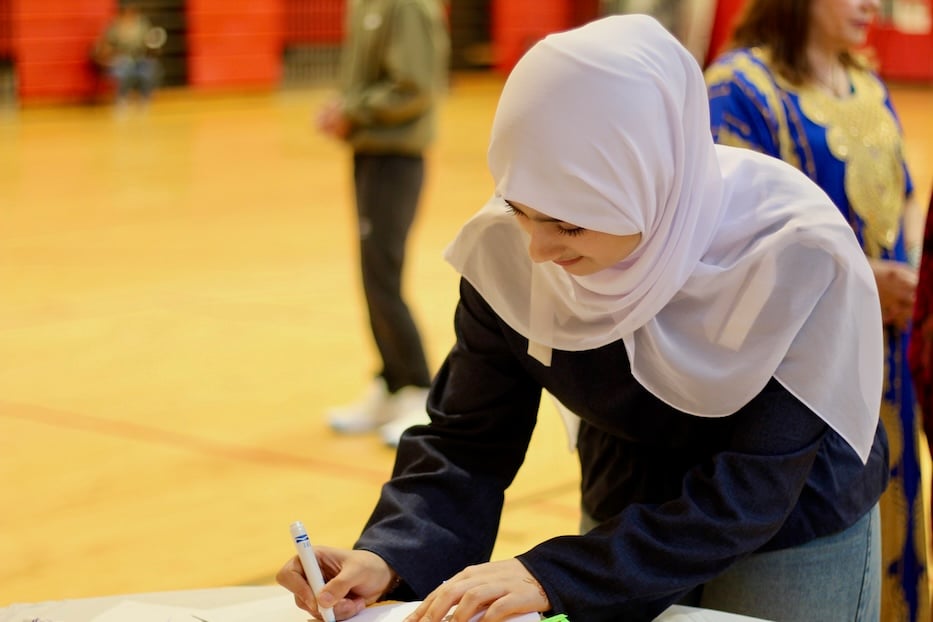
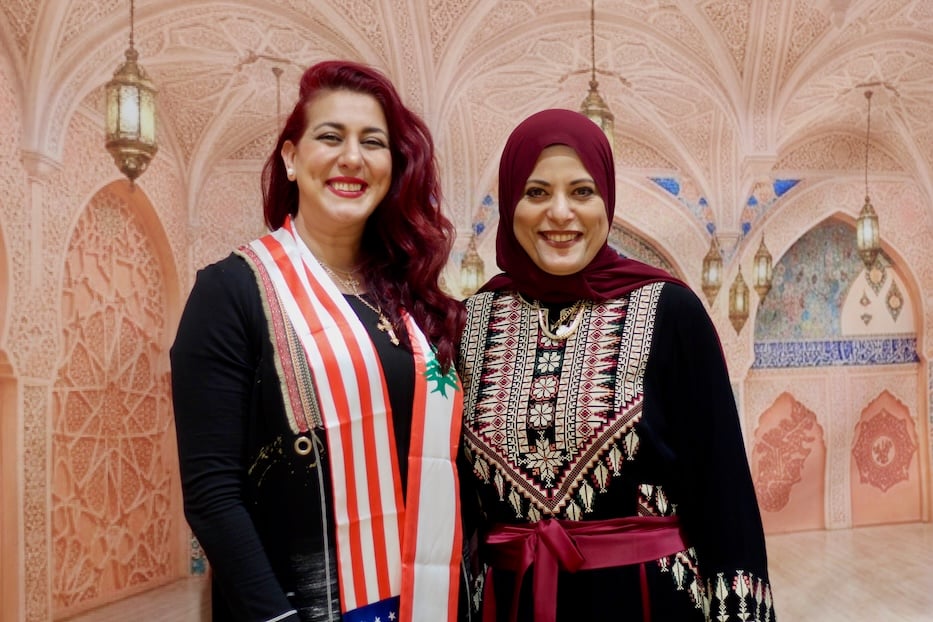
Top: Carla Hazzam and Hanan Elkamah. Bottom: Husha Hakimi helps students at a station where they could write their name in Arabic. Lucy Gellman Photos.
When Husha Hakimi walked into her first Arabic class at Wilbur Cross High School, she didn’t know what to expect.
Back then, she was still a newcomer to the country, more comfortable in Farsi than she was in any other language. She still missed her native Kabul, the place that had made her a self-described “city girl.” Cross, with its different academies and hundreds of students, felt huge.
Then she remembered that a new language meant more friends, easier peer-to-peer conversations, and the ability to step in and translate if a classmate needed help. Suddenly, it didn’t seem so overwhelming at all.
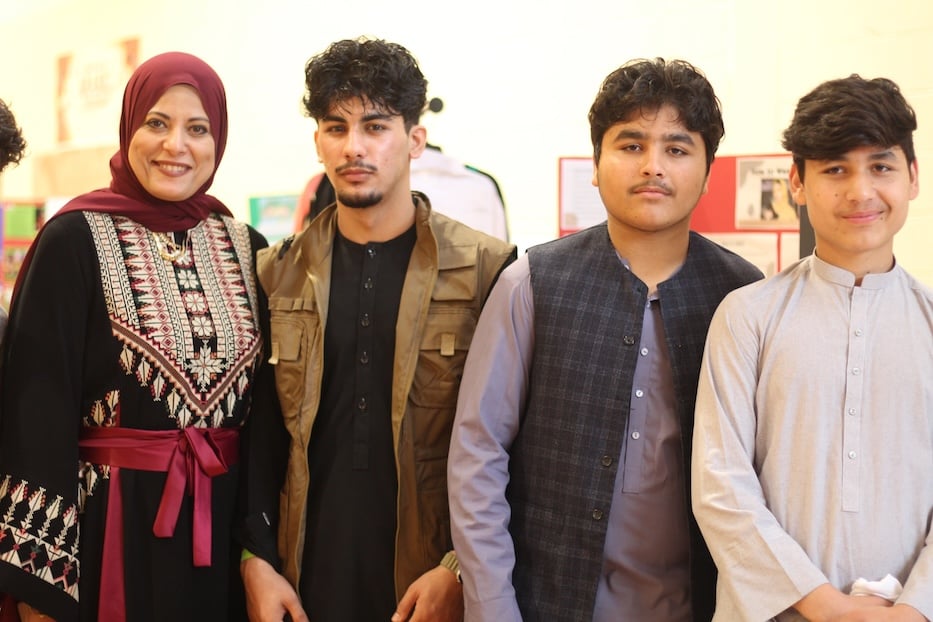
Last Thursday, Hakimi joined hundreds of classmates at Cross’ sixth annual Arabic Festival, a tradition that has continued to grow with the district’s commitment to teaching the language. Organized by educators Hanan Elkamah and Carla Hazzam, the event is designed to share Arabic language, food, culture and history, with the hope of building empathy and dispelling misinformation amongst students.
It received support, as it has in years past, from both Qatar Foundation International and the Cross PTA.
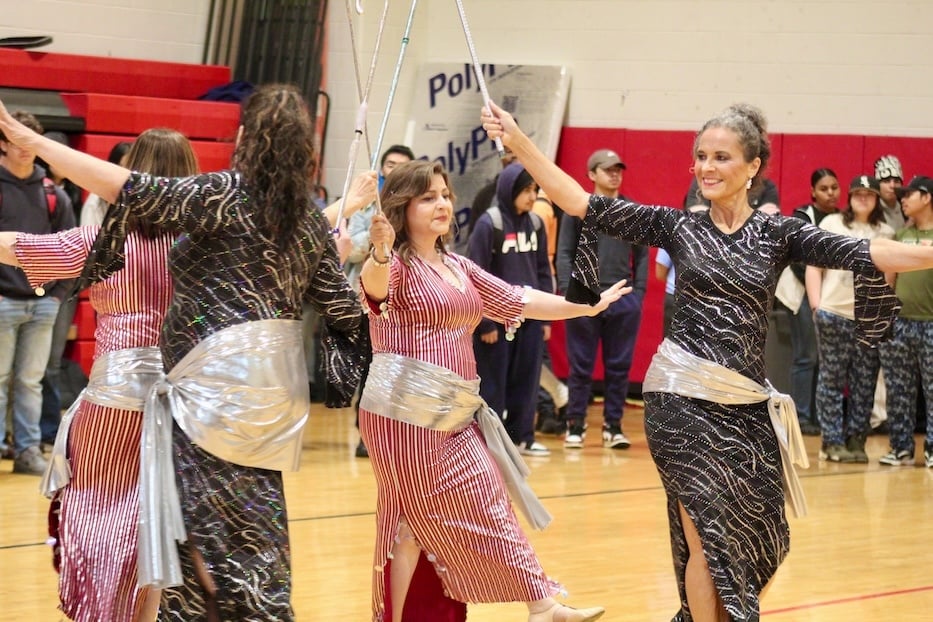
“We’re not trying to change or judge one another,” said Elkamah, who came to the U.S. from Egypt three decades ago this year, and has taught Arabic at Cross, where she now leads the World Language Department, since 2018. Thursday, she had dressed carefully in a long black thobe with vibrant, embroidered Palestinian tatreez that seemed to glow in red and white stitches from the thick fabric. “We’re learning about peace through culture.”
“Our differences make us beautiful,” added Hazzam, who came to Connecticut after fleeing war in Lebanon 21 years ago, and joined Cross’ faculty in 2023. “We want people to understand that language is not a religion,” but a vibrant way to learn about other countries.
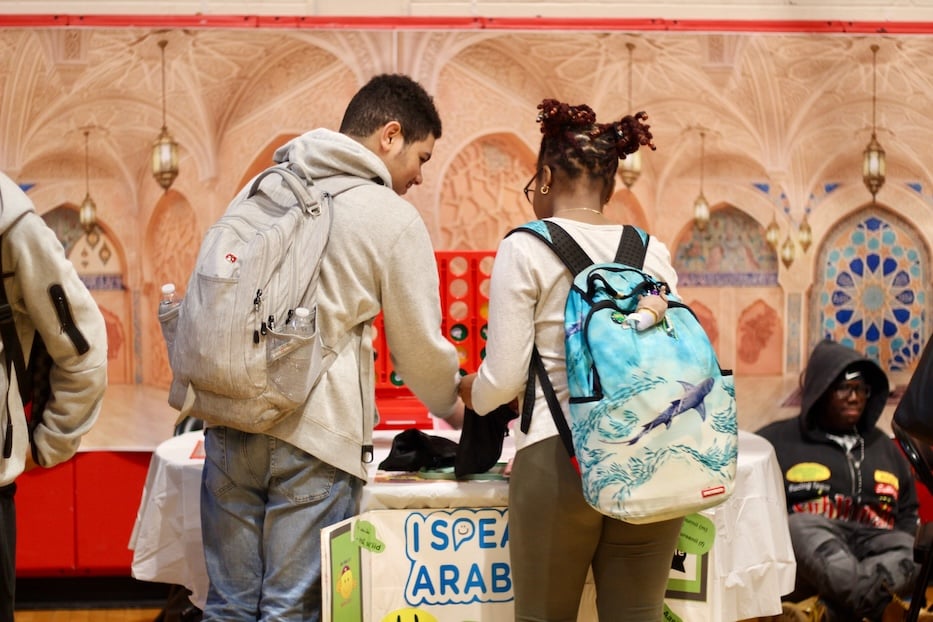
Currently, Cross has 130 students enrolled in Arabic, including a number of native Spanish, Pashto, Farsi and Dari speakers who felt inspired to pick up a second (or a third) language, and often came with questions about travel to some of the 22 countries that comprise the Arab world. Hazzam, who is Christian, said that she works to teach students that there is as much racial, economic and religious diversity in that part of the world as there is at Wilbur Cross.
As teachers and students put the finishing touches on the gym—craft tables with henna, language-matching games with prizes, and banners decorated with high, medieval red brick arches and the great pyramids of Giza—music flowed through the space, setting the tone. Danbury-based dancer Delores Matzen, who performs as Ms. Riskallah Riyad collected her thoughts as dancers changed into their costumes for the festival.
Close to the gym’s heavy double doors, volunteers laid out trays of pita bread, hummus, shawarma, and fragrant rice, all courtesy of Chap’s Grille downtown. Elkamah’s husband, Khalil Elsankary, owns the space—and has helped several New Haven Public Schools students work on their Arabic as a volunteer with the district.
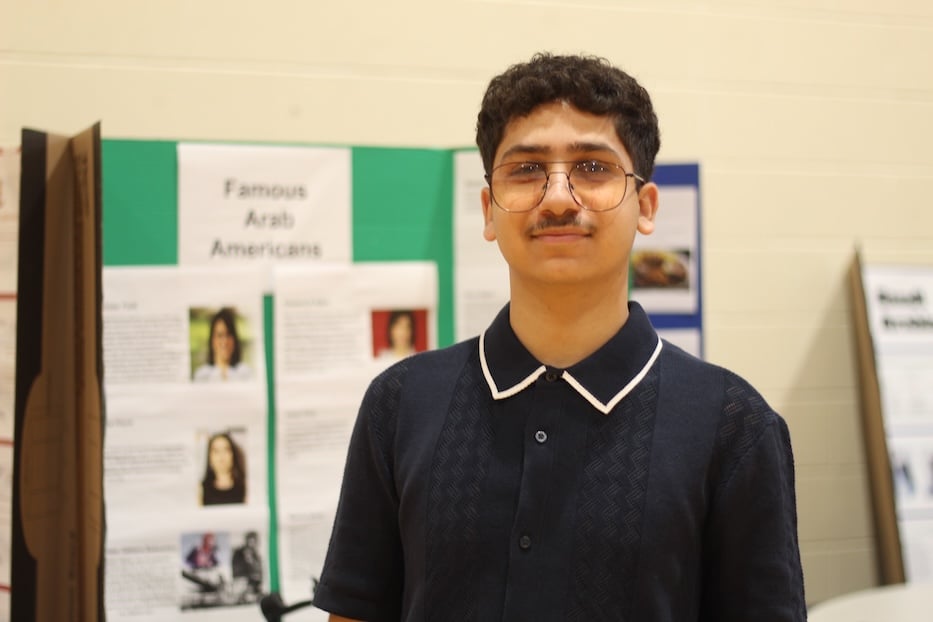
Sophomore Alaa Alagami buzzed through the room, taking pictures and video that could appear on Cross’ social media. A refugee from Syria, from which he and his family arrived three years ago, Alagami said that he was grateful for a chance to share his culture with the school.
In the last few years, he’s learned that his peers know very little about Syria—and if they know anything at all, they know only years of civil war and the calculating cruelty of Bashar-al-Assad.
But Syria has lived many lives, including centuries of vibrant literature, sacred and secular poetry, an outpouring of culinary artistry, and art and architecture that contain thousands of years of history. He takes Arabic so he can hold closely to that past, and his family's present.
“We learn Arabic so we don’t forget home,” he said as Elkamah translated. “The home language.”
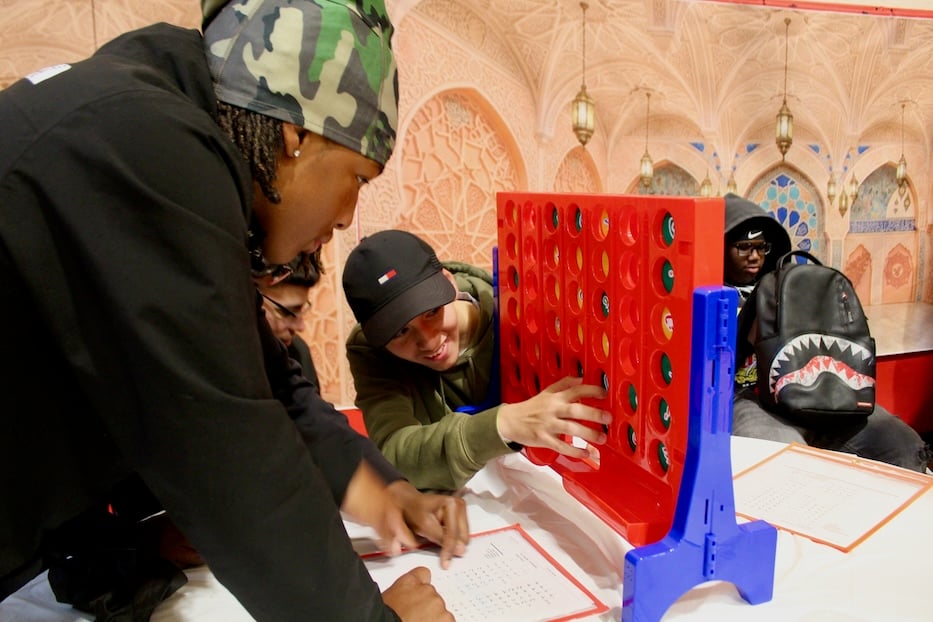
Across the room, sophomores Matteo Perez and Abdiel Soto invited their classmates to play a language-themed game of Connect 4, the candy-colored discs printed with neat, Arabic letters in white script. As native Spanish speakers—both are Puerto Rican, with family between the island and New Haven— they chose to take Arabic for the challenge of learning a third language.
“It’s not as hard as I thought it would be,” Perez said as he welcomed sophomore Jeremiah Thames to the table. “And it’s cool to learn a new language!”
“I’m making new friends,” Soto added. He sidled up to James as he sounded out the letters that make sh, dh, and final h sounds.
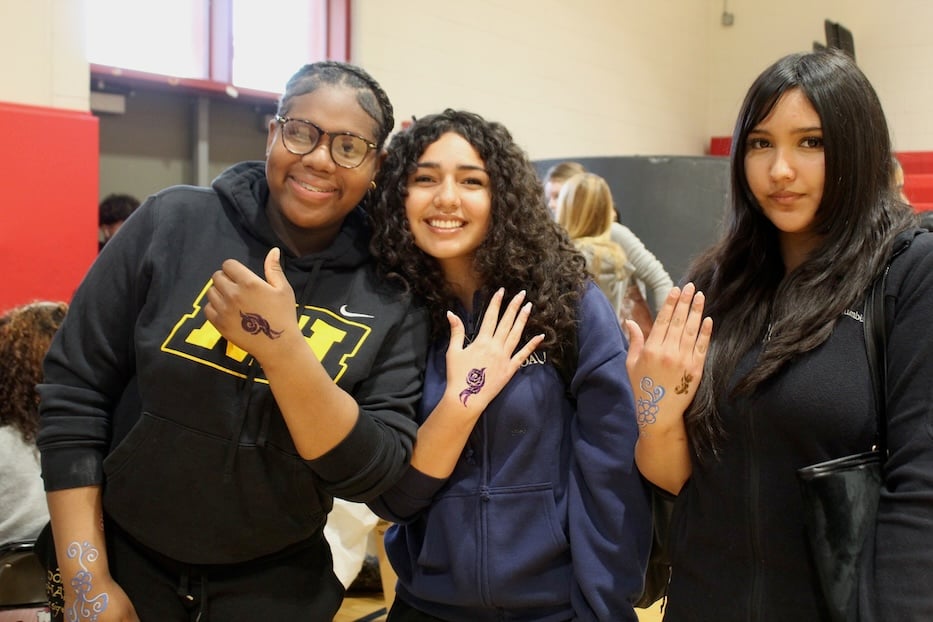
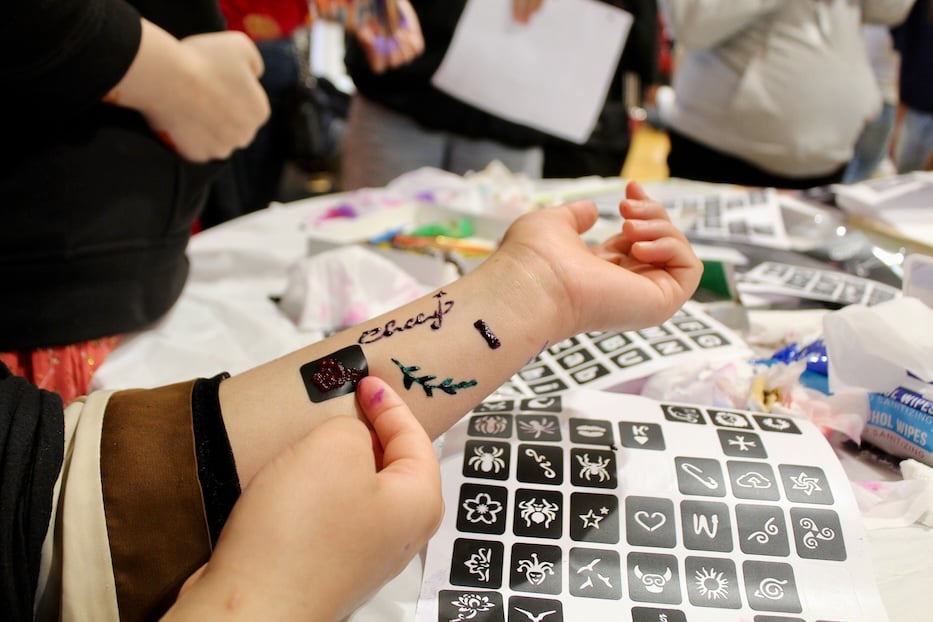
At a henna station one table over, sophomore L.J. (she asked that her name and photo not appear) praised Hazzan, noting how at ease she makes students feel in her classroom. A few years ago, she came to the U.S. from Afghanistan, fleeing increasing violence that had gripped the country. After working to learn English—her first language is Pashto—she picked up Arabic as a way to communicate with more of her peers.
Thursday, that included peers who did not even speak Arabic, but were excited to learn more about the Arab world’s culture and customs. A little after 11 a.m., Spanish language student Emery Thomas, who is a sophomore, stopped by the henna table to see what the art form was all about. She ultimately left with a new understanding of both the dye—here, squeezed out from tubes like paint—and its use for rituals like weddings, holidays, and celebrations.
“It's good!” Thomas said of the festival, echoing Elkamah’s belief that such events can help break through harmful cultural misconceptions. “I think these kinds of events open up room for conversations that need to be had.”
Around Thomas, conversation rose and fell as other school groups entered the room, many soaking in the number of activities waiting for them. Currently, eight schools in the district—Cross, Metropolitan Business Academy, Engineering and Science University Magnet School (ESUMS), Hill Regional Career High School, Benjamin Jepson Interdistrict Magnet School, Family Academy of Multilingual Learning (FAME), King-Robinson Interdistrict Magnet School, and Roberto Clemente Leadership Academy—offer Arabic.
FAME teacher Soha Osman, who grew up in Egypt and now teaches Arabic in the district (she also teaches French at Aux Trois Pommes, a private language school on State Street), said she was thrilled to see students buzzing from table to table, learning new information at each station. For years, she’s watched the festival grow, with new activities knitted in throughout the day. Thursday, she walked around the gymnasium with her eighth graders, beaming for much of the morning.
There was plenty of reason to: students chatted animatedly in Arabic, sampled trays of food that seemed to magically never run empty, and left with henna designs that bloomed across their arms and hands, some as bright as the sun. They stood wide-eyed as dancers from Connecticut Dance Oasis took the floor, bodies constantly in motion. When a drummer invited them to step closer, many did, doing a call-and-response on his command.
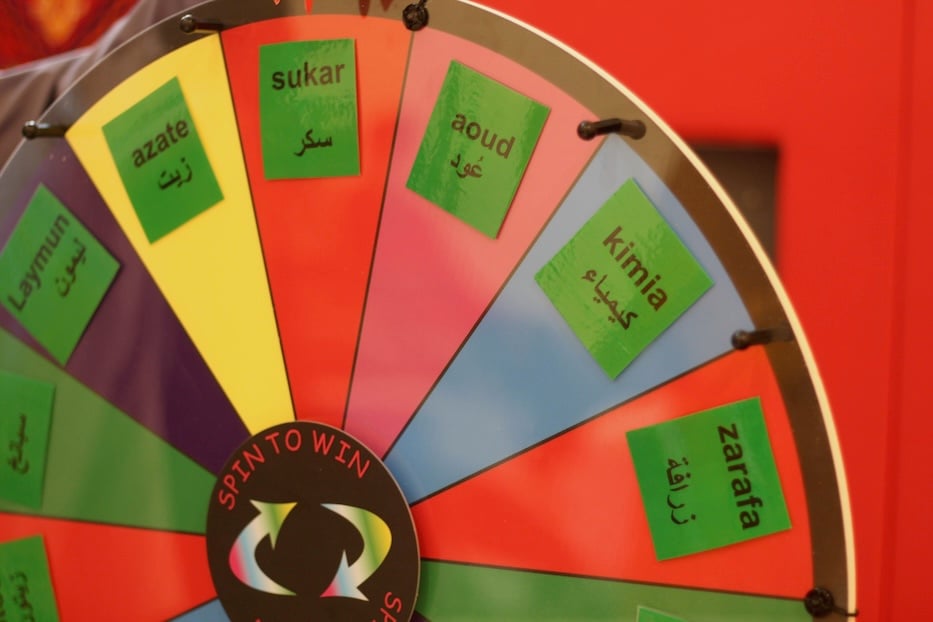
Back across the room, students Fardin Ali, Shawkat Fariqi, and brother Rahmat Faqiri invited their peers to spin a multicolored wheel, on which color-coded segments each showed off a different word in Arabic, with the phonetic pronunciation above the Arabic letters. Below, students had reproduced the same group of words in English, urging their classmates to match the two.
Some, like sukar (سكر) and kimia (كيمياء), the Arabic words for “sugar” and “chemistry,” showed how much two languages can have in common. Others, like Aoud (عود), which translates to “wood” or “stick,” took longer to ponder. As fellow students gave it a spin, Ali and the Faqiri brothers cheered each of them on.
“It’s a really supportive community, people try to help you,” Ali said. Growing up in Afghanistan, he never imagined that he would finish high school in New Haven. Now, with English, Pashto, and Arabic under his belt, he feels more confident talking to his classmates.
He added that events like the festival are important in letting Cross’ student body—and young people across the district more broadly—learn firsthand that the Arab world and its people represent much more than war and violence. Often, he finds himself correcting misconceptions that classmates pick up from social media.
“It’s not what they see in the media,” he said. “When they learn about it, their minds maybe change.”