

Culture & Community | Music | Southern Connecticut State University | Arts & Culture | New Haven Symphony Orchestra
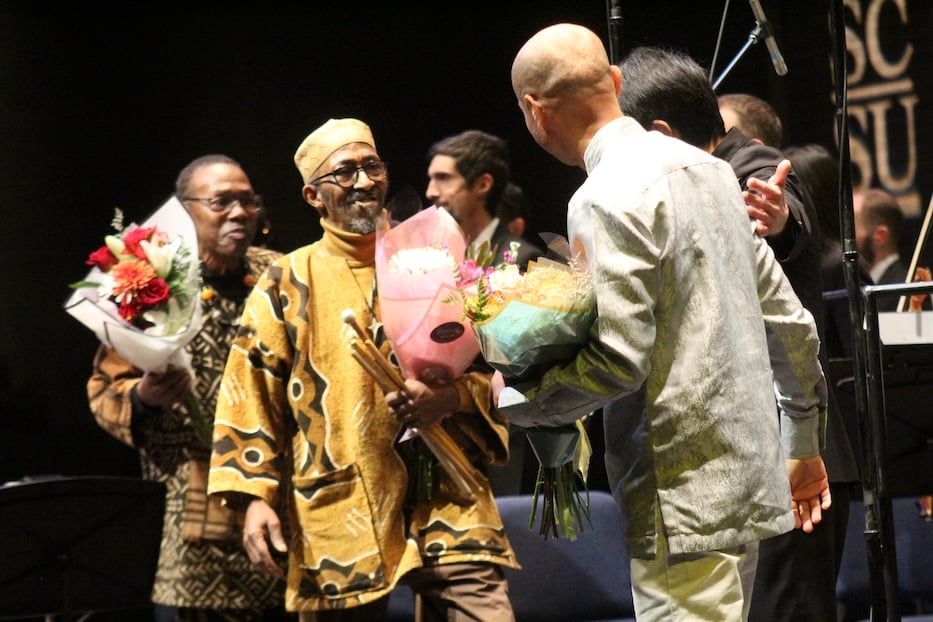
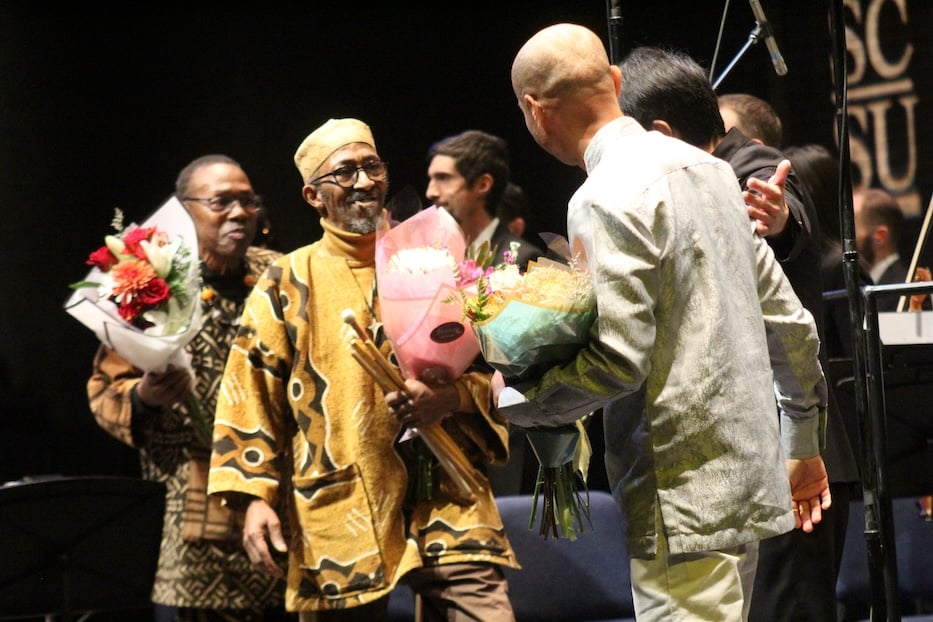
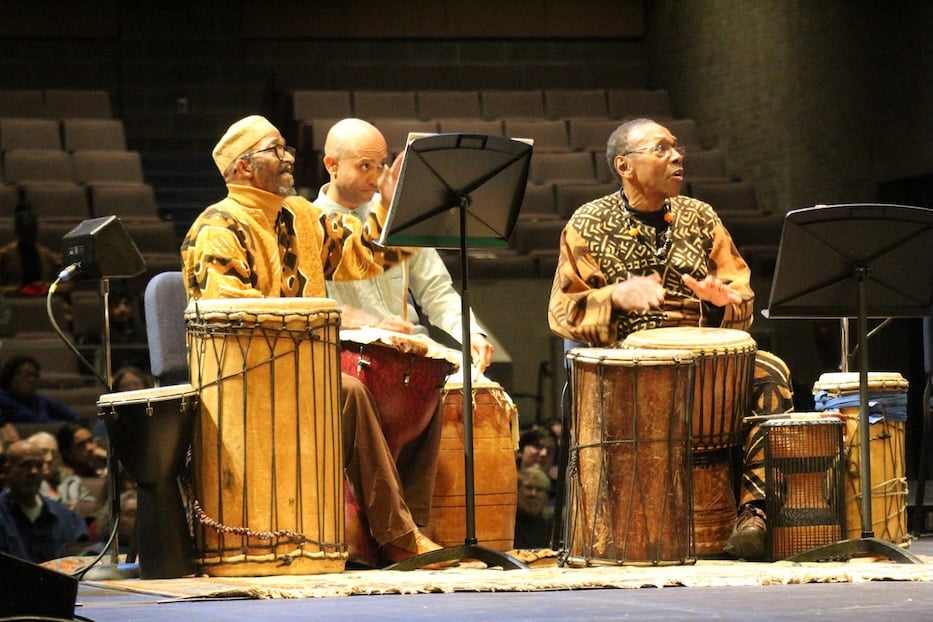
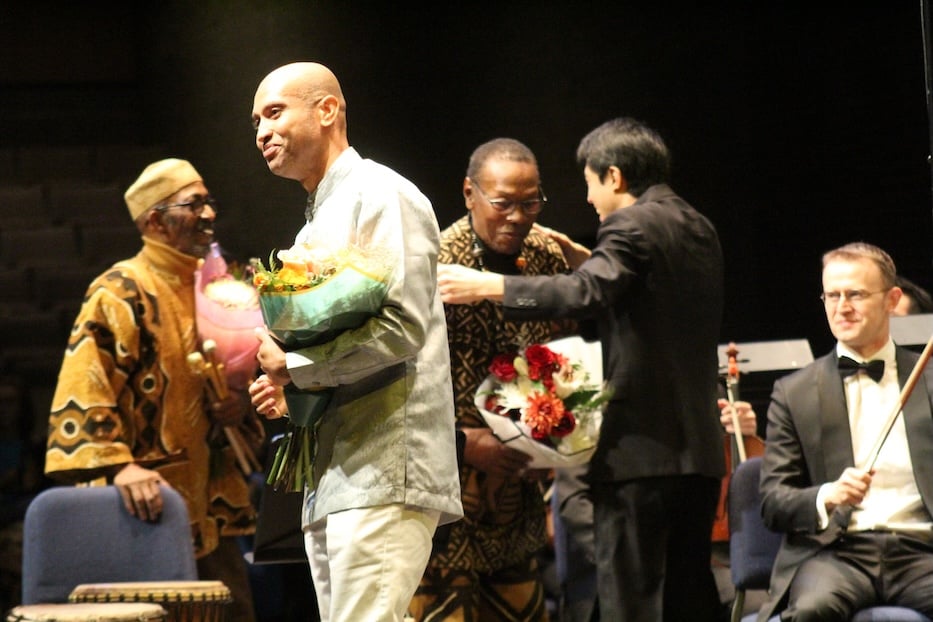
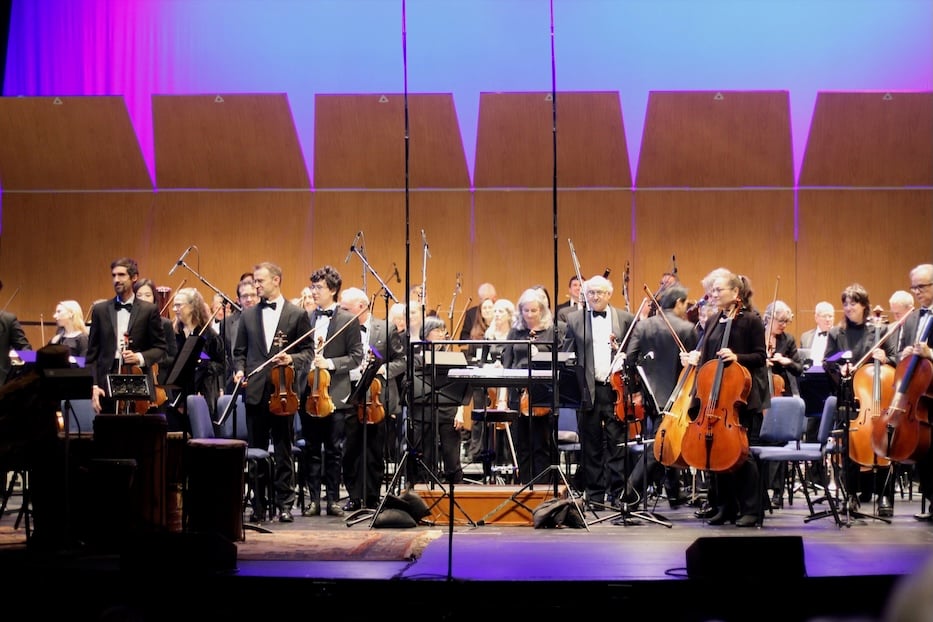 Top: Michael Mills (in yellow) with Derrick Skye, with Brian Jawara Gray and Perry So in the background. Bottom: The NHSO in action. Lucy Gellman.
At first, the two drums were the only voices in the room, ringing out through the cavernous space with a round, warm sound. On the stage, still half-cloaked in shadow, Michael Mills and Brian Jawara Gray conjured an intimate drum circle, as if it was just them and the taut, singing skins beneath their palms. If someone leaned in close enough, they could almost hear Mills’ gravelly intonation of the words heart-beat, heart-beat.
A tentative, then steadied, clapping came from the percussion section, as though a voice had joined in. The conversation had begun.
Continents, rhythms and centuries collided at Southern Connecticut State University (SCSU) last Sunday, as the New Haven Symphony Orchestra (NHSO) presented "Feel The Beat," a percussion-centered program with George Gershwin, Derrick Skye, Silvestre Revueltas and the Blue Steel Drumline. Held at the John Lyman Center for the Performing Arts, the concert became a powerful call to both listen to history and to think of it as a living and embodied practice, passed down by the hands that shape and carry it.
While Skye's extraordinary "Between Suns" may have been the centerpiece of this action—thanks in no small part to New Haven treasures Michael Mills and Brian Jawara Gray—musicians world-built throughout, from Gershwin's 1928 "An American In Paris" (arranged by Pacho Flores, who performed with the symphony in May) to Revueltas' 1939 "La Noche de los Mayas," in which bombastic drums undergird a sweeping and cinematic ode to Mayan culture.
"It's been an amazing challenge for us, because this is not music that we play every day, but you've made it so wonderfully joyful," So said to Skye before launching into the piece, and it seemed that he was speaking at once about a single composition and the whole concert.
And from the first few notes of "An American in Paris," the swirl of rhythm had a kind of distinct pull, taking the audience back to a city Gershwin immersed himself in a century ago. Bells chimed and strings sprang to life, and suddenly the symphony was not in a college auditorium at all, but in the center of Paris, watching old-school Citroëns and side car taxicabs fly by on their way past the Tuileries gardens and Place de la Concorde.
Woodwinds trilled a hello, and buses trundled down a road that had appeared from nowhere. In the first chair of the violins, concertmaster David Southern leaned in, and appeared to dance as he played, the music alive in his neck and shoulders. Horns honked their hello from the percussion section, and it was as though taxicabs had made their way into the auditorium, where they were suddenly welcome with open arms.
.jpeg?width=933&height=622&name=NHSO_FeelTheBeat%20-%201%20(1).jpeg)
For those familiar with the eponymous 1951 film, it was easy to close one's eyes and see the opening credits, set in the City of Light just years after the end of the Second World War. Strings hurried past in perfect sync, and water gushed over the Fontaines de la Concorde. Violins dipped and hummed, and the camera jumped to the Tuileries, the Opéra Garnier and Pont Alexandre III. There, in the hustle and bustle of the Left Bank, was Gene Kelley, ready to bring the music to life.
“I think he [Gershwin] is just the icon for how American music is a wonderful melting pot of influences from all over the world,” So had said just minutes before, and it was. No sooner had strings and percussion conjured a bustling cityscape than the clarinet swooped in, its voice warm and duck-like all at once. The melody slowed to a march, horns keeping it moving, and musicians seemed to savor the moment even as they worked to catch up.
So, moved by the sound, lifted his arms and appeared to do a relevé in perfect first position, followed by what can only be described as a loose interpretation of the Horton Technique. Marimba sang its hello, and his body jerked forward at the waist, as if pulled toward the instrument with a magnetic force.
When strains of jazz entered the fray, he appeared to defy gravity entirely, bouncing on the waves of sound that spilled out into the audience. By a final note from the tuba, it felt as though the symphony were watching the sun rise from the Pont Neuf, and the whole pink-soaked city was their oyster.
“Gershwin is one of our national treasures,” So said, and the audience seemed to agree with applause that traveled up and down the aisles, and into the cracks and crevices in the auditorium. In the back of the auditorium, Eric Triffin stood to let the music move him, and a few young kids took note, swaying along in their seats. The wonder was contagious.
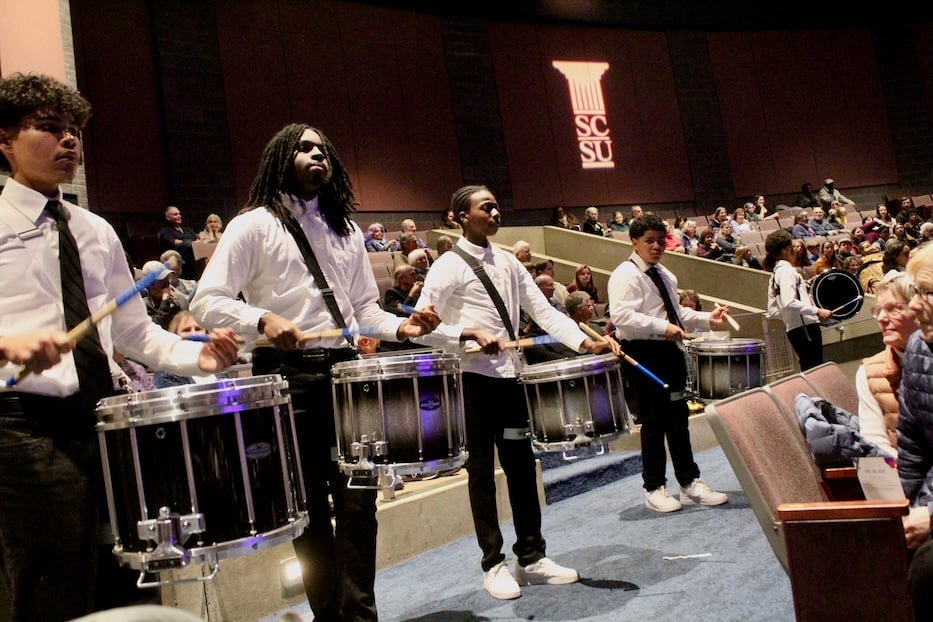
It stayed with the audience for the entirety of the program, from the final, jazz-infused notes of “An American In Paris” to a performance from Blue Steel that became a bridge between the first and second halves of the performance. In Revueltas’ “Noche de los Mayas,” it flowed from a swaggering, dramatic fanfare to propulsive percussion that nearly got the audience on its feet. In an interlude from the drumline, it hammered through the floor, consistent even as a drummer summoned help with his bass drum, and reinforcements swooped in.
But nowhere was it stronger than in Skye's "Between Suns," which debuted with the Knoxville Symphony Orchestra (KSO) earlier this year, after close to three years of collaboration with the organization. In 2022, Skye began to work on the piece after the KSO performed James DeMars’ “Sabar: Concerto for African Drums” with the group Indigenous Vibes and the drummer Obayana Ajanaku. The work, which DeMars published in 2001, combines the Sabar drumming tradition of Senegal with more traditional classical work for orchestra.
At the time, “it was an intense and really rewarding experience,” remembered KSO Music Director Aram Demirjian in an interview with Knoxville radio station WUOT earlier this year. Working with Ajanaku, he began dreaming about a composition that could showcase the group’s skills, spotlight West African drumming, and bring in classically trained musicians for whom polyrhythms were a stretch. Skye was the composer who brought that dream to life.
“I’m always in search of a musical vocabulary, a voice, a music where anybody, from anywhere, much like our country, can hear the music, but then hear phrases that are personal to them, no matter where they come from,” Skye said Sunday, looking out onto the audience. “So it’s a bit of a holy grail that I’m after.”
What sets “Between Suns” apart, he added, is that members of the orchestra echo several of the polyrhythms that drummers play, making it a deep dialogue (and for the NHSO, a worthy stretch) between traditions, instrumentalists, and histories of music and migration. These range from Ghanaian Fontomfrom drumming to the sonic traditions of Morocco’s Amazigh people. As they come together, they show the deep richness and diversity of a part of the world that is often spoken of or taught in terms of colonial contact, forced migration and resource extraction.
“One of the things that’s really fun about this type of music and this type of work is when you’re around it for a long time, you can hear the melody of rhythm,” Skye said. “The melodies are there, and the longer that you’re around the rhythms, the melodies reveal themselves to you.”
Sunday, that was audible from the first movement, “Solar Periapsis,” to the last, an exuberant layering of sound titled “Orbital Convergence." As the piece began, Jawara offered a rolling, sing-song drum that punctured the darkness, and Mills responded without any need for words at all. Behind them, musicians sat at the ready, listening before they joined the conversation.
For any listener who has been to Jawara’s Monday classes at the AfAm House or New Haven’s healing drum circles—at Bregamos Community Theater, on the New Haven Green, at citywide block parties and arts festivals across the city—it was the heartbeat that he and Mills often open with, both an offering and a benediction. Before long, clapping from the percussion section had joined in, a little uncertain but still eager. The horns cried out, as if talking back to the drums. Then it was the woodwinds, jumping in on top of each other.
By the second movement, Jawara had traded his djembe for a hand drum, the sound almost gurgling, brook-like as it bounced through the room. Mills, seated to his left, answered with a steady, rhythmic flurry. If a listener closed their eyes, they could see the sky changing from pink to blue to almost-black, stars twinkling against its velvet backdrop. Instruments, feeling the movement, seemed to rise slowly around the drums, as if they were breathing.
The symphony paused for a moment between movements, and applause filled the auditorium, bucking buttoned-up tradition. As Mills and Jawara pushed into the next movement, a few voices popped up from the rows, talking back to the musicians with exclamations of “Oh!” and “Yes” brimming with gratitude. Clapping entered the fray once more, louder and more persistent. From the right side of the stage, the cellos and double bass players turned their instruments into unlikely vehicles for percussion, reimagining the way they could touch the taut strings and hard, cool wood underneath.
That’s part of the point, of course: Mills and Jawara are powerful educators and masters of their craft, passing on a tradition that now-ancestors like Baba David Coleman carried for years. And yet, they’ve been largely boxed out of organizations and performances associated with “high art,” a byproduct of white supremacy and de facto segregation that is very much alive and well in New Haven. Works like “Between Suns” are both a reclamation and an unlearning. Sunday, it fit in So’s second season with the NHSO, in which he has used music as a lens through which to view the climate crisis, civil rights struggle, and extremely American epidemic of anti-Black racism.
By the time Skye joined for the final movement, the whole space was on the edge of its seats. From three drums on the stage, the audience could hear the foundation of music itself, the breadth of a diaspora that springs from the hands that understand its weight and continuance. Further back, the symphony seemed to be fully interstellar, trying to find its rotation around the sun one section at a time. The drums rang out, and those histories collapsed in on each other, joyful and cacophonous. If they struggled intermittently—and they did—it was part of the toil and triumph of the work.
“This is what I love about this country,” Skye had said before the piece, and his words rang true long after intermission. “There's people from everywhere. The journey for me, and for many of us, is: How can we understand each other better? How can we understand each other better? How can we understand each other better?"”