

Culture & Community | Dance | International Festival of Arts & Ideas | Arts & Culture | WNHH | Yale Schwarzman Center
Gio Roper Photos.
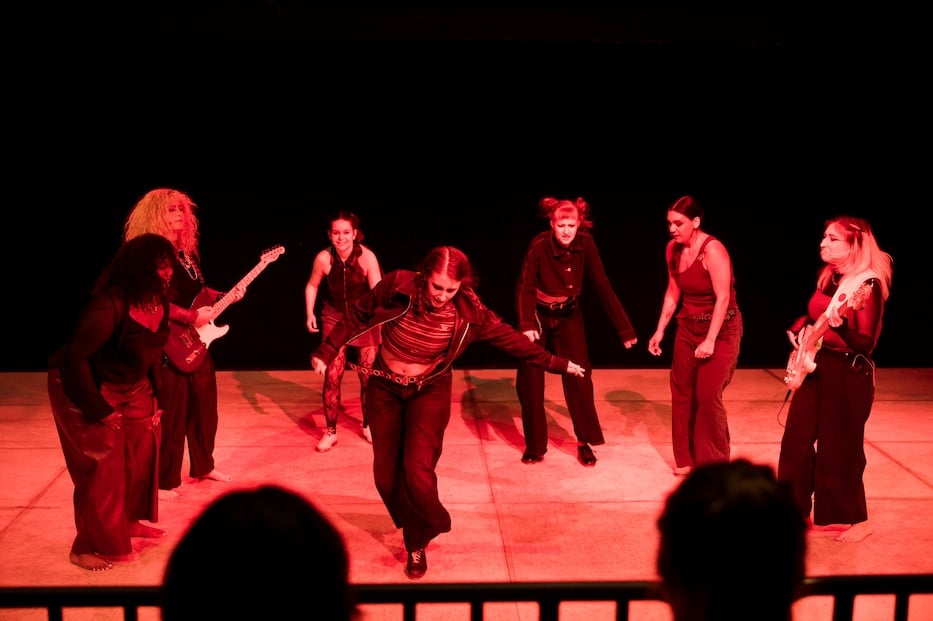
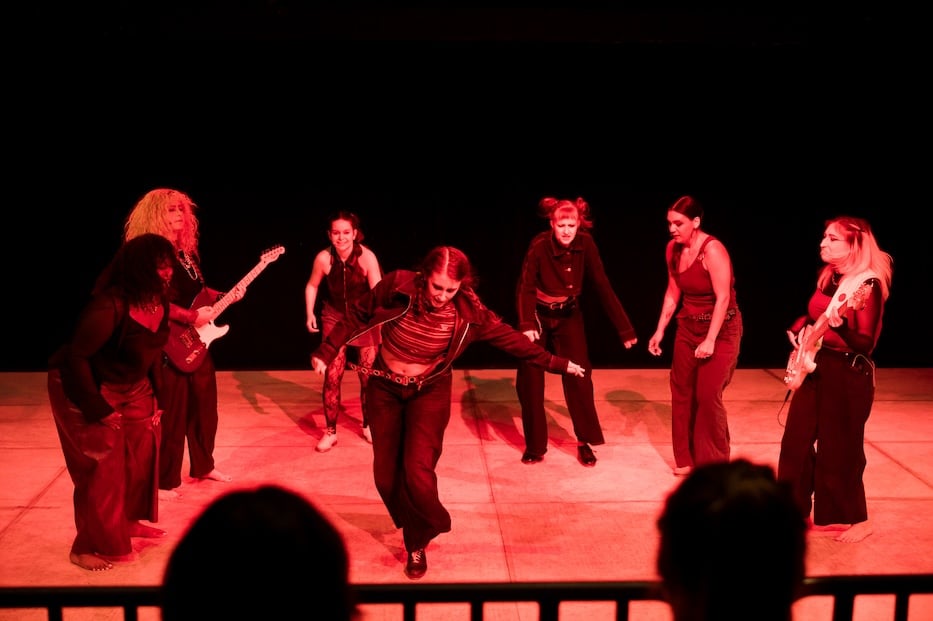
The performers were an album, spinning on an old-school turntable. Shoulder to shoulder, they rotated, feet moving, sound floating over the audience. Pink-red light drenched the stage in a sort of waking dream. At the center, Alexis Robbins was the needle and the drop. Her body lurched forward and wound through space, knees bending and then snapping back again. Her arms seemed to find themselves in midair, slicing through the half darkness.
It was 1999. It was 2026. She was exactly where she needed to be.
That scene, performed on a stage intimate enough to see the glistening sweat and rise and fall of breath, belonged to the world premiere of the Mercy Velvet Project, an immersive, multi-media rock opera and concert album that has been five years, hundreds of hours of rehearsal, and dozens of creative team members in the making. The multi-modal, fleet-footed brainchild of artist and choreographer Alexis Robbins and bassist Christie Echols, the performance opened for a short, two-day run Friday and Saturday at 53 Wall St. in New Haven, the home to the Department of Theater, Dance, and Performance Studies (TDPS) at Yale.
Robbins presented the work in collaboration with the Yale Schwarzman Center and the International Festival of Arts & Ideas. In addition to Robbins, who is the choreographer, producer, and artistic director, cast members included musical director and bassist Echols, guitarist and vocalist Maya Harrison, lead vocalist Demiah Latreece, and dancers Megan Gessner, Maria Clara Laet, and Isabella Serricella.
Because the work is so interdisciplinary, no one artist remained in their respective lane: dancers sang and played instruments (lest an audience forget, they are also percussionists themselves), musicians knelt and sometimes laid down on the floor, glided across the stage and leapt triumphantly into the air. Every person on stage sang throughout the show, including in multi-part harmonies that were sparse and somehow still lovingly layered.
In so doing, they presented a new model for dance and music in New Haven, where often-siloed art forms are so interdependent on each other that it’s hard to tell where one ends and the other begins.
“This music has lived in my bones since I was six,” said Robbins earlier this month on an episode of WNHH Community Radio’s “Arts Respond” program. “I feel like I’m existing in this world that we’ve created, and then particularly within this specific work, I feel very held by the six other people that I love and I’m performing with. I feel that we do that for each other—we’re holding our metaphorical hands together to get through the thing.”
The project itself is a story within a story. When Robbins was six or seven years old, her dad, Mark Robbins, was in a band called Mercy Velvet, with friends who included vocalist Deb Lili and her husband, guitarist Lou Lili. In 1999, the band cranked out its first and only album, entitled “Live In Vain,” produced and mixed by Grammy winner Tony Maserati.
Then Deb and Lou Lili split up, and the project—despite a limited run of copies out in the world—never quite made it to public consumption. For Robbins, still a kid, the album lived on—in her living room, in her practice spaces, in her mind and body. Even after she went to college and started teaching and working in New York, it remained—just as it did eight years ago, when she moved to New Haven and started spreading the gospel of rhythm tap across the city. At some point, she realized that she wanted to revisit it in a full production.
Since 2022, she has been building out the show while also teaching, coreographing, and performing, with works in progress showings in New Haven, West Haven and New York (read about those here, here, here, here and here, including as recently as last December at CitySeed’s Fair Haven hub). Earlier this year, just months after a showing and fundraiser, she announced that the premiere would finally take place during the International Festival of Arts & Ideas, presented in the city she now proudly calls home.
Friday, Robbins also took a moment to honor Deb Lili, whose support and kindness has helped carry the project forward. Lili died of cancer earlier this year in Rhode Island, where Robbins grew up.
As it came to the stage as a complete work Friday, Mercy Velvet proved to be many things: a propulsive concert, an album, told through the nostalgia-soaked kaleidoscope of Robbins’ childhood, a triumph for music and dance that included not just tap, but also jazz, lyrical, modern and minimalist techniques and a three-person, live band that lifted the ensemble off its axis in all the right ways.
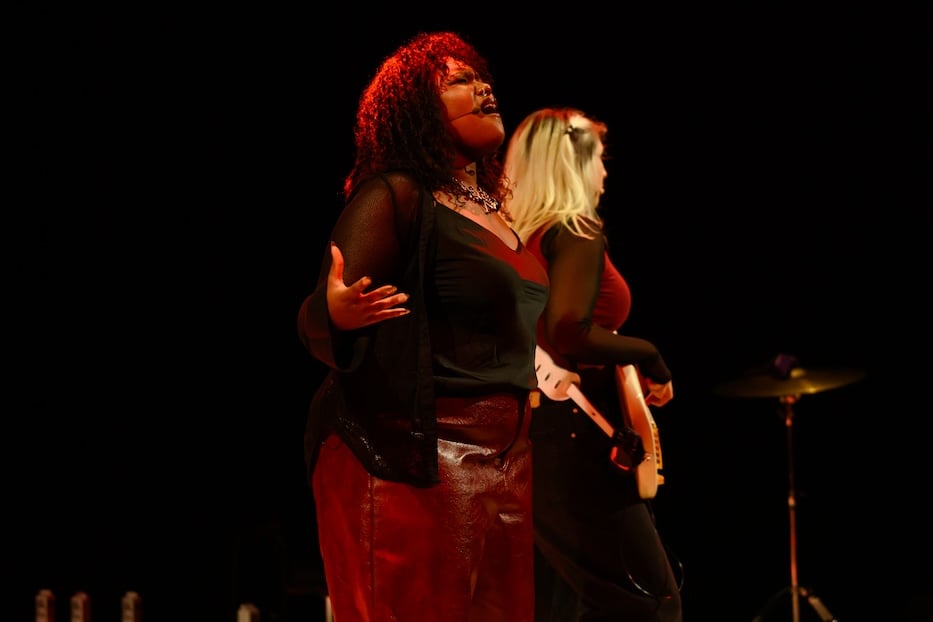
Take, for instance, performers’ introduction to the album’s titular track, in which Latreece’s voice rose and wound through the theater, vast and soulful. “If I could stop one heart from breaking,” she sang, and the house snapped to attention. She repeated the phrase, her voice muscled. “If I could stop one heart from breaking—” Friday, the audience was quiet enough to hear a pin drop. There was the sense that something was about to split open. “If I could stop one heart from breaking / I would not live in vain.”
Gio Roper Photos.
Already, the ensemble had established that this would be no ordinary night: they had started by stretching onstage, stopping for big, warm hugs as if they hadn't seen each other in months. Robbins, pressed up to Echols’ back, helped the bassist pull their arms and shoulders above their head, elbows raised sharply to the ceiling. Laet and Serricella sank into deep crouches, as if the audience were simply backstage with them. Gessner, doe-eyed and expressive, looked around until it seemed she'd found her place.
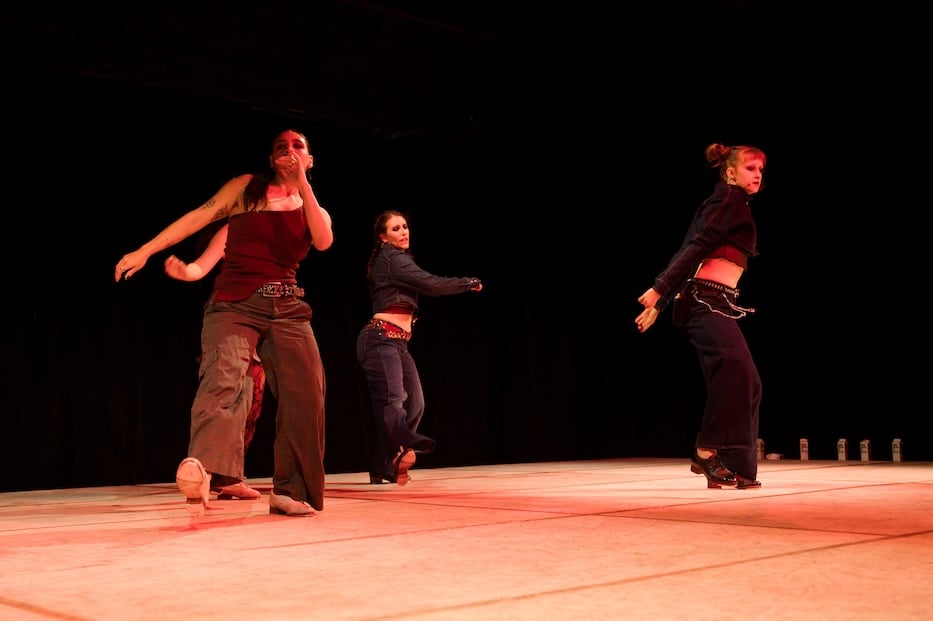
For a moment, it seemed possible that the ensemble was suspended in the 90s, artists sporting thick red lipstick, chunky belts, messy pigtails and high ponytails. To cheers, Robbins entered with fluorescent blue eyeshadow and a cropped knit top, circa Saved By The Bell and Boy Meets World. And denim, so much denim. This was a Cranberries concert meets the American Girl collection at a bar somewhere in Greenpoint (a nod to Eli Oremland, who helped with costume design, alteration and stitching). And the audience was ready.
And oh, when the music hit. As a performance, the Mercy Velvet Project offers up the album in its entirety, with nine tracks that Robbins and Echols have stretched out and rehashed in a way that makes them entirely new, and entirely indebted to the original band at the same time. As Latreece ushered in the performance Friday, her voice filling the space, she stood at the lower righthand corner of the stage, light falling over her. It was the last moment of complete stillness that the audience would see for over an hour.
By the end of the first verse, the air hummed and buzzed, electric. In the audience, a person could feel the dancers around her, spread out across the stage, before they could see them entirely. Bass and guitar began to dance around each other, so urgent that a listener could feel them in their ribcage. And Laet, dancing for her life, came in as the percussion, setting a tone to which other dancers joined in one by one.
On stage, the pace picked up. Feet struck the floor, whispered against its surface, and clack-tapped out a whole rhythm section. Robbins entered, at once a main character and an ensemble member, feet not yet encased in the tap shoes for which she is best known and equally beloved in New Haven. As Latreece’s voice rose and fell between swelling instrumentals and footfalls, Robbins moved around the stage, her movement at once crisp and lyrical.
Her arms shot out, so precise and propulsive that a person could almost feel it. She moved forward, magnetized by the sound; she flew to the side, a marionette pulled by mellifluous strings. Before long, six bodies had moved into the center of the floor, gliding around her. They were just getting started, with a technical precision only outmatched by an electric chemistry onstage.
That synergy hummed through the entire performance. In “Life Is So Strange,” for instance, voices rose through the theater like a Gregorian chant, so lush that a listener might have mistaken the performance for a choral concert. ”I listen so intently,” they announced, bending time as they wove around each other. “But the answers lead nowhere / So many voices speaking.” The voices began to echo and intertwine, overlapping in ribbons of sound.
Gio Roper Photos.
And yet, it was as if the chant was caught inside an acid trip: Laet sported a pair of pink sunglasses and tapped a cymbal, her face ecstatically contorted with wonder. Robbins, approaching from the upper right of the stage, looked skeptically at a pair of blue shades. Then something shifted: she slipped them on, leaned into a groove, and was suddenly part of this world.
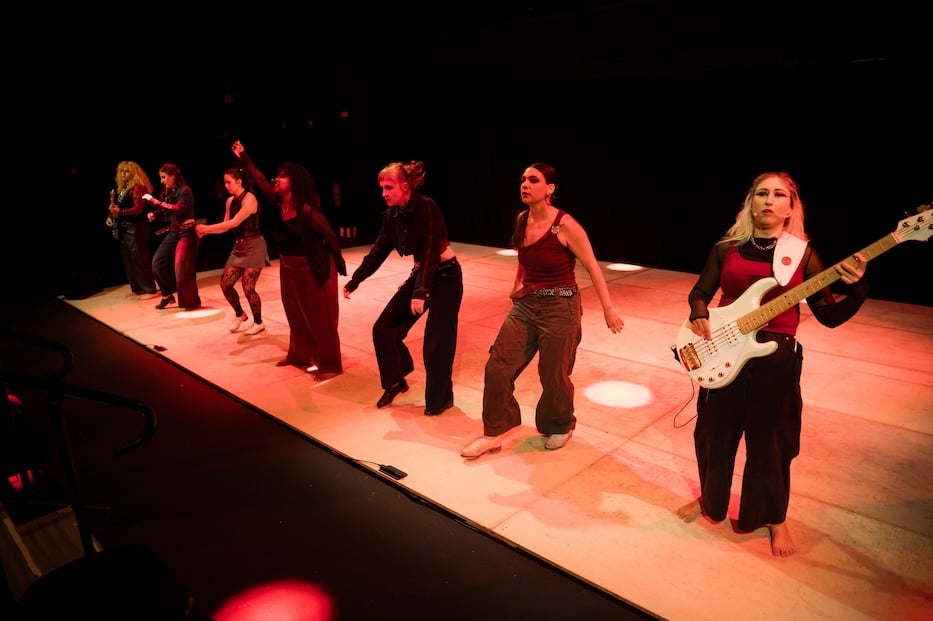
Some of the work’s strongest moments were these vignettes, which gave way to gorgeous, all-in dance and music sequences that showcased cast members’ sheer talent and ability to lock in. In “Good Morning Babylon,” a banger that has Latreece tapping into the fullness of her register, dancers and musicians made their way to the lip of the stage, the air already crackling. With bass thrumming beneath it, Latreece’s voice seemed endless, as if it could fill the space and keep going.
Then, music fell away, and seven voices were the most pressing thing in the room. “And I want you / And I need you / And I’m taken by your ever-loving charms / And I’m depraving you / But I’m ob-sess-ed! by you—” they sang all at once. When the moment ended, their words melted right into a tap routine in which eight feet spoke with a single, insistent voice. In the theater, members of the audience bobbed and breathed in time with the sound.
So too in “Changing Times,” which felt like Robbins had dipped into the history of the Judson Dance Theater and avant-garde composition, and come out with something totally unexpected. Beneath glowing, Elphaba-green light, cast members slowed to a near-glacial pace, movements deliberate, molasses-like and articulated. Latreece pressed into Laet, holding her gently for several beats as the two recharged. Robbins, who often leads with strength and force, reverted to something like the puppet she’d been in the first number.
“In these changing times / Where has humanity gone?” Latreece asked, with a timelessness and grace that was as much about 2026 as it was 1999. Bodies pulled toward each other, each a force field. Echols found their way to the ground, back flush against the sprung floor as they played all the while. At one point, the lights began to rotate, and it was as if the floor had shfted beneath them. “Is it clear?” Robbins’ voice broke through, and the audience could feel the shift into the next number. “Is there a clear view?”
There was and is something distinctly human there, seven artists holding each other up (sometimes literally) for the entirety of the show, and acting out this thing called life in the process. Friday, performers drank water onstage. They didn’t try to hide how hard they were breathing. They held each other, bodies pressing into bodies, arms reaching out and making contact. They flowed through the album, knitting songs together, with both power and panache. They folded in humor and longing, with particularly expressive performances from Gessner and Laet.
They showed, in words that Echols spoke during “How Do You Feel?” that none of these artists were alone—and neither was the audience witnessing their work. As attendees clapped on beat during “Story of an Hour” and again during “Mercy,” a person could see how artists pumped each other up and became storytellers all at once, with faces that contained whole worlds of emotion. By the end, as they broke into a coordinated kind of dance party and then sang in harmony one last time, audience members sprang into a standing ovation.
When she spoke briefly after the performance, Robbins too focused on the times she has given—and received—grace and mercy from the community. To make the performance space possible, producing director and Yale TDPS professor Shilarna Stokes opened up spaces at Yale that Robbins had never had access to. Members of A Broken Umbrella Theatre, and particularly Ryan Gardner, lent the team wireless mics and a key to their storage unit, to make tech that much easier. Robbins, in turn, opened her house to a creative team of nearly two dozen people, and made sure they were fed and cared for.
“It’s so bold and it breaks so many perceived boundaries of tap dance, and contemporary dance, and music,” said Laet before the performance, and the words rang true throughout. “To be in someone’s childhood dream is a very big responsibility, it is a very very big responsibility. I’m truly honored to be in it.”
For more about the Mercy Velvet Project, listen to the interview above or visit Robbins' website.