

Culture & Community | Hamden | Arts & Culture | ConnCORP
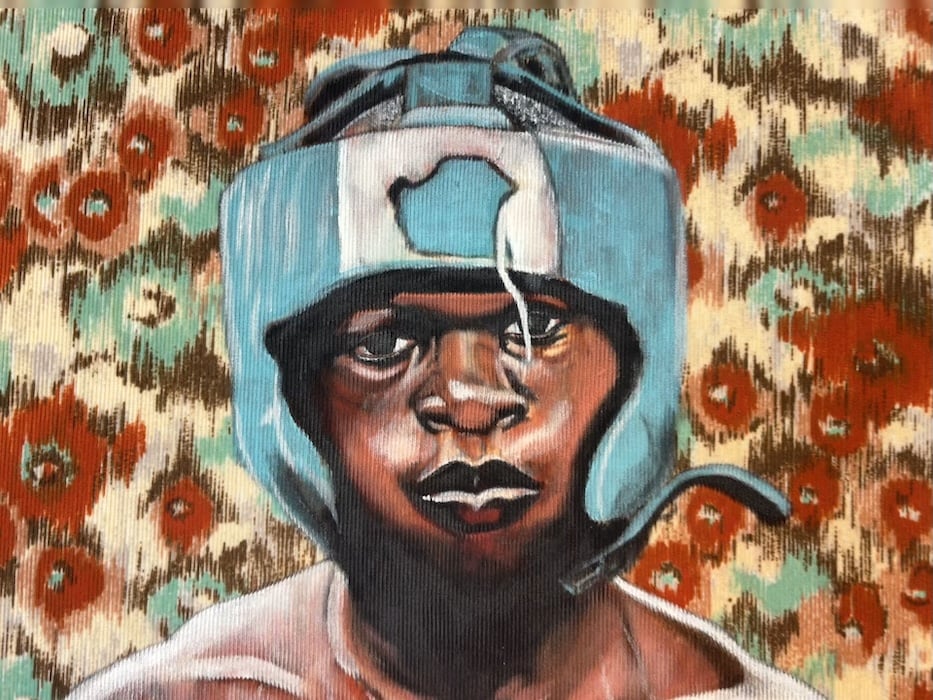
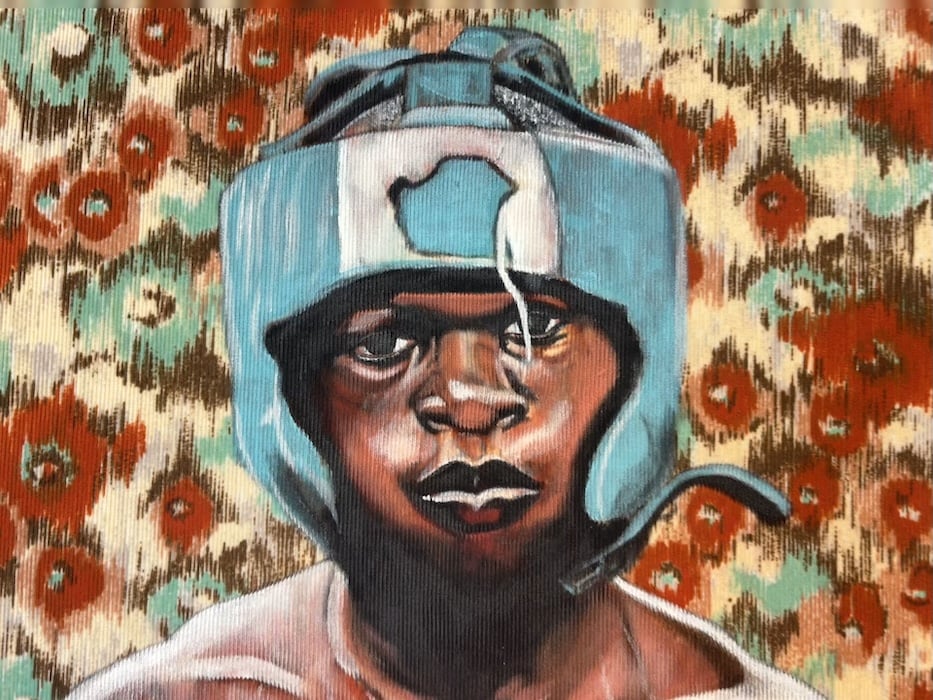
Detail, Call me by my name (Mar-Kees), one of the works by Marquis Brantley Sr. in the show.
Two dark eyes peer out from light blue boxing headgear. They belong to a young man, centrally placed on a wooden stool within a large painting. His gloves are oversized compared to his compact, muscular frame, which is streaked with sweat. The figure’s fixed gaze contrasts with the colorful floral backdrop that engulfs him: rings of burnt umber and teal, marked by vertical striations of dark brown.
Move closer, and you’ll see the soft ribbing of a well-worn fabric that provides the structure of Marquis Brantley Sr.’s acrylic painting, Call me by my name (Mar-Kees). This inventive approach to material forms the central premise of the current two-person exhibition, Between Memory + Matter, which continues through October at Orchid Gallery. The gallery is located in a first-floor hallway in the LAB at ConnCORP, a revitalized school building at 496 Morse St. in Hamden.
Curator nico w. okoro selected Brantley and Alyah Lacombe from an annual open call for Orchid Gallery, now in its third year of presenting work. From these submissions, the resulting exhibitions occupy an unassuming space inside the LAB’s main floor. The shows and their associated programs aim to cultivate the broader arts scene within the community, while specifically supporting regional Black artists and artists of color.
As the title Between Memory + Matter implies, Lacombe and Brantley share a heightened awareness and investment in materiality, though from here, their oeuvres part ways. Brantley mines his personal experiences and family archive, while Lacombe draws from her Haitian heritage. Together, they have sourced a broad range of objects—cheesecloth, burlap, and discarded plastics, for instance. Sometimes the artists layer embedded meanings into the work, while at other times, the connection between the materials and the meaning remains subtle.
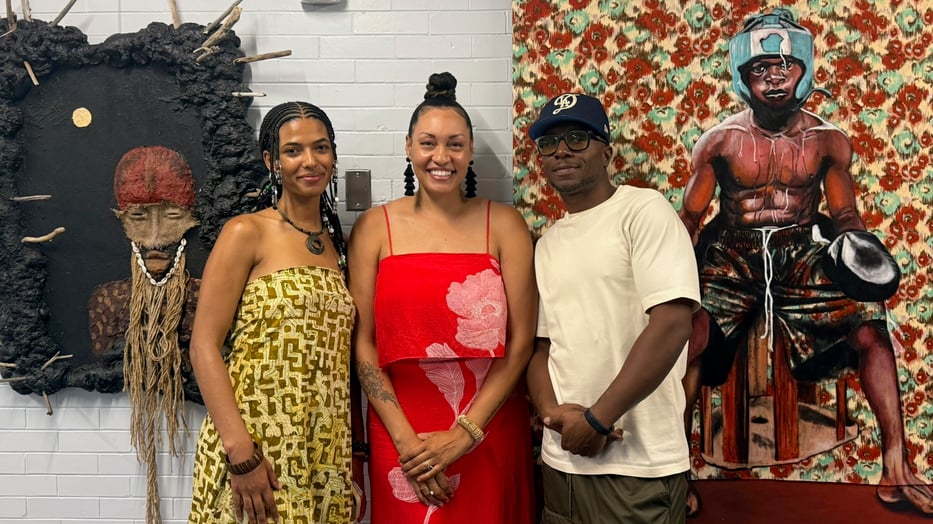
Alyah Lacombe, nico w. okoro, and Marquis Brantley Sr. Image courtesy nico w. okoro.
The surprise of Brantley’s stunning large-scale painting Call me by my name (Mar-Kees)—with its symmetrical composition and naturalistic approach—is its unusual substrate. The bold patterning of the corduroy backdrop at once weaves into and offsets the imagery. The boy’s shorts momentarily seem composed of the same pattern that comprises the background, creating a delightful friction between the actual and imagined forms. With this recognizable texture and its unfussy design, the corduroy adds warmth to the work, imbuing the painting with a sense of familiarity.
Elsewhere in the gallery, Brantley places a figure—also a Black male—within a solid ultramarine background. Marquis Tyrone Brantley, Jr. (my first born) lacks some of the anatomical inaccuracies that plague the aforementioned work—notice how the calves bulge oddly as if overly flexed in the first piece—but there is no sense of play with materials here. The acrylic paint handling appears deft, yet Brantley’s conversation with the found fabric is missed. This work falls short of the curatorial underpinning of the exhibition as well as the nuanced construction of imagery found in Call me by my name (Mar-Kees). This is just a painting, though a good one.
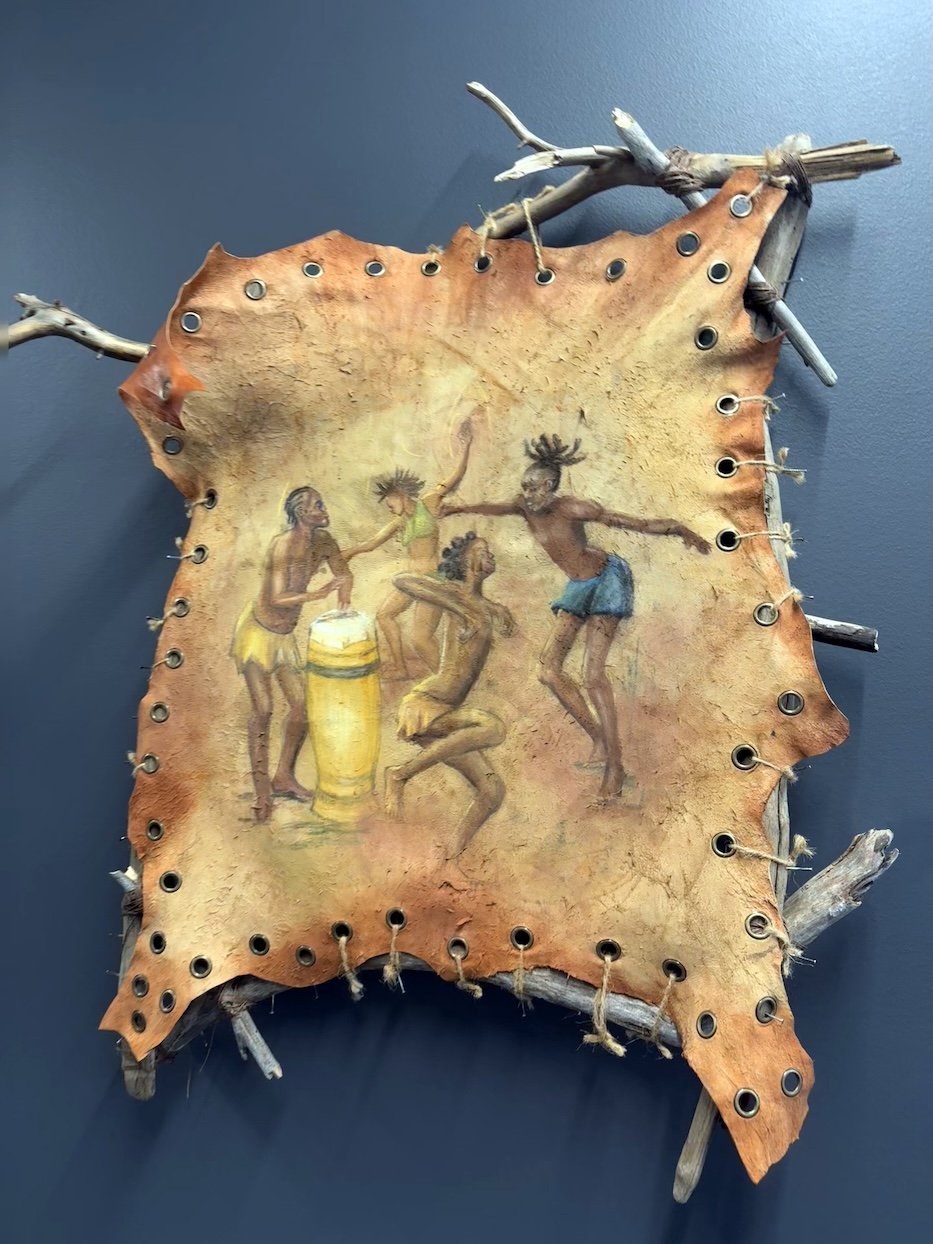
Alyah Denea Lacombe, Sound the drum (2025). Mixed Media (Goat Leather, Pastel, Ghanian soil, Driftwoods).
By contrast, Lacombe picks and adds items to her compositions that further cement her content. For example, two large feathers are a prominent feature of She who Listens to the Trees. A young woman seems to speak to a small bird, with a thin rope wrapped around the edge of the composition, binding them together. The piece depicts a moment of understanding, hearkening back to the sacred connection between women and the environment—an area of interest identified by the artist.
The woman, bare-breasted, and the bird are alone, caught in an almost awkward moment of mutual understanding. Lacombe’s inclusion of natural ingredients hammers home the conceptual framework: natural elements evoke a natural world. Lacombe’s subjects do not feel like they’re from our times. You’ll find here a nostalgia for the kind of embodied knowledge that comes from existing in a way that radically departs from twenty-first-century life.
Reverence for the earth, particularly as conveyed by symbolic ancestral figures, is a recurring theme for Lacombe, and the natural materials become an easy, if not obvious, way to illustrate this. Burlap and clay abound. Wooden sticks perforate the irregular edge of … and the natural. Their points protrude from irregular globs of dark gray paper mache and clay, enclosing the face of a bearded person inspired by the idea of a medicine man. The sticks seem to say, this way of life is fully of the earth.
In another imagined vignette, Sound the Drums portrays several people dancing together around a man playing a large drum. Their movements envision “sound before it’s heard,” according to the artist’s statement. This celebratory scene transmits joy, their collective energy bound within the goat leather surface stretched across a driftwood frame. Both the frame and leather magnify the dynamism of the setting—a consistently additive approach to material and meaning.
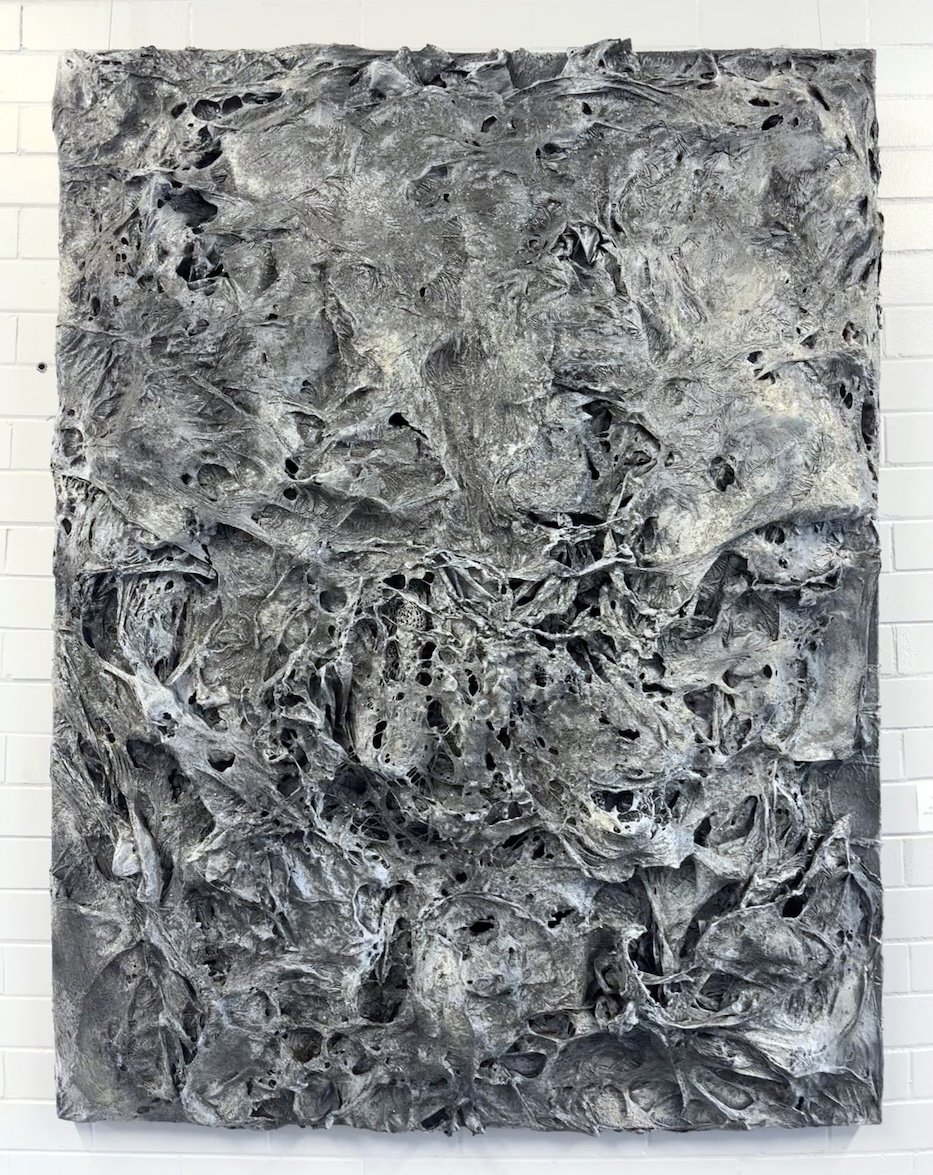
Brantley's Woven By Bones.
A recent series by Brantley also alludes to the natural world, but in this abstract body of work, he strays from the earthy tones and materials that characterize Lacombe’s output. He also abandons the figure that populates some of his other pieces. In its place, Brantley embraces some of the most unnatural substances as a way to conjure the landscape genre. Whereas Lacombe leaves objects as recognizable entities, Brantley disguises his material choices in these newer works, isolating their shapes and textures.
Plastics, sometimes melted, are melded with remnants of other household or industrial items. A spray of paint, with the occasional burst of glitter, blankets all, homogenizing the terrain under a uniform color. The discarded objects become unrecognizable, reduced to textures and volumes. Brantley seems to adopt these materials as a vehicle for considering the toxic and synthetic shape of our contemporary world—a far cry from Lacombe’s earthy admiration of times long past.
In Woven by Bones, a ghostly gray hue covers webs of crusty and crinkled channels. Near the left side of the composition, a soft orange peeks through the dusty coating—was this once a grocery bag? Elsewhere, the webbing of produce packages creates another gossamer layer across this rich topographical landscape. Brantley’s assemblage feels permanent—unmoving and unalive under a heavy plastic encasement.
What lies between memory and matter? In this exhibition, Lacombe leans on the memories or embedded meanings of objects, while Brantley does not employ a singular method to exploit his materials. He seems to be developing and testing various approaches, while Lacombe has a more consistent formula at hand. For both artists, materiality becomes part of a sometimes evolving artistic strategy, elements that can be transformed or receptacles to amplify an existing message.
Between Memory + Matter continues through October at Orchid Gallery, 496 Newhall Street, New Haven.