

Culture & Community | Public art | Arts & Culture | Wooster Square | Cheshire | Lost In New Haven
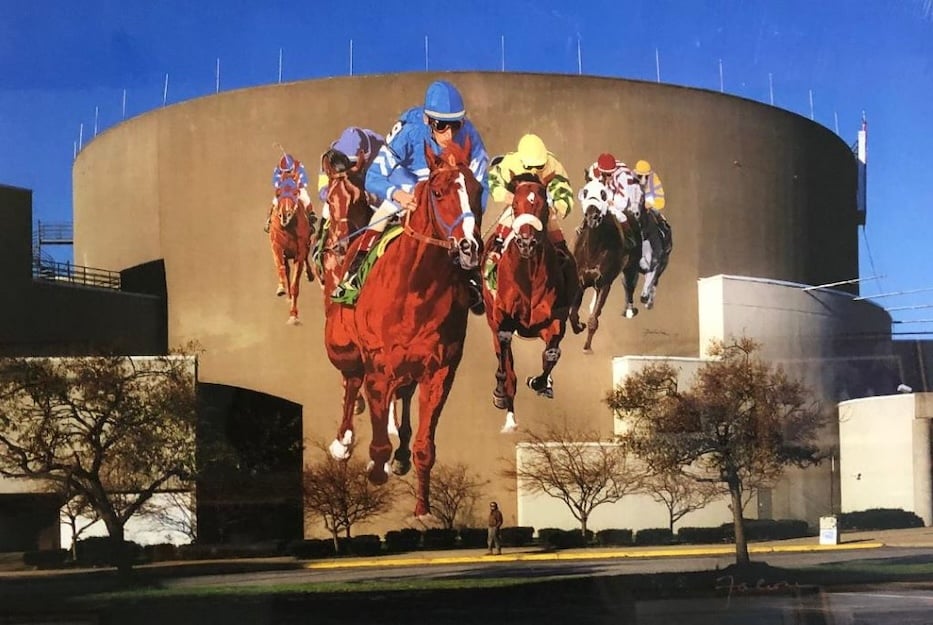
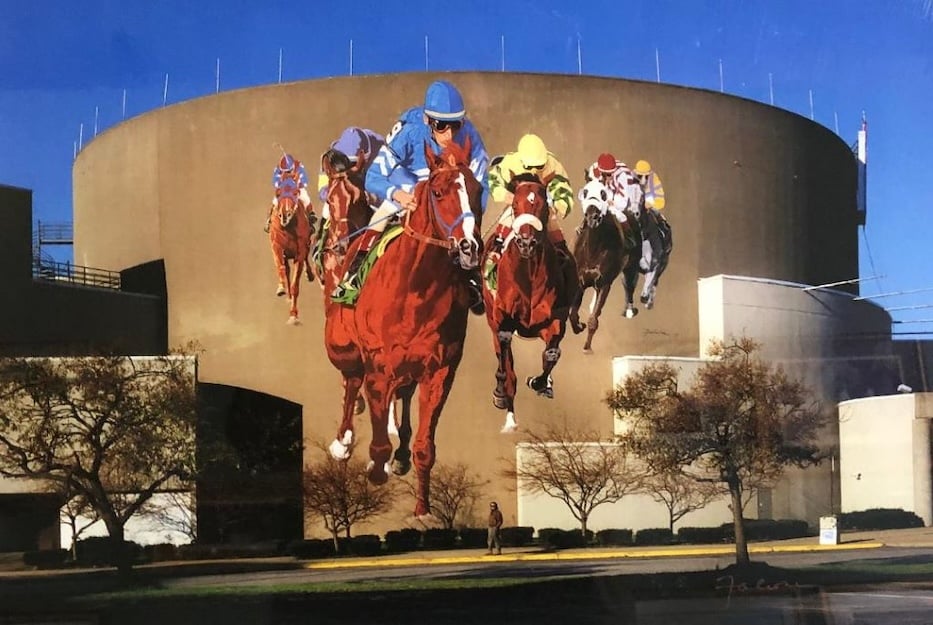
"Fast Track," seen both at Sports Haven (Falcone is that dot at the bottom) and at Lost In New Haven. The first image is courtesy of Tony Falcone; the second is from Lucy Gellman.
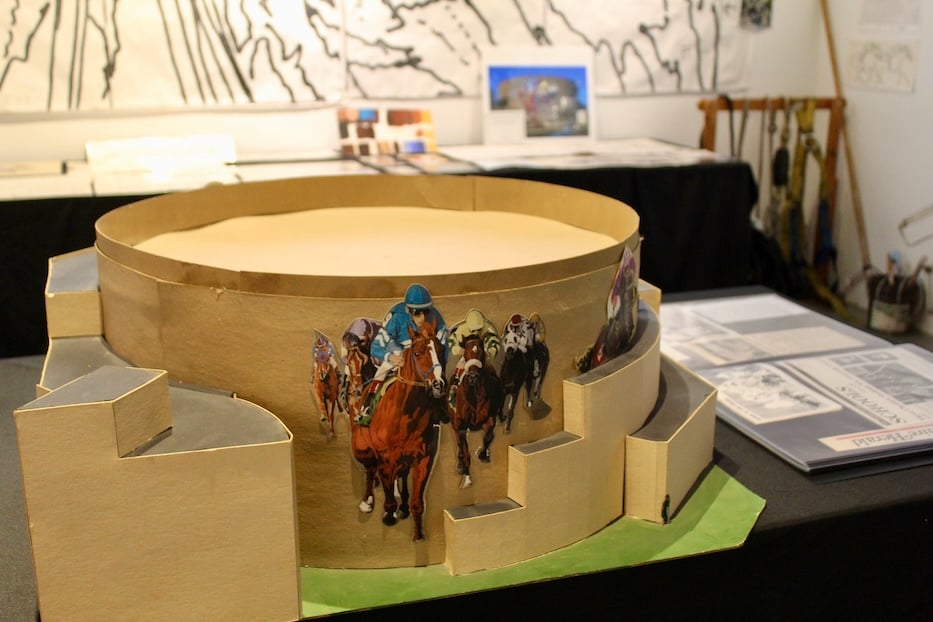
It’s the horses, charging forward with jockeys leaning into their manes, that stop a viewer in their tracks. At the front of the pack, a chestnut-colored steed makes a break for it, eyes glinting and focused on the horizon line. A stripe of white slices down his face, nostrils flaring out on either side. There’s a sense of propulsion here, and it’s nearly impossible not to get caught up in it.
The horses, who wrap around a dollhouse-sized model of the soon-to-be-demolished betting hall Sports Haven, are part of “Fast Track,” a solo exhibition featuring the work of Cheshire-based artist Tony Falcone at Lost In New Haven on 80 Hamilton St. The exhibition tells the story of Falcone’s eponymously named, large-scale and beloved 1995 mural of horse racing that has graced the sides of the drum-shaped building for 30 years.
As they become part of New Haven’s history, curator and community historian Rob Greenberg is working to make sure Falcone gets his well-deserved flowers—and turn a gut-wrenching moment for public art in the city into a teachable opportunity.
A closing reception for the show will be held at Lost In New Haven this Thursday, Aug. 13, at 5 p.m. It follows both on-site teaching in the galleries and a PechaKucha talk that Falcone gave last month; details and more information are available here.
“This woke up a lot of feelings, and as I’m looking at a lot of my murals, I’m thinking about them possibilities for doing something new,” Falcone said of the show, which shows off both his process and many of the materials and supports that he used to make the 90-by-70 foot mural become a reality. “Creating shows around that so people can start getting excited about the murals all over again.”
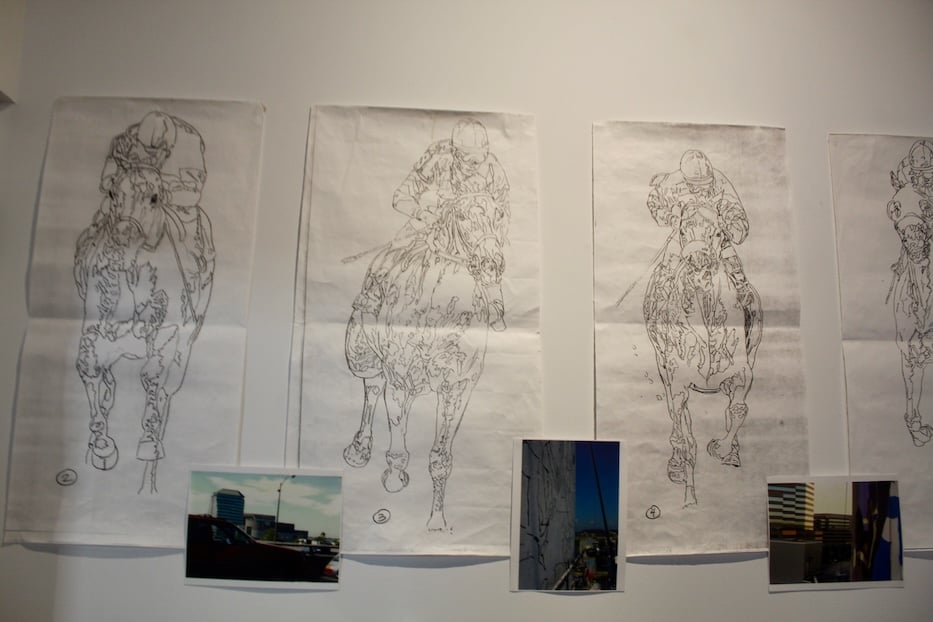
In the exhibition. Lucy Gellman Photos.
The story of the exhibition, in many ways, begins not this or last year but in the early 1970s, when Falcone made a leap into public art. Born in New Haven’s Hill neighborhood and raised primarily in Bethany, he had never planned on being an artist, he said. Instead, he was working as a pool director and lifeguard when a colleague mentioned to him that his doodles were good.
Falcone had never thought of his drawings as more than that. But the colleague, an art teacher named Dan Daddona, went on to start talking about murals, which piqued Falcone’s attention (“I remember saying, ‘What’s a mural?!’” he said with a laugh). In 1974, he tried his hand at one with Daddona, “and I was hooked.”
By then, Falcone was working as a firefighter, which he did until 1977 as a way to bring in a steady income and support his family. Then that year, he worked on “La Aquariata,” a 10,000-square-foot aquatic mural at the Cinemart Theater in the Hamden Plaza that showed an underwater seascape from four different points of view.
That was it. Falcone and Daddona “made a vow” to become full-time artists, a plan that started slowly because the economy went belly up in the early 1980s. From their new studio in Prospect, the two ran a program teaching youth to paint houses. Then as the economy began to improve, they returned to collaborative projects. At some point, Daddona moved to Florida, where he still lives today.
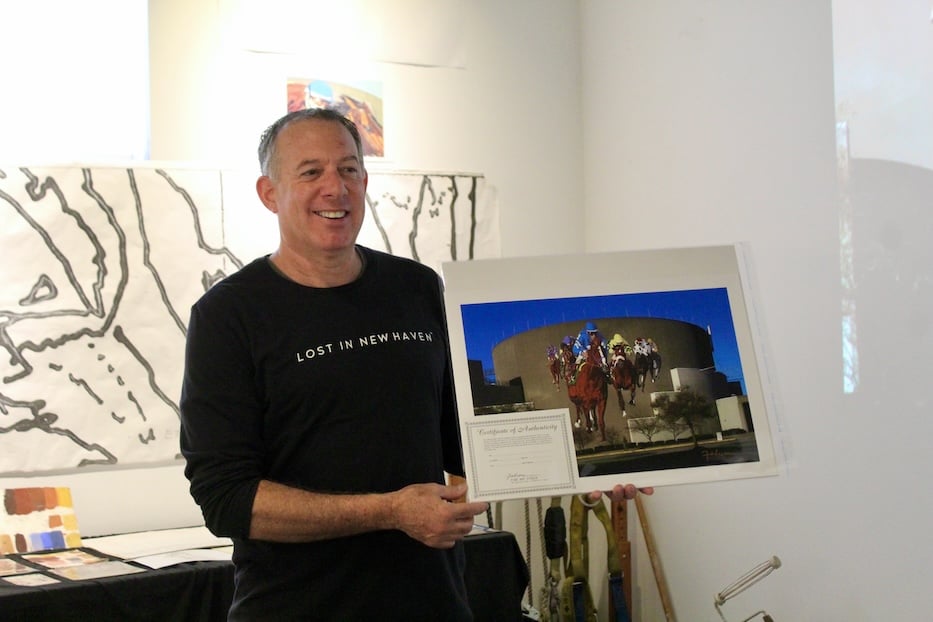
Greenberg with a print of Falcone at the mural site. Lucy Gellman Photos.
In the 1990s, Falcone’s work led him to Sports Haven, which had opened as a theater in 1979 and then was remodeled to specialize in what’s called off track betting. When he began to talk to executive leadership about a mural, he had a pastoral scene in mind. Over multiple conversations, it became clear that wasn’t going to happen—but that a mural still could.
“I really was proposing mares with foals and scenes splashing around,” he said, the smile audible in his voice. “And they looked at me and they said, ‘Tony, we want jockeys. We want silks.”
That the design was unlike anything Falcone had ever done didn’t phase him: his two decades of work as an “accidental artist” had prepared him for such a project. From his studio in Cheshire—Falcone and Andrews live in an eighteenth-century home in the town—he started drafting a design that placed brightly-clad jockeys atop galloping horses, their bodies angled forward so that it seemed they were charging right out of the frame.
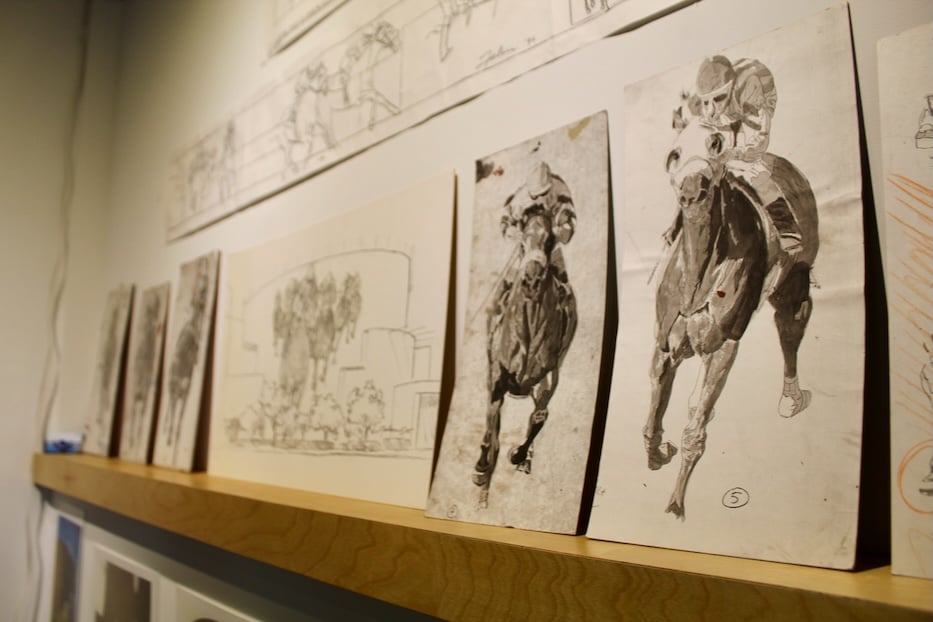
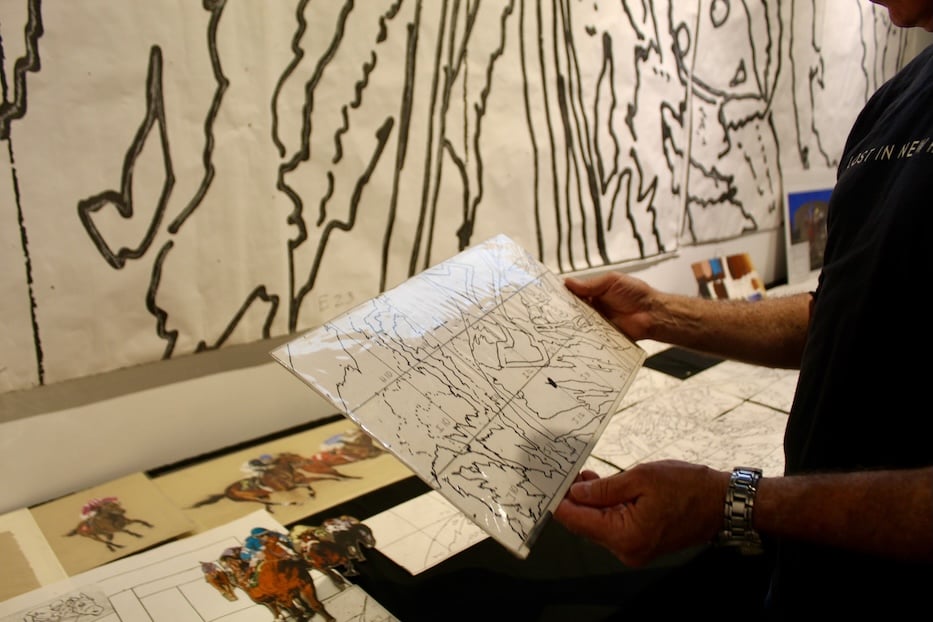
Through his research, Falcone drafted drawings on drawings of horse racing, starting small and scaling up until he had planned out a gridded design. He learned that he would need to import a special type of paint called potassium silicate, which bonds to porous surfaces like the one that covered the Sports Haven building.
Because “Fast Track” was such a large project—the first six horses are about 90 feet by 70 feet—he was meticulous in creating an image to scale, and then mapping everything out to the square inch. If he made even one mistake, he recalled, the whole design could get upended. He ultimately spent a month in the studio and a month on location.
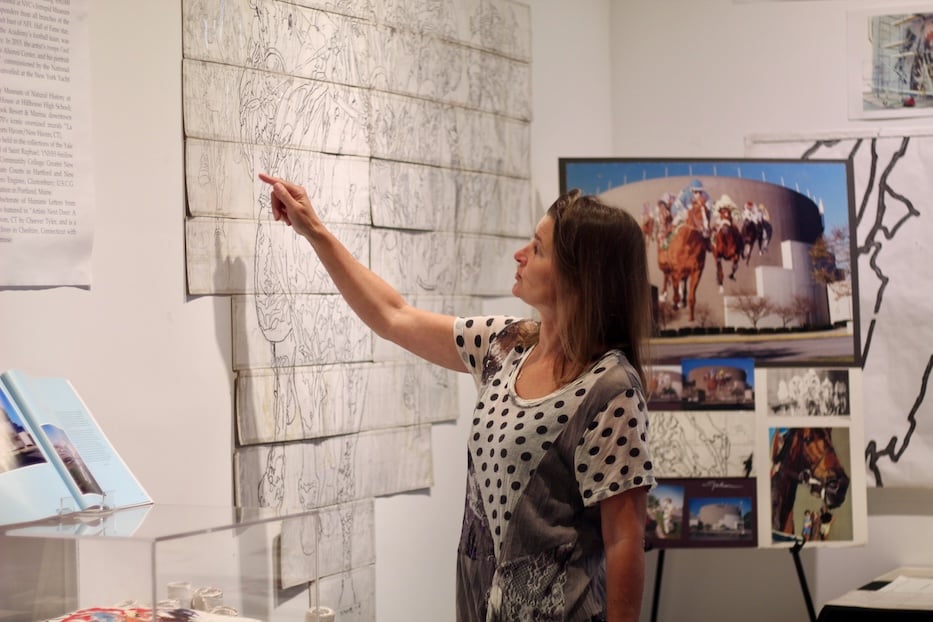
Smelser with one of the gridded images that made Falcone's work possible.
“I had to map the painting out with a grid system,” he remembered, joking that he often felt “like Spiderman” at the site, hanging from a safety harness as he worked. “I had to number each box of the grid, which it was and what column it was in. I’m literally having to look at a map [as I’m painting]. Because when you’re so close, it just looks like India or Africa.”
When Falcone finished the east wall of the building—that’s part of the iconic race image that people can see from I-95—he received a second commission for the north wall, with a horse that looked as though it was barreling toward the finish line. After that, he said, the betting hall changed hands, and new leadership was less interested in public art.
Even after the project was done, Falcone found himself delighted each time he saw it from I-95. In the years since that mural appeared, his name has become inseparable with the story of public art in, and often about, New Haven. The mural remains one of his favorite projects.
“When I’m driving through New Haven, I always feel like I’m driving through my paintings,” he said. “And when I’m looking at Sports Haven, there’s a sense of awe. It gets my juices going again.”
So he was devastated when, last year, he learned that the building was going to come down, meaning that the mural would come down with it. It’s not the first of his artworks to be lost to history; that’s happened many times over. But it didn’t make the news any easier to receive.
Enter Lost In New Haven, which has become a museum of New Haven history, told through thousands of its objects. While the museum’s 80 Hamilton St. site is still relatively new (previous homes for the collection include the old ACME Furniture building, may her memory be a blessing, and Reclamation Lumber on Grand Avenue), the collection is not—which means that Greenberg has been keeping his finger on the pulse of New Haven for decades.
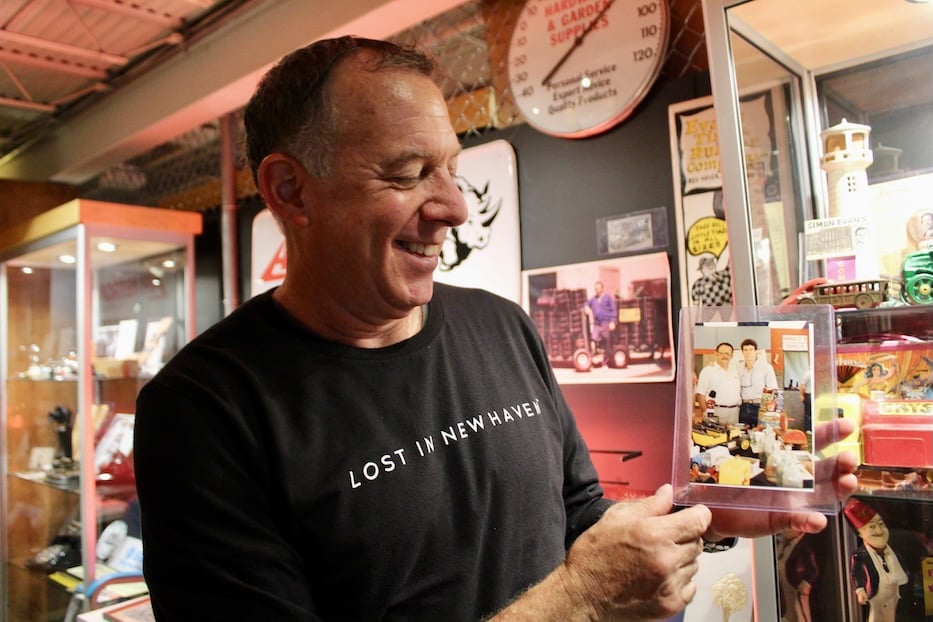
Greenberg in the museum with a photo of his grandfather, who was the inspiration for his vast collection.
When Greenberg heard that the betting hall would be coming down last year, he could feel the grief in the wider cultural community. “There were a lot of people calling me, asking, ‘How could we save the mural?’” he remembered. So he reached out to Robert Dillon, a building official for the city’s Office of Building Inspection & Enforcement, and started asking if it was possible to get a fragment of the mural.
“It’s like Pompeii,” he said. He explained that saving the mural in its entirety was and is unlikely, due to its sheer size. But a piece or pieces of the mural seemed entirely more reasonable.
He also talked to a disheartened Falcone, and floated the idea of an exhibition around the immense artistic labor that had gone into “Fast Track.” With Sound School teacher Steff Smelser, who is Lost In New Haven’s curriculum director, Greenberg began talking about a time that Falcone could talk to students about the work, and the strong elements of STEAM (Science, Technology, Engineering, Arts & Math) woven into every step of his process.
“What we want is for students to really understand the creative process,” Greenberg said. At Lost In New Haven, that’s part of a wider mission to teach young people about New Haven history, STEAM education, and museological practice while also giving them a professional space to exhibit their work.
Even in the past half year, he and Smelser have practiced what they preach, with performances from the Monk Youth Jazz & STEAM Collective and students from the ACES Educational Center for the Arts (ECA), and an exhibition from students at The Sound School.
Falcone loved that vision. On a recent visit with students, he spoke candidly about his process, which forced him to get over a long-held hatred for and skepticism of math through the process of mapping out every piece of the work. “And I had to use science!” he remembered telling them with a laugh.
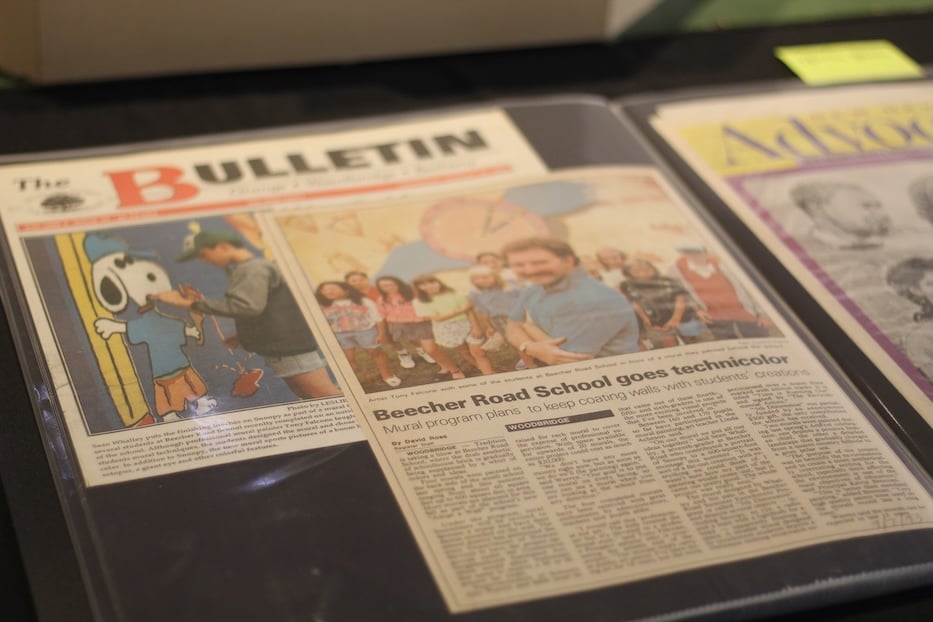
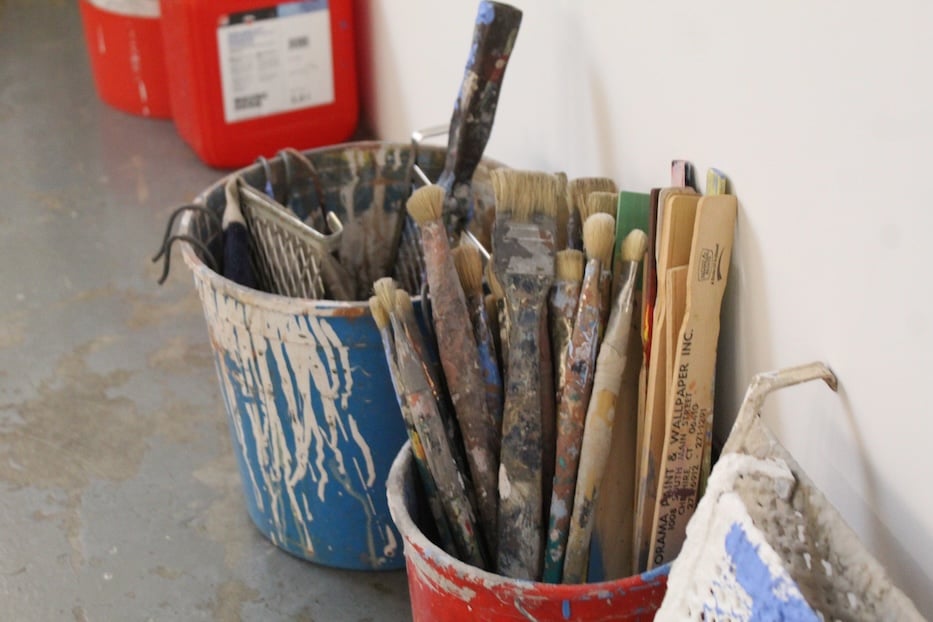
On a visit to the exhibition last week, that attention to process was palpable, from preliminary drawings of the horses and jockeys to newspaper cut-outs lovingly arranged in a binder at the center of the gallery. On one end of the room, a large bucket of paintbrushes sat beside a rack with safety harnesses, immediately making the act of painting feel more real.
On the other, around a wall text explaining the show, a viewer could get close to pencil drawings that Falcone had worked on, then magnified to map out where each daub of paint could be accounted for. In between then, propped up on a table at the back of the room, a long strip of drawings became the eye of a horse, hard to decipher from up close.
Going forward, Greenberg said he hopes to continue working with Falcone, including on a Water Street mural that can give people a sense of the land when much of it was still water in the 1800s. In recent years, he’s been working on an excavation project at the site, where Benedict Arnold’s home once stood. That kind of public artwork makes a city sing—and lets people know that they’re in a city that invests in its art and artists.
It’s also a reason that he’ll miss “Fast Track” in the years to come.
“What happens [with public art] is it enriches all of New Haven,” he said. “When you’re looking at it [‘Fast Track’] from I-95, you recognize the talent in New Haven. It’s coming back around.”