

Co-Op High School | Culture & Community | Education & Youth | Music | Arts & Culture | New Haven Public Schools | Metropolitan Business Academy
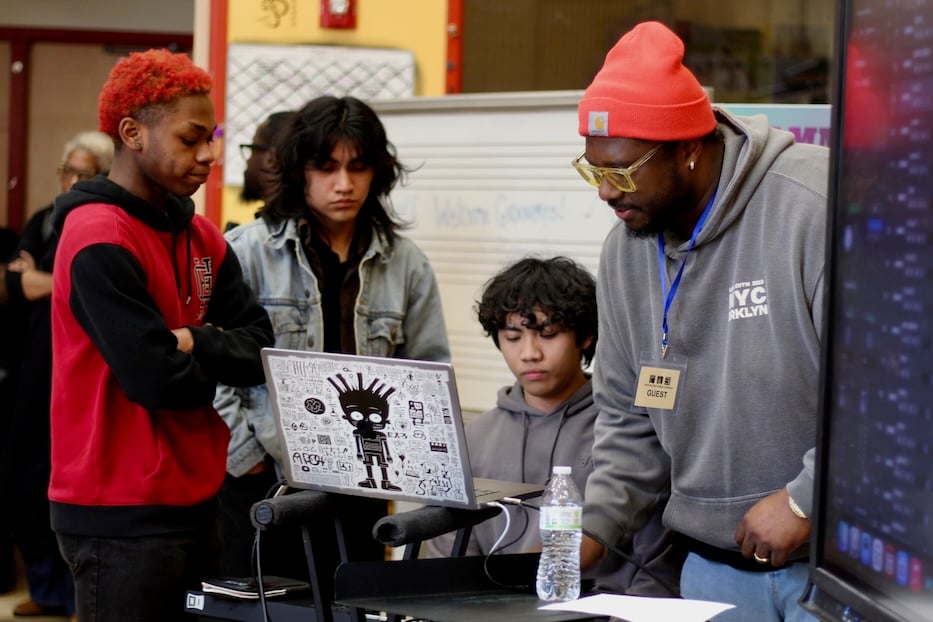
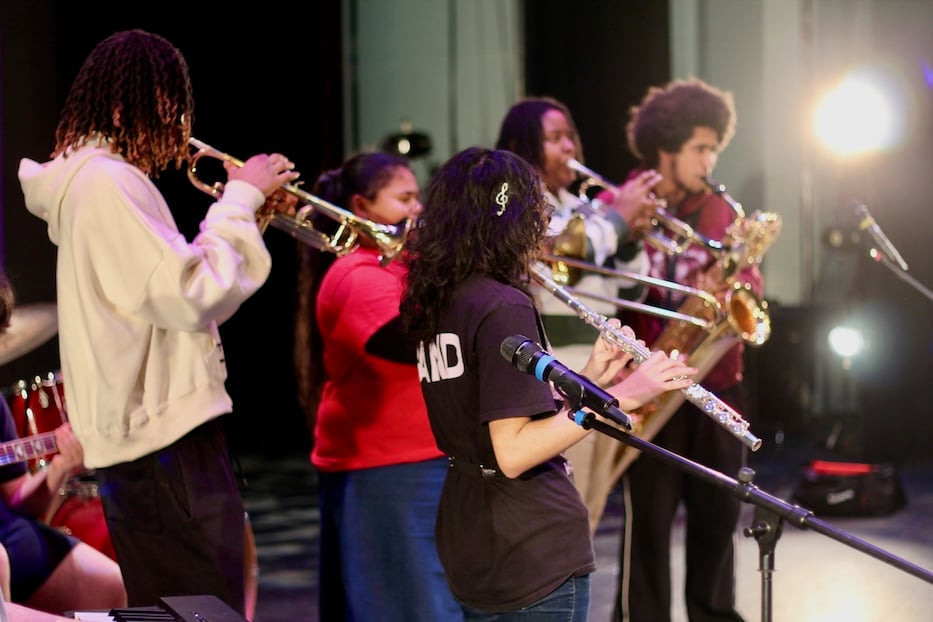
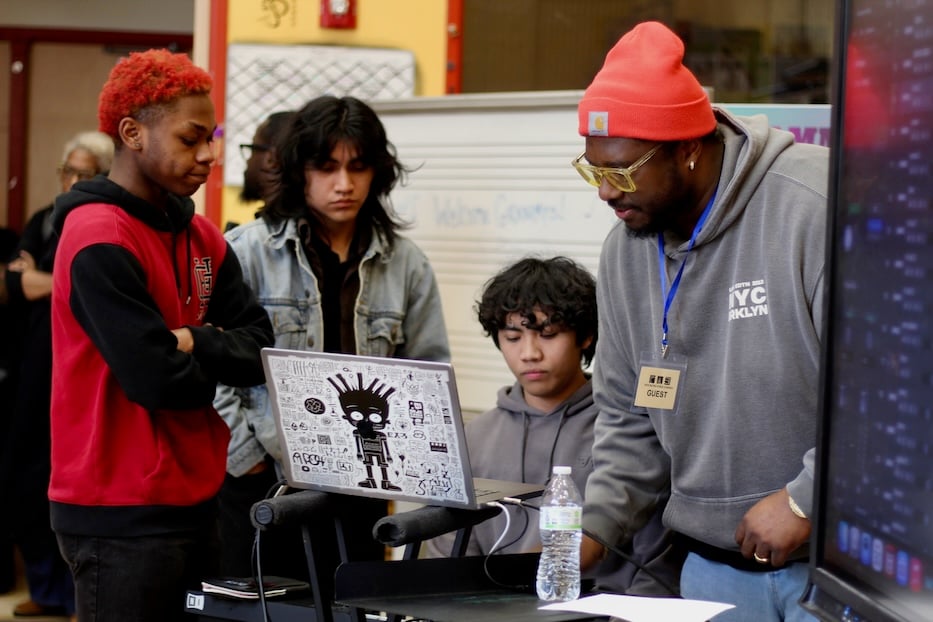
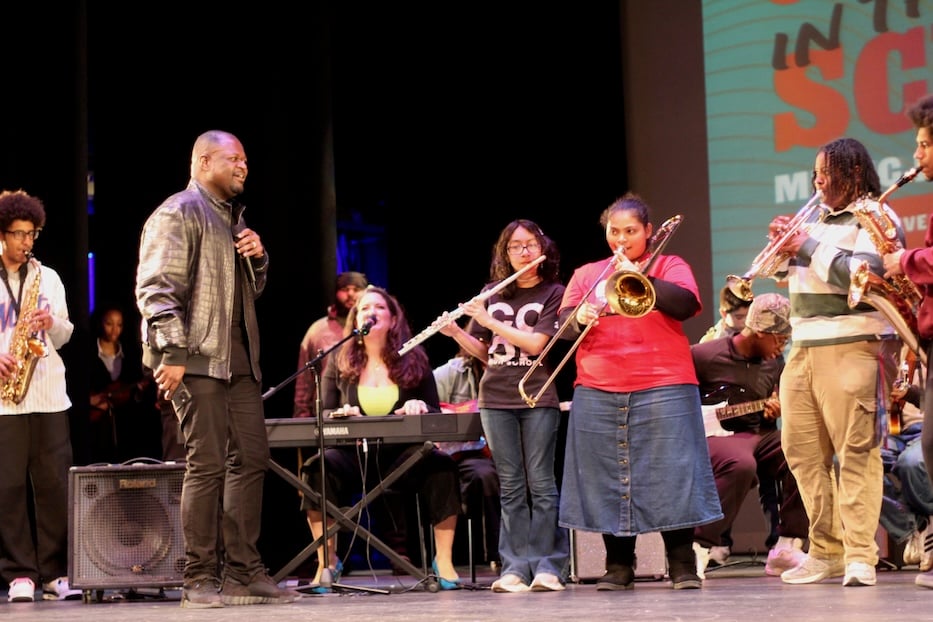
Top: Christian Lawrence with fellow students and Swagg. Bottom: NHPS students from across the district's nine high schools join Nicole Zuraitis for a jam session. Lucy Gellman Photos.
The metronome was already going, strong and steady as it soared through the room, when Christian Lawrence sat down at the keyboard and looked instantly at home. Still in her seat, Caitlin Curtin puzzled over lines of text, turning them over in her head as she tried to build lyrics. Back on the keys, Lawrence found a beat, and leaned in as if he was praying.
“Yeah,” said D. Arcelious Harris, a Grammy-winning producer and educator better known as Swagg. “We’re gonna lay that down.”
Lawrence is a senior at Metropolitan Business Academy, and aspiring producer who has been making music since he was seven years old. Curtin is a senior at Engineering and Science University Magnet School (ESUMS), where she rarely gets to make music during the school day.
Last week, their worlds collided at Cooperative Arts & Humanities High School, as the New Haven Public Schools (NHPS), GRAMMY Museum and Recording Academy came together for the inaugural “GRAMMY In The Schools Music Industry Career Day.” The brainchild of veteran educator Pat Smith, who “retired” from Co-Op last June and then became the coordinator of fine arts for the New Haven Public Schools, it laid the foundation for future arts collaborations across the district. Roughly 150 high school students, from all nine high schools in the district, attended.
“I feel a lot of gratitude,” said Smith, who taught band at Co-Op from 1998 to 2025, and left last summer alongside beloved educator Harriett Alfred. “The scope of this has started to sink in, and it’s really the manifestation of a dream.”
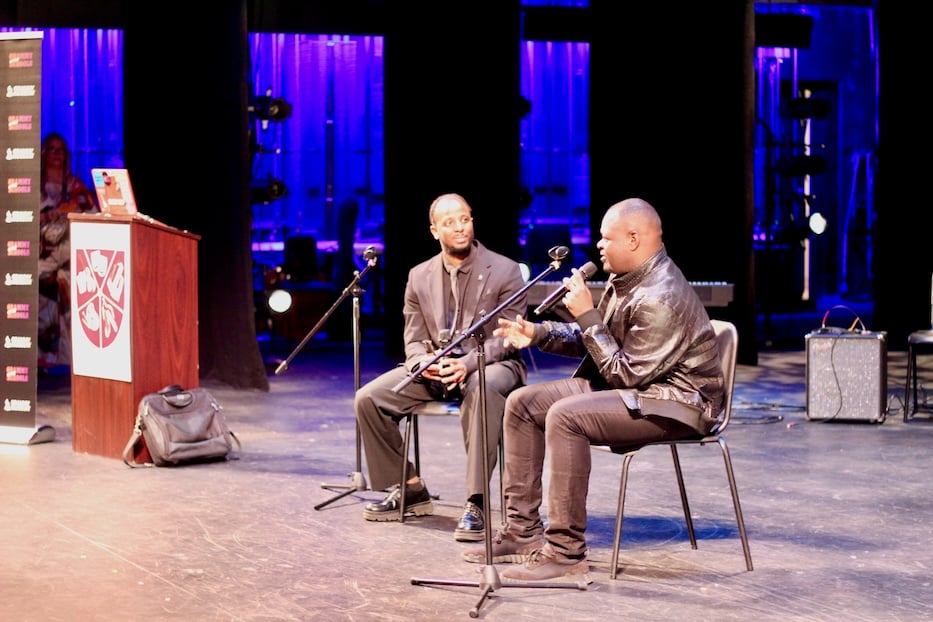
Jason "Poo Bear" Boyd, who spoke to students about his own beginnings in New Haven.
The program has been years in the making, he added. In 2017, Smith (and Co-Op) won the Grammy Signature School Community Award, in what became his introduction to the GRAMMY Museum and Recording Academy. Then in 2022, he was nominated for the GRAMMY Music Educator Award, for which he was ultimately named a semifinalist. Just two months later, he was back with “The Creator’s Classroom: Student Spark,” a day of professional development for educators across the district.
The industry career day was the first iteration of a student version of that, he explained. In addition to GRAMMY-winning artists and producers who led the workshop, the day featured panels from artists Jason “Poo Bear” Boyd, who grew up in New Haven, and musician Nicole Zuraitis, who won her first Grammy in 2024. It ended with a jazz jam session with students from nine different NHPS high schools, playing nearly two dozen instruments as Zuraitis held it down on the mic.
When the day arrived last week, Smith’s vision came vibrantly to life, thanks to both GRAMMY collaboration and fellow NHPS arts coordinators Ingrid Schaeffer and Kim Weston. Holly Maxson, who is the district’s supervisor of fine arts, was also present; in the past year, she has helped increase artistic collaboration across the district.
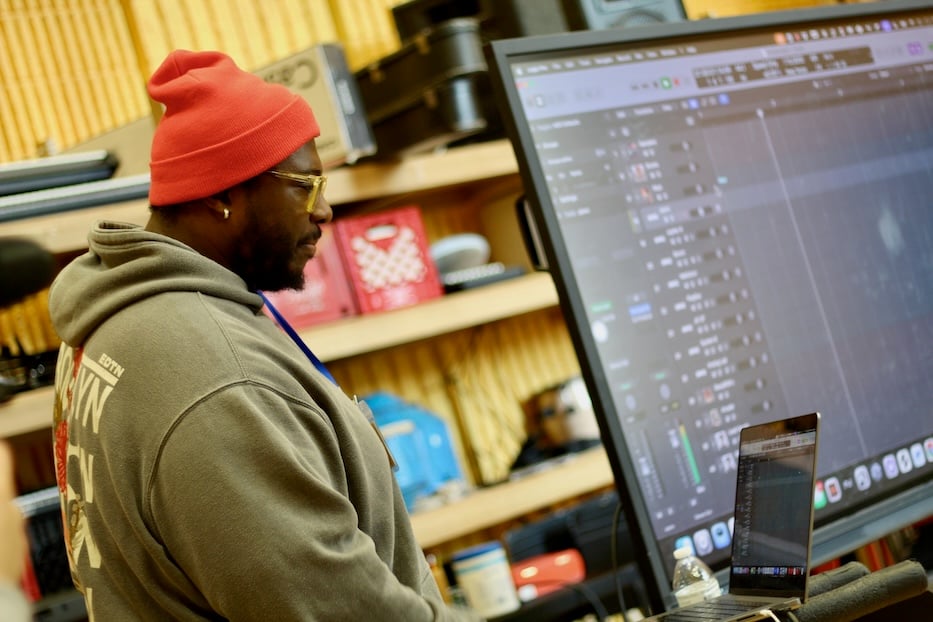
Inside Christine Dominguez’ second-floor band room, New York-based producers Swagg and Riggs Morales (or simply Riggs, as he said to students) handed out sheets of paper, on which they asked students to write a potential song title, and then four words related to that same song title.
“Think about the emotion, the feeling, relatability—most of the songs that you guys love, there’s something relatable about it,” Riggs said. “Who would want to drop a grenade for you—” he took maybe half a beat for students to register the Bruno Mars lyric and dropped his voice to close to a whisper. “Yeah yeah yeah.”
“Great song,” chimed in Swagg, who has worked with dozens of artists including Baby Face, J Que Smith, and Tony Dixion to Tiara Thomas, Juke Box, and Dawn Richards. “I wish I wrote that song.”
“As a songwriter, it’s my job to communicate and try to convey a song that you feel, a thought,” he added. “I want to communicate a thought and I want you to feel it, right? As a producer, I build context around that thought. It’s the vehicle in which that thought moves. Right?”
In the fourth row, where young musicians usually spend their mornings poring over sheet music, Metropolitan Business Academy junior Delylah Banores looked over her page, parsing out sports terminology that might translate to a love song. Three years ago, during a socially difficult freshman year, Banores “started writing poetry instead of bottling it up,” she said. She hasn’t stopped since—which made Monday’s assignment feel natural.
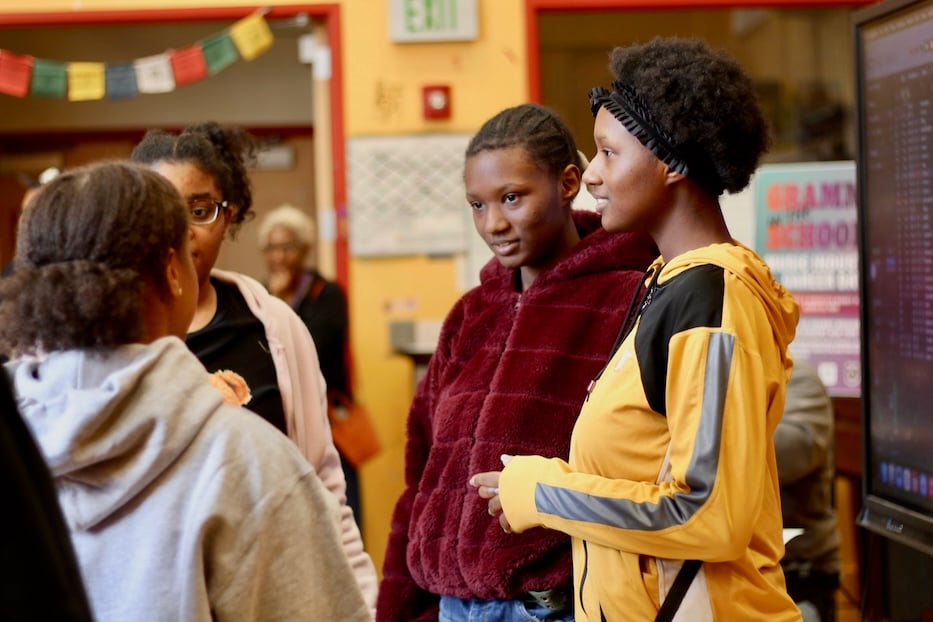
From the words on the page, she started cobbling tougher sentences, listening to other students think through words that ranged from crush and universal to alegría, the Spanish translation for joy.
“Keyboard? Any keyboard players? Can you raise your hand?,” Riggs said, interrupting her train of thought. On a large screen at the front of the classroom, Swagg had pulled up a blank file in Logic Pro, a platform that songwriters, podcasters and producers often use as they are working through tracks (FL Studio, Cubase, and Pro Tools are other personal favorites, he said). “Drums? Is there a Mike Will in the house?”
From where he sat toward the back of the room, Lawrence hopped out of his seat, as if he had been waiting for this moment. In a flash, he was at the keys, sounding out a beat over the thump and click of a metronome that came from somewhere inside the program.
He lowered his head toward the keyboard, cocking it just slightly to the side, so that one ear hovered close to his hand. His hair, dyed a hydrant-colored red that was fading into orange, added a pop of color to the space.
“Let’s go a little bit slower,” Swagg said, adding space to count him in. “I like the groove.”
Around the room, a few students scribbled more words onto their pages, some handing the papers over to Riggs for his approval. “Mold me entire!” Riggs read with glee. “Cathartic!” “Bacon, egg and cheese? Oh, someone’s hungry.”
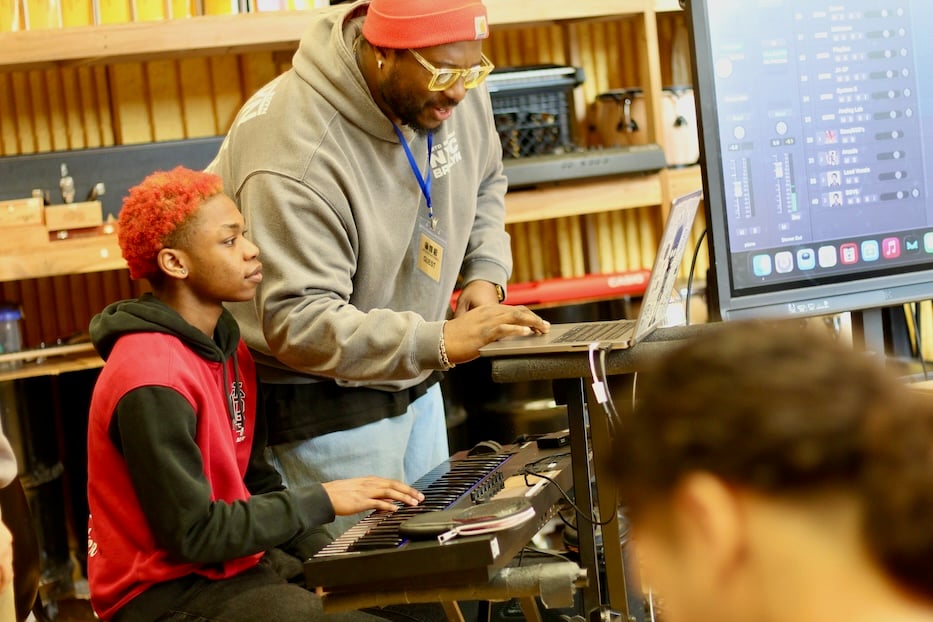
Back at the keys, Swagg moved Lawrence from the beginnings of a track to what he calls a “sonic composition”—a lush soundscape that blooms around an idea, and then a hook. Lawrence, who has been making and producing music since he was seven and plans to study production at Western Connecticut State University in the fall, nodded along appreciatively.
“I feel like music makes me get in touch with my emotions,” he said later in the session. “Honestly, every time I have a paper and pencil, I’m writing.”
For the moment, all of his attention rested on Swagg.
“We got a dope melody here, we got a cool loop going, how can we make this—” Swagg paused for a moment as Lawrence’s notes floated across the room, eliciting a few Mmmmmms from classmates. “Feels even more special. Let’s move it outside of the piano, and think of something cooler, a synth or something, right? But let’s first build up the parts and then we can play around with a different sound.”
Lawrence, rising from the keyboard, headed over to a drumset sitting empty across the room. From the front and second rows, ESUMS senior Adina Salahuddin and Metro freshmen Rachel and Anna Gorham headed over to the piano, still thinking through lyrics. Across Rachel’s page, she had scribbled the words I need your love, a thought interrupted halfway. A beat later, maybe two, Curtin was in the mix.
The four, making a circle close to the drums, began to sway to the sound that Lawrence had laid down, now transformed into a synthy echo of itself. Dah-duh-dug, dah-duh-duh, ventured Rachel, as Anna suggested she could bring it up an octave, her finger pointed momentarily towards the ceiling. Salahuddin, who has been honing her vocal skills alongside the violin at Music Haven, joined in. Soon,
Curtin had brought out her phone—a supposed rarity for a school day—and was singing along:
Come on, don’t let it take me, break it
Leave me hopeless
I know you see me baby rocking out of focus
I’m trying, But you’re lying
Can’t be in your world if you’re hopeless
‘Cause you’re not hoping for me—
Riggs checked the time, surprised that only about a minute remained. With the skill and grace of a seasoned teacher, he brought the room back to attention.
“Guys, please,” he started. “Whatever you do, you have to stay with it. Because at some point, you will hit a wall. And on the other side of that wall, there is a breakthrough.”
“I think there’s power in giving young people permission to dream,” Swagg added as the room emptied out, and both he and Riggs headed back down to the auditorium for a panel and jam session with Zuraitis. Growing up in small-town Georgia, it was the church that gave him that permission. Now, he tries to do that for the young people he works with. “Connection starts horizontally.”
“It’s Ok If Your Journey Is Squiggly”
That permission to dream—even and maybe especially when things are going very, very badly—flowed through a discussion from Zuraitis and Nikisha Bailey, a professor at Drexel University who is also an audio engineer, educator and entrepreneur. As they took a seat on the stage, Zuraitis wound back the clock to her youth in Waterbury, where she excelled in sports, but never felt a strong sense of camaraderie.
That changed when she walked into a band classroom for the first time, and picked up a trombone. “The only place where I felt like I had my people was in band,” Zuraitis said, with a smooth, sultry voice that a person could hear the musicality in, even as she spoke. From the auditorium’s fourth row, Co-Op student Rachel Collins hoisted her trombone into the air and squealed.
“It was definitely a marathon, and not a sprint,” she added of her slow and sometimes uncertain journey into the jazz spotlight. After falling in love with the trombone, Zuraitis studied at Litchfield Jazz Camp—a program from Litchfield Performing Arts that is very much still in operation—and then went on to pursue voice at New York University and Louisiana State University. But when she moved to New York over 15 years ago, she hit a little bit of a wall.
For years, she remembered, she (and soon her partner, fellow musician and big band leader Dan Pugach) were hustling, cobbling together gigs to make ends meet while also recording albums, playing at jazz clubs, and trying to get their name out there through competitions and festivals. It was exhausting, she remembered. At one point, she and Pugach played two weddings in a single weekend, and then she performed over a track five nights a week at a restaurant in New York City.
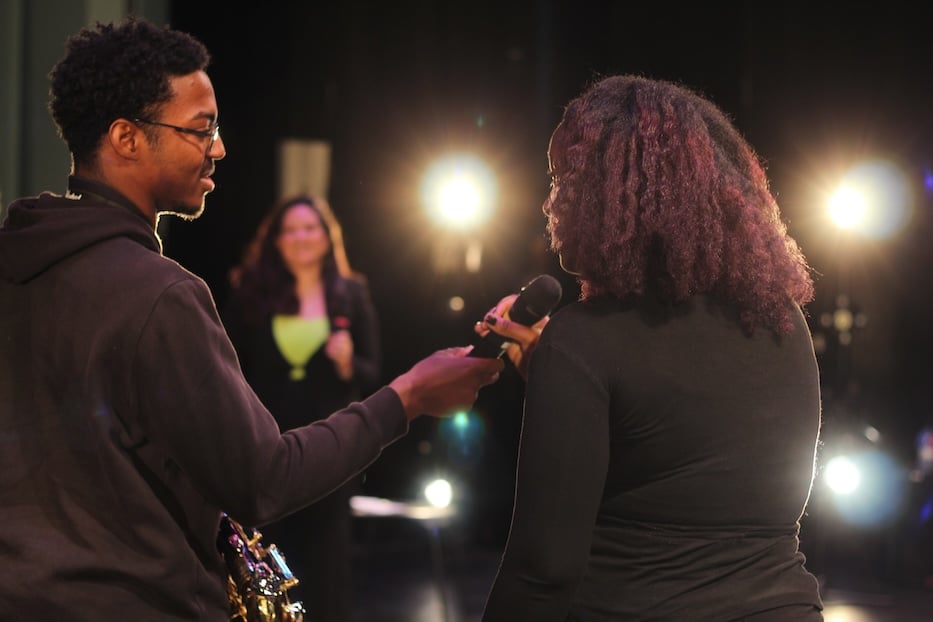
Dontae James, a senior at Wilbur Cross High School, hands the mic to vocalist Nadia Okwuosa, a senior at Co-Op.
“I called it the cave of depression because it was dark and people were hammered and everyone was talking over me,” she said to a few uneasy-but-knowing laughs from the audience, including the music educators in the room. In other words, “We almost did kind of give up.” And then, miraculously, they rallied.
In 2017, a friend recommended that she join The Recording Academy, a piece of advice that changed her life. That year, she and Pugach submitted an arrangement of Dolly Parton’s “Jolene” for which they garnered a Grammy nomination. Then two years ago, in 2024, she won her first Grammy for her album How Love Begins, the first of two awards she would win in as many years from the Recording Academy.
“Sometimes, you just need a little bit of a boost to think, ‘You can do this,’” she said.
She added that rising in one’s field—particularly as the live and performing arts are forced to compete with the ease and comfort of everything from streaming to artificial intelligence—takes time and patience. She remembered meeting the bassist Christian McBride, with whom she has since collaborated, several years ago. It wasn’t until 2021 that she asked him to work with her, on the album that became How Love Begins.
Back in the audience, Curtin listened intently. Since the time “I was itty bitty,” she’s loved music, from OG Lady Gaga and vintage Queen to a cabaret performance of RENT that gave her the musical theater bug. But at ESUMS, where she is finishing her senior year, she rarely gets the chance to make music with her peers. This opened a new world.
“You have to wait sometimes,” Zuraitis said before she opened the stage to a jam session from different high schools across the district, with young jazz phenoms like Dontae James and Nadia Okwuosa sharing a stage for the first time (Okwuosa also blessed the audience with an original song, the video for which is at the bottom of this article). “You have to wait it out and keep building your craft. … it’s ok if your journey is squiggly, and not a straight line.”