

Culture & Community | Dixwell | International Festival of Arts & Ideas | Arts & Culture | Elm City Freddy Fixer Parade
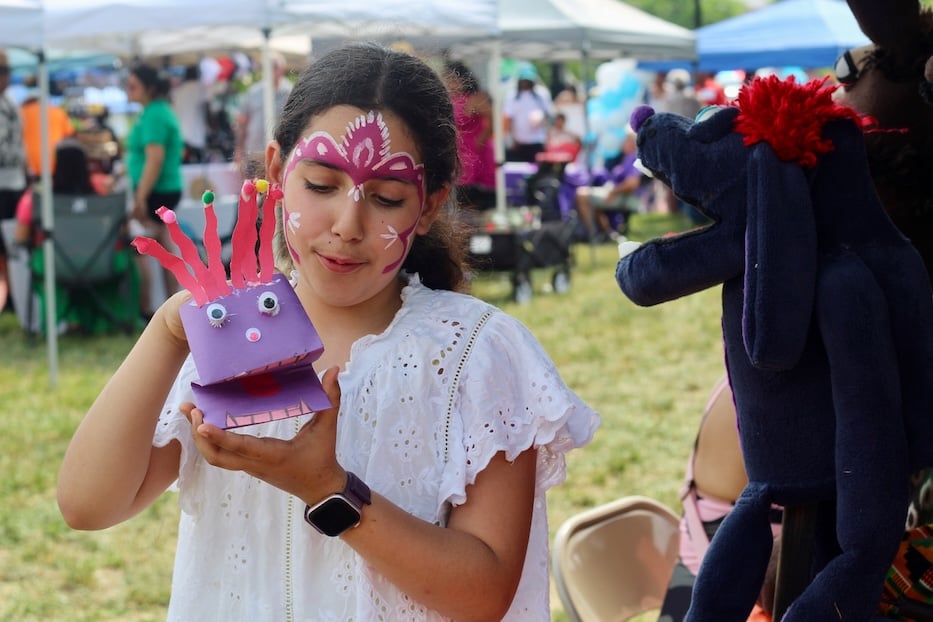
Sirat Gonzales. Lucy Gellman Photos.
Twelve-year-old Sirat Gonzales studied the puppet taking shape beneath her hands. On a long, folded purple rectangle, a pink tongue and rows of teeth formed an open, smiling mouth, a fuchsia nose bunny-like above it. She glued on two googly eyes, and suddenly the shape seemed animated, like it might burst into song.
“I want it to have curly hair,” said Sirat to artist Iyaba Ibo Mandingo, reaching for a length of red-pink construction paper that soon rimmed her puppet’s face in chunky, undulating strands that reached skyward. Mandingo, watching the creature take shape, beamed and nodded. It was exactly the kind of thing he hoped for when he began setting up that morning.
Saturday afternoon, Sirat was one of hundreds of New Haveners who came out to the 13th annual Dixwell Neighborhood Festival, organized by Stetson Branch Manager Diane Brown and the International Festival of Arts & Ideas. Held in the sun-soaked plaza outside the Dixwell Community Q House, the event brought together New Haveners across at least three generations, from young puppet designers with their faces jubilantly painted to artists like Donald Carter, who have been carrying their craft for decades.
Dozens of vendors, from musicians, visual artists and designers to social service providers like Elm City COMPASS and the Yale New Haven Hiring Initiative (NHHI), came out to support the event. On the plaza, named in 2024 in honor of writer and activist Daniel Stewart, hours of activity and entertainment awaited attendees, from sultry-smooth performances to line dancing and chances to jump rope with the 40+ Double Dutch Club.
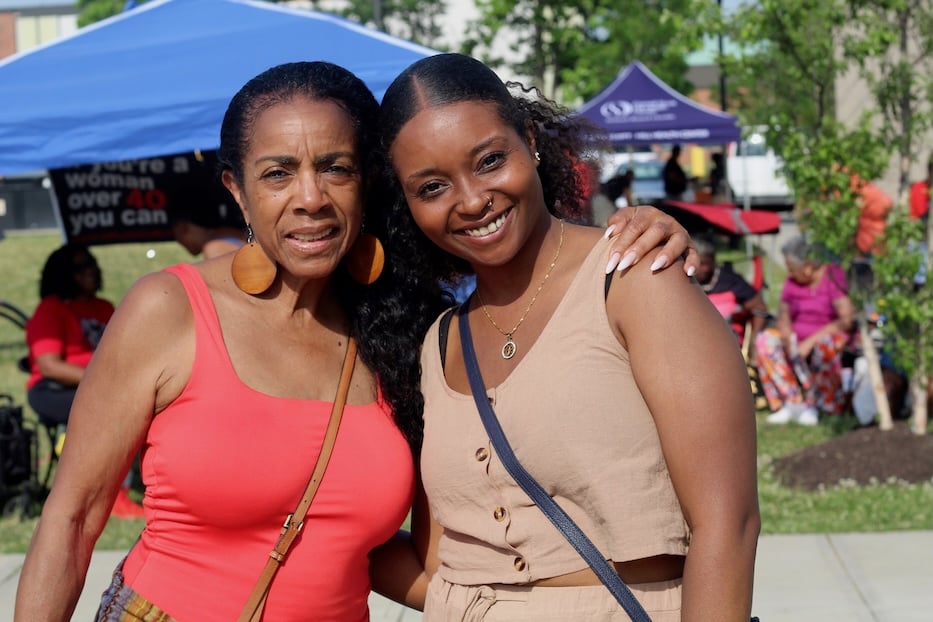
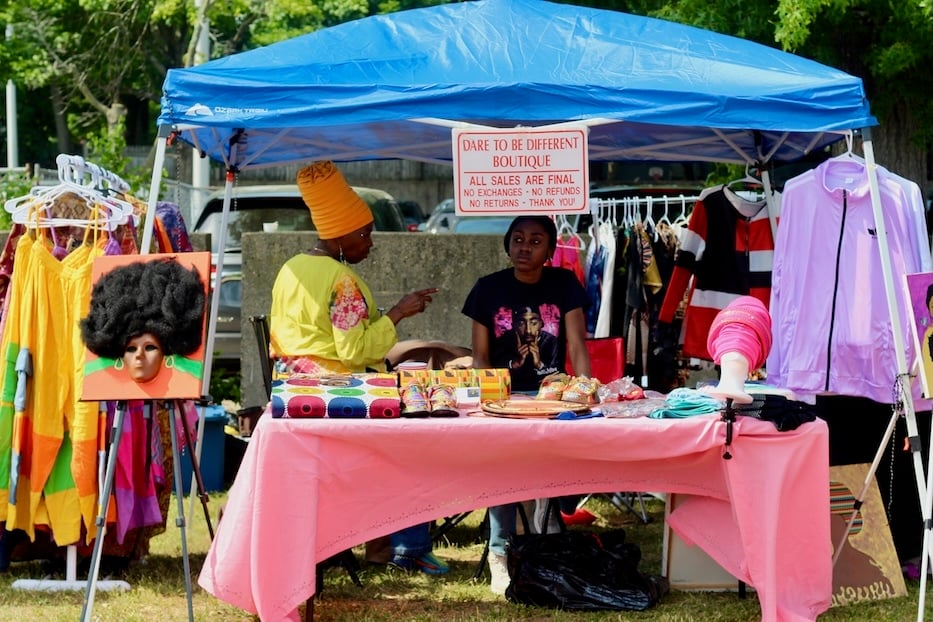 Top: Brown with Shannon Miller, community impact manager at the International Festival of Arts & Ideas. Bottom: Iyaba Ibo Mandingo.
“I’ve been a committee of one for the last two years,” said Brown, who has seen the festival through over a decade of change and kept it going, including virtually during the Covid-19 pandemic. This year, she made it happen on a tight budget of about $3,500. “People get tired. I’m not upset about it. I’m proud of this … it’s a lot of work, but we got it done. It’s a nice, safe space.”
“I’m trying to rebuild the village, like when I was a little girl,” she added. “It’s for us.”
Saturday, the focus on intergenerational connection wove from artists to attendees to organizers and back again. In one corner of the field beside Wexler-Grant School, Saima Choudhury invited people beneath a tent to learn about the art of henna, which she first fell in love with as a young Bangladeshi girl growing up in Birmingham, England.
.jpeg?width=933&height=622&name=DixwellFest2026%20-%201%20(1).jpeg)
Top: Choudhury at work. Bottom: Desiger Donald Carter later in the day.
In Birmingham, Choudhury was one of seven children, with an interest in henna that grew with each wedding, party, and Eid celebration she attended. She marvelled at the ornate designs that bloomed across a person’s skin, from reverent nods to nature and detailed, climbing flowers and vines to ornate patterns that wove in and out of each other, covering hands and forearms with the sepia dye.
“We always did it! We loved it,” she remembered. The older Choudhury got, the more interested she became in learning and sharing the art form, which varies by country and culture, but always starts with the same thick, brown- and copper-colored paste of dried leaves, essential oils, lemon juice and sometimes tea. “It’s a social thing, to do with community. We’re sharing our customs and traditions.”
Choudhury knows that firsthand: she moved to Connecticut in 2011, when she married an American. Doing henna helped her find community, and feel more at home. Just a week before the neighborhood festival, she had brought a plastic tub of paste and freshly-assembled piping bags to Scantlebury Park, where a joyful community observance of Eid al-Adha was underway.
“We’re not always from the same place, but I tell people, ‘Just try it once, and you’ll never go back,” Choudhury said with a smile. “I never think of it as a business. I just think of it as something we do.”
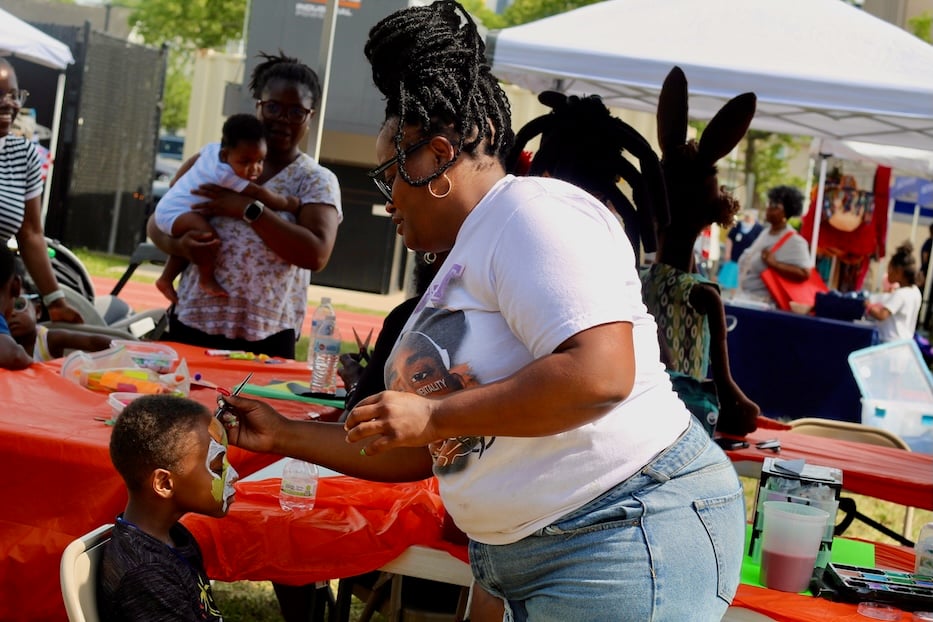
Lady J the Artist does face painting.
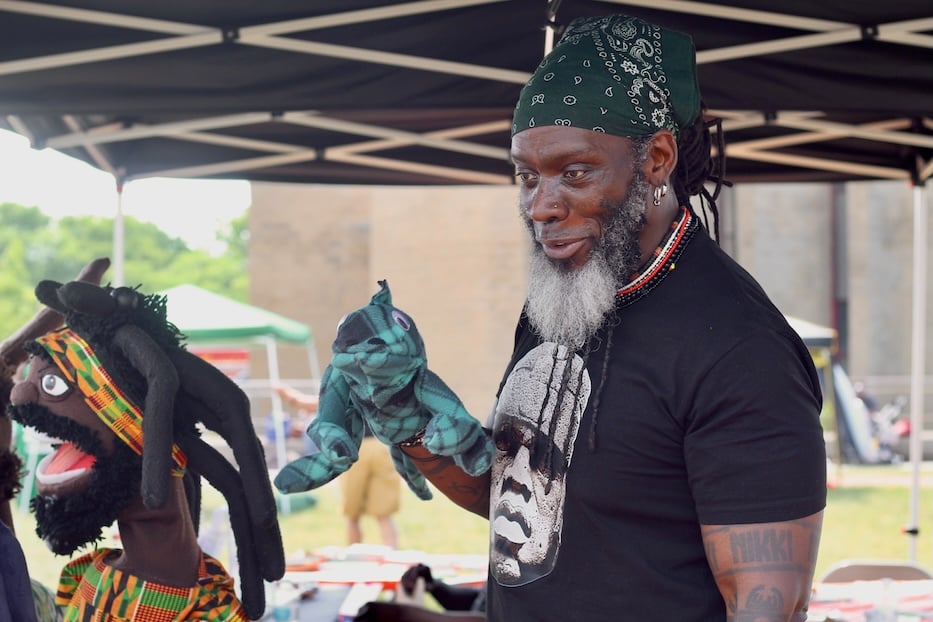
Across the grass, Iyaba Ibo Mandingo had set up a tent for IyabaArts, which does multi-media storytelling, poetry, music and song with puppet arts across the city and the state (Mandingo, a powerful poet who was born in Antigua and grew up in New Haven, also performs by himself). Long before he started crafting stories with the aid of puppets, he knew Brown through Southern Connecticut State University (SCSU), from which he graduated in 1992.
When Brown became Stetson branch manager in 2006—the library then lived across the street, in a Dixwell shopping plaza—she invited him into the library to tell stories. Mandingo, inspired by the concept of “ubuntu” (I am because you are), started weaving instruments, toddler-sized puppets, and retellings of African proverbs and stories across the Black diaspora.
“I’m ready to argue with anyone who says there’s a better social construct [than ubuntu],” he said. As a kid, “I grew up at a time when neighbors took care of each other,” including looking out for each other’s children. Now, he works with children because they are often more open-minded and receptive to suggestions than adults who are fixed in their ways. “We start from a place where we can get that feeling back again.”
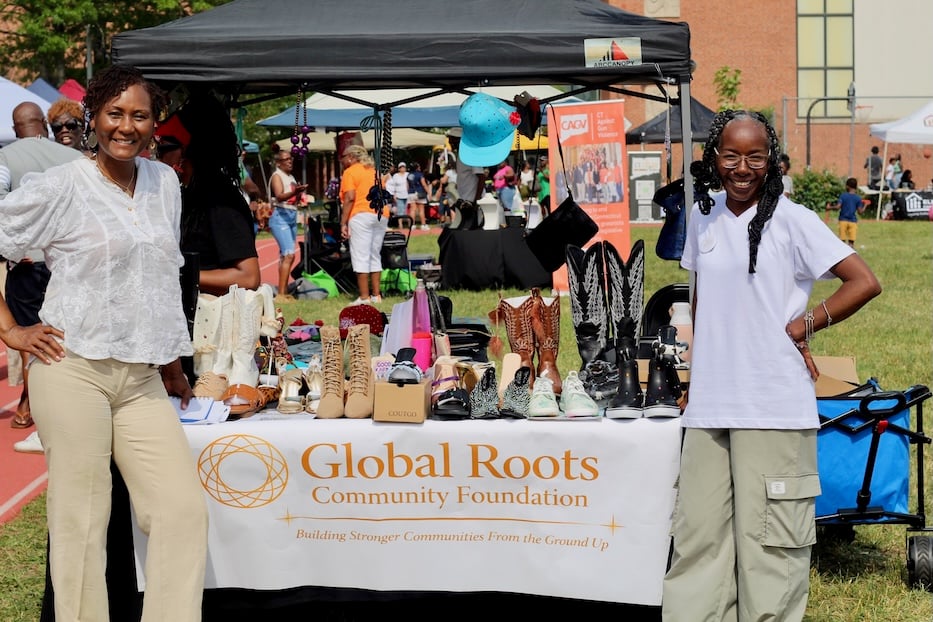
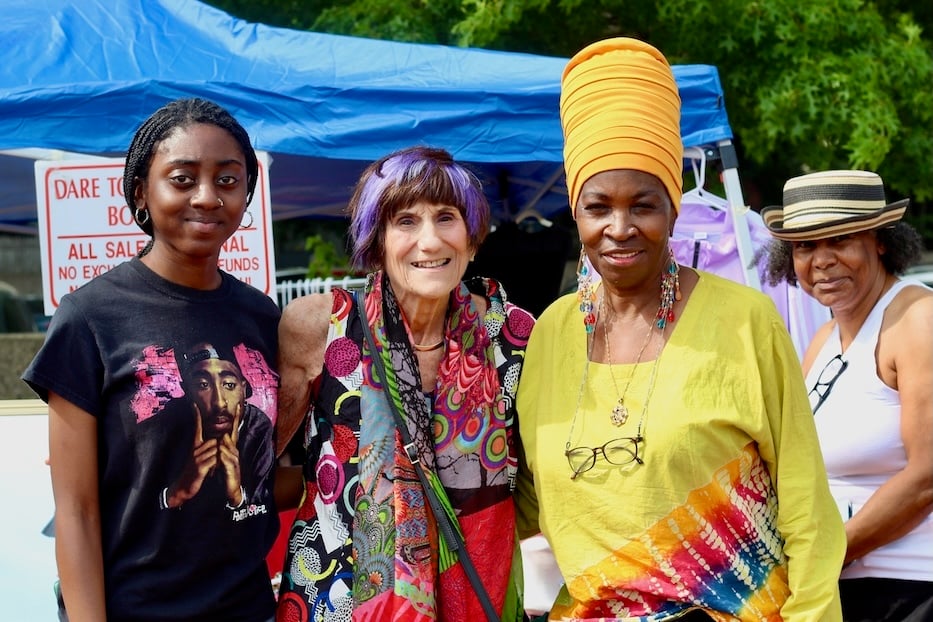
Top: Tywanna Johnson and Tracey Massey. Bottom: Hamida Imoro, U.S. Rep. Rosa DeLauro, and Malika Sharif.
As Mandingo turned his attention to 5-year-old Joel Demayakor—“Wait a minute! You got beautiful eyes!”—lifelong friends Tywanna Johnson and Tracey Massey handed out information for Global Roots Community Foundation, a new organization dedicated to reconnecting Black people with their diasporic roots. Next year, for instance, the group plans to travel to Ghana for the first time. The festival was a perfect place to kick off that work.
“We love Dixwell,” said Massey, who was born in New Jersey but grew up in New Haven, and attended the erstwhile Winchester School before it was Wexler-Grant. Years later, she still considers the neighborhood home, and had brought her daughter and grandson out Saturday to share the neighborhood love. “Dixwell is a part of us. From grandparents to babies, we are all family.”
Johnson, who attended Eli Whitney Technical High School and SCSU, then served in the military before working for the Department of Children and Families, echoed that love for the community. Like Massey, who has come to the festival for many years, she was excited for a place to gather safely and celebrate the start of summer.
“We really want to keep the community like it was back in the day,” Johnson said. Already, she added, she’s excited for New Haveners to learn more about Global Roots, and was also there to get the word out.
“It feels like home,” chimed in Dr. Hanan Hameen-Diagne, who leads the Official Juneteenth Coalition of Greater New Haven. While Hameen grew up in New York (“it’s the same festival vibes!” she said, smiling), her dad, the jazz drummer Jesse Hameen, hails from New Haven—meaning that she had a whole family, both blood and honorary, waiting for her when she moved to the city. The neighborhood festival always feels like a reunion, she said.
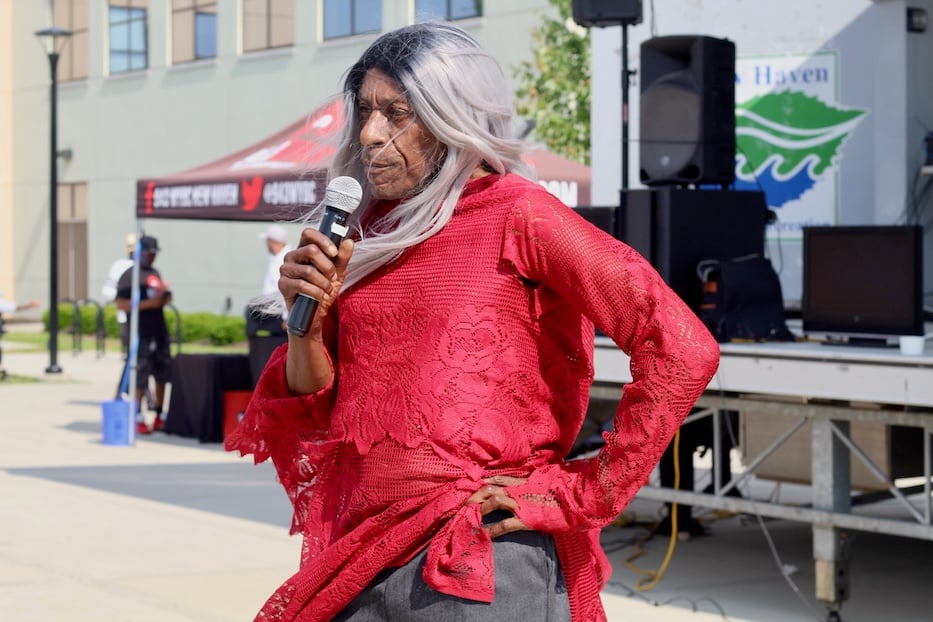
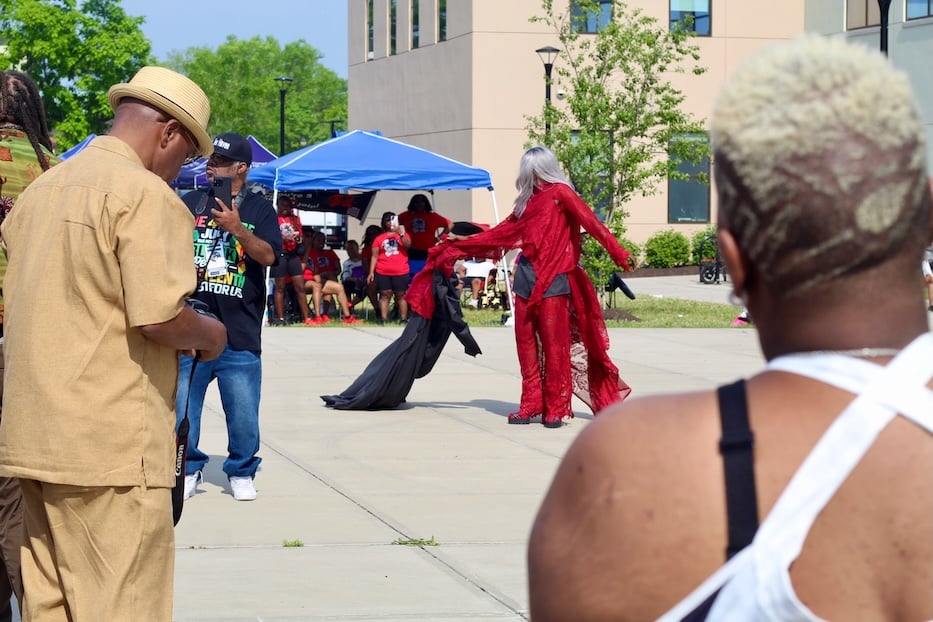
Nowhere, maybe, were the vibes more propulsive than during the afternoon’s final performance, as designer Donald Carter brought on over a dozen models, many of them working with him for the first time. As music began to pump over the patio, Carter strutted out in a layered, lacey red top and matching pants, with denim shorts below and a platinum-blonde wig.
Where there had been a few dozen people milling around before, there was suddenly cacophonous applause, people pulling out their phones to record.
“Did we like the walk?!” he said to cheers, peeling off a red layer to reveal his uncovered back underneath. “Okay, okay, okay! How’s everybody doing today? Are we feeling my outfit?!” An enthusiastic Yassss! went up from somewhere in an impromptu second row. “It’s the Apollo but it’s Donald Carter’s Apollo.”
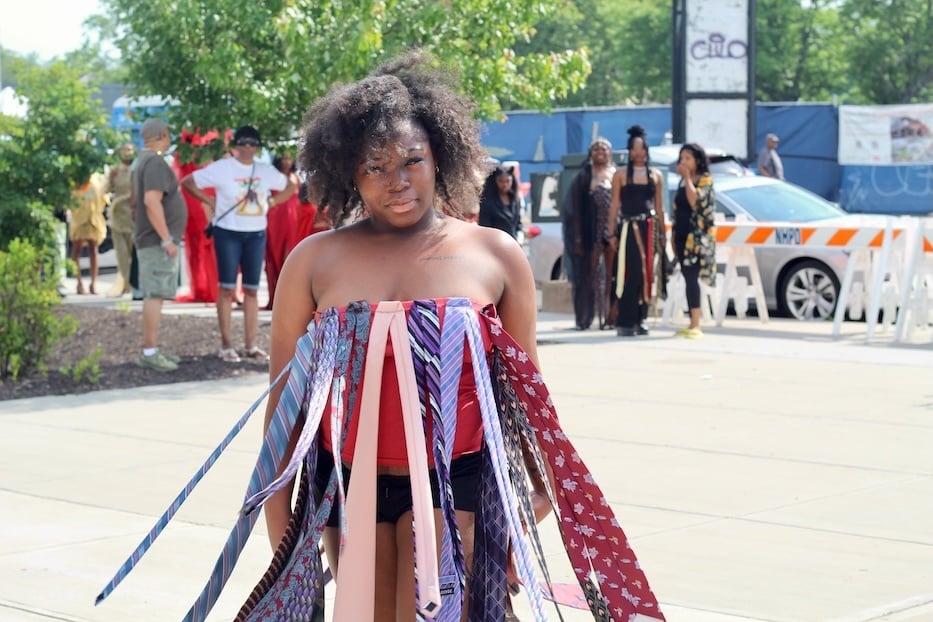
To applause, models twirled out in long, flowing pieces and rigid, scalloped bodices made entirely of scarves, crisp bands of pattern and color that flapped in the breeze. The ties, of which there are dozens, come from a collection Carter built up when he worked at Gatsby’s, a men’s clothing store in the Connecticut Post Mall.
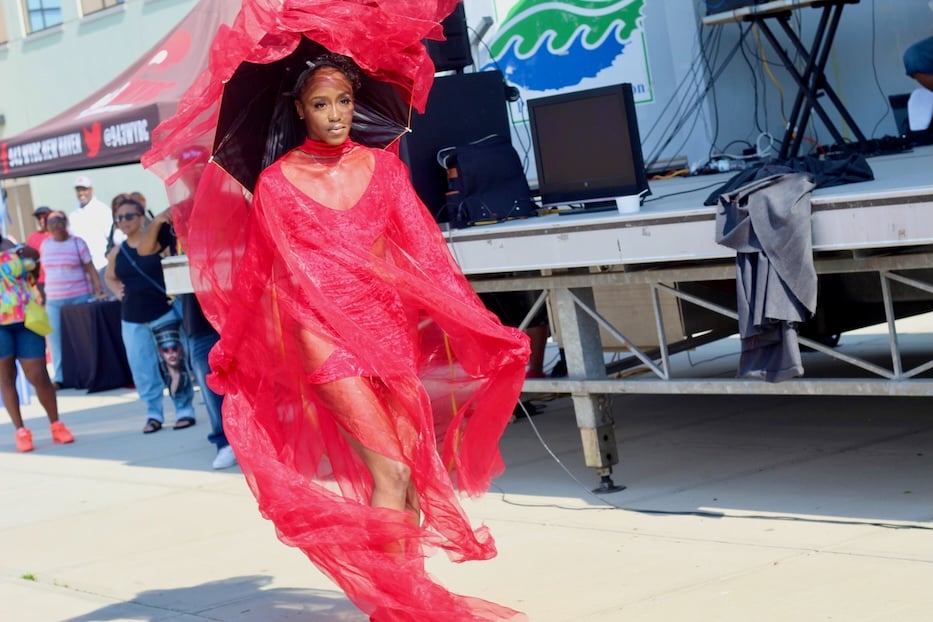
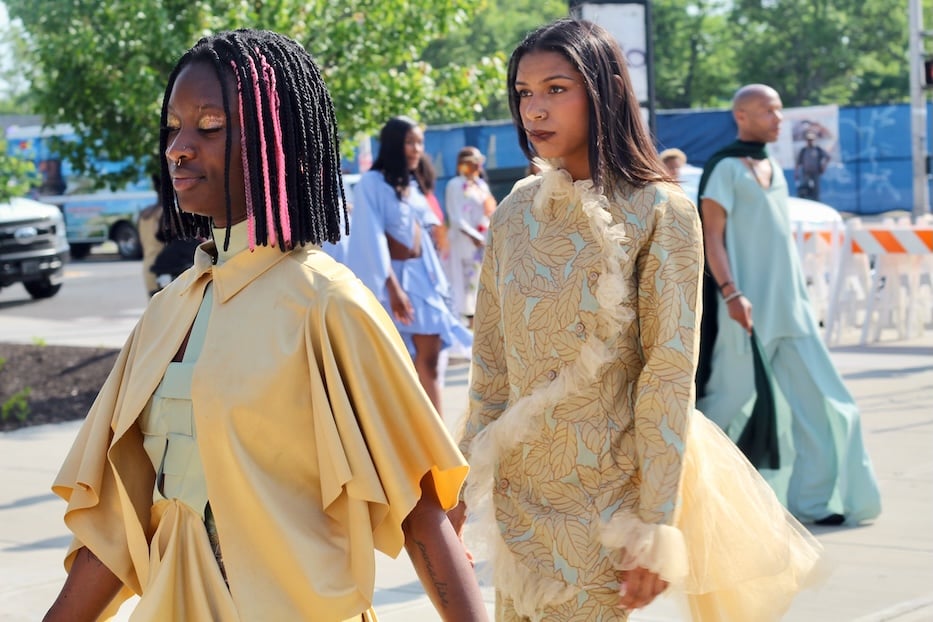
The praise, delivered in whoops and whistles and the occasional “he did that!,” continued as a model strutted out with a dress made for both the present and the Island of La Grande Jatte, with a generous bustle that bobbed with movement.
“Okay you girls, you know what to do when you have no butt?” someone guffawed behind the screen of their phone. “Bustle it!”
As he spoke, more outfits glided onto the patio, transforming it into a runway worthy of fashion week: a linen and velvet dress two different shades of blue, with an umbrella-sized hat festooned with huge blue feathers; a tight, ruby red number with a hat fit for a second line, and a matching tulle cover that glowed; a creamy silk jacket that felt like it was part Wall Street, part Wakanda.
A model moved forward in a regal red-and-gold number, with a kind of pseudo-blazer on top that turned into a single pant leg below. Not far behind, another rocked a tight blue number that looked like it had been pulled from Versailles in the late 18th century, and simply shortened for the occasion.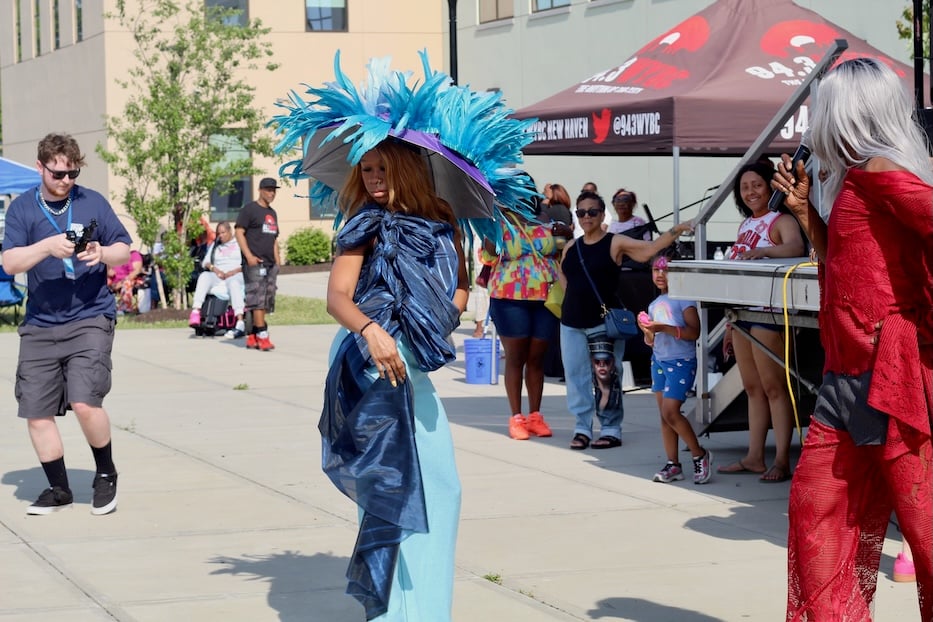
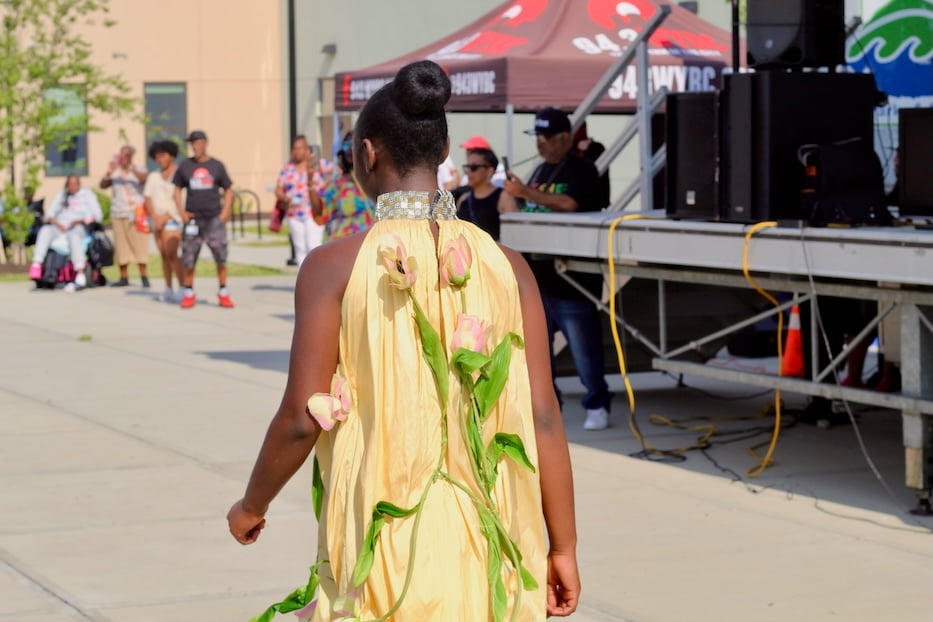
“Marie said ‘Let them eat cake,’” Carter said as the model jutted out her hips and moved toward the wide avenue. “She’s eating cake and she’s serving it too.”
From where she stood with her goddaughter, Barnard freshman Hamida Imoro, Malika Sharif took it all in, a vision in rich sunflower yellow from her high, wrapped head covering to her long dress.
“I’ve always been a unity person,” she had said earlier, and the words echoed as elders and infants alike clapped for the models as they floated and twirled down the runway. “It takes a village to pull this together.”
As he packed up his car later in the afternoon, Carter echoed that sentiment. Decades ago, he first met Brown when he was eight years old. The two have been inseparable since.
“I’m so honored that I got to show up and show out for the community,” he said. “It’s about the community.”