


Culture & Community | Erector Square | Fair Haven | Music | Arts & Culture | Music Haven
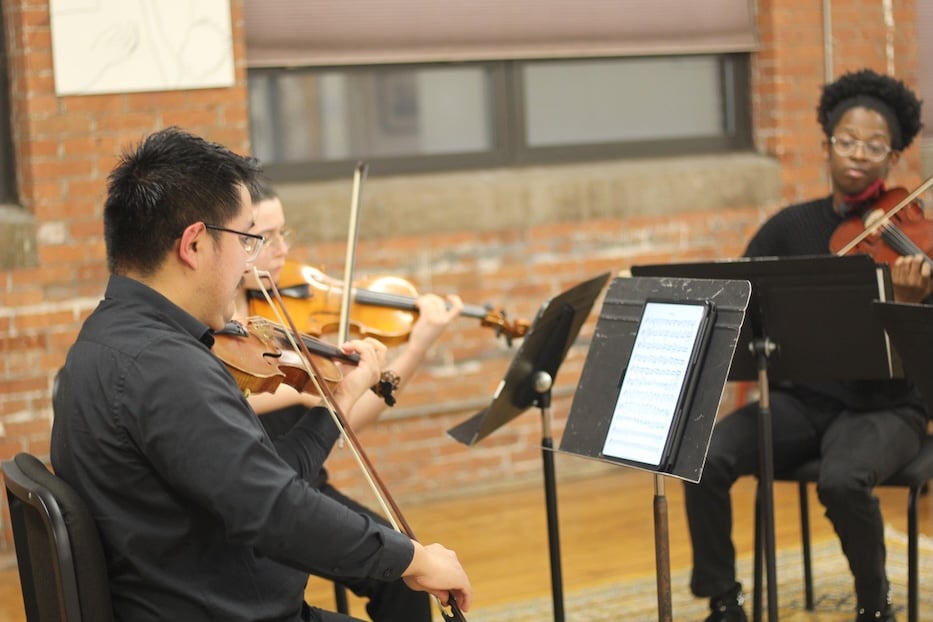
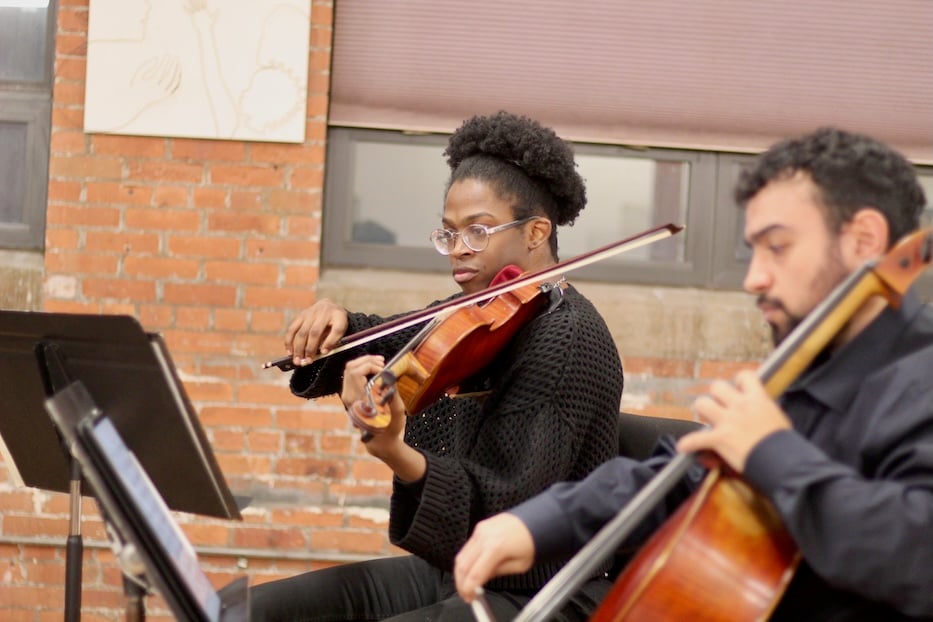
Top: Cristofer Zunun and Christina Sack, who alternated violin seats in different pieces. Bottom: Dio Matthews and Dylan Costa. Lucy Gellman Photos.
It was easy to miss it if you weren’t looking, even as you listened.
The viola and the violin were having a heated conversation, just as they had been on and off for over a decade. On the left, violin chattered and wound upward, crisp and regimented as if it were trying out a box step. Beside it, the viola answered with a deep, almost rumbling voice, the sound coming from somewhere in the instrument’s wooden chest. Beside each other, musicians Cris Zunun and Dio Matthews pressed their feet into the floorboards and locked eyes.
Then, for just a split second, they smiled—a familiar smile, like they were kids all over again.
Matthews and Zunun, one half of the Legacy String Quartet CT, have been playing music together since at least 2014, when both of them were newly-minted teenagers at the arts incubator Music Haven. Thursday night, the two returned to the organization to give back to the place that became their artistic launchpad. The concert raised a total of $830.
For both of them, it was about more than the money: it was about artistic family. Both now live and work in greater New Haven, where their stories began over 10 years ago. Zunun, who graduated from Cooperative Arts & Humanities High School and headed to UConn in 2019, is now an assistant teacher at Cold Spring School. Matthews, who studied computer science and music performance at Western Connecticut State University, does IT for the Stratford Public Schools.
“It feels super important and appropriate at this time [to come back and make music together],” said Matthews, a violist who graduated from Music Haven and headed to college in 2018. “Things are not looking great right now, but all throughout history, there have been musicians. There’s still hope. There’s still music.”
And there was, for nearly two hours that brought together Ludwig Van Beethoven and Aleksandr Borodin, Joe Hisaishi and Michael Jackson. In its current iteration, the Legacy String Quartet includes cellist Dylan Costa, who is a doctoral student in mathematics at the University of Connecticut; violist Matthews; and violinists Zunun and Christina Sack, the latter of whom directs choir and orchestra at Platt High School in Meriden. The four met in a variety of ways: through shared mentors, shared schools, and similar musical circles.
As they made their way to the front of the room, waves of applause suggested that it was going to be a good night. As musicians sat, the room felt like a homecoming, the sound of tuning so natural to the space that the concert would have seemed incomplete without it. Behind them, two wire sculptures from the artist Susan Clinard showed teachers reaching down to their students in profile, instruments in hand. Sandwiched between her parents in the second row, Music Haven alumna Isabel Melchinger cheered the group on, and for a moment, it felt closer to 2016 than 2026.
But when the quartet started with Hisaishi’s "Path of the Wind,” best known as the theme of Hayao Miyazaki’s My Neighbor Totoro, the time that had passed—and the care and discipline that musicians have continued to build—became clear. As the violins played in the viola and cello, they kept a brisk pace, dipping in and out of each other. Across from them, Costa joined in, a few spare, plucked notes becoming the deep, full hum of the instrument. From her chair, Sack laid down the melody, a sweet and warbling ribbon of sound.
“We decided to play things that made us happy,” Matthews had said beforehand, and it was easy to see why. As “Path of the Wind” gave way to “Departure,” the theme from Miyazaki’s 1989 film Kiki’s Delivery Service, a sense of lightness floated through the room, strong enough to forget how hard the past year has been, on both Music Haven and many of the families that it serves. As the song unfolded from the center of the room, a tangle of strings came apart, the parts singing to each other as the cello rumbled, and viola and violin called back longingly.
It never meant that the group shied away from talking about a darkness that can feel more immediate, more proximate these days. Before Borodin’s String Quartet No. 2, first composed and performed in the 1880s, Costa paused to point out the moments of friction, rigidness and solemnity in the piece, which takes a listener on a journey through four movements.
“When it comes out, it’s a beautiful thing,” he said. Evening had fallen outside, leaving thick, layered streaks of old precipitation visible on the windows. “But sometimes it comes out of the darkest moments.”
During the Allegro, which opens the piece at a slow, polite kind of clip, Matthews and Sack looked right into each other’s eyes, strings swirling around each other as the first violin picked up the pace and the three other voices followed. By the second movement, a Scherzo, the instruments peeled away from each other in a rich, luscious call-and-response, all the urgency of the first movement opening up to a kind of detente, a short-lived mellowness.
It didn’t last, and soon strings had started that frantic chatter once again, at once furious and wistful. By the third movement, a Nocturne, Borodin was all but there, still pulling new tricks from his bottomless musical bag. From just left of center, Matthews’ viola began to vibrate and roil beneath the violins, as if it had transformed into a didgeridoo, or bent time and space and music history to bring Tuvan throat singing into the string section like it was no big deal.
“This is why we do what we do,” Executive Director Milda Torres McClain had said before the concert, and the words echoed as the quartet barreled towards the fourth and final movement before intermission. While McClain became the executive director in 2022, she’s worked at Music Haven since 2014, when she joined the organization as its director of operations. It means she watched Matthews and Zunun grow up. “This is the point of our program.”
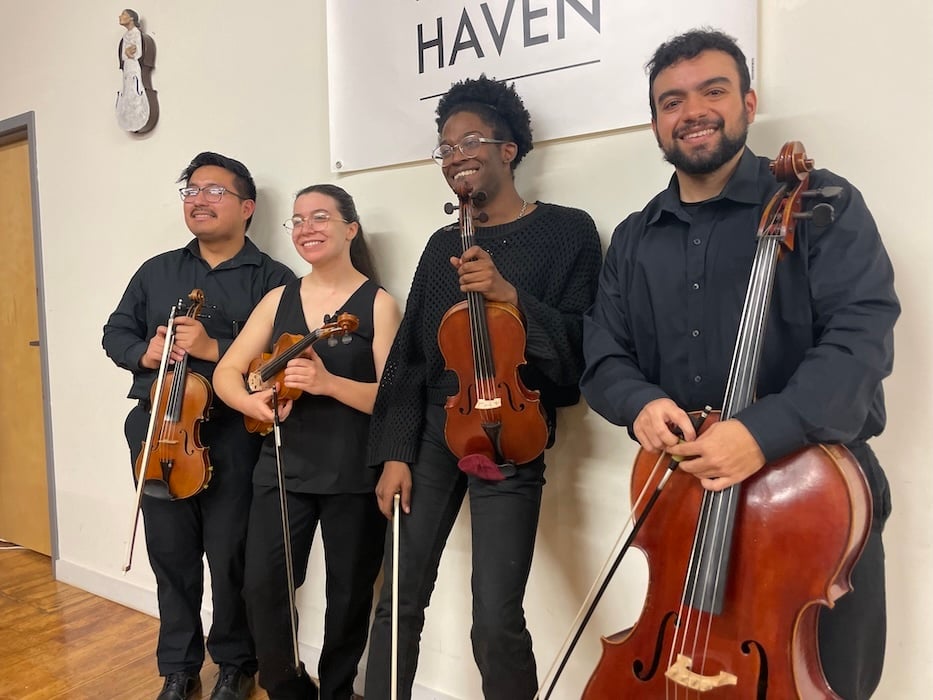
Top: Cris Zunun, Christina Sack, Dio Matthews and Dylan Costa. Bottom: Noel Mitchell, Dio Matthews and Cris Zunun at Woolsey Hall in 2018, during Maestro Alasdair Neale's audition for the New Haven Symphony Orchestra.
And it was. At moments, it was possible to catch glimpses of Matthews and Zunun as their younger selves, still-awkward high schoolers who were just starting to figure things out. In one snapshot, brought to life in Borodin’s String Quartet, they were adjusting their posture and chatting over cheesy, fragrant slices at the now-shuttered Wall Street Pizza (rest in peace) before many a field trip to hear the symphony at Woolsey Hall.
In another, they were playing the concerts—what felt like dozens, although it was only two or three a year—that turned into graduation ceremonies, raucous celebrations, and full-fledged performance parties as they traveled from Southern Connecticut State University to John C. Daniels School to the new Dixwell Community Q House, which wasn’t even finished until both Matthews and Zunun were in college.
In another still, both were college graduates hanging out in West Haven, watching one of their former teachers perform in a new string quartet. As a string arrangement of “La Llorona” swirled around them, they chatted about the Legacy Quartet, then in its infancy in Danbury. The years fell away, just as they always do. That’s part of the bond forged as teenagers, Zunun said: the two have never lost touch. It’s been one long, winding conversation, through which music is a continuous, glistening thread.
“Music Haven gave me a chosen family,” Matthews said, making sure to credit both peers like Zunun and Melchinger, and cheerleaders like former director Mandi Jackson, who beamed from the second row beside her youngest son, Eli. “I could flourish here. If not for Music Haven, I would have never gone to college. I would still be in my little apartment, despairing. It [the concert] sort of feels like the culmination of my entire time here.”
That was clear as the group closed out the evening with Beethoven’s String Quartet No. 4 in C Minor, one of six that the composer wrote during his lifetime. The piece, composed at the turn of the nineteenth century, introduces in four movements a kind of sweeping drama to any room in which it is played, the kind of music that paints a picture of the composer with knitted brows and a pinched, pensive face over a desk, quill in hand.
In other words, “It’s moody, it’s brooding, and it’s restless,” Sack said with a big smile. Just minutes later, she had captured that in motion, as a string snapped from her violin during the quiet, understated urgency of the first movement, and she whisked it away, the music around her beginning to boil, while playing all the while.
In the audience, only a few people seemed to register the moment, smiling back as she and the others pressed on. When the third movement, which knits together a minuet and a trio, gave way to a full, lush build of strings in the finale, it felt like the only conclusion the night could have.
“I was just in awe,” McClain said in a phone call afterwards. “Tears of joy … I’m so glad that I was able to experience it. You know, you never know, because the students go in so many different directions after they graduate. My dream was always to see our students playing out in the community.”
To have them back at Music Haven made her night particularly special, she added. During their time at the organization, both Matthews and Zunun experienced the Erector Square space that the organization moved to in 2017, and has since been able to thrive in. It was, however, a former auto parts garage on Whalley Avenue was their first musical home. When they returned to Erector Square Thursday, they could see in real time how it has grown into a beloved third space for over 100 young people in New Haven, who come even on the days they don’t have lessons.
It also comes as Music Haven, which serves 117 students in violin, viola, cello, piano and now choir works to grow its mission amidst a changing landscape for arts funding. Last year, the organization received an announcement from the National Endowment for the Arts—once a reliable funder—that the agency would be pulling its annual funding (it remains unclear what will happen this year, McClain said). It was just the beginning of a fiscal year in which funders became more competitive, while the amount of money they gave was often smaller.
This year, McClain reduced the organization’s budget from just over $1 million to $955,000, a number that does not include any staff cuts. In a phone call Monday, she said that trimming $100,000 from the budget translates to a lower line item for food (the Board of Education now provides snacks for the organization’s students, which is relatively new), fewer independent contractors, and fewer workshops for the students. While she has not had to let any staff members go, she added that Lygia Davenport is now the director of operations and development—a job that once encompassed two positions.