


Culture & Community | Music | Arts & Culture | New Haven Symphony Orchestra
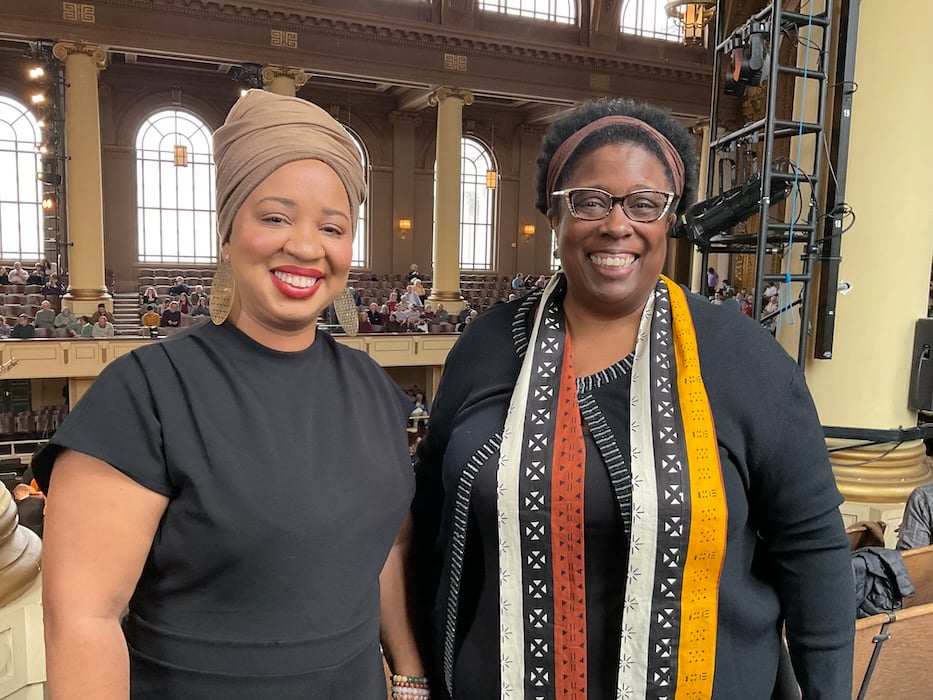
Courtney Bryan with a member of the Heritage Chorale. Shaunda Holloway Photo.
As the first notes of Courtney Bryan’s “Visual Rhythms" sailed over Woolsey Hall, hundreds of ears turned toward the stage, the bodies to which they were attached ready to move along. In another world, artist Norman Lewis stood before a blank canvas, and began to work on his midcentury painting Autumn Garden.
In the upper balcony, feet tapped and heads began to bob. Below, legs moved; shoulders swayed. Some listeners clasped their hands in prayer-like fashion. An infant, peacefully nestled in a sling, was so lulled by the sweet sound that they made not a single cry. Young children and adults alike all looked straight ahead, suspended under the same musical spell. This was music a person could feel right to the marrow.
That sound filled Woolsey Hall—and transported listeners many times over—on a recent Sunday, as the New Haven Symphony Orchestra (NHSO) presented “Goin’ Home” with Composer In Residence Courtney Bryan, NHSO Maestro Perry So, and members of the Heritage Chorale of New Haven. Held in the heart of downtown New Haven, the concert featured work by Bryan, 20th-century American composer William Grant Still, and Czech composer Antonín Dvořák, whose work has become an NHSO favorite in recent years (the organization last performed his Symphony No. 9, “From The New World,” alongside composers Darian Simerson, Maurice Ravel, and Joel Thompson four years ago, but has kept his oeuvre in frequent rotation).
“The challenge everywhere was to introduce the melodies and rhythms of oppressed people into the constructed masterpieces of the oppressors, and the journey through strong resistance, partial acceptance, and ongoing struggle for integration is one of the central stories of American concert music,” wrote So of Dvořák’s own musical journey in his program notes for the show. “In this concert, we present two Black composers [alongside Dvořák] who have created powerfully personal music languages under the burden of this highly disputed history.”
What followed, under So’s sharp and agile direction, could be described as a quenching of existential, soul-deep thirst one feathered note and bow stroke at a time. When the orchestra opened with Bryan’s “Visual Rhythms,” which was commissioned by and premiered at the Jacksonville Symphony two years ago, each enchanting note rendered the eardrums helpless. Was it a trance? No. It was pure mystery and magic, made clear through Bryan’s composition.
That lives within the work itself. In the piece, Bryan, who has previously described herself as “a minister of music,” celebrates the works of several prominent Black artists and musicians, from Lewis, Romare Bearden and Frank Stewart to Petra Richterová, a living photographer whose work has focused on the art and music of the African diaspora. The piece, which contains 11 movements, is designed to both fête these artists and bring multi-sensory texture (and attention) to their work, which like Sunday’s lineup stretches across creative generations.
As he conducted, So moved in choreographic fashion, the self-proclaimed non dancer lunging forward and receding like the tide, equally theatrical and genuine. At points, his conducting style seemed almost alchemical, driven by something beyond this earthly realm that only musicians could see and feel completely. From the stage, layers of music history fell lushly on top of each other, their back and forth a rich conversation.
Outside Woolsey’s doors, maybe the highest office in the country was questioning the value of diversity. But in the hall, the true complexity and richness of the nation was revealing itself, with one composition that flowed into the next. There was a humility there, a sense of shared responsibility that allowed an entire orchestra, musicians dressed nearly in crisp black and white, to become a single entity. To believe in transcendence.
That continued as So, with the Heritage Chorale at the ready, prepared to conduct Still’s 1937 “Lenox Avenue,” nine decades melting away as spirited brass rang out, strings joined in, and rich voices gradually misted the air. As Still’s 11 movements opened with “The Crap Game,” a listener could imagine making their way down the eponymous avenue, the sights and sounds of late 1930’s Harlem keeping a steady, bouncing clip as they walked. By the time it dipped into “The Flirtation,” members of the audience were along for the ride, soaking in each step.
At times, a person could feel both Still and poet Langston Hughes, a frequent collaborator of his, swirling through the space, still alive in the music. A series of multi-percussive rhythms carried the audience forward, as if they were passengers on a train headed uptown. Alternating sharp horns, and short strikes of strings, pushed and receded like crashing waves. One bassist held the neck of his instrument gently, gliding the bow against its frame. Surely, this was his own kind of “goin’ home”—comforting, thought-provoking, uplifting, and nourishing all at the same time.
That richness deepened as the Heritage Chorale stood from the left balcony, and sang from the heart. The group, which educator Jonathan Quinn Berryman founded and still conducts, spans several decades, a composite of dedicated vocalists who are preserving African American traditional liturgical, gospel and chorale. Together, they wore sashes slightly different in style and color, yet gave a clear, unified presentation. While listening, one might have wondered if the builders of Woolsey Hall had imagined whether or how the sounds of instruments and voices would travel under the domed roof? Had they imagined these anchoring melodies, and how they would become a permanent fixture in the minds of attendees?
“It’s wonderful. It’s exciting to be able to perform a piece that is uniquely New Haven,” Berryman said during the concert.
Lola Nathan, who works with students at Engineering,& Science University Magnet. School (ESUMS) on music, said that she was thrilled to be there. She attended with her great-godson, a testament to music’s impact.
“I am here because I love music,” she said.