

Boricua pride | Culture & Community | Festival Puertorriqueño | Arts & Culture | New Haven Green | Puerto Ricans United, Inc.
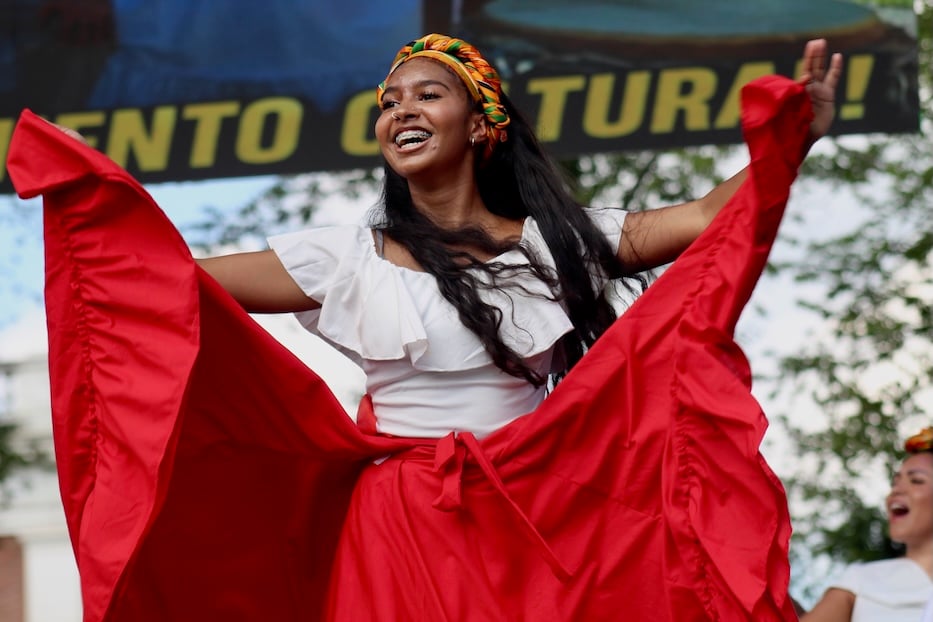
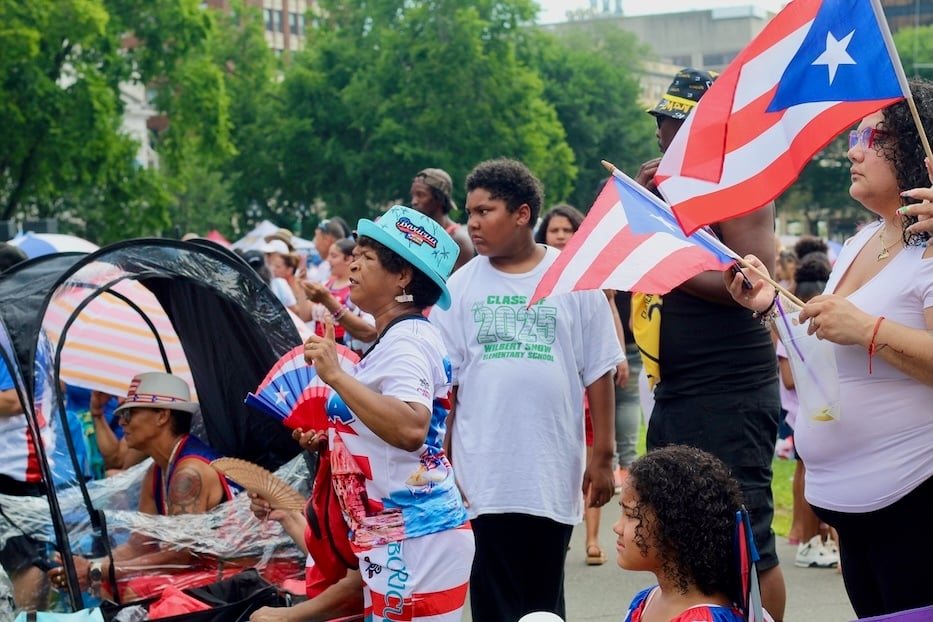
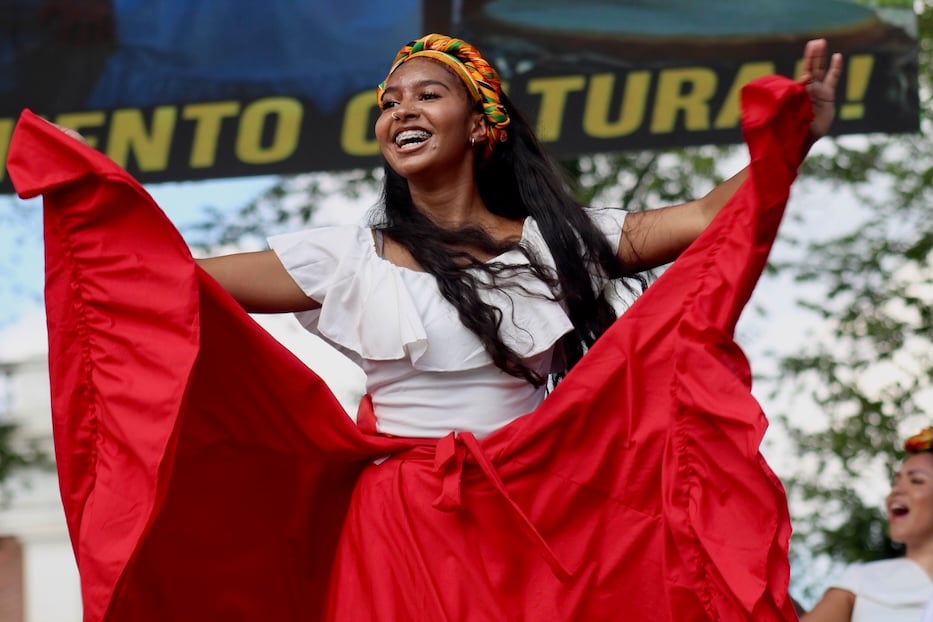
Top: Samara Henaro, a student at W.F. Kaynor Technical High School who has been dancing bomba for about a year. Bottom: The scene on the Green. Lucy Gellman Photos.
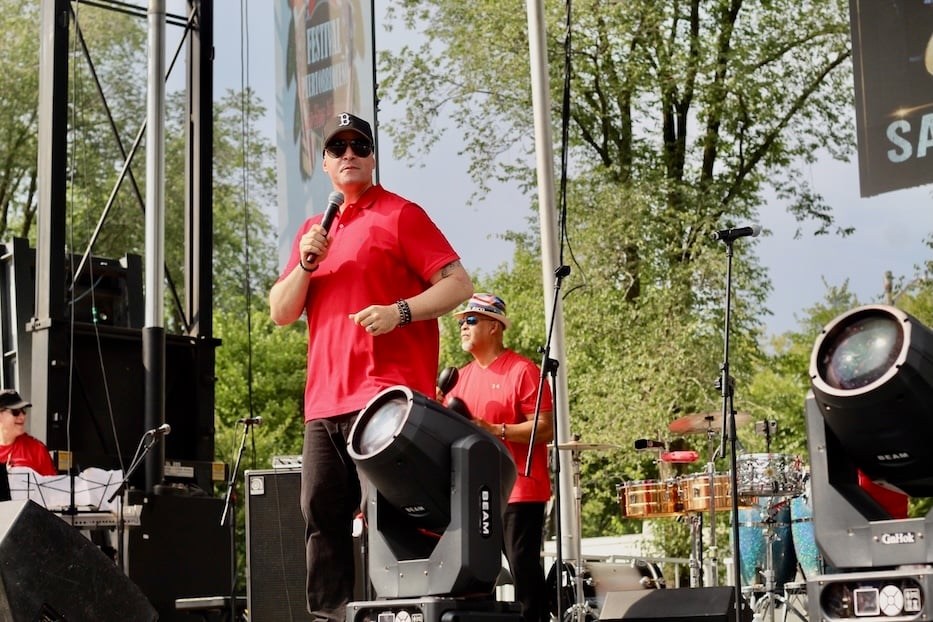
It was just past 1 p.m. on Saturday, and already the New Haven Green undulated with the red, blue, and white of the Puerto Rican flag. On a sun-soaked stage, the sound of congas and cuatro bubbled up from Carlos el Lunatico y Su Grupo Tipico, musicians dancing along to the beat. From her seat, Santa Perez realized she could no longer stay still, and slipped a cow bell casually out of her bag. She rose to her feet, and began to play along.
Saturday afternoon, Perez was one of thousands who came out to sing, dance, play and eat their way through the city’s tenth annual Puerto Rican Festival, a vibrant celebration of Puerto Rican culture and community that stretched from one end of the New Haven Green all the way to the other, with flag-festooned cars, motorcycles and dirtbikes that took to the surrounding streets for much of the afternoon. Organized by Puerto Ricans United, Inc., the event gave attendees a space to both savor the day and advocate for Puerto Rico, where tens of thousands of people are in the midst of a water crisis.
“Today we celebrate our commitment to New Haven, but it’s also not lost on me that while we celebrate, our brothers and sisters continue to suffer in Puerto Rico,” said PRU President Joe Rodriguez, buzzing between artists and attendees in the sticky heat. “We have people in Puerto Rico who have unreliable [access to] water. Infrastructure is crumbling. There are healthcare and education concerns. So while we celebrate our culture, we also have to renew our commitment to Puerto Rico.”
.jpeg?width=933&height=622&name=TonyFalcone%20-%201%20(1).jpeg)
Top: Members of Carlos y su momento musical. Bottom: Santa Perez, who came ready with a bag of instruments. She lives in downtown New Haven, she said, and didn't have far to travel to the festival.
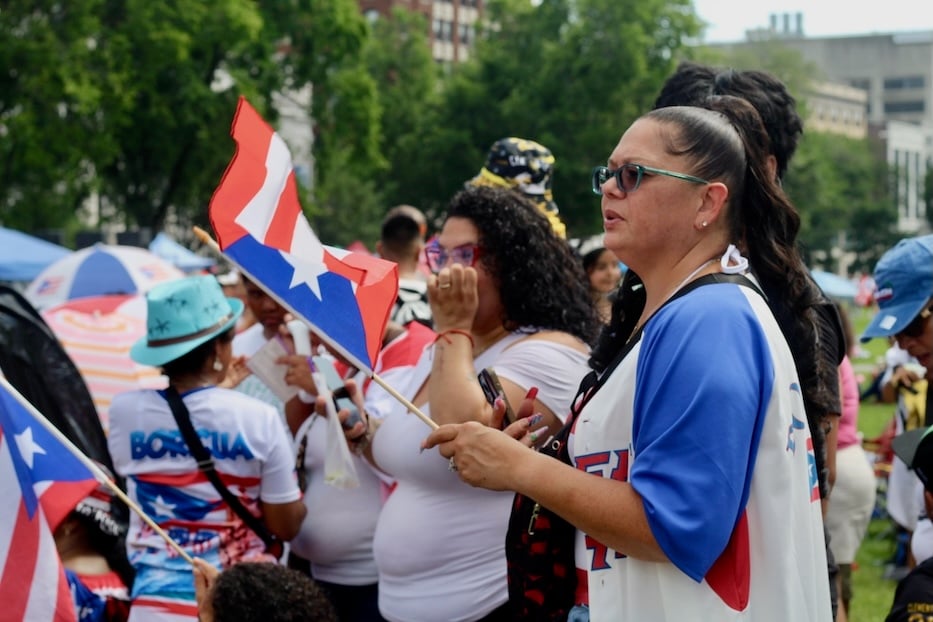
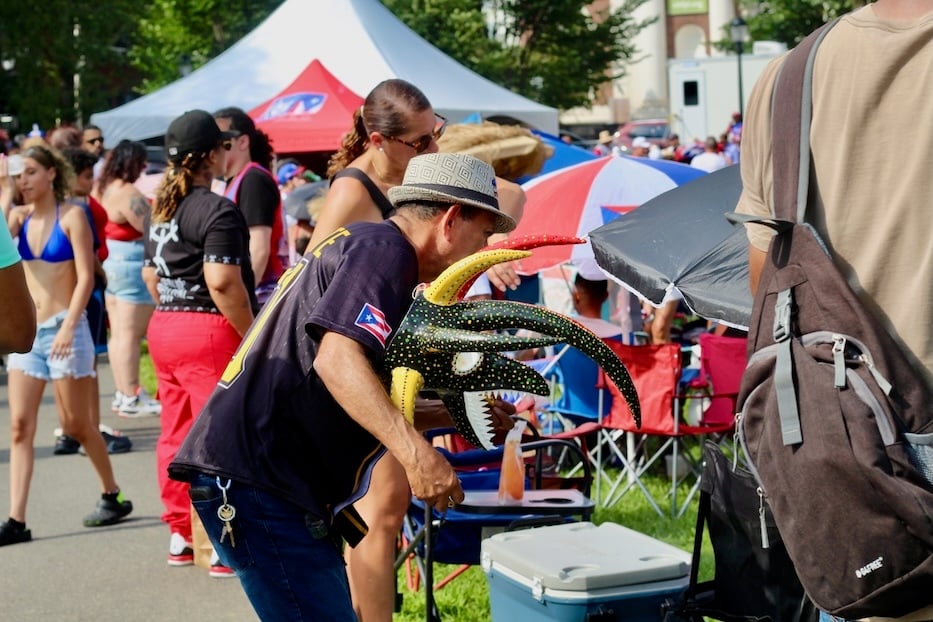
On stage and across the Green alike, that message resonated with hundreds of attendees, who had come from as close as Park Street and as far as New York and New Jersey to celebrate. Amid flags fitted superhero-like over backs and shoulders and the smells of piping hot empanadas, pernil, and tostones, attendees were often too busy to talk, dancing their way through the afternoon instead. Even those who stopped at vendor tents and food trucks kept moving, swaying at the hips and two-stepping in the dirt.
But when asked, many of them paused to center the family, friends and relatives in Puerto Rico who are caught in the crosshairs of a bureaucratic system that is failing them. Some also highlighted the importance of displaying the flag, which was illegal to display between 1948 and 1957, during the enactment of a gag law called La Ley de la Mordaza.
Making her way to a tent by the stage with her mother, Gloria Cordero, PRU member Magaly Cajigas rocked a long dress and matching headband modeled on the black-and-white Puerto Rican flag, which signifies independence. Ten years ago—around the same time that PRU was coming into being—a version of that flag appeared as street art in Old San Juan, Puerto Rico overnight, where a technicolor flag had once been.
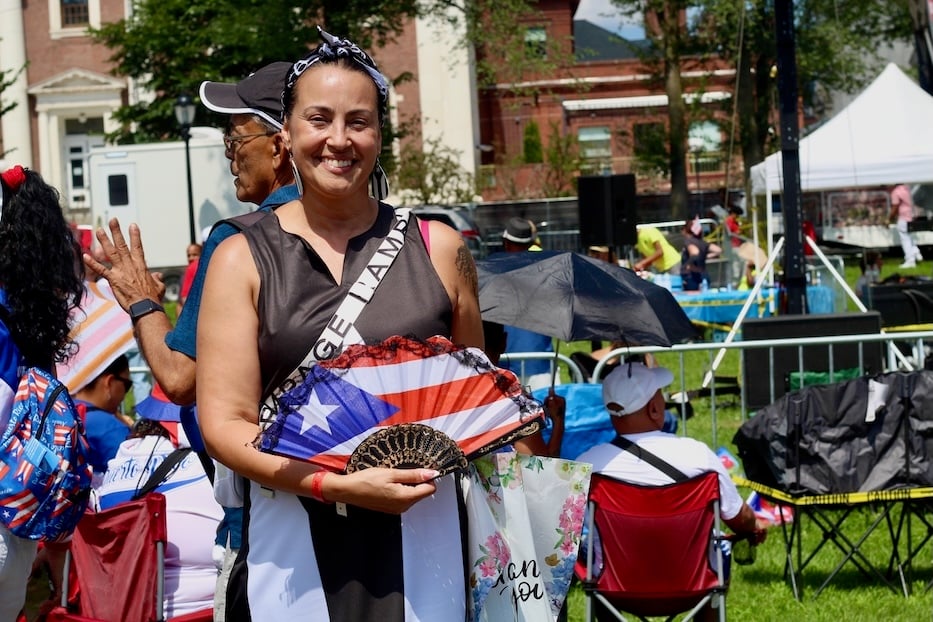
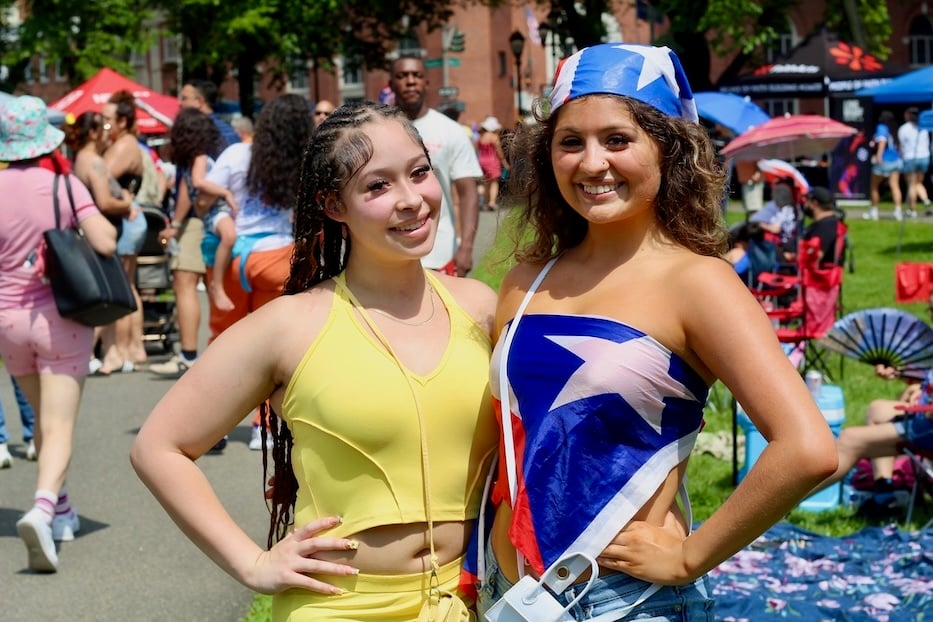
Modeling multiple versions of the flag, and multiple generations of PRU, were Magaly Cajigas (top) and Lysella Pujols and Johanelyz Arroyo, (bottom) former Junior Miss Puerto Rico and Miss Puerto Rico of Greater New Haven. Arroyo, a graduate of James Hillhouse High School who is headed to Texas State University next week, said that "it just feels like an honor" to represent the pageant—and PRU—at the festival. At the same time, she said, Puerto Rico was very much in her thoughts. "I just think right now, it's critical that we look at it."
The collective of artists who painted it were clapping back on what was referred to as PROMESA—the Puerto Rico Oversight, Management, and Economic Stability Act. PROMESA, which is still in effect, was an Obama-era policy to provide federal oversight in Puerto Rico. For many Puerto Ricans, it became an extension of years of colonial power struggles and land grabs that left Puerto Ricans financially strained and chronically underresourced.
On the island and on the mainland, that version of the flag has since become recognizable —and in the past five or so years, a more frequent sight at the downtown festival. Elsewhere on the Green, a few attendees also waved the Grito de Lares and an 1895 version of the flag, which shows a five-pointed star inside a sky blue triangle, surrounded by bands of red and white. The latter also signifies a movement for Puerto Rican independence, over a century before the current one.
“I’m celebrating but I’m protesting at the same time,” Cagijas said. For her, the water crisis is just the latest development in a long and upsetting story of civic disinvestment—which makes it all the more infuriating. “This has been ongoing for years.”
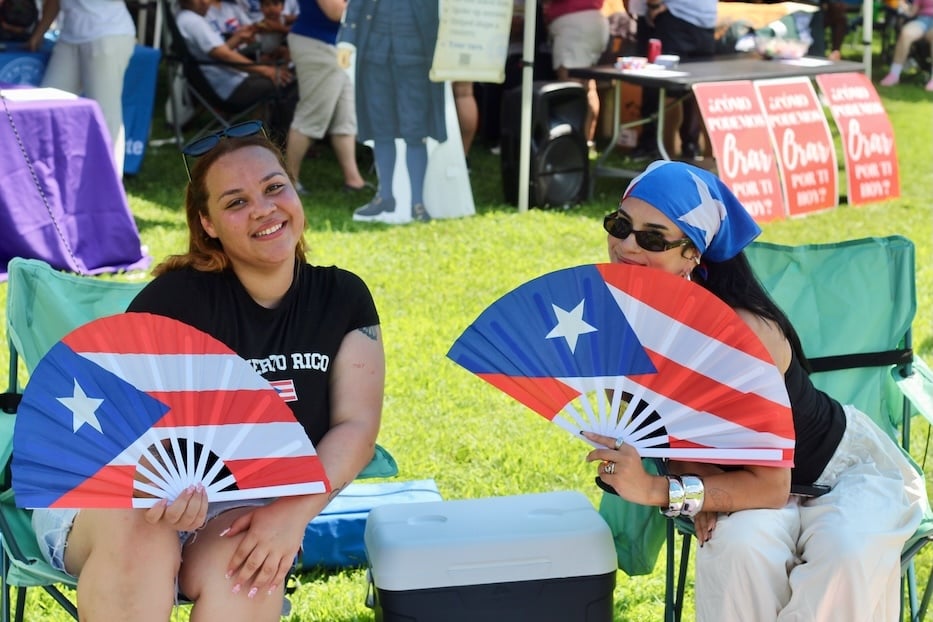
Across an expanse of grass dotted with Puerto Rican flags, friends Joyce Diaz and Astrid Mendez had finished setting up their tent, and let the sound of mid-afternoon salsa swirl around them. Born in Puerto Rico and raised in Waterbury, Diaz said that she was excited to come out to the festival—and had immediately been moved by how eager people seemed to help.
“To me, it’s honestly celebrating our culture, our community,” she said as a billow of pink silk rose up from the stage, signifying that young dancers from Leaders for Educational Advocacy and Diversity (LEAD) had taken the stage. She brought out a huge fan emblazoned with the Puerto Rican flag to keep herself cool as the temperature continued to rise.
.jpeg?width=933&height=622&name=TonyFalcone%20-%203%20(1).jpeg)
Top: Joyce Diaz and Astrid Mendez. Bottom: Sisters Danielle and Kaniya Rogers. Danielle is a rising freshman at Cooperative Arts & Humanities High School.
Beside her, Mendez said she was most ready for the day’s food and the music. Raised on the mainland, Mendez has worked for years to reconnect to her Puerto Rican culture, through everything from dancing to food. At home, she said, she and her boyfriend “try to keep that alive,” including with riffs on traditional Puerto Rican recipes. Saturday, she’d come out with black-tipped nails and a black tank top in a similar nod to independence.
Just a few yards away, sisters Danielle and Kaniya Rogers had begun to dance, hand in hand with each other as they worked on their salsa moves. The two, who are Black and Puerto Rican, called the festival a beautiful and timely reminder of the island’s diversity, where Puerto Ricans come in all colors, shapes and sizes due to the island’s long and layered history.
“I just love seeing my people,” said Kaniya, who learned to dance salsa from her dad, and then honed her skills with teacher Millette Nuñez during her time at James Hillhouse High School. “To me, I feel like there was a time when we weren’t able to show our culture, so it feels like freedom.”
Back on stage, emcees from Bomba Radio revved up the crowd, with a call of “Yo Soy Boricua!” that reverberated across the Green. From where the Rogers sisters stood to the tent Cajigas had been heading toward, hundreds of voices took up the charge, responding with a thunderous “Pa' Que Tu Lo Sepas!” that almost sounded like music.
As they walked by, two friends wearing matching shirts yelled the response, their voices rising bell-like and sharp into the thick, hot air. Across their shirts, the words “Chancleta Survivor” were emblazoned in a comic red-and-white font.
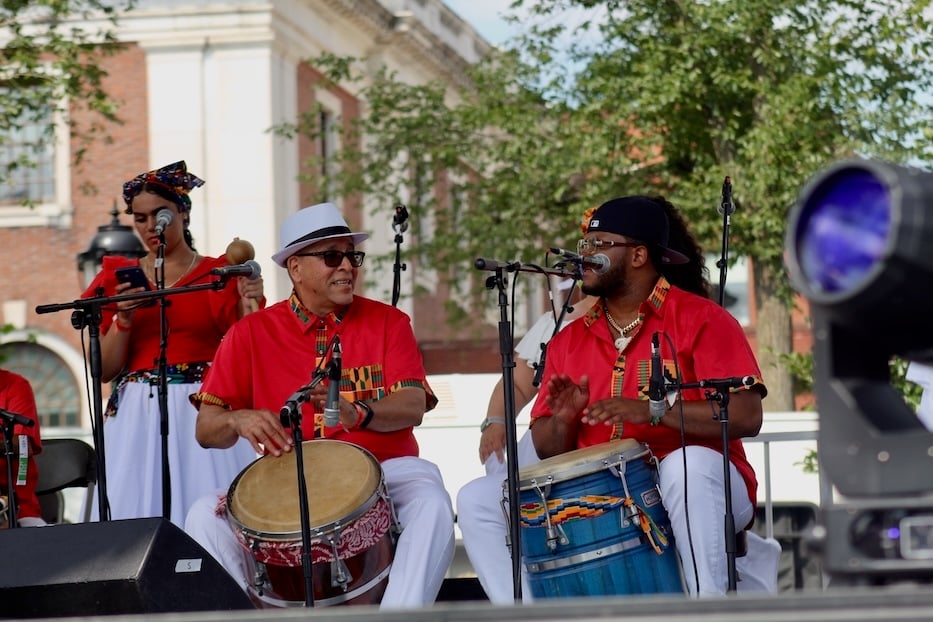
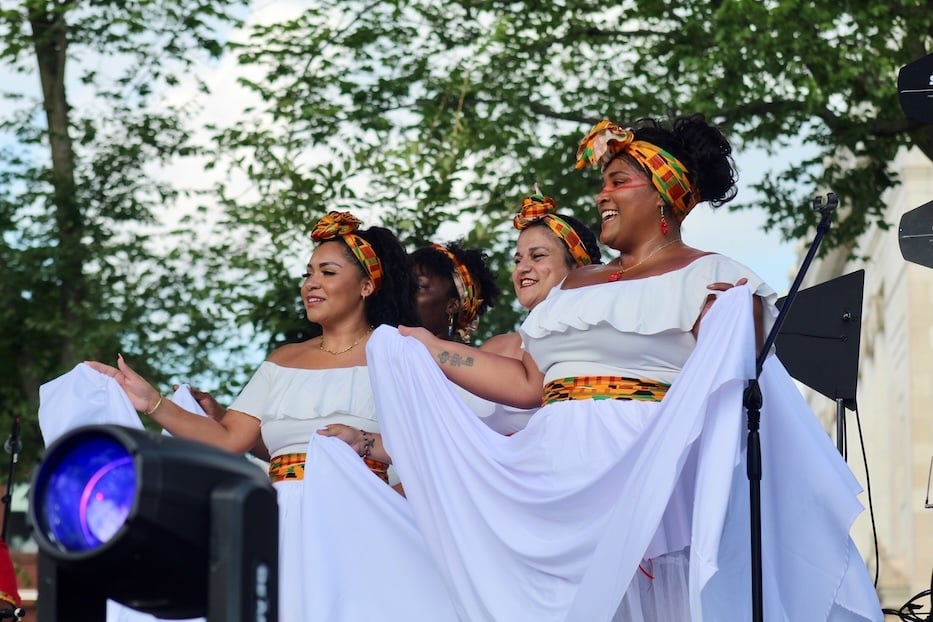
Top: Kevin Diaz and Alex Rosado of MCAC. Bottom: Bomba!
While this year’s pull may have been former TKA member La India, who has been hailed as “La Princesa de la Salsa” by the late salsa icon Celia Cruz (who was, fittingly, “La Reina de la Salsa”), an afternoon-long lineup of musicians brought the heat long before she arrived. As Carlos el Lunatico y Su Grupo Tipico wound down their set, members of Movimiento Cultural Afro-Continental (MCAC) waited in the wings, with a performance from students who have been learning bomba during a girls’ empowerment summer camp at Viva Dance & Fitness in West Haven.
When musicians slipped into their seats and placed their hands on their instruments, a kind of soul connection happened. They brought attendees to attention with the ringing, steady beat of barrilles, propulsive as dancers Kelvia Flores, Shantel Green, and Drea Sanchez swept onto the stage. Dancers swayed with original poetry that introduced Puerto Rico’s long history, and the origins of bomba as a music and movement of resistance.
“I am / resistance / wrapped in rhythm,” called out Green, her words carrying across the grass as the drums rolled beneath her, and she lifted a blood red cloth into the air and held it taut between both hands “I am bomba … and still, I am not your beginning.”
Behind her, Sanchez emerged as an Indigenous Taíno woman, a nod to the island’s painful history of colonization. She took it back centuries. “Before the ships, before the flag, before they renamed my land, I was Boricua!” she called out. “They tried to write that we vanished. But look closely—we are in the cheekbones. We are in the soil. We are in the word huracán!” The audience cheered.
Young dancers were already taking mental notes, many of which became part of their movement onstage. Samara Henaro, a student at W.F. Kaynor Technical High School in Waterbury, watched her teachers’ every movement. Moments later, as she took the spotlight in a billowing red skirt, she let those centuries of history move through her feet, her hips, and her bent arms.
“I like the music a lot,” said Henaro, who started dancing bomba roughly a year ago, in part because it helped her appreciate her own Guyanese heritage. While it had taken her a moment to move beyond “the adrenaline rush” that she gets every time she performs, she was thrilled to have done it.
“It was nerve wracking, but I felt more confident,” chimed in fellow camper Leilani Mielez, who was also still coming down from the performance.
Even as a few heavy clouds gathered overhead, the festival showed no sign of stopping. Diaz, sweaty and ecstatic after performing onstage, pointed to how natural and equally significant it felt for him to play bomba—and pass it on to the next generation—as he has for years now.
“It’s amazing!” he said. “This is in our DNA. We can play bomba all day, all night … it’s a 400-year-old tradition. It’s in our blood.”
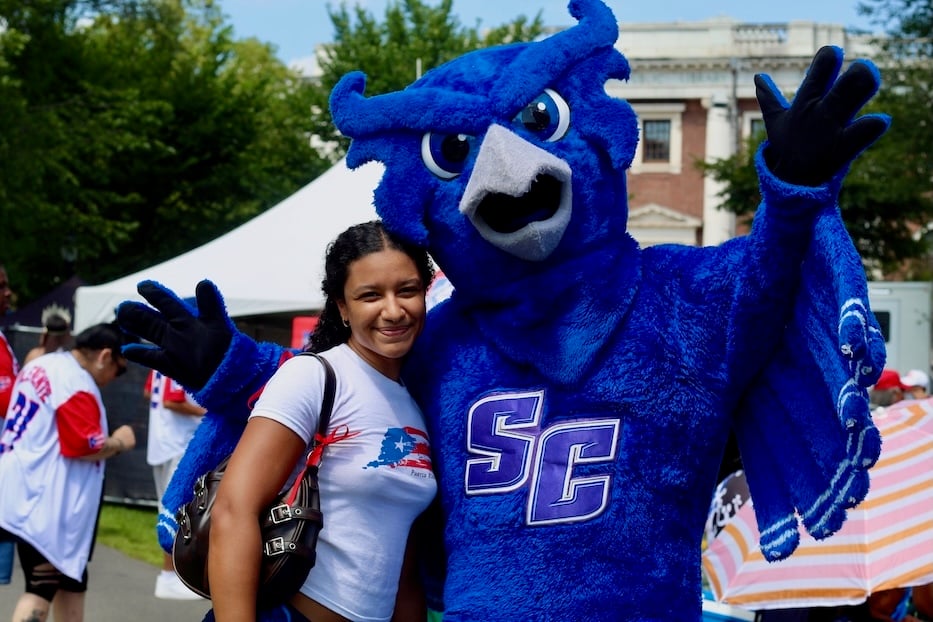
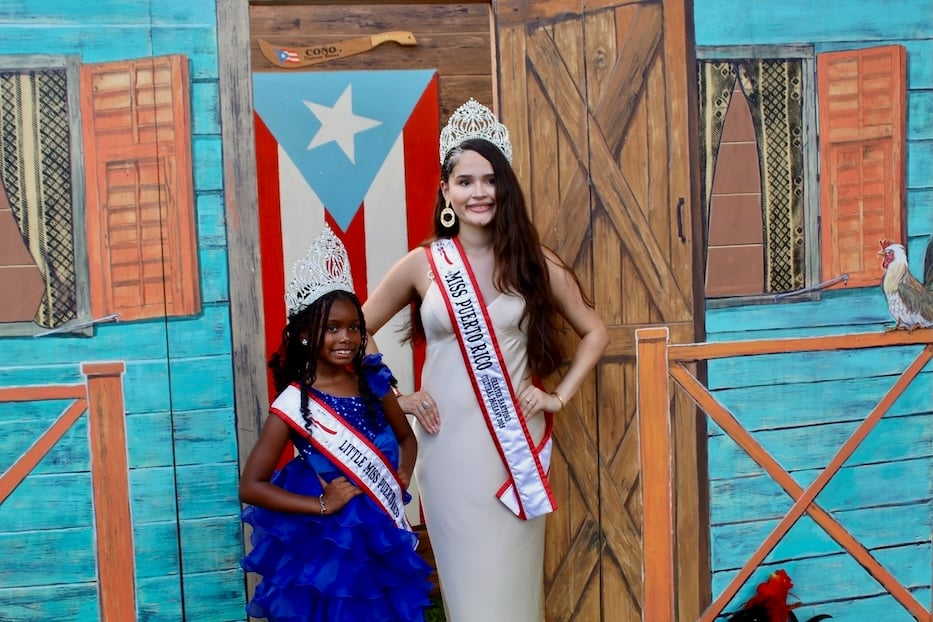
Top: Madison Roman and Otis. Bottom: Little Miss Puerto Rico and Miss Puerto Rico of Greater Hartford, E'lyanis Mia Starks Garcia and Charlotte Enid Agosto Ortiz. "For me it's about celebrating our African and Latino roots," said E'lyanis.
As they made their way down the criss-crossing pathways that cut across the Green, Southern Connecticut State University (SCSU) student Madison Roman and the school’s blue-feathered mascot, Otis, also took a moment to share a few dance steps with the crowd.
Roman, who was born in the Bronx and moved to New Haven as a teenager, praised the event for its sense of inclusivity, from different genres of music to the diversity among thousands of Puerto Ricans who attended.
As a future teacher—Roman is studying early childhood education, with the hope of shrinking the opportunity gap—the day’s mission resonated with her.
“I’m proud to be Puerto Rican!” she said. “It makes me feel like part of a community. I feel like there’s a lot of divisions in the world right now, and we’re just able to come together without judgement.”
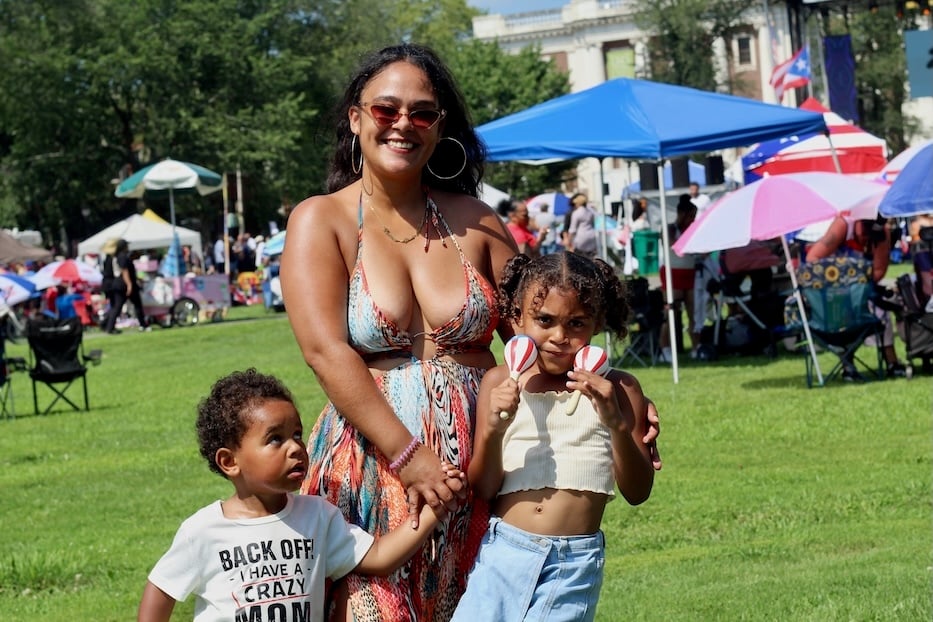
Top: Alejandra, with her kids MaRocco and Dhales. Bottom: David Sepulveda and his artwork. Sepulveda, who is Puerto Rican, received recognition for his work with PRU in 2018.
That was true, too, for Alejandra, who came out with her young kids, Dhales and MaRocco. For years, she experienced the Fiestas de Loíza en Connecticut en Honor al Apostol Santiago (FLECHAS), a precursor to the Puerto Rican Festival that Menen Osorio Fuentes co-founded in 1977, and community members ran until 2009. When FLECHAS ended, it left a palpable hole in the city’s Puerto Rican community—particularly at a time when that community was still growing.
So when Alejandra saw that the festival had returned a few years ago, she was thrilled. As Dhales played with a pair of flag-patterned maracas, she noted the significance of passing it on to the next generation.
“It feels so good!” she said of being back. “I’m happy. Everyone comes together.”
And around the Green, everyone had. Beyond bouncy houses, mobile basketball hoops and a tent for Via Láctea where Reinaldo Sánchez doled out generous scoops of piña colada, guava panetela and coquito ice cream, artist David Sepulveda and Bregamos Community Theater founder Rafael Ramos invited attendees to pose alongside two different backdrops, both equally important to the spirit of the island.
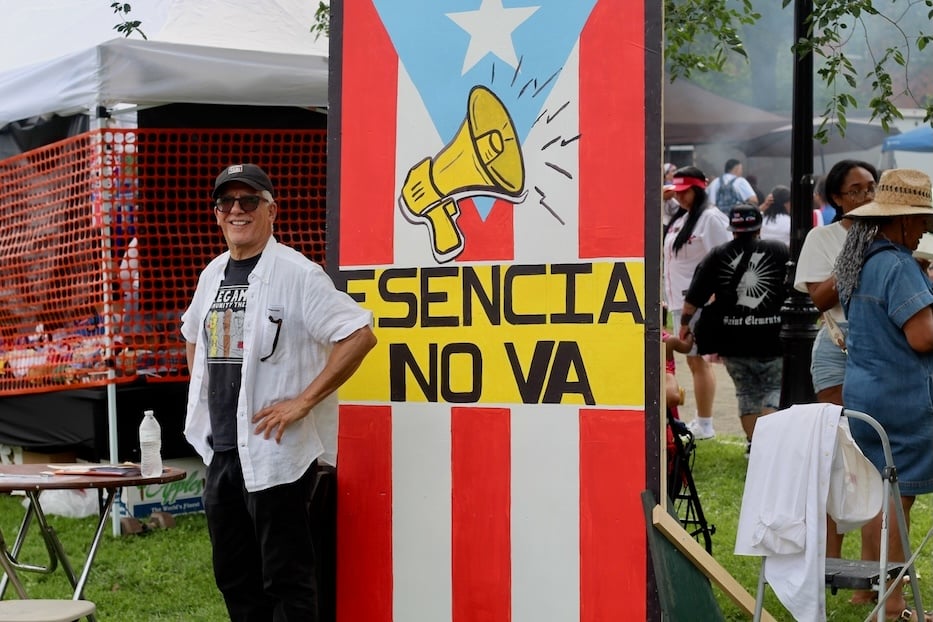
In one, Sepulveda explained, attendees could dress up as el jíbaro, a sustenance farmer who has become, in recent years especially, a symbol of Puerto Ricans’ relationship with the land and interest in reclaiming agricultural sovereignty. In another, which Sepulveda had completed just 24 hours before the festival, the words cut across Esencia no va cut across a Puerto Rican Flag in blocky yellow text, a megaphone electric above them.
“This is a case of class displacement,” Sepulveda said, explaining that the slogan references a 2,000-acre luxury development proposed for Cabo Rojo, Puerto Rico, that would close off public land—including beaches—to Puerto Ricans already living there. That kind of development, he continued. would further pitch the island into environmental and economic precarity, including scarcity of resources for those who are already living without basic necessities.
“We have to respond, be active, and support,” Sepulveda said, handing out copies of a zine he had made to further explain the issue.
Backstage, Rodriguez was still moving between musicians, chatting with attendees and making time for the occasional question. Beyond Saturday’s festivities, he said, PRU will be partnering with the Hartford-based Connecticut Institute for Community Development (CICD) to raise emergency relief funds for Puerto Rico, and distribute them to grassroots groups already working on the ground. Give here.
That work is ongoing, Rodriguez said; PRU and CIDC first collaborated on disaster relief after Hurricane Maria, and have since "replenished those funds over time.” In 2023, the two organizations distributed $6,000 in microgrants to organizations doing work on the island. Going forward, he said, they plan to do the same.
“I don’t care what your cause is,” he added. “Whether it’s environmental justice or politics … stand up for Puerto Rico, what you believe in. Our island needs us now more than ever.”