

Culture & Community | Education & Youth | Arts & Culture | Theater | New Haven Academy
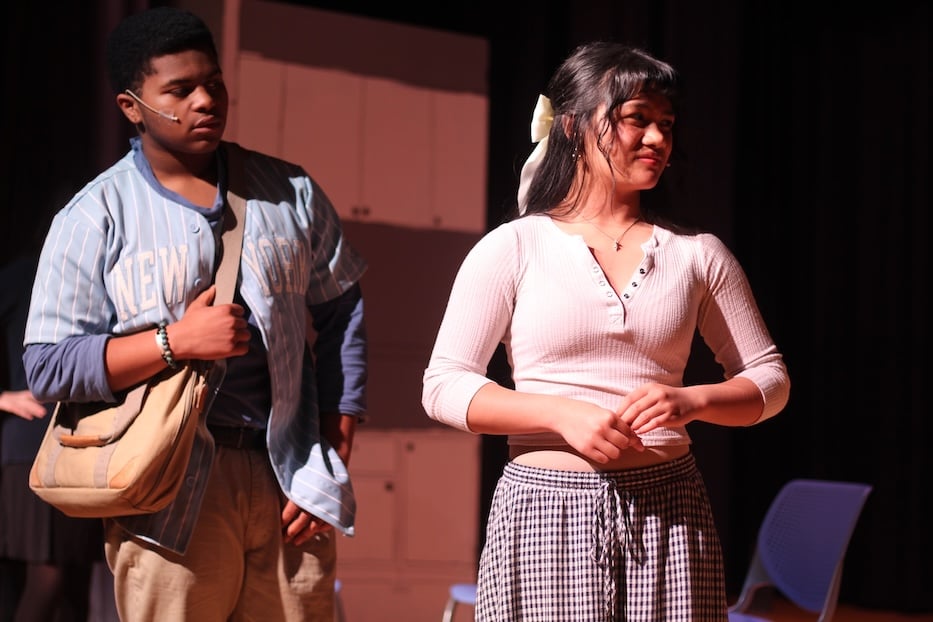
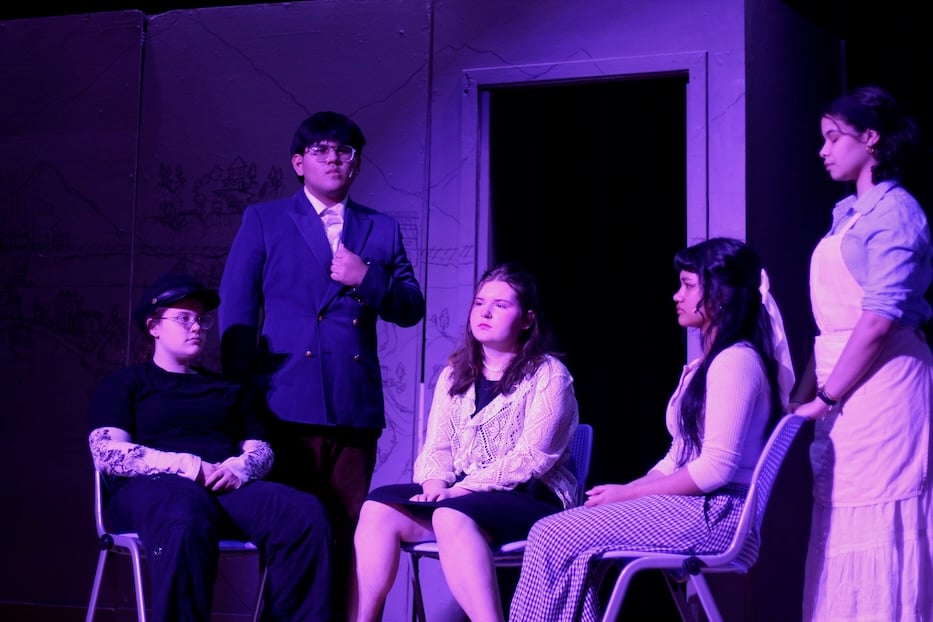
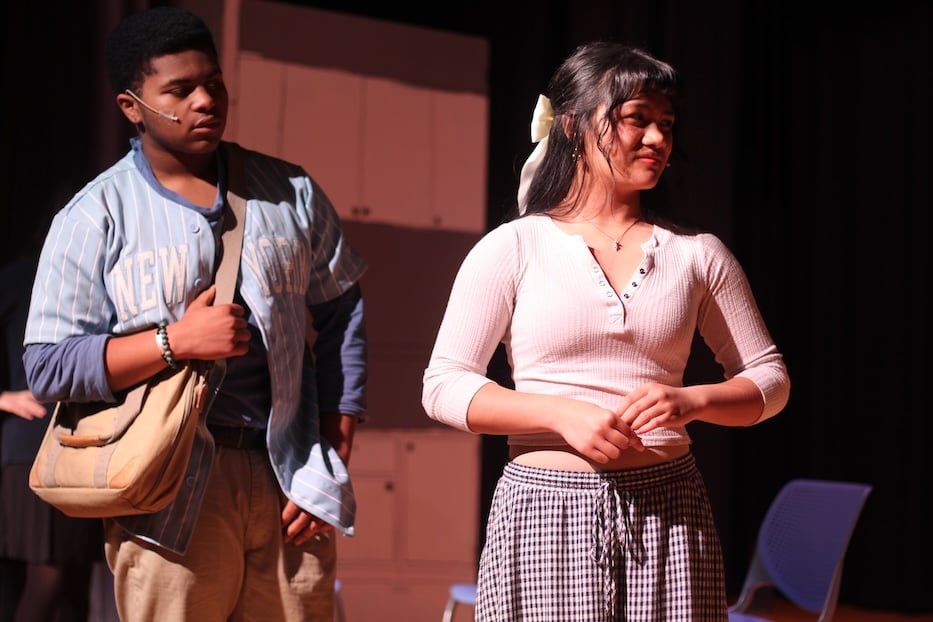
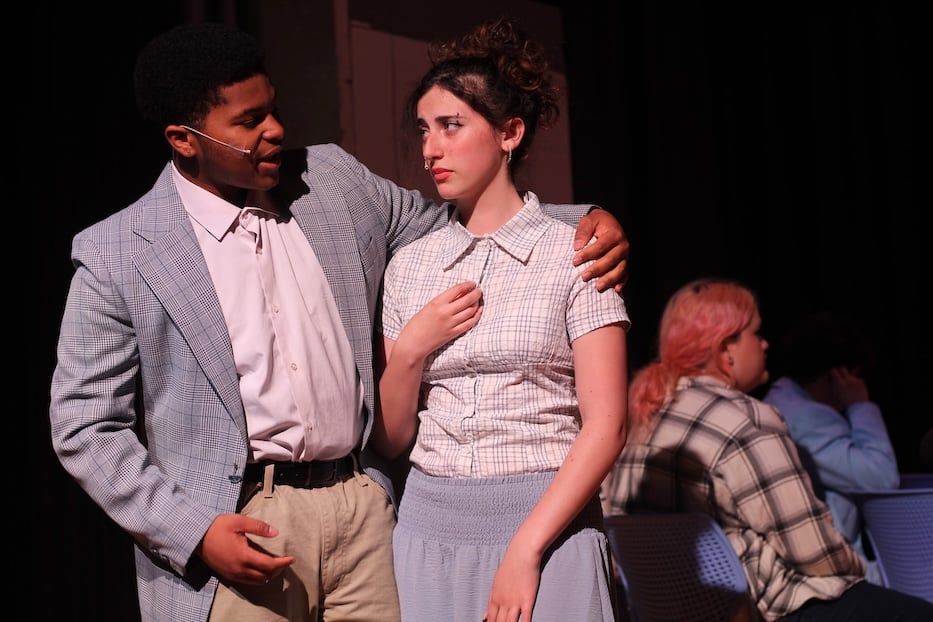
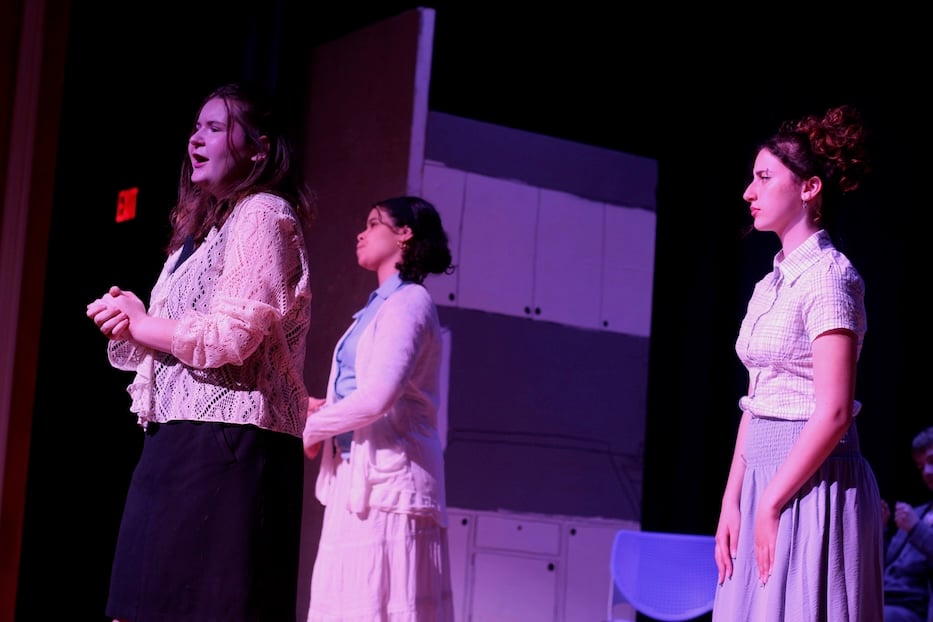
Top: Christopher Samuels and Thea Jade Barbieto in Our Town. Bottom: Gabriella Osborn, Joseph Pallo, Molly Davis, Thea Jade Barbieto, and Tomitsela Engel-Halfkenny.
The stage managers stand beside a sprawling map of Grover’s Corners, ready to take the audience on a journey. At the center, there is the railroad, the station puffing clouds of smoke into the air. Then Main Street, winding its way past a handful of shops, their windows still dark. The two point out the churches by denomination, moving from the Presbyterians to the Methodists, onto the Unitarians, and then the Baptists and the Catholics. Their voices are a meditation.
Dawn is breaking. Soon, Mrs. Gibbs and Mrs. Webb will be at their stoves, making breakfast for their children. The sound of an old, tired dairy cow will clip-clop down the street, jars of milk clinking beside it. But for a moment, this could be New Haven, sunlight slanting over the New Haven Green before the wondrous chaos of the day.
In a performance that finds profound strength in its understatedness, students in the Legacy Studios Drama Club present Thornton Wilder’s Our Town, transforming the 1938 play into one that is both cemented in time and completely of this moment. As it comes to the stage this weekend, cast and crew members have made it entirely their own, driving home a reminder to savor the present before it is gone.
The play, directed by “drama poppa” Ty Scurry, runs Thursday through Sunday at New Haven Academy at 444 Orange St. in New Haven. Tickets and more information are available here. It is, perhaps poetically, the final show for seniors who helped build Legacy their freshman year.
In addition to NHA, there is representation from Wilbur Cross High School, ACES Educational Center for the Arts, Betsy Ross Arts & Design Academy, and Cooperative Arts & Humanities High Schools.
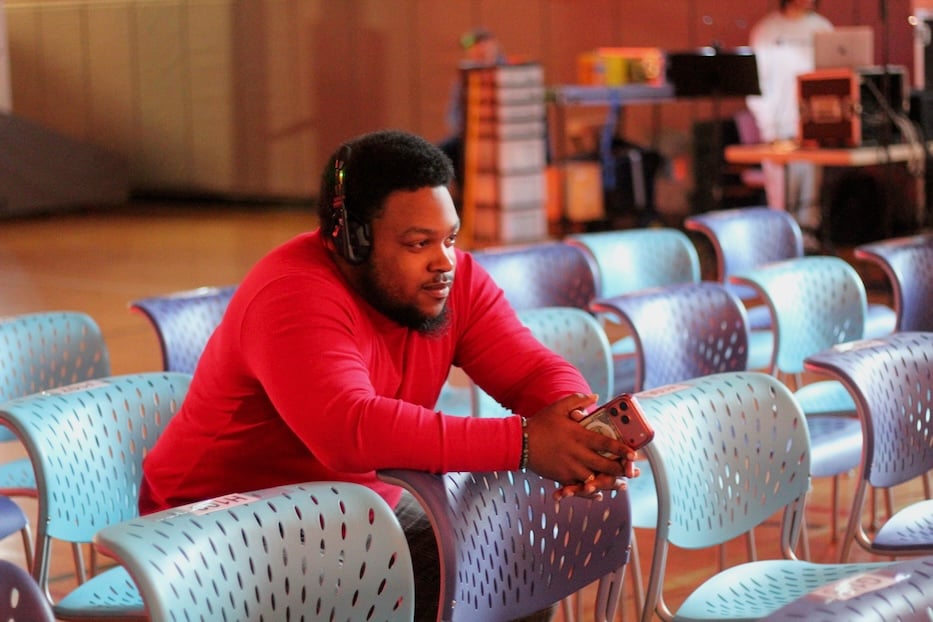
"Drama poppa" Ty Scurry, who has watched once-freshmen become seniors on the NHA stage.
“I wanted to challenge them [students], but also give them a chance to reflect on what they’ve built, especially the seniors,” Scurry said at a tech rehearsal on Tuesday night, adding that the play has come together in a miraculous five and a half weeks. “This show, for me, is a chance to give gratitude.”
Written in 1938 and set between 1901 and 1913, Our Town follows two families, the Gibbses and the Webbs, as they move through just over a decade of child-rearing, love, marriage, and death and dying in small-town New Hampshire. On one side of the stage, Dr. Frank Gibbs (Oliver Reymond) and his wife, Julia (Andy Sosa), are doting parents to their two children, George (Christopher Samuels) and Rebecca (Sophia Olivia Quiñones). On the other, newspaper editor Charles Webb (Joseph Pallo) and wife Myrtle (Tomitsela Engel-Halfkenny) love up on their children, Emily (Thea Jade Barbieto) and Wally (a sweetly bashful Gabriella Osborn).
Around them, life happens: babies are born across the river, the choir perseveres through the drunk and stormy whims of its conductor (Semaj Battle-Reed as a prickly and capricious Simon Stimson), technology keeps changing, faster than anyone can predict. Kids sip strawberry phosphates and learn to play baseball and make sure their Latin assignments are done before bed. Townies fret and fume and gossip (a winning Molly Davis as Ms. Soames), and sometimes the tea is piping hot. The story moves forward thanks to the Stage Manager (seniors Austen and Zooey Fay, who are also twins).
Everyone is growing up too fast, a fact that none of them can see until the moment, like a dream that dissolves in the sunlight, is gone. That’s the thing about time: its thievery is so subtle we don’t always feel it happening, until of course we do.
In the original script, Wilder makes it clear that Our Town belongs, in fact, to both the actors and the audience: he leaves space intentionally blank for the show’s director, producer, and actors, yoking Grover’s Corners to the actual setting at hand. The device, delivered deftly by the Stage Manager, invites whoever is in the room to see themselves in the characters, well before they ever step onstage or slide into a seat before the lights go down.
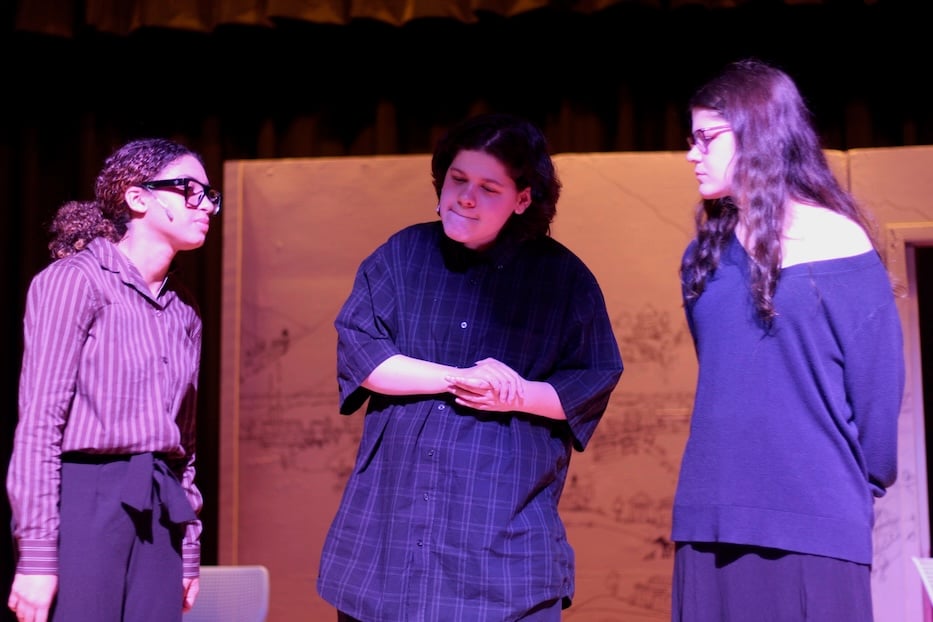
Janiyah Correa and Austen and Zooey Fay.
In this Our Town—which actually looks and feels like our town, thanks to a cast that reflects New Haven’s vibrant diversity—that’s all palpable, with a minimal set that lets the acting sing. As they step onstage, the Fay siblings feel like they were made for this show, with a kind of calm and measured pacing that is contagious. Here, the stage managers are not headset-sporting techies so much as dramatic puppeteers, omniscient as they build and conduct the world of the play.
Austen Fay, who has stage managed for Legacy Studios since his freshman year, holds onto the role’s irony here: he recognizes his character’s power, but never takes advantage of it because he loves the people onstage too much to do that to them. In lockstep with him, Zooey brings a coolness to the performance, as though the narrative cards she deals to actors don’t hold the weight of life and death.
As Grover’s Corners springs to life, everybody in this cast understands the assignment, and then some. When she comes on stage dragging an imaginary milk cow, Eleanor Burke (she plays the dairy farmer, Howie Newsome) sets the show into motion, mining the character for grit and humor when the lines alone don’t give her much to work with.
Taking the same lead, the town’s residents each shine in their own way. Davis, who is just a freshman, is sharp-tongued and animated as she hams it up as the town gossip, with a keen sense of timing that hits when a person least expects it. As bright-eyed newspaper boy Joe Crowell, Jr., Jaileen Sowell is so winsome that it’s a gut punch when Austen Fay announces that the character studied at MIT just to die in the Second World War. Even as the croaky-voiced history professor, who is perhaps as old as the town itself, Janiyah Correa finds both heart and humor, with a speech pattern that runs on a comic, almost cartoon-like delay.
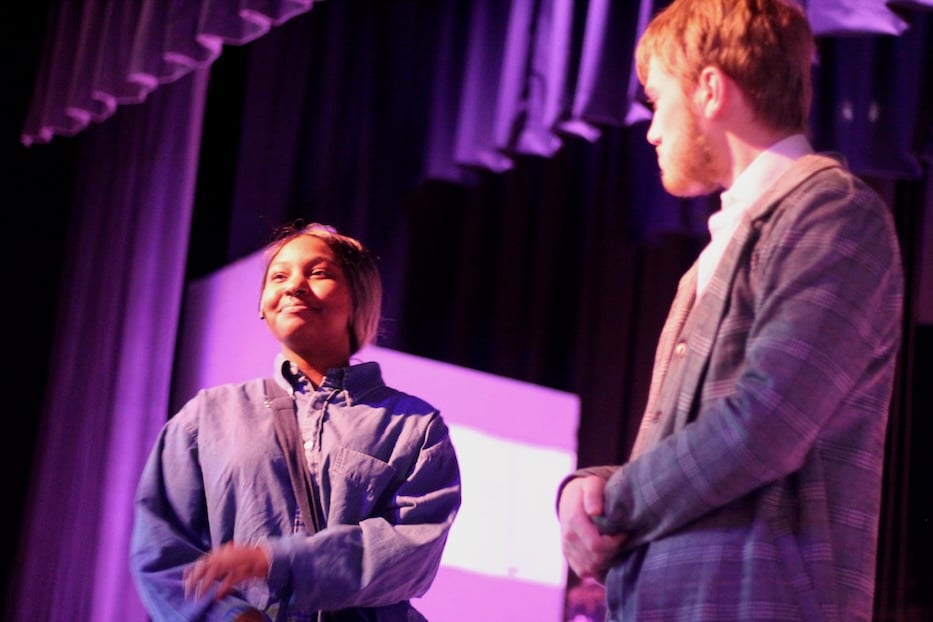
Jaileen Sowell and Oliver Reymond.
Grover’s Corners, which is both of our world and not, is of course not without humor and moxie and romance, and this cast of young people just gets it. When, as Stimson, Battle-Reed half-growls, half-barks that the choir should “leave loudness to the Methodists!” it is scathing enough to bite, and becomes fodder for evening gossip amid the thick, sweet scent of heliotrope.
When, as George and Emily, Samuels and Barbieto begin that awkward dance of young love, they nail the sublime inelegance of living in that in-between, the liminal space between crushing on someone and folding them into every part of one’s life. So much of this discovery—whispered conversations, homework help, heart-opening disclosures made over ice cream sodas—is a testament to Scurry’s directorial eye, which finds emotional depth the actors need to pull the second and third acts off.
For those who have watched these young thespians bloom into being, there’s an equally fun chemistry between Pallo and Samuels that gives Outsiders vibes, a testament to the lives they have lived on this stage (Reymond and Samuels are also dynamic as father and son, but take time to find their rhythm). So too in the sweet, shared moments between Engel-Halfkenny and Sosa, who here take on the mental load of motherhood with a sort of wisdom and sass that seems well beyond their years.
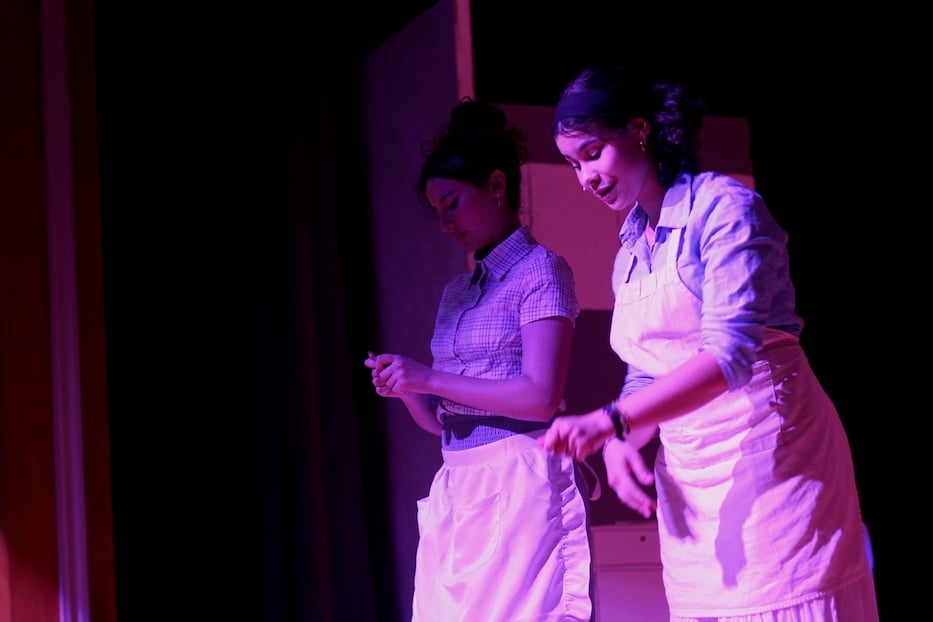
Andy Sosa and Tomi Engel-Halfkenny.
In one, for instance, the two are standing side-by-side, stringing beans that will make their way to the canning process, and become part of Ms. Webb’s pantry for the fall and winter months. The conversation is natural, easy: the two talk about Myrtle’s lingering cold, about their chicks—both human and avian—and their husbands, about the furniture salesmen who have recently been by, and the things they would do with a sudden infusion of a few hundred dollars.
“He offered me three hundred fifty dollars for Grandmother Wentworth's highboy, as I'm sitting here!” Julia Gibbs says, and the glimmer of a dream dances behind her eyes. Myrtle Webb bursts into a smile that is infectious. “Why, Julia Gibbs!” she says, and there is such warmth there that the moment is one we want to preserve in amber. Whatever comes next, she already knows that she’ll support it.
In addition to both of them—Engel-Halfkenny and Sosa are veterans of this stage—the show belongs to Barbieto, a senior at Co-Op who is often behind the scenes, working on her visual art projects. When as Emily she heads off to school, an oversized white bow in her hair, Barbieto is buoyant and girlish, with a serious, scholarly streak that makes it clear she’s capable of anything.
When she tucks in beside her mother and asks questions about growing up, the catch in her voice is genuine enough to forget that Engel-Halfkenny is her peer, and not her senior. When she speaks candidly to the boy next door, outlining the flaws that he can’t see, her mouth twists in a way that shows she also is falling in love with him.
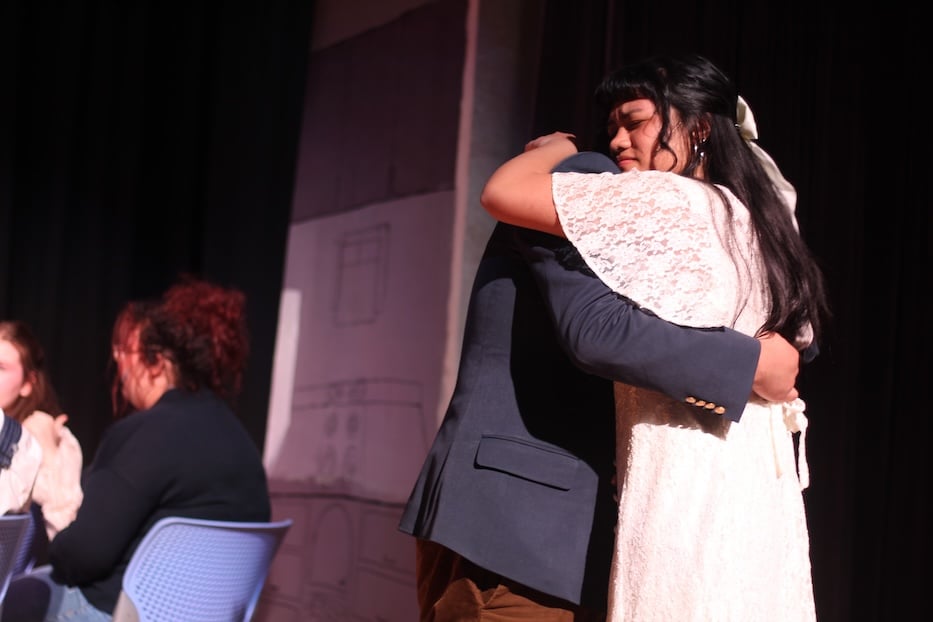
Pallo and Barbieto.
And when she, joyfully recalling a speech she gave on the Louisiana Purchase, confides in her father that “it was like silk off a spool! I’m going to be making them my whole life!” our hearts crack wide open and then crack again, because her whole life is so much shorter than anyone (except, perhaps, those all-knowing Fay siblings) knows at that moment.
That’s the point, right? We eat our breakfast and go to school and kiss our babies so quickly that we forget to breathe them in, and stop time for a single, shampoo- and dirt-scented moment. We throw baseballs and rush home and eat dinner and assume we will get to do it all again the next day. We move, constantly: through our homes, down our streets, in our schools and workplaces, from one task to the next, from one chapter of life to another. We strive so hard we forget why we are striving in the first place.
If we are lucky, we learn to stop, too, for the perfect pitch, for a meal lovingly cooked and the hands that cooked it, for the smell of heliotrope on a spring evening like the ones this week, where there’s just an edge of cold left in the air.
What a surreal privilege, this act of living. Or as Emily says at the end of the show, in a way that can bring a person to their knees, “Do any human beings ever realize life while they live it? Every, every minute?”
Christopher Samuels and Andy Sosa.
Scurry wanted to bring that message home this year, he said at a tech rehearsal this week. When he first read the show as a sophomore in high school—Scurry is a graduate of Wilbur Cross, where he was very much a theater kid himself—he didn’t understand why it had withstood the test of time. He found it dry and entirely too long, with dialogue that felt too old-timey to survive in a New Haven classroom, much less on a high school stage.
But then years passed. Scurry graduated from high school and started a drama program at James Hillhouse High School. It was there, around the time he’d started rehearsals for The Wiz—an early casualty of the Covid-19 pandemic—that English teacher Tim Kane suggested he read it again. Something clicked for the first time. Close to a decade later, it’s clicking all over again.
“It’s just a beautiful story,” he said.
As students perform it, they’re also entering a sort of New Haven theater history: Long Wharf Theatre mounted Our Town 12 years ago in 2014, with a cast that included community members and featured artwork by third grade students from Davis Street School. Four years ago, in 2022, the theater returned to it for a single evening, as they read an excerpt during a farewell to the theater’s long-time Long Wharf home. Almost a century before that, in 1929, Wilder built a home in Hamden, Connecticut that still stands on Deepwood Drive today.
Davis (at front of stage) with Tomi Engel-Halfkenny and Andy Sosa.
At a dress rehearsal Tuesday, several of the seniors in the cast said that the show has taken on an emotional weight as they prepare to graduate. In a few minutes, the curtain would open to a quiet set, chairs arranged at the upper left and right corners. Students, filling them, would break into one of the only changes that Scurry has made to the show: an a cappella cover of Bill Withers’ “Lean On Me,” which lifts the show before it has even begun.
Back in the cafeteria, Austen and Zooey Fay slipped into a table across from Scurry, reminiscing on their four years of high school. During that time, they’ve watched Legacy transform from an idea into a full after-school club with three shows a year.
“The time went by very quickly,” said Austen, who plans to attend UConn in the fall. “I’m like, ready to go do more in college but I’m not ready to go. Having a lead role is really interesting, because you get to see a lot more of the perspective from actors.”
“I’m not ready for you to go!” added Scurry with a laugh, praising him as the best actual stage manager he’s seen in a very long time.
Nearby, Barbieto and Engel-Halfkenny chatted before actors finished getting in costume and Scurry called places. Engel-Halfkenny, who plans to attend Sarah Lawrence College, said she’s grateful to take on the role of mother one last time (she was Asaka, Mother of the Earth, in Once On This Island last year), in part because she’s such a natural caretaker at home and in her family. The character just feels right. She was also excited by the challenge, she added: Wilder didn’t give the Mrs. Webbs of the world that much to work with, so she had to do a lot of critical work around character development.
“You kind of become them, you have no choice” Barbieto chimed in. She later added that she’s been able to sit with her character’s narrative arc, in which Emily suffers a tragic fate when she is still just barely an adult herself.
“I think it’s easier to find that space because I’m a senior,” she said. “It’s not the end of my actual life, but it’s the end of this part of my life.”