

Culture & Community | Fashion | Arts & Culture | Ninth Square | The Devil's Gear Bike Shop
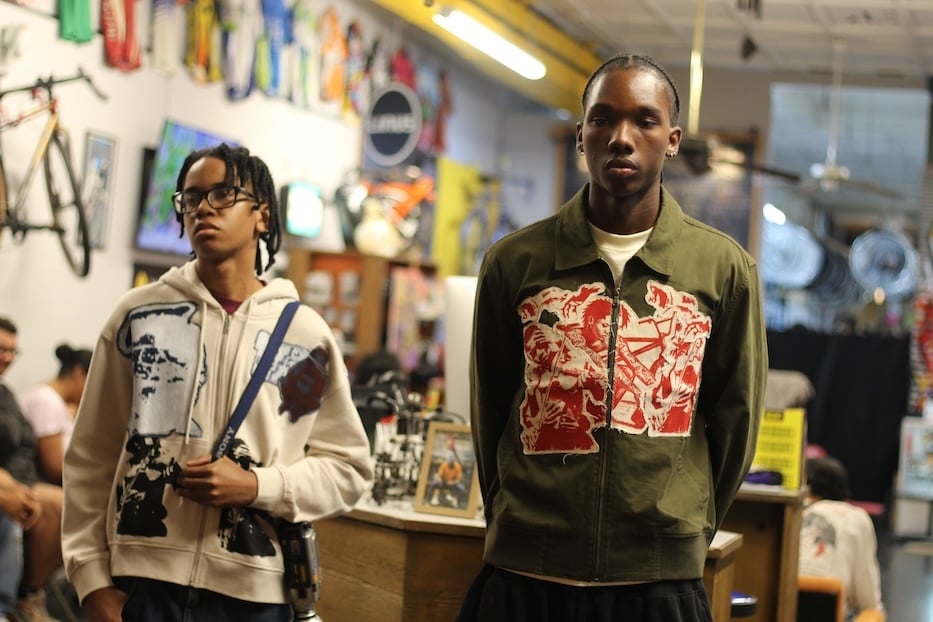
Designs from RNS, in which clothing became a sort of narrative through line of the night. Lucy Gellman Photos.
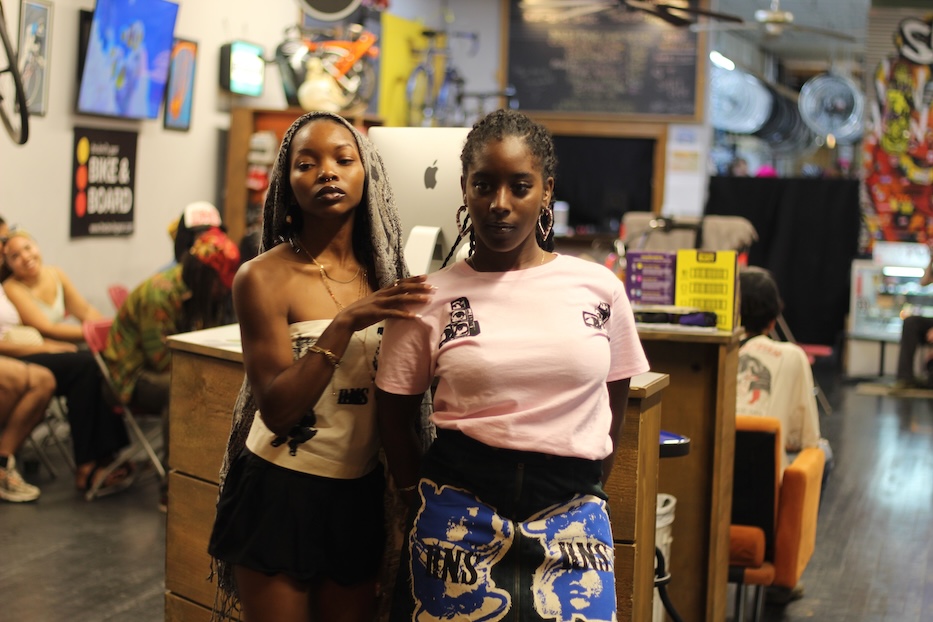
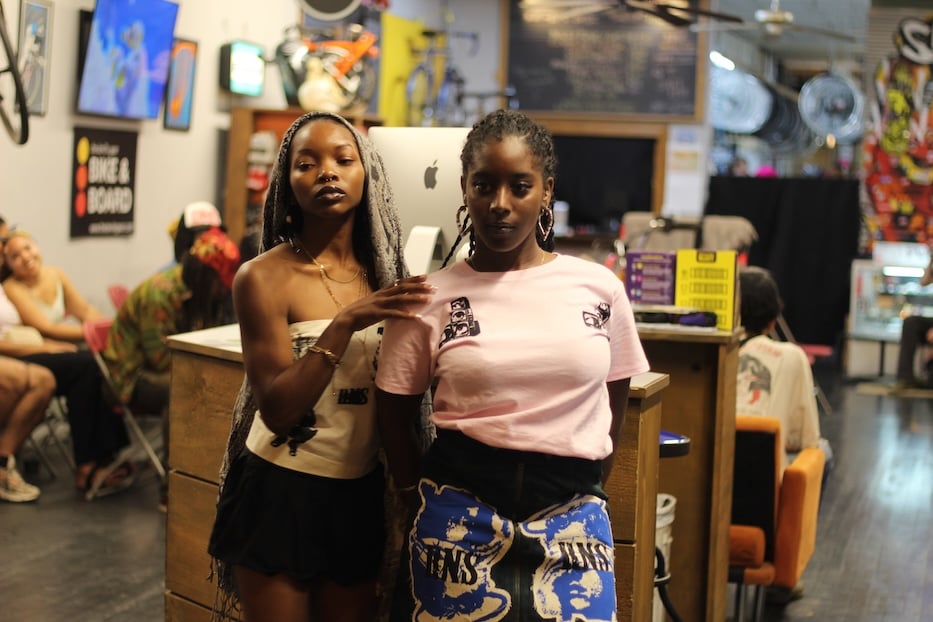
At first, there was so much to take in that it seemed like a person could go back 10 times, and still miss something. At the rose-colored corners of a model’s shirt, old-school, boxy television sets sat atop each other, an eye open and unblinking at the center of each. Beneath it, a skirt exploded into color, trypan blue splashed across two large patches that had been carefully sewn on. If a person looked closely, they could see faces emerge in the pools of color, a trio of letters printed just beneath the forehead.
For William Higgins and Nigel Lowndes, who are founding members of the streetwear brand RNS, it was part of a vision coming to fruition—with a room of peers and mentors to cheer them on.
That style came to Chapel Street Friday night, as the nascent, New Haven-grown brand RNS celebrated its first birthday with a fashion show, music performance and sartorial collaboration at The Devil’s Gear Bike Shop downtown. For close to two hours, a cast of over a dozen models strutted, posed, and worked the runway, turning a bike and skateboard shop into a portal to high art and sustainable streetwear.
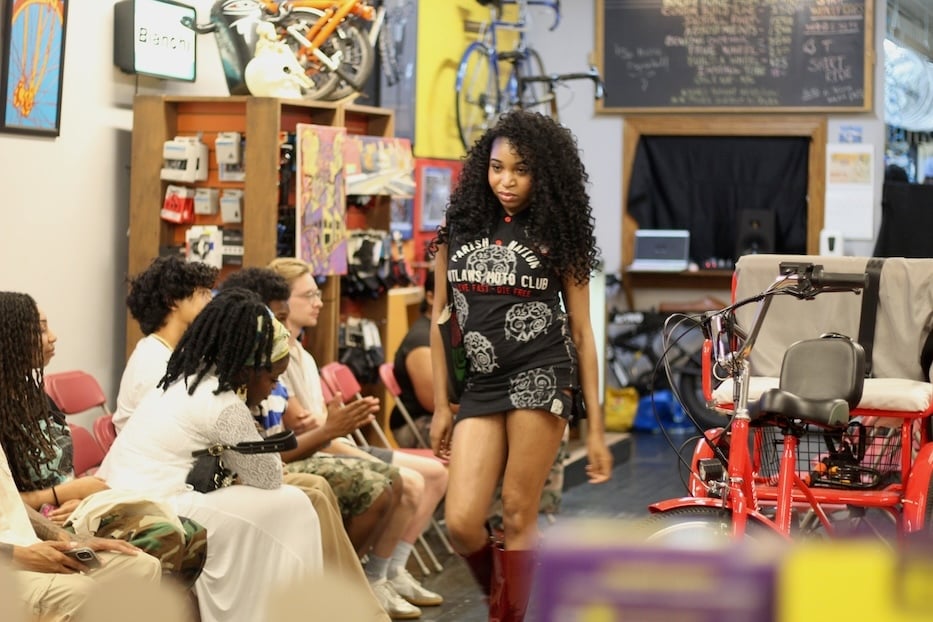
Christmas models Open Mnds.
Collaborators included Open Mnds Founder Terence Okwuosa, Threads By Tea Founder Tea Montgomery, and Johnny Brehon and Greg Ledovsky of Devil’s Gear. Together and apart, the three designers offered dozens of striking, often labor-intensive looks (and lewks), each imbued with a fierce and singular sense of personality.
DeadBy5am’s Brenton Schumaker, who has been a mentor to Higgins and Lowndes for over a year, did not bring work but came for the show, cheering the two on.
“It’s a movie and our story,” said Higgins when asked what a person could expect to see as the runway heated up, and models began to walk. He added that the moment felt a little surreal, as has much of his journey into fashion design. “I’m nervous, I’m happy, I’m excited.”
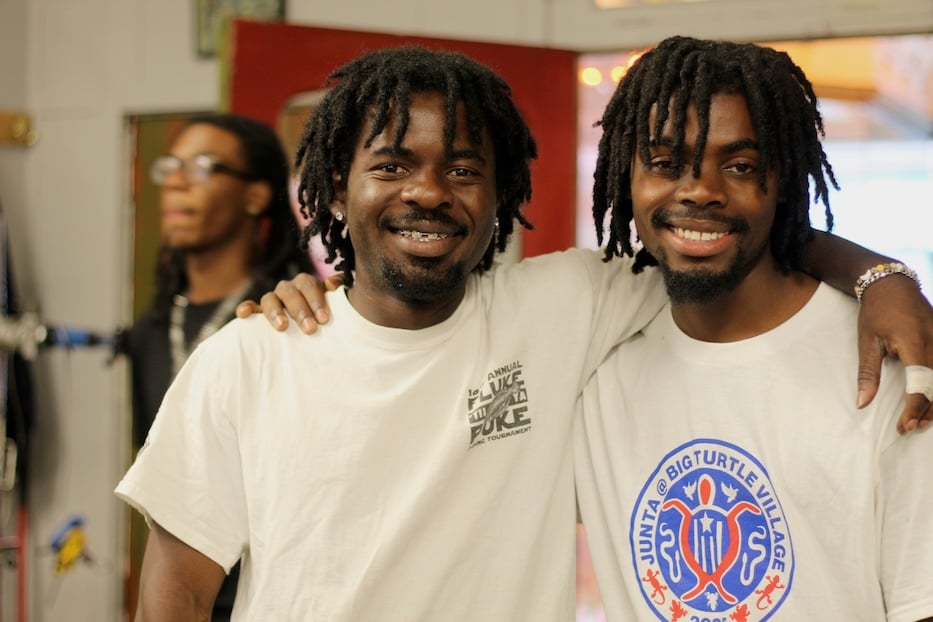
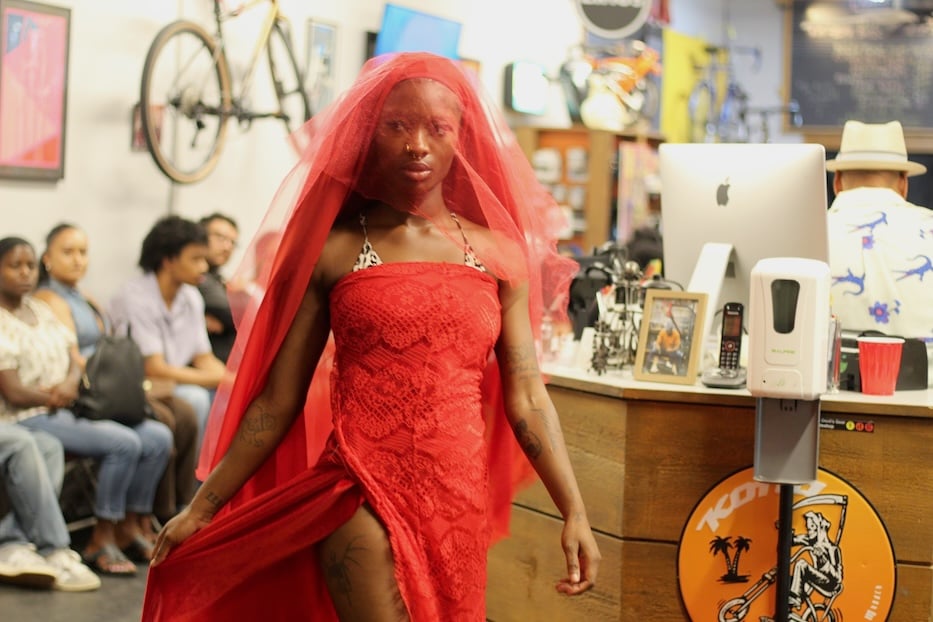
Top: William Higgins and Nigel Lowndes. Bottom: One of the night's final looks from RNS.
The show was months in the making, both he and Lowndes added. Around February, when winter seemed like it might stick around forever, Higgins started thinking about where he could mount an inaugural fashion show, a task that has followed (and at times, plagued) many a designer in New Haven.
In the past years, fellow fashionistas have gotten creative: runways have popped up everywhere from CITA Park to Westville’s Central Avenue Patio to the atrium at New Haven’s City Hall. At times, they’ve filled gymnasiums, streets, train stations (and Metro-North trains) and parking lots, making do with what they have. But Higgins’ mind went to his trusty bike—“that’s my primary mode of transportation,” he said—and the shop owners who keep it in tip-top shape.
When he brought the idea to Brehon and Ledovsky, it was an easy yes. For years now, the two have been trying to create a bike and skate shop that is also a cultural third space, with pop-up exhibitions and concerts that have featured artists like Sir-Michael Burrow and Lovelind Richards. For years now, the shop has also been a steadfast supporter of the music festival Seeing Sounds, which last year made the move from Edgewood Park to downtown New Haven.
“We don’t know where these kids will end up, and this may be the jumping off point for them,” Brehon said, sitting amidst large, spindilly wheels and half-assembled bicycle skeletons in the shop’s repair bay. He looked around as one model made a beeline for the bathroom, and another found a spot to slip on the final pieces of their outfit. “This is truly New Haven, and we’re glad to nurture it.”
He’s been “actually, like blown away” by the dedication Higgins and Lowndes, who are 22 and 20 respectively, have put into the show. In the weeks leading up to Friday’s event, they came in to look at the space, map out a potential runway, and run rehearsals with models to make sure they felt comfortable. Then Friday morning, the two arrived hours early to clean and prepare the shop. Brehon said they’d been there all day, running between floors.
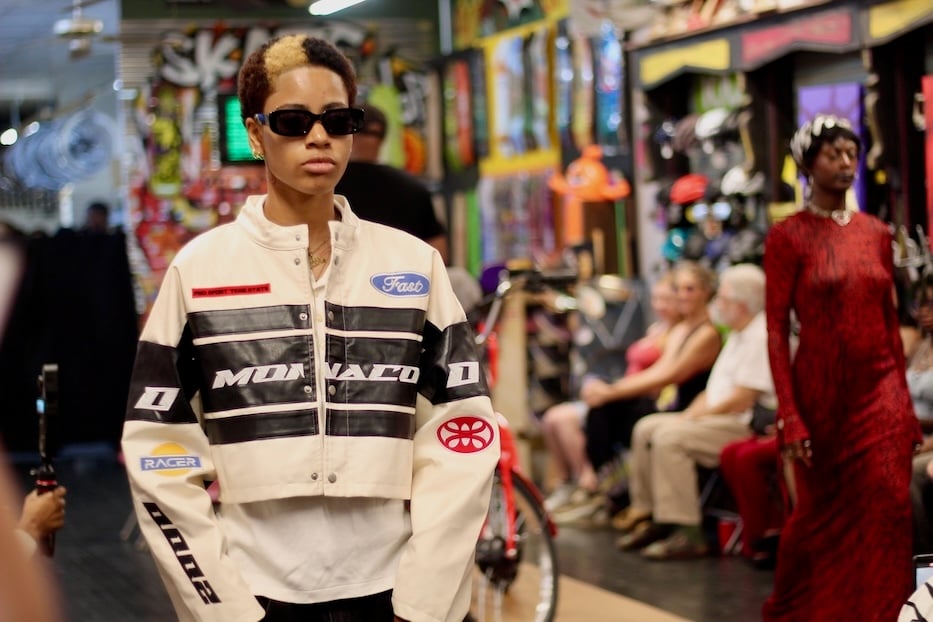
As models walked the runway—first to pumping and lo-fi music, and then to a voiceover from Sweets & Sounds Founder Angel Dahfay, a person could see their vision come to life in full, vibrant color and dynamic design, from repurposed garments to hand-sewn jackets, pants and skirts that gave fabric a completely new life.
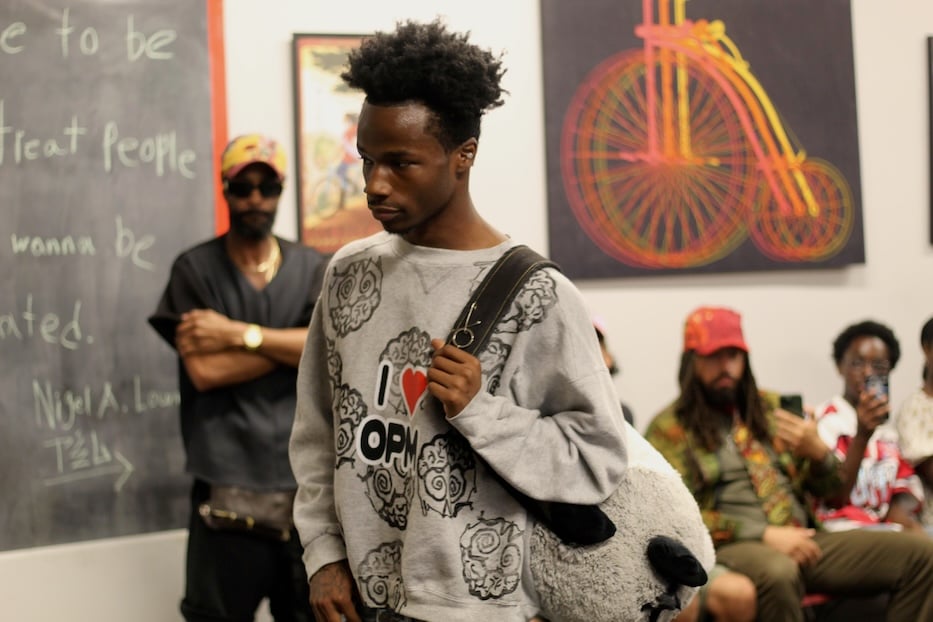
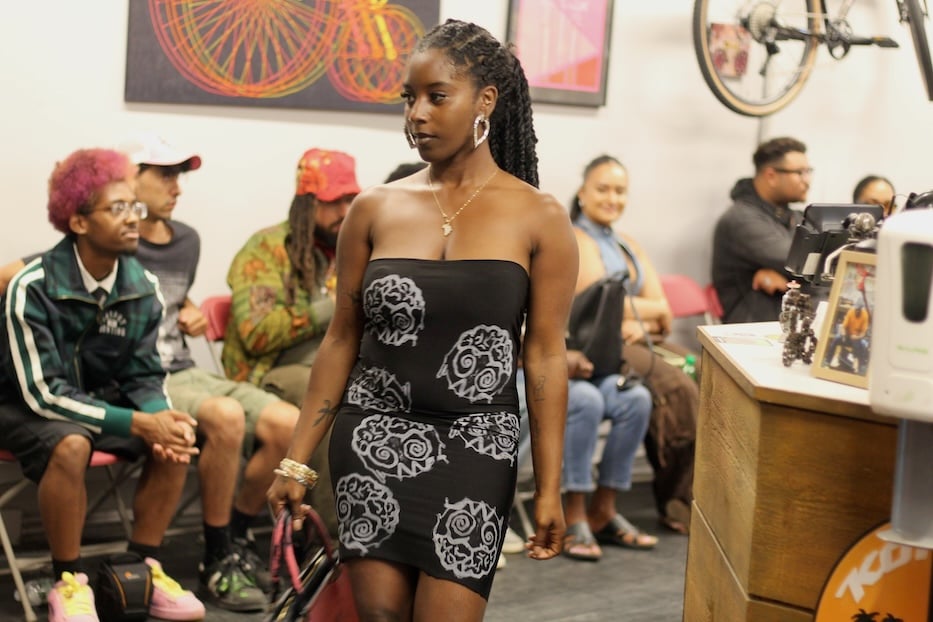
During the first of three sets, dedicated to RNS’s nascent and new work, Higgins and Lowndes showed off their versatility, from sleek, body-hugging and patterned dresses to repurposed jerseys to hand-sewn and printed pieces.
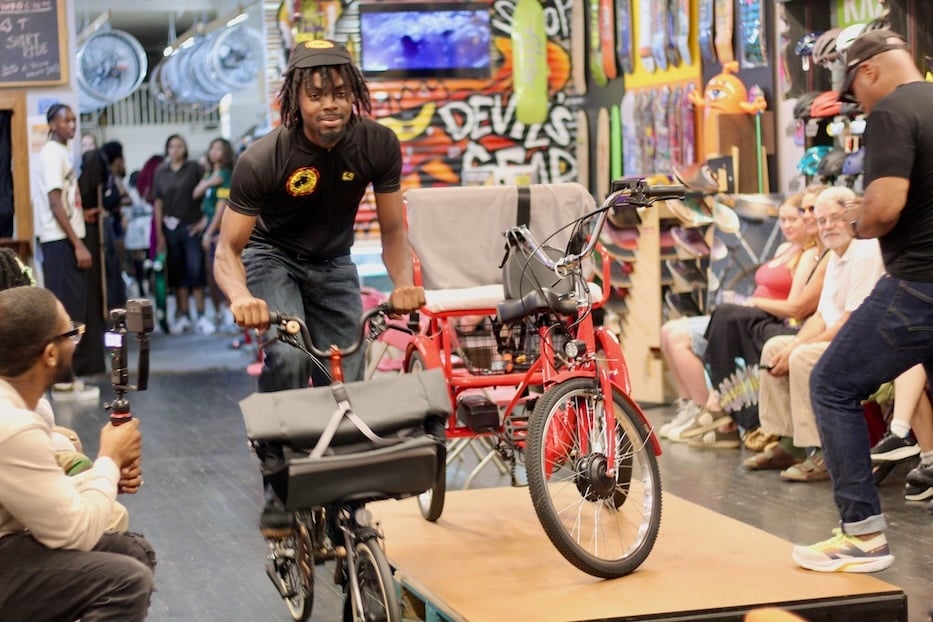
Lowndes made it clear that the brand intends to make a communal and yet grand entrance: he kicked off the show by donning a fitted Devil’s Gear cycling jersey and riding through the space. On a plush couch by the register, where the makeshift runway forked, his mother Dionne Lowndes lifted her phone and began to record, beaming as she watched her child glide past skateboards and cycles.
“It’s pretty incredible,” she said as another model emerged, a skateboard tucked beneath one arm as she showed off cropped, embroidered jeans and a rhinestone-studded belt. “I’m so proud of him.”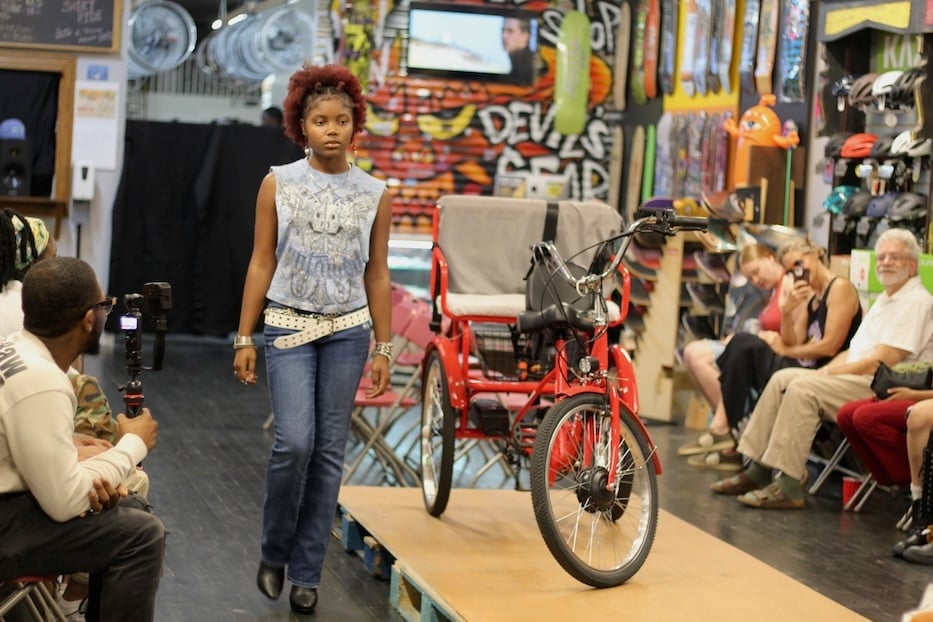
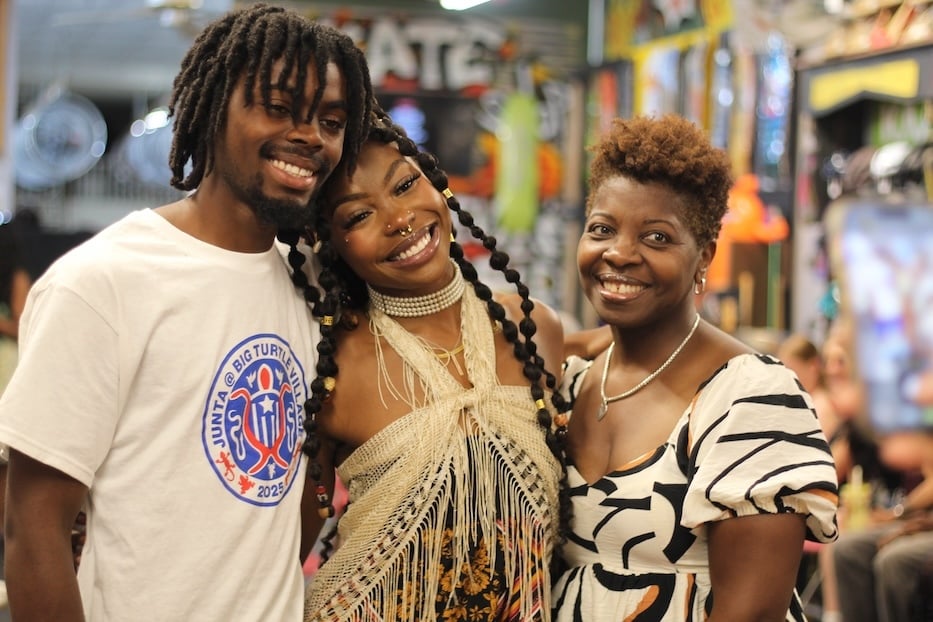
Lowndes with his big sister, Jahlyn Lowndes, and his mom, Dionne.
The fits, for which he had very much set the tone, kept coming. From reworked sports and university apparel (have you seen a Green Bay Packers jersey made into a crop top with a diagonal hem?), models emerged from a makeshift staging area in dresses that made it feel like a night on the town. In one, a cheetah-print stretched across hydrant-red fabric, a thick band of spotted fabric sewn in between two lengths of stripes.
When the model pulled her arms back, a viewer could see the magic of the outfit: the fabric had a sheen to it, letting the light dance around skin encased in the sleeves. To complete the look, RNS’ designers had added a black and white headscarf, with a sense of an outfit that might go from day to night, pedestrian to club-ready.
At another moment that drew snaps and cheers, a thick black curtain parted to reveal Lowndes’ older sister, Jahlyn, in a brightly-patterned dress, a shawl with fringe fitted over the chest, and then looped around to make a halter top. As she walked down the runway, eyes fixed on the open front door and a lamp-lit, humid Chapel Street outside, the fabric fluttered from her shoulders to her ankles, clusters of orange flowers bright against an orange-and-pink zigzag pattern and a black background.
Part of the thrill, as people watched, was the diversity in RNS’s design, from reworked denim to Frankensteined, baggy skirts that included old neckties and strips of different fabric. There were body-hugging corsets and t-shirts with raised embroidery and cut-off sleeves, for an aesthetic somewhere between West Side Story, Avril Lavigne and the 1980s punk band Death. There were coordinated black-and-white numbers that looked neat as a pin, and printed streetwear that seemed ready for the New Haven Green.
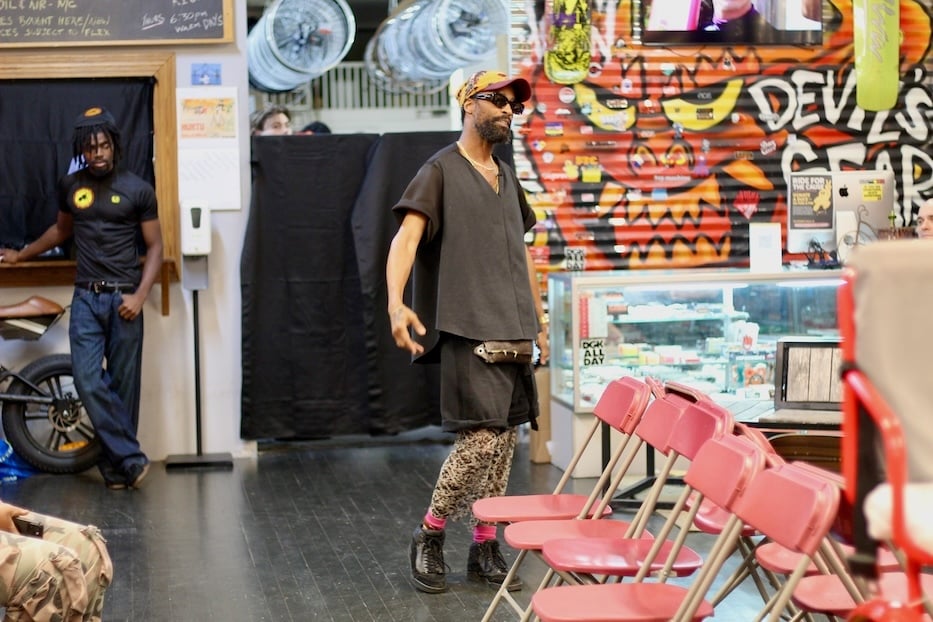
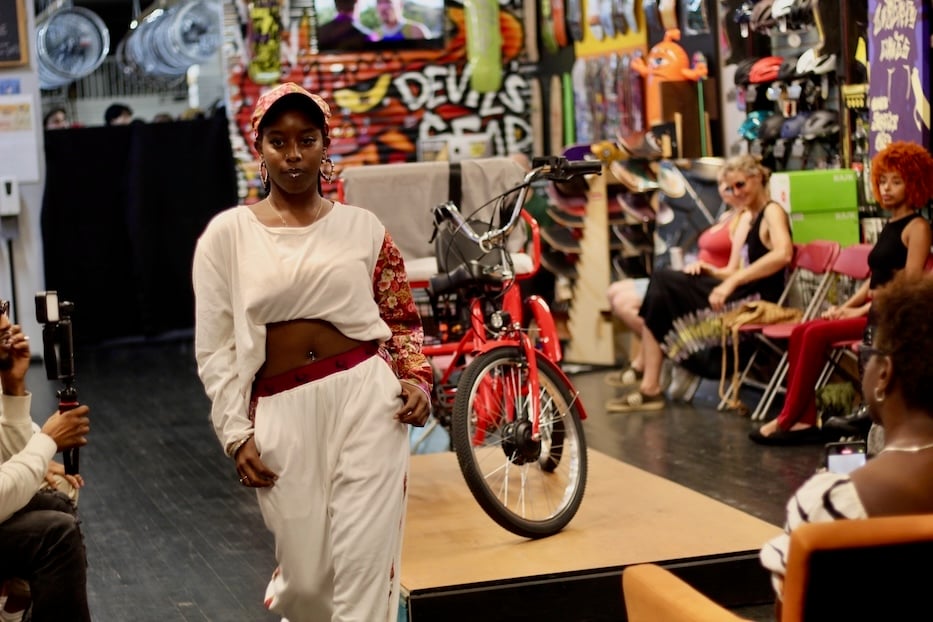
That momentum continued as Lowndes—“Can I get a yyyeeeearh?” he asked, cupping his hands around his mouth as attendees responded enthusiastically—introduced Montgomery, who has become a fixture of New Haven’s fashion scene with Threads By Tea and a constant, curious willingness to collaborate and experiment.
A little less than a year ago, Lowndes remembered, he met Montgomery at Bregamos Community Theater, after founder Rafael Ramos asked him to help out with Trash To Fashion’s inaugural workshop and ball. When Lowndes walked into the space, he didn’t see a lot of people who looked like him. Then he spotted “this one brother”—that was Montgomery—and walked over to introduce himself.
Montgomery, who has never been stingy with his talent, took Lowndes under his wing and taught him to sew (Schumaker, whose love affair with sewing began when he was young, has also been a mentor to Lowndes and Higgins). So when the RNS team was planning the show, giving Montgomery some flowers felt like the only thing to do.
It was clear, within seconds, that he’s still very much creating, with a sharp and incisive ability to mix patterns, save and repurpose fabrics, and balance streetwear with impeccable elegance. In one design, for instance, Montgomery married a luscious, deep-red floral print with a creamy white fabric, sewing the two together in ways that let the red become an accent color, without ever overpowering. On a shirt, that meant a sleeve; on pants, thin pink-and-red blooms ran down the sides of thick white fabric.
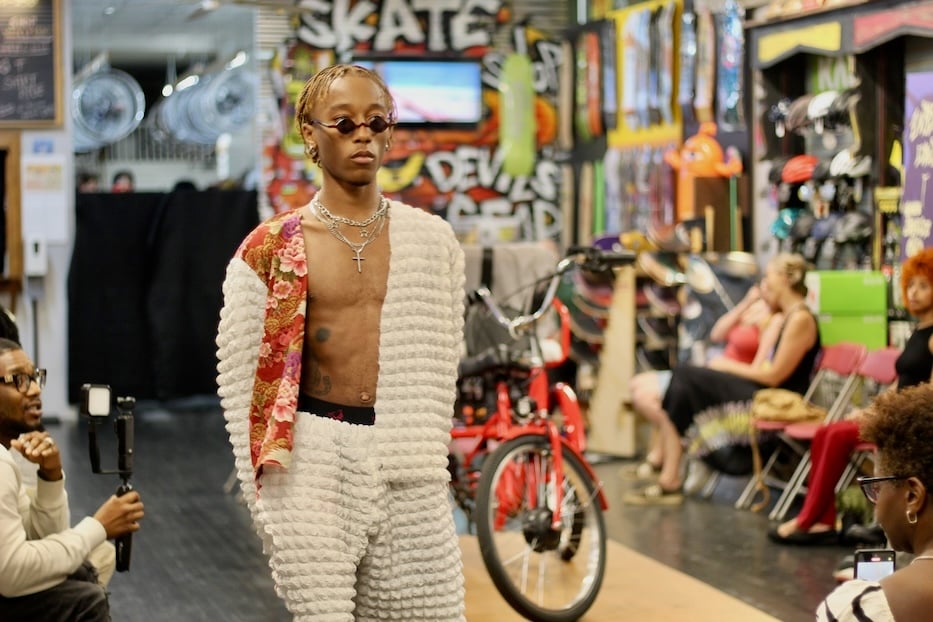
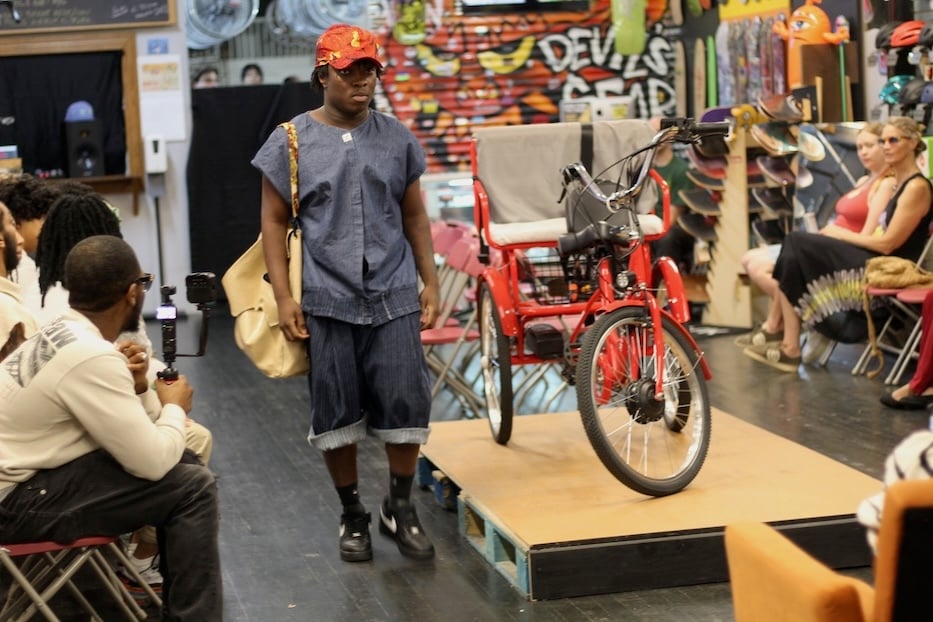
On a jacket and shorts set that Montgomery recently finished, he added an element of texture, with a scalloped, light white fabric that had a sheen to it. Presented over an open chest, and beneath layers of silver jewelry, the piece showed Montgomery’s talent for bringing together the quotidian-ness of streetwear (a nod to him for the loose threads still hanging from the outfit, which felt somehow true to life) and a grace fit for fashion week in London or Paris.
So too moments later in the night, when he presented a turquoise suit with a plunging, crushed velvet neckline that glittered beneath the shop lights, followed by a dress printed economically with patterns including birds in flight, and tied at the waist with a thick length of fabric.
“It feels good!” he said of the show. “When RNS first started, I was one of the people that they came to. When they asked me about this, I wanted to show some pieces that I made this week. What I like that they’re doing is making sure they meet people [in the community] and getting involved in the community. They definitely have a good work ethic and they are supporting their community.”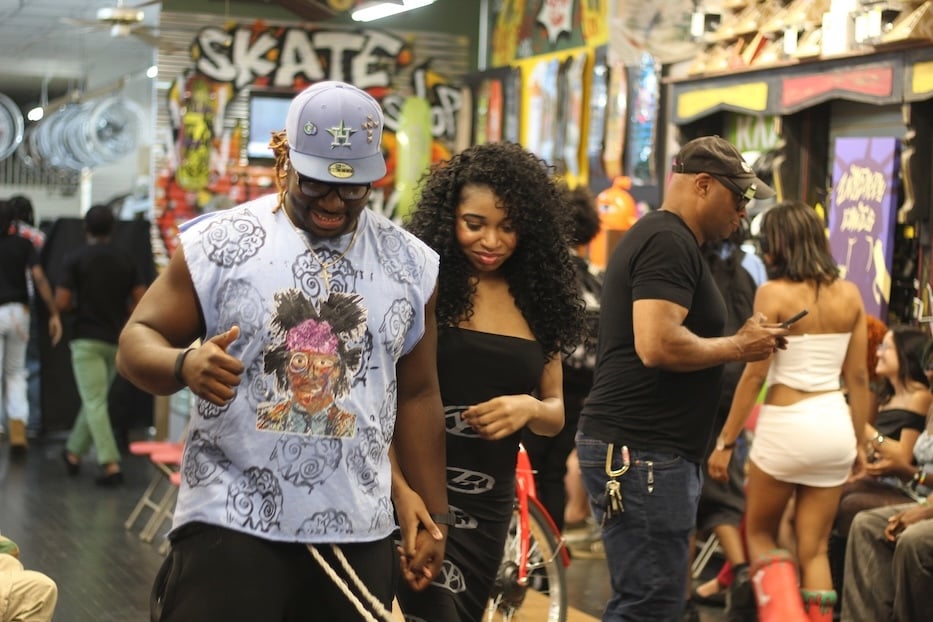
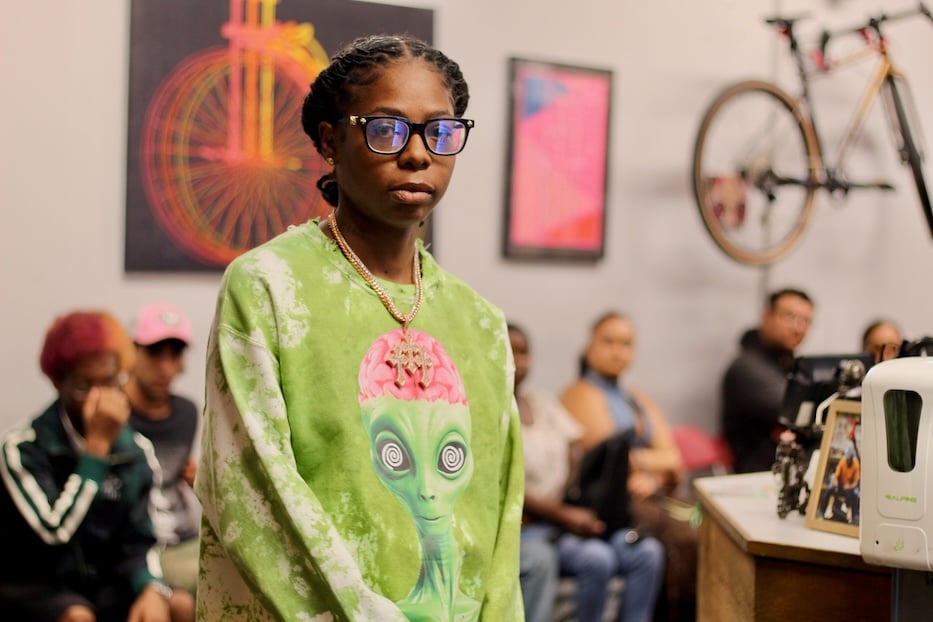
Top: Okwuosa and Krystal Christmas, who also modeled. Bottom: Open Mnds in action. In a nod to Okwuosa’s own role as a student, many of the looks came accompanied by backpacks.
When it was time for Okwuosa’s moment in the spotlight, he seemed ready. For over a year now, he’s been building up Open Mnds, a brand dedicated to mental health that he launched during his time as a student at Gateway Community College, and has since grown to a series of artmaking workshops and a small studio space at 128 Temple St. in downtown New Haven.
As he balances running a small fashion business and his academic work—he is pursuing business at Southern Connecticut State University, or SCSU—his outlook and his life have become very much intertwined. Currently, “I’m really focusing on the feeling” of what it means to be mentally healthy—and the self-care and balance that it takes to get there.
“It’s been hard!” he continued. When Okwuosa moved into his studio on Temple Street last October, he would stay in the space working on designs until four or five in the morning. The sleep deprivation caught up to him, and Okwuosa realized that it wasn’t sustainable.
Now, he prioritizes sleep, runs in the morning, and makes sure to drink at least a gallon of water every day. He’s minding his mental, and he wants others to, too.
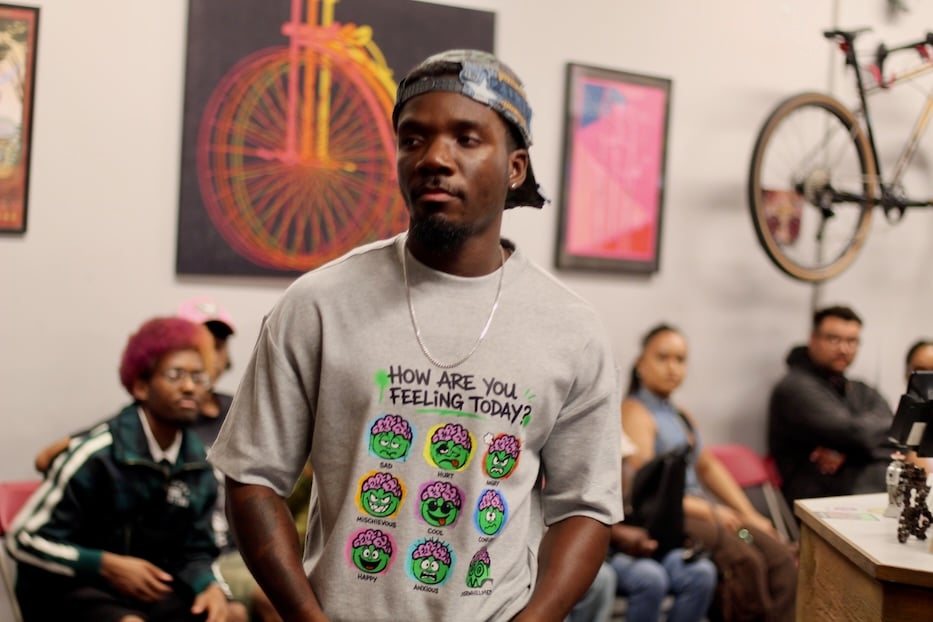
One of his newest designs, for instance, features a cartoon-esque, adult take on a feelings chart that might hang in a toddler’s room, with a grid of nine faces that range from “Happy” to "Mischievous" to “Sad.” Where smiley, color-coded and circular faces might otherwise be, though, there is a green face, always surrounded by a halo of primary-colored light, with the pink, domed kinks of a brain spilling out of the top.
It’s an instant reminder that those small tools for emotional regilation—checking in, taking deep breaths, and talking about feelings—are appropriate at any age. So it’s not surprising, maybe, that another reads “Turn Your Pain Into Passion,” with applique at the neck and arms that Okwuosa has carefully applied himself. Okwuosa, who leads workshops around mental health, wants to practice what he preaches.
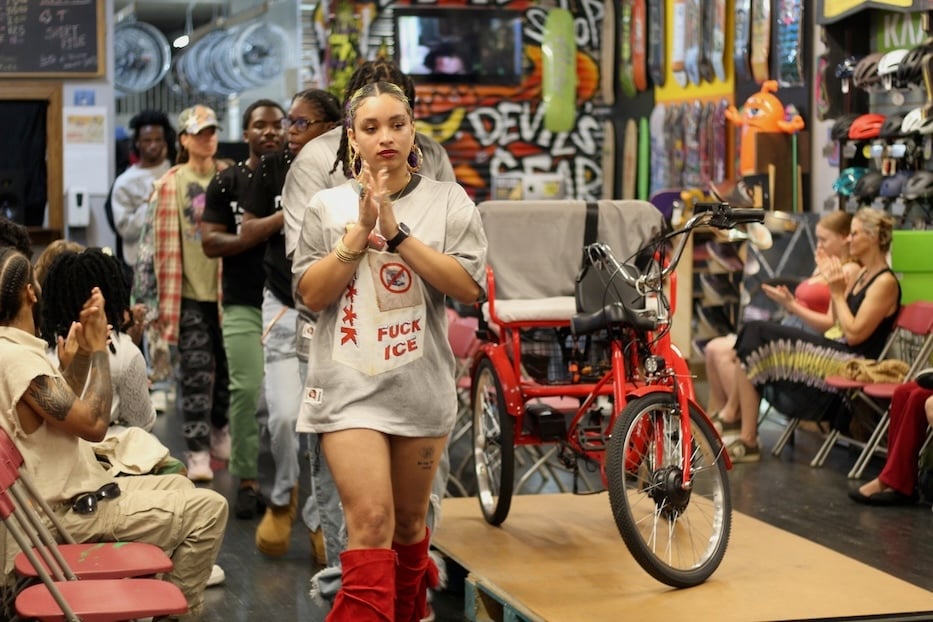
Okwuosa has also branched out into the full picture of mental health, meeting the moment with a series dedicated to political resistance. Friday, two matching shirts read Fuck ICE, the letters in blocky red text against an ice machine. As the models came together, posing in the front of the shop—and the glow of the open door—the audience cheered.
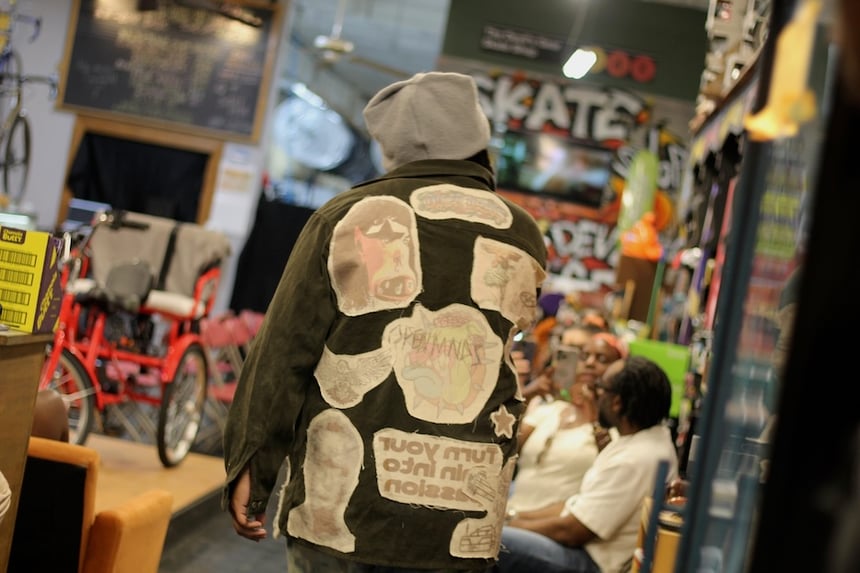 The night was far from over and a person could feel the momentum building still. Okwuosa, accompanied by his girlfriend Krystal Christmas, walked beaming through the shop, applause filling the air around him. Behind the curtains, a flash of red fabric fluttered up into the air for a moment and then came back down, a sign of things to come.
“It’s good!” Christmas had said earlier in the evening, and the words still felt alive in the space. “I think it’s a good thing for the community.”