

Culture & Community | Politics | Arts & Culture | Westville
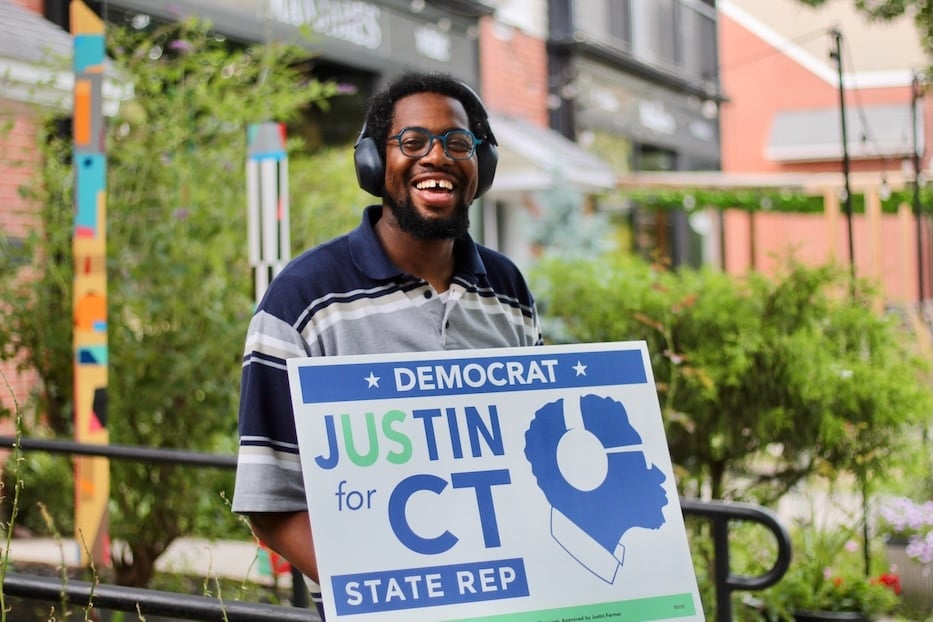
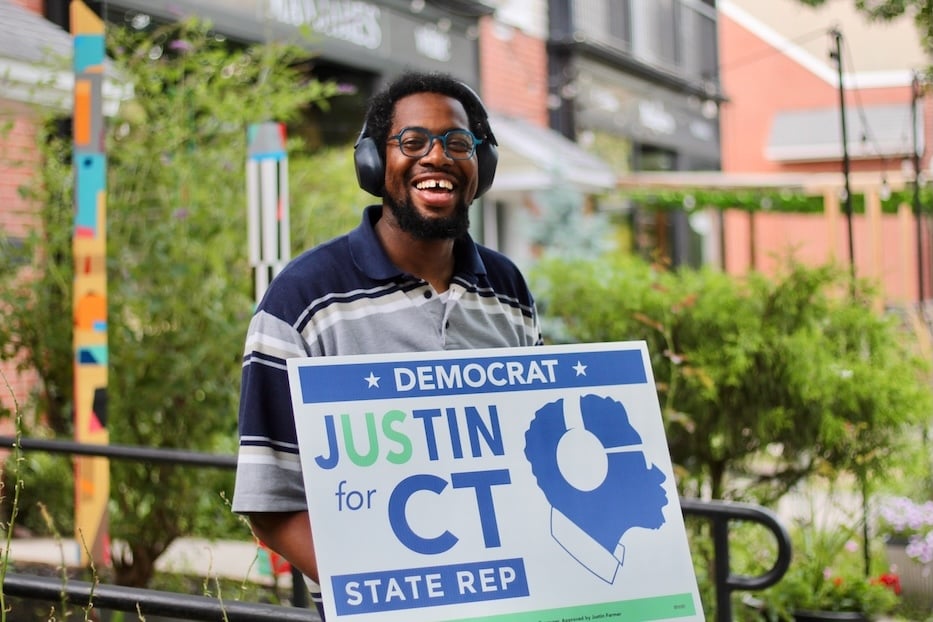
Justin Farmer on West Rock Avenue last week. Lucy Gellman Photo.
Just off West Rock Avenue, Raphael Saadiq’s “Keep Marchin” was setting the tone for the weekend, the sun making its slow descent as the musician proclaimed We gotta keep on! We just gotta keep on! Keep on marchin', yeah! On the track, voices swelled in the background. On the sidewalk outside, a trickle of people made their way through the neighborhood, some stopping at the scene, and stepping inside to take a listen.
“Music just informs who you are,” said State House candidate Justin Farmer, one hand stretched over a mouse as he scrolled through his discography. His finger hovered over Girl Talk’s “Minute By Minute” for a moment, as if he was contemplating where he wanted the evening to go next.
It’s one of the ways that the arts, and particularly music and visual culture, are showing up in Farmer’s campaign for Connecticut’s 92nd State House District, an area that includes New Haven’s Westville and Amity neighborhoods, as well as sections of Edgewood and the Hill. At a listening party and informal discussion at the Westville arts incubator SOURCE / MATERIAL Friday night, he pointed to the importance of both in keeping him grounded, pushing him forward, and helping him talk about his lived experience as a candidate.
Farmer, who served on the Hamden Legislative Council for three terms, and made waves when he ran for State Senate 2020, is currently running against incumbent State Rep. Pat Dillon, who has held the position since 1985, and former East Rock/Downtown Alder Eli Sabin, who stepped down from that position in January of this year, shortly before his lease in Westville began. To read more about the three, check out this coverage from our friends at the New Haven Independent.
“Arts and culture are important right?” Farmer said in a phone call Saturday, following Friday evening’s event and after a morning of knocking on doors. “I think part of the reason we have such a hard time connecting is that people sometimes reject their culture, or are afraid to share their culture and explain their cultural differences. But when you talk about it, it’s like, ‘Hey, I felt moved by this thing. You felt moved by this thing.’ It’s an easier way to have these conversations.”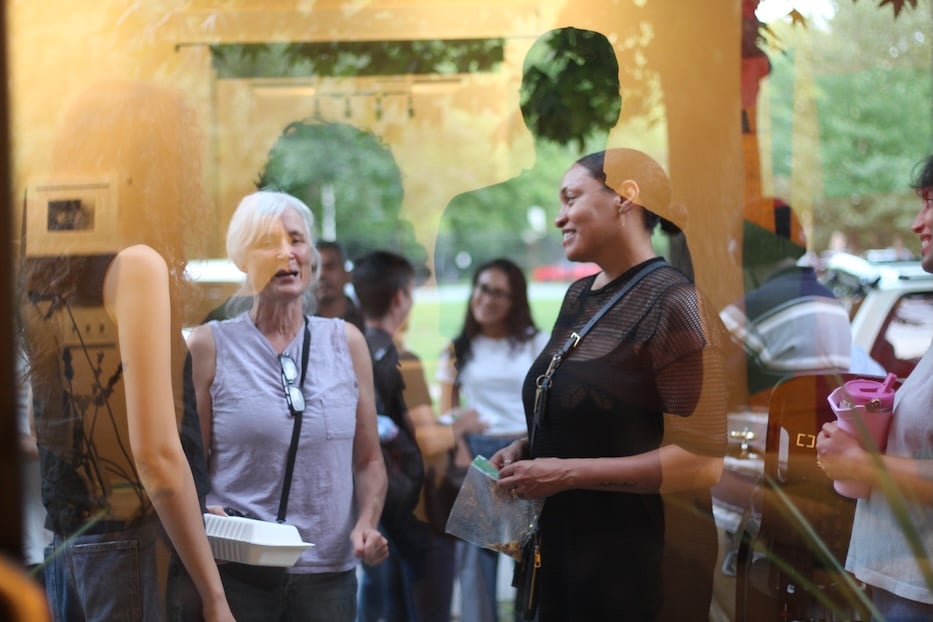
Top: WVRA Executive Director Lizzy Donius (center) with her daughter, Alice McGill (left) and curator nico okoro (right). Bottom: The scene inside.
On the campaign trail, he added, artmaking has given him an opening to talk about everything from the environment to intellectual property, artificial intelligence, and public education, as well as his own lived experience as a Black man and a person with a disability. Farmer lives with Tourette’s Syndrome, a neurological condition that can cause verbal or physical ticks. More on that below.
Farmer’s love for music began in Hamden, in a Jamaican immigrant household where artists like Bob Marley, Buju Banton and Ras Michael were in constant rotation. By his 10th birthday, he had found a musical comrade in his cousin, Keyla Whyte, Westvillian whose tastes bent toward old school rap and R&B, and who liked to trade music with him. That never ended: the two still swap CD recommendations (Farmer largely stays off streaming platforms, which can exploit artists, but he does use the offline app Musicolet).
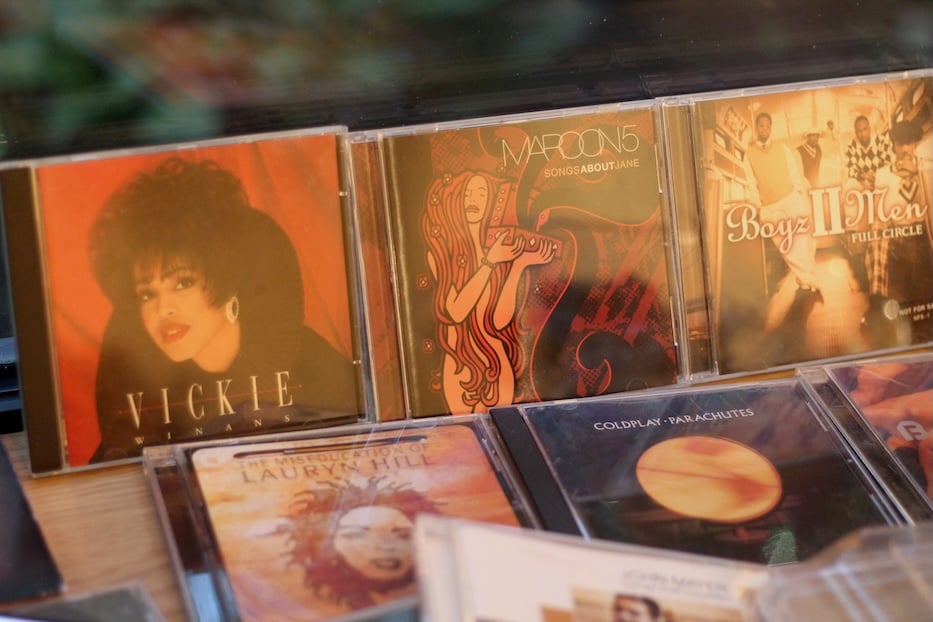
It was his first exposure to “all the rap,” with favorites that included (and still include) 2Pac, Nas, and Jay Z among dozens of others—artists who he now lists among hundreds of songs he’ll gravitate towards. Years later, he lists artists including Lauryn Hill, Erykah Badu, and Jill Scott to among his favorites—which also include artists like John Mayer, Carrie Underwood and blink-182.
As he got older, growing his sonic palate, music also became an unexpected lesson in racism and stereotypes. When Farmer got involved in grassroots advocacy work over a decade ago, people would look at his noise-cancelling headphones—he wears them to control and regulate his Tourette’s, sometimes for up to 17 hours a day—and “they would say, ‘Oh, I know what you’re listening to,’” he recalled.
When he asked, they clarified that they meant rap. Exclusively rap. It frustrated him.
“Like, yeah, I listen to some Remy Ma, but I also listen to some Yo-Yo Ma too,” he said. “I listen to everything.”
While he bristled at the assumptions—he still does—he also saw it as a chance to engage with people, busting stereotypes as he talked about his musical tastes, his experience with disability, and his platform. It’s what has inspired him to often march alongside artists, poets, and vocalists, including the spoken word artist Sun Queen and, in 2020, the artist Thabisa Rich as she belted Sam Cooke’s “A Change Is Gonna Come” while waiting for a statue of Christopher Columbus to come down.
“A lot of art, it feels apolitical but it’s not,” he said. “It’s a gateway to saying, ‘Hey, actually everything is politics.’”
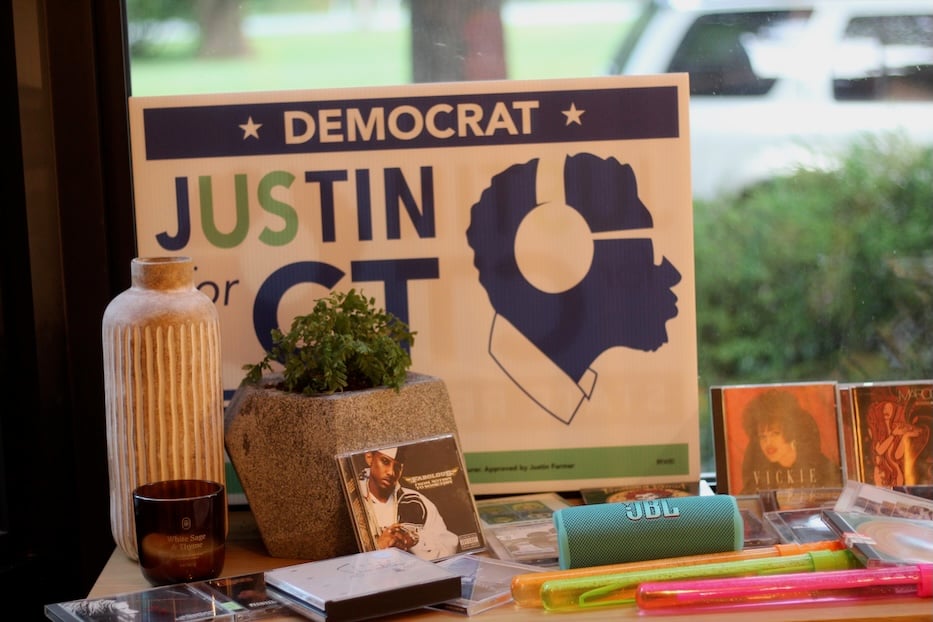
Friday, that was evident as a soundtrack sailed from Dev’s “Getaway” to Aretha Franklin’s “I Never Loved A Man” to Marvin Gaye’s “Distant Lover,” the sound filling the space. Inside, CDs covered tables and counters, their covers catching every so often in the light. A campaign sign sat propped up in the corner, looking out onto West Rock Avenue; two shirts hung over seat backs, as if they had come just to listen.
Attendees trickled in and out; toddlers (including in full disclosure this reporter’s) started an impromptu dance party with organizer Nate Fox in the center of the room. Trays of cookies sat untouched in the corner, attendees poring over album covers and chatting with each other over favorite songs.
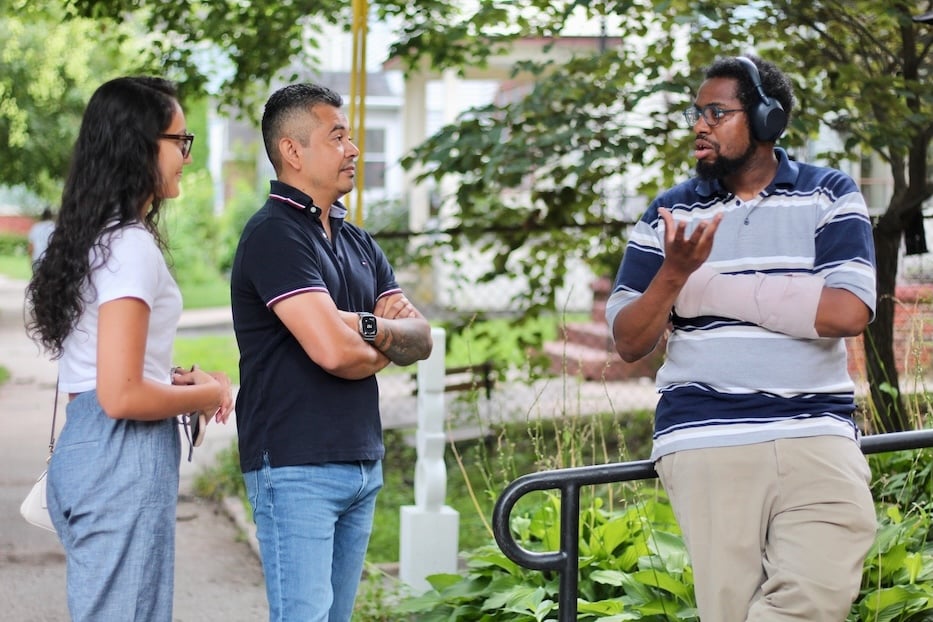
Heidi Oyuela and her dad, Carlos Oyuela, chat with Farmer.
Outside, Farmer greeted recent college graduate Heidi Oyuela and her dad, Carlos Oyuela, who both live in the 92nd district and will be making time to vote on the 11th. Six years ago, Heidi remembered, Farmer was the reason she got into grassroots politics. At the time, she was still a sophomore at Hamden High School, and her AP Government teacher encouraged students to get involved in a local race.
That race ended up being a tight one: Farmer was running against Jeorge Cabrera for the 17th State Senate district. Oyuela saw a young, eager candidate who shared many of her progressive views, and built alliances by pounding the pavement and knocking on doors. When she left Hamden for Pace University in 2022, she studied political science and women and gender studies—just like Farmer.
Her early advocacy for Farmer encouraged her to work on “a lot of campaigns,” including Zohran Mamdani’s run for New York City mayor last year. Now that she’s graduated, she wants to do political organizing professionally—including in the district she now calls home. Oyuela’s family moved to Westville five years ago.
“I love the energy and the diversity!” she said. She added that she had signed up to canvass, so when she saw the event was happening, she was excited to swing by and get involved.
nico w. okoro, who runs SOURCE / MATERIAL and was recently appointed executive director of the International Festival of Arts & Ideas, echoed that enthusiasm—although she made it clear that she would not be endorsing anyone or talking about candidates during the evening. For her, opening the space to Farmer was about a chance to build community around artmaking, which is why SOURCE / MATERIAL exists. She sees Farmer doing that when he shows up to events not just in the district, but across New Haven.
Back inside, Saadiq’s “Keep Marchin” faded into D’Angelo’s “I Found My Smile Again.” On a playlist, not far ahead of them, were tracks from the Red Hot Chili Peppers, Waylon Jennings, LMFAO, Will Smith, Wiz Khalifa and Alicia Keys. The night was young, and there were hundreds of songs to go.
“Planting The Seeds of Change”

Alisha Martindale's original design. “It just did so much heavy lifting in creating an opening for me to talk about Tourette’s and to talk about why I wear headphones,” he said.
Farmer’s interest in the arts, particularly in the last decade or so, has extended to visual culture and graphic design, a field he thinks about frequently as he pursues journalism (along with political science and women, gender and sexuality studies) at Southern Connecticut State University (SCSU).
When he was first considering a run for municipal office in Hamden—that was nearly a decade ago—he reached out to the designer and photographer Alisha Martindale, who he met through his time at Southern. At the time, Martindale was a graduate assistant in the university’s Department of Women’s & Gender Studies and an assistant on the Hamden Arts Commission, “just starting to dip my toes into graphic design.”
“Justin was this soft-spoken, kind, engaging kid on the SCSU campus that knew literally everybody in almost every department,” she remembered Wednesday. “We bonded over our love for Hamden, where we both grew up, and both were taking on more serious roles in the town’s community at the time.”
At some point, the two started talking about Martindale’s creative work, including graphics that she created for the department. Farmer’s interest in politics dovetailed with her own work, including a thesis exploring the history of protest art. Years later, she can’t remember whether Farmer asked or she offered—but at some point, the two agreed to collaborate on a graphic for his run in Hamden’s Fifth District.
“Being new to graphic design at the time, I didn’t know much about typography, but I knew I wanted to do something other than the commonplace political ‘5-star red, white and blue,’” she remembered. “Because that stock art, cliché motif is most certainly not who he is as a person.”
She thought about Farmer’s headphones, by which he was often and widely recognized. Then she turned toward her own set of values, and let it inform her design process. As she worked on a design, she sought to use art to build “an empathy bridge, because while we are different, we all have the same core desires to be seen, heard, and fully understood.”
Martindale also thought about the use of art as a tool for communication, which she could trace back as far as pub signs in the Middle Ages. She also nodded to mentor and painter Nathan Lewis, a teacher of hers at both Paier College of Art and SCSU, who encouraged students to think about meaningful symbols that they could integrate into their work.
Everything for the design started not on a computer screen, but with pencils and paper. The number five became both “the defining object” in the sign—it was Farmer who opted for the blue color—and a headphone-like shape that people could identify as soon as they saw the sign.
Martindale nailed it, Farmer remembered at SOURCE / MATERIAL on Friday. Normally, he’s a very private person, but the suggestion of headphones in the design helped him open up about his journey with Tourette’s, which has shaped his views on public education, access to affordable healthcare, and policing and police accountability.
“It just did so much heavy lifting in creating an opening for me to talk about Tourette’s and to talk about why I wear headphones,” he said.
When Farmer ran for State Senate in 2020, he knew that he wanted to keep the headphones and update the design, he said. This time, he worked with Hamden-based designer Chris Atchley, who is also involved in the Hamden Democratic Town Committee, and saw offering up his services as an easy lift in a chronically under-resourced, grassroots campaign.
“When I got involved with the [Democratic] party, I really wanted to start electing leaders who I believe in,” he said. “Justin was one of many that I've been able to help … the nice piece of it, especially with grassroots campaigns, is I can volunteer my time in a lot of ways.”
He and Farmer talked about the values that were important to his campaign, including the inclusion of Farmer’s headphones in any graphic. In a nod to U.S. Sen. Bernie Sanders, a democratic socialist who in early 2020 ran in the Democratic Presidential Primary (and has remained iconic in New Haven since), the “Us” in “Justin” became its own color-coded word.
In that same race, Farmer also collaborated with a number of young artists who created unofficial campaign art; read about that here.
When Farmer decided to run in the 92nd District race last year—he filed to run officially in January, and has been on the campaign trail since—he wanted the design to be largely the same, and opted to work with Atchley again and make a few minor tweaks. “He broke down for me why his logo was so meaningful to him, and so, I was like, ‘We can update it a bit, so it reflects your current profile," Atchley said in a phone call Saturday.
Atchley added stubble around Farmer’s chin, to acknowledge that the candidate had grown older and more seasoned between the two Connecticut General Assembly races. The two held onto “planting the seeds of change,” which is an agricultural pun on the candidate’s last name that has been with him since that first run.
“When I get to do something that is a passion for me and help a candidate that I believe in, it's the best case scenario,” Atchley said.