

Culture & Community | Lyric Hall | Public art | Arts & Culture | Westville | Westville Renaissance Arts (WRVA)
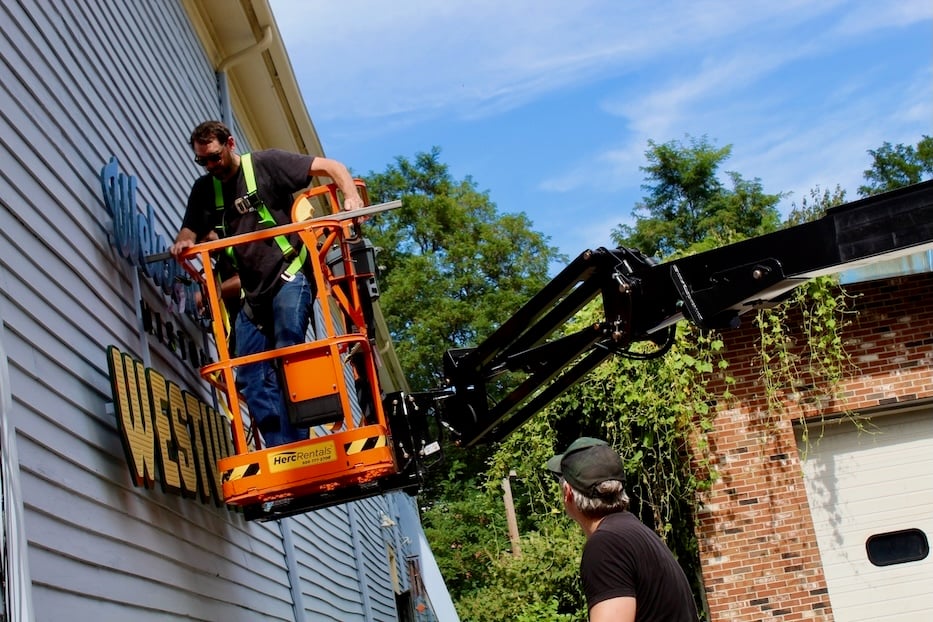
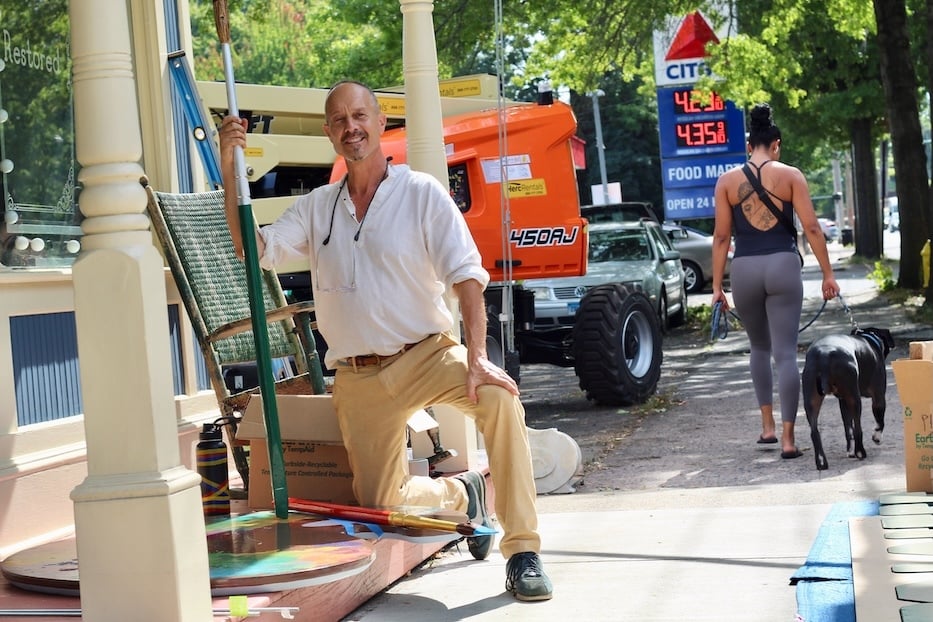
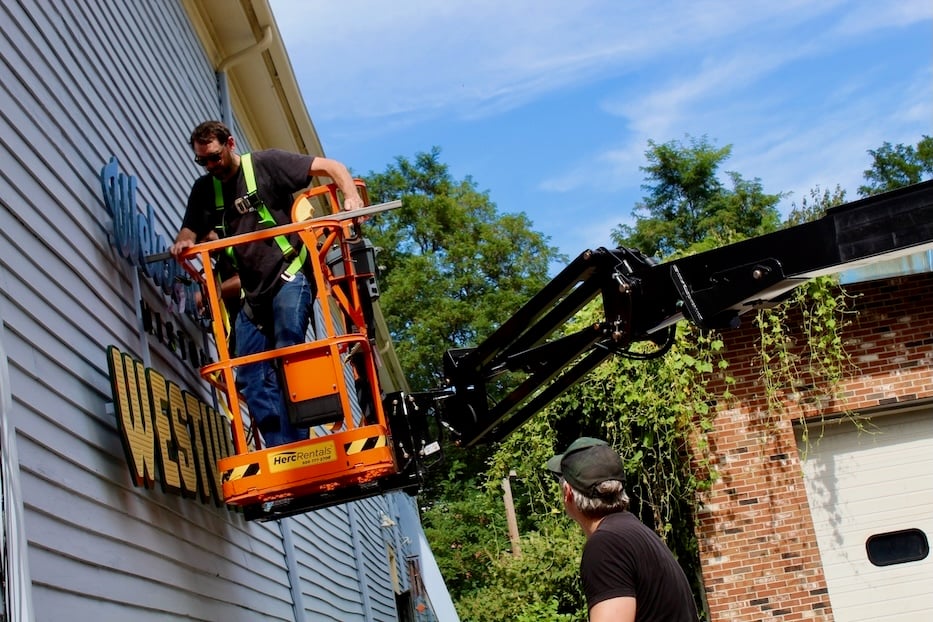
Top: Ryan Paxton and Gabe Miller-Haug install a sign that reads "Welcome To Historic Westville" on the side of Lyric Hall. Bottom: John Cavaliere, who has owned and operated Westville's Lyric Hall at 827 Whalley Ave. since 2005, poses with a repainted, larger-than-life artist's palette and paintbrushes. Lucy Gellman Photos.
The words glowed over Whalley Avenue, in powder blues and yellows that wove across the side of Lyric Hall. On one end, a flourish dangled off a W, letters looping in and out of each other to form the word Welcome. Beneath it, Westville appeared in blocky yellow font, the word Historic tidily wedged in between. Two larger-than-life paintbrushes and a giant artist’s palette waited patiently nearby, the blooms of green and blue, red and yellow dancing in the light.
That moment, over two years in the making, came to Whalley Avenue last Thursday, as staff members from the Eli Whitney Museum and Workshop installed a long-awaited sign on the side of Lyric Hall New Haven, facing out onto a stretch of Whalley Avenue that sees over 20,000 cars each day, according to the Connecticut Department of Transportation. Since 2024, owner John Cavaliere has been dreaming about the artwork, which he sees as a new gateway to Westville and a chance for the neighborhood to heal after a heated, prolonged debate about who gets to make public art in the neighborhood.
Lyric Hall is a theater, screening space, and antiques and restoration business located at 827 Whalley Ave. In the many lives that it has lived—a vaudeville theater turned garage turned commercial storefront, turned theater all over again—it has recently shared a blocks-long radius with two widely contested murals, one depicting cartoon animals playing pickleball, and the other an aerosol landscape that appeared earlier this summer at Whalley Avenue and Fitch Street, meant to welcome people to the neighborhood.
“It’s ironic that the impetus for this was a kind of controversial mural and now we have this other controversial mural,” Cavaliere said on Thursday morning, as a small crew from the Eli Whitney Museum & Workshop stabilized the back of the sign and prepared it for installation. “There’s this juxtaposition of the nib of the industrial spray can [down the street] and these paintbrushes from the Renaissance.”
“We’re keeping it real,” he continued. “We have a score to settle ... we need to come together and heal. There are kind of two gateways to Westville now.”
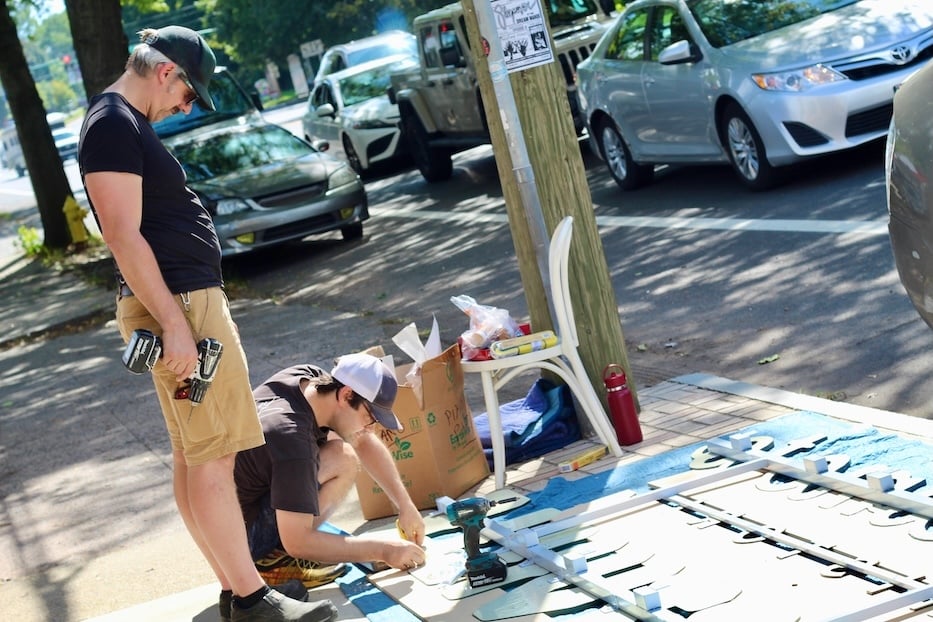
Kevin DeChello and Gabe Miller-Haug.
The story of the sign goes back to 2024, when Pickleball CT developer Harrison Blume commissioned a mural from the artist Perez, a son of New Haven whose work has traveled from downtown to Fair Haven to a baseball academy to a beloved daycare in between. Blume, who grew up in Woodbridge, envisioned a tableau with sporty, cartoon dogs playing pickleball, which Perez aimed to bring to life by the end of the summer.
When the two started on the piece, they received significant pushback from Westville’s tight-knit arts community: the Pickleball CT piece would cover a mural titled As In The Light Of Marielle by the artist Faring Purth, a project completed with community input in 2016. Cavaliere was among many of the artists and small business owners who were frustrated by the design. He called Lizzy Donius, executive director of the Westville Village Renaissance Alliance (WVRA), and began talking about a different vision for public art.
“I realized I had to do something,” he said, crediting the outsider artist Peter Wickenden, who is a friend and close creative collaborator, with helping him realize that he needed to spruce up the outside of the building as a kindness to the neighborhood. “It’s about the community.”
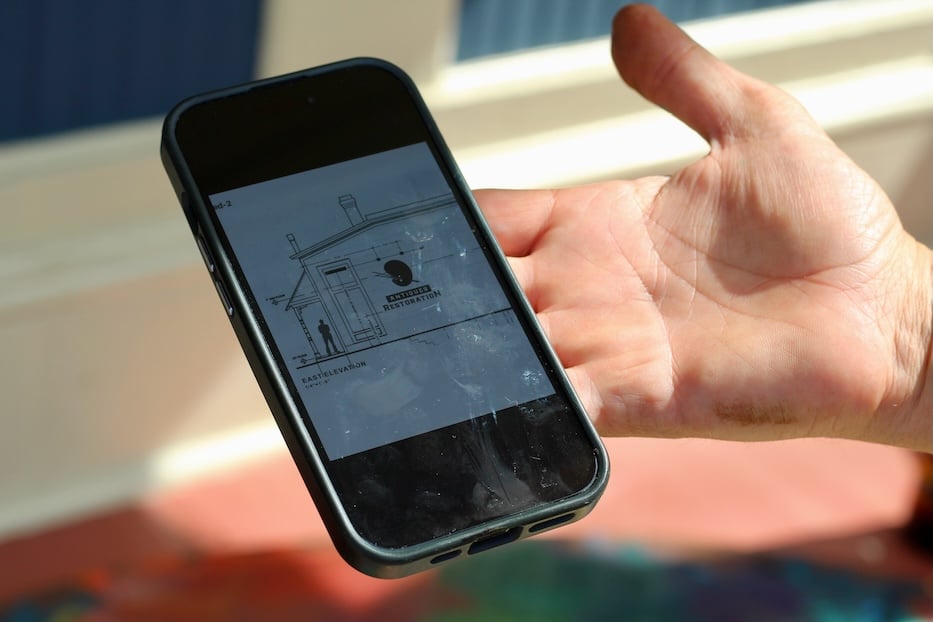
The initial design, which came from artists George Corsillo and Susan McCaslin, who run the firm Design Monsters. Cavaliere ultimately realized that instead of a sign for Lyric Hall, he wanted one welcoming people to the neighborhood.
Cavaliere proposed a sign that would welcome people to the neighborhood, and tip them off to its quirk and creativity, just as he seeks to do with his business. Since reopening his doors to the public two years ago—a feat after a near-sale of the building, a global pandemic, and ongoing flooding of Biblical proportions—he has launched new partnerships, including with Best Video Film & Cultural Center (BVFCC) and artists who rent the space for their performances.
Donius was game. In the fall of 2024, Cavaliere received a $1,800 grant from WVRA, and then $500 from the city’s Department of Arts, Culture & Tourism. Several people came out of the woodwork to help: artists George Corsillo and Susan McCaslin, who run the firm Design Monsters, offered to do the design for free. Ryan Paxton, executive director at the Whitney Museum and Workshop, hopped onboard to bring the 12 foot by 5 foot image (plus the palette, which is a seperate piece) to fruition. Andy Rubinoff, who has organized many a glamorous event across New Haven, suggested he could light it, Cavaliere remembered.
“It gives our apprentices and staff opportunities outside the museum and at a bigger scale,” Paxton said as he arrived on the sidewalk Thursday, and immediately jumped in to help museum and workshop staff members Kevin DeChello and Gabe Mahler-Haug. “It’s a pretty big project,” perfect for the 100 teen apprentices that the museum has attracted in the past year.
For Cavaliere, who grew up in Hamden’s Spring Glen neighborhood and has lived and worked in Westville since 2005, it also marks a kind of full-circle moment. Prior to his time in the neighborhood, Cavaliere didn’t have an exact home base. Decades ago, he went to the ACES Educational Center for the Arts and studied at Connecticut College with the late Barkley Hendricks, but couldn’t stay put after finishing his studies. He was young, and not yet ready to settle down.
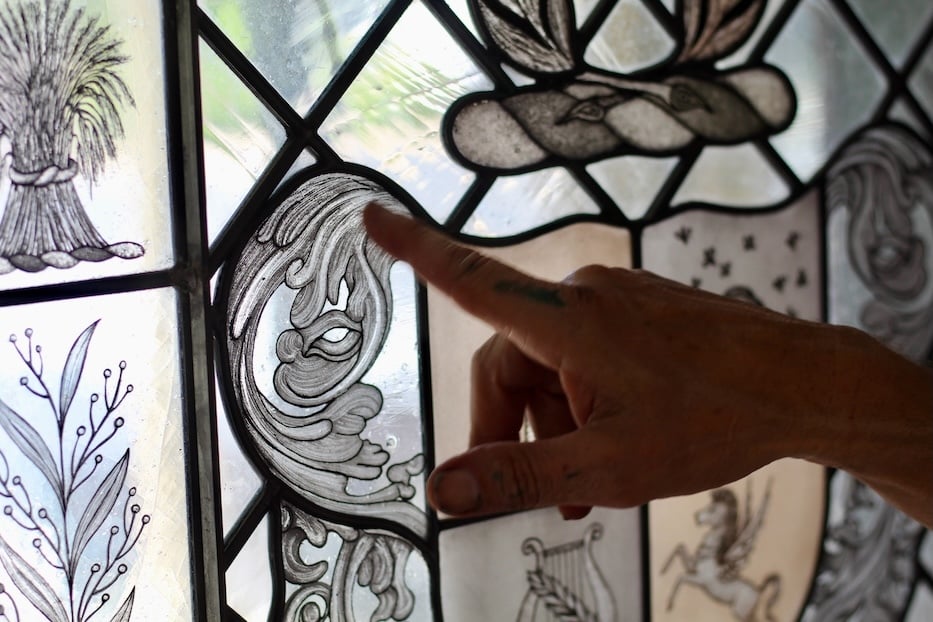
Cavaliere, inside Lyric Hall, pointing out some of the artistic touches that make the space so unique. After he moved in, his friend Peter Wickenden designed the stained glass window that now adorns the building's front door.
In the late 1980s, Cavaliere traveled to New York City, where he worked as a security guard at the Metropolitan Museum of Art and lived at the McBurney YMCA, which offered inexpensive single rooms through 1999. After becoming interested in the Met’s thousands of frames—and the art they safely encased—he became an apprentice to Mark DeVito, a master guilder who ran a restoration business in Stamford. That ultimately brought him back to New Haven.
By 1999, Cavaliere had opened the first Lyric Hall on State Street, where it remained for six years (it is named after the historic Lyric Hall in New London, where he went to college). He moved to Westville two decades ago, after hearing about the building from antiques dealer Wayne Chorney, and falling in love with it. After years of cobbling together enough to live on, backing out of a sale, then surviving a global pandemic, he reopened his doors in 2024 with a vision for several new collaborations.
The sign, which took two years from start to finish, scratched that itch.
“Covid was a gift, because it got us to regroup,” he said Thursday, as he watched DeChello and Mahler-Haug lift a larger-than-life palette off of his porch, and lay it on the sidewalk (“There she is!” he nearly purred, while recalling finding the piece at an estate sale in Berlin, Conn. and knowing he wanted to restore it immediately). “Now we’re back with a vengeance.”
The sign also honors Lyric Hall’s cultural and creative roots, he added. From 1913 to 1920, the building was a silent film and vaudeville theater. After 1920, it lived many lives: it was a livery, an auto repair shop, a toy store, and a flower business. When he bought it in 2005, he lovingly nursed the building back to health, turning it into a beloved third space for artists across the city.
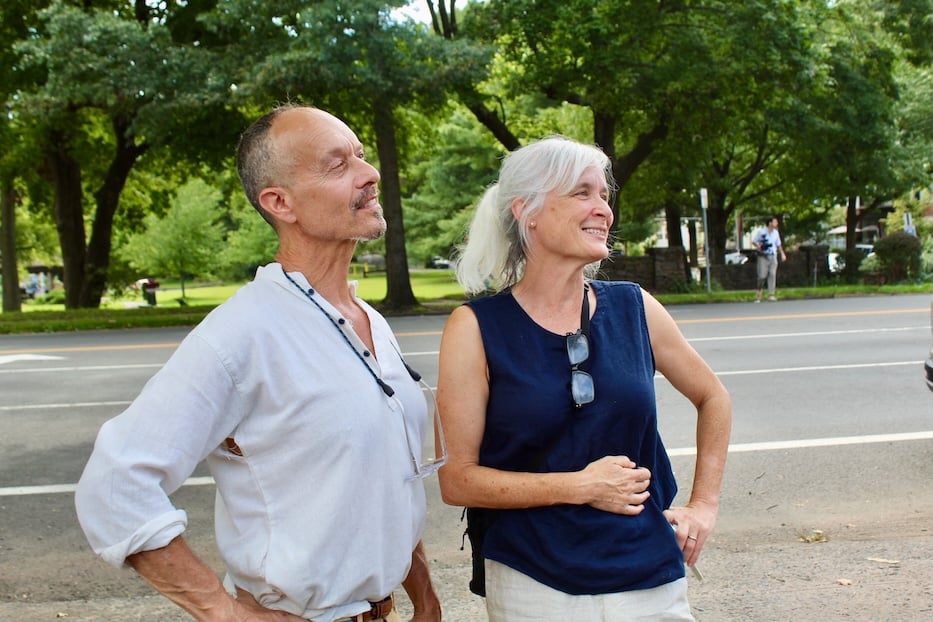
Cavaliere and Lizzy Donius.
Now, the sign feels like a chance to welcome people to both the neighborhood and to the space. Thursday afternoon, Cavaliere seemed to radiate light as the time came, and Paxton and Mahler-Haug got into a cherry picker, and began to fix the sign onto the wall. Only when the lift pulled back for a moment could a person read the entirety of the sign, announcing Welcome to Historic Westville. By the end of the day, the palette and painbrushes had appeared above it.
Smiling from ear to ear as the sun drenched the side of the building, Donius joined Cavaliere and filmmaker Travis Carbonella to watch the installation. In her position as executive director of WVRA, she’s watched the neighborhood evolve for years, with an artsy core that has changed, but not cracked, even as businesses have come and gone. As Paxton and Mahler-Haug finished the sign and moved on to the palette, she marveled at the tableau. It was, it seemed, finally home.
“It feels like it should have always been here,” she said.
Learn more about events at Lyric Hall here.