

Bregamos Community Theater | Collective Consciousness Theatre | Culture & Community | Fair Haven | Arts & Culture | Theater
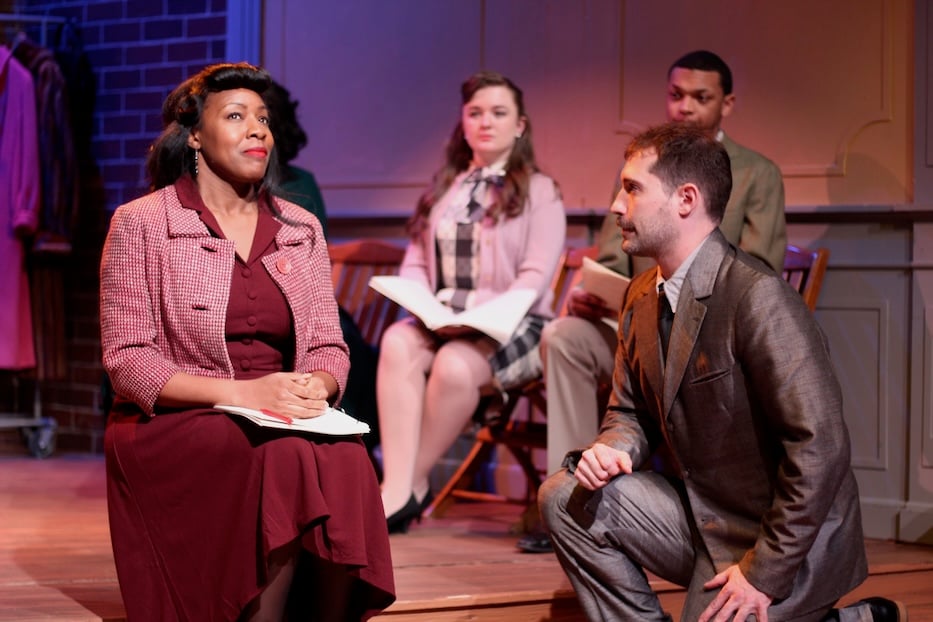
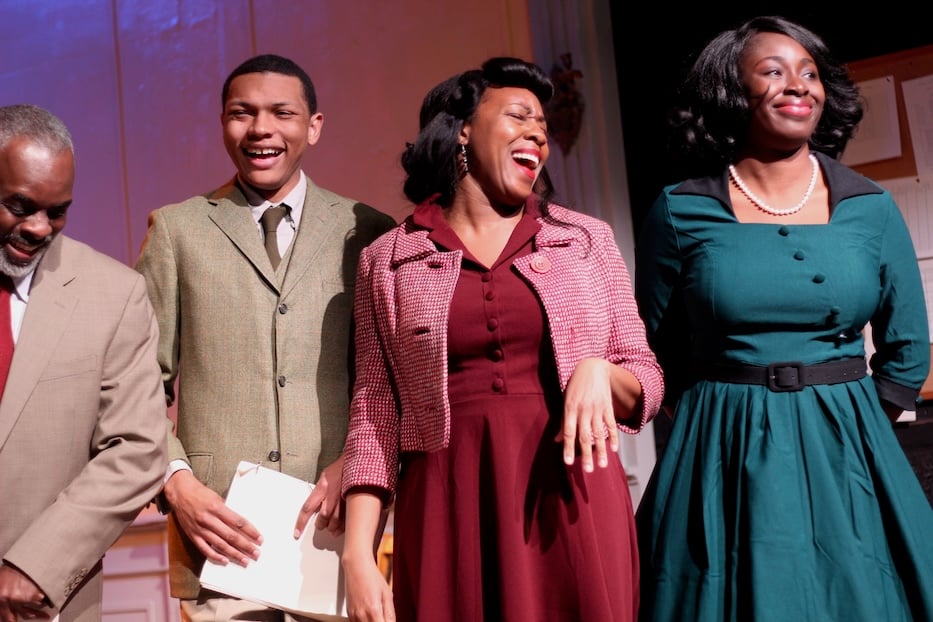
Tamika Pettway and Griffin Kulp in Alice Childress' Trouble In Mind, which runs at Collective Consciousness Theatre through March 29. Lucy Gellman Photos.
“Laugh! Laugh at everything they say, makes 'em feel superior,” actress Wiletta Mayer tells newbie John Nevins just minutes after he has walked into the rehearsal room.
It is their first day on the job together, and the two are easing into the space, warm but guarded as conversation floats between them. John, still baby-faced and full of hope, scrunches his eyebrows. He’s skeptical. A narrative door swings open, ever so briefly.
“Why do they have to feel superior?” he asks. In his mind, he’s already working on a portrait of the white director who is due to walk in any minute. Wiletta stares back, and before she even speaks—“You gonna sit there and pretend you don't know why?”—her face says everything he needs to know.
Has she sold out, or done what she needs to do to survive?
Wiletta Mayer (Tamika Pettway) asks all the right questions—and answers many of them, too— in Alice Childress' Trouble In Mind, running Thursdays through Saturdays from Collective Consciousness Theatre (CCT) through March 29. Directed by Jenny Nelson with a cast that is as sharp-tongued and quick-witted as it is dynamic, the show is both funny and sharply prescient, a testament to how little the needle has moved on race relations in this country in the last 71 years. Or in a less passive voice, how little white people are willing to give up in the name of equity.
All productions take place at Bregamos Community Theater, 491 Blatchley Ave. in New Haven. On the final weekend, there is also a Sunday performance; tickets and more information are available here.
“This show is historic because of the life of the play,” Nelson said during a tech run last week, shortly before performances opened. While Trouble In Mind ran Off Broadway in 1955, it did not make it to Broadway until 2021, because Childress refused to tone it down for white producers and audiences. "It is important to produce this play as much as possible. We owe her [Childress] that—to center her in this way.”
“This play really talks about the relationship between the actor and the director,” Nelson added. “It’s so important to know the power you have in the room and use it for good.”
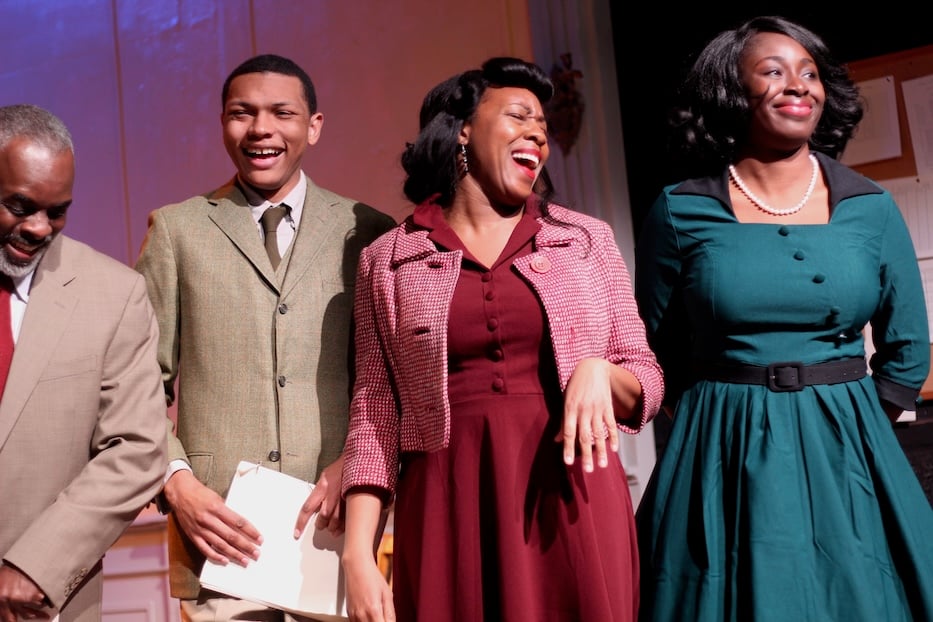
Joshua Eaddy as Sheldon Forrester, Justin Villard as John Nevins, Tamika Pettway as Wiletta Mayer, and Raissa Karim as Millie Davis.
It’s the way Childress writes the story, and the biting critique that she brings to the script, that makes this show a doorway and a mirror all at once. A play within a play written in the 1950s, Trouble In Mind follows seasoned actress Wlletta Mayer (Pettway) as she walks into the rehearsal room for Chaos In Bellville, the latest drama in a long resume. From the moment she steps on stage, Pettway makes it clear she owns the place—or deserves to—a dream that is punctured when other actors begin to come in.
Inside the theater, old colleagues (Raissa Karim as Millie Davis, Joshua Eaddy as Sheldon Forrester) and new (Justin Villard as John Nevins) start to gather, words filling the space as they catch up with each other. Soon, the audience meets white actors Judy Sears (Elizabeth Finn) and Bill O’Wray (Josiah Rowe) who protest the presence of their own ingrained racism so strongly that it is an extra character on the stage.
When Judy announces early on, for instance, “and they’re absolutely right!” of Black people—then looks around bright-eyed, as if she’d a dog that deserves an extra large milkbone—Finn nails the squirm-worthy nature of performative allyship, not for the last time in the show.
That’s just the tip of this dramatic iceberg. Chaos In Belleville, written by a white man, is a new play that may catapult actors to Broadway fame—if they can stomach it. The script is drenched in a prejudice that is both racial and regional, with a suggestion that Black people in the South are uneducated, unrefined, and largely passive participants in their own oppression.
It’s a kind of writing that seems exhaustingly, timeless, as if this could be New England during the mid 19th Century, when Northerners claimed moral clarity while owning slaves and turning out inventions like the cotton gin, or the present, when New Haveners will haul a bright, hand-painted sign to a Sunday afternoon protest, but can’t be bothered to show up at City Hall for a budget hearing or sign up for an hour of courthouse accompaniment per week.
Directing it all is a glib Al Manners (Griffin Kulp, who is back to do unctuous very well), who eight years ago may have been caught up in #MeToo, but now might just get off with a finger-wagging and pass as an ostensibly visionary and progressive director. His foil is the loveable Henry (Michael Isko), an Irish immigrant who can see the history of colonial oppression in a different light.
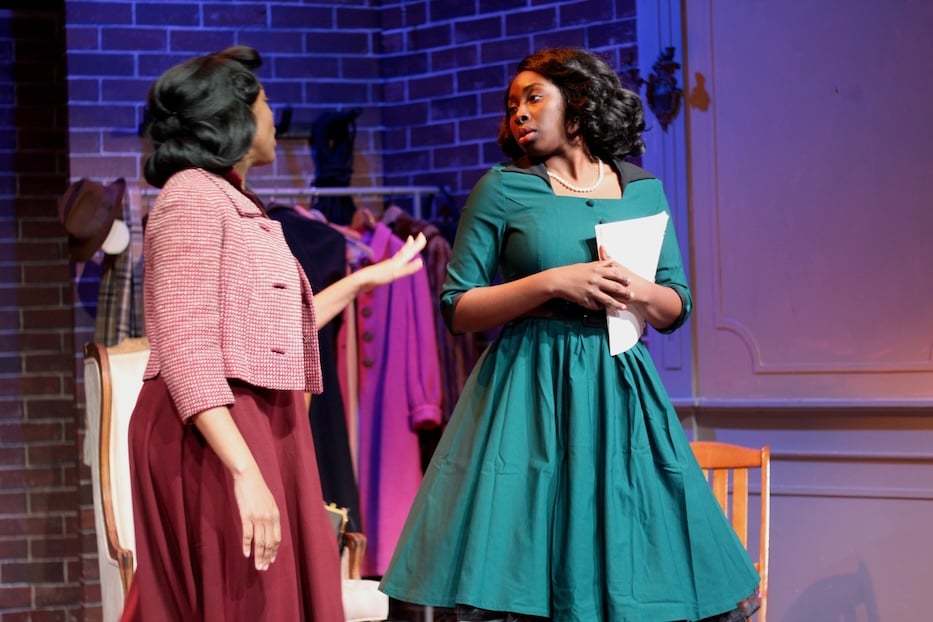
Tamika Pettway as Wiletta Mayer and Raissa Karim as Millie Davis.
From the jump, the parallels to the present abound, often so head-spinningly accurate that one can see why Childress was barred from Broadway for refusing to make herself small or palatable to white patrons. When John enters the room, Wiletta takes him instantly under her wing, taking him through the etiquette of a Broadway rehearsal before Manners arrives on the set. As she speaks, the audience realizes that this has very little to do with theater at all, and much more to do with white comfort.
“White folks can't stand unhappy Negroes … so laugh, laugh when it ain't funny at all,” she says, and a person can see how much she’s carried to make it in a field that treats her as less than human. When John pushes back, insisting that it must be more nuanced, she gives him a second warning, urging him to lie if asked for his opinion on the play. She’s doing what she must to see another day on the stage.
It’s this moment that has clearly, for Wiletta but perhaps also for Pettway and Villard, played out over and over again in rehearsal rooms, where directors assume that having a Black body onstage is synonymous with ending the color line in the American theater. When Wiletta raises a concern with the lack of lived Black experience in the script, it’s almost too on the nose when Manners responds with a curt, yet somehow also breezy, “Wiletta, don't complicate my life.”
We know this guy (perhaps we are this guy), because we’ve seen him in our offices, on our panels, in positions of nonprofit leadership he earned on slick vocab, an edgy pair of glasses and the backs of countless female colleagues. What makes him so dangerous is that he can pull off the optics of anti-racism, while continuing to subjugate people in his workplace. Or as Nelson suggested, “his actions are villainous, but he is not a villain,” so much as a product of the systems in which he doesn’t fully know he’s complicit.
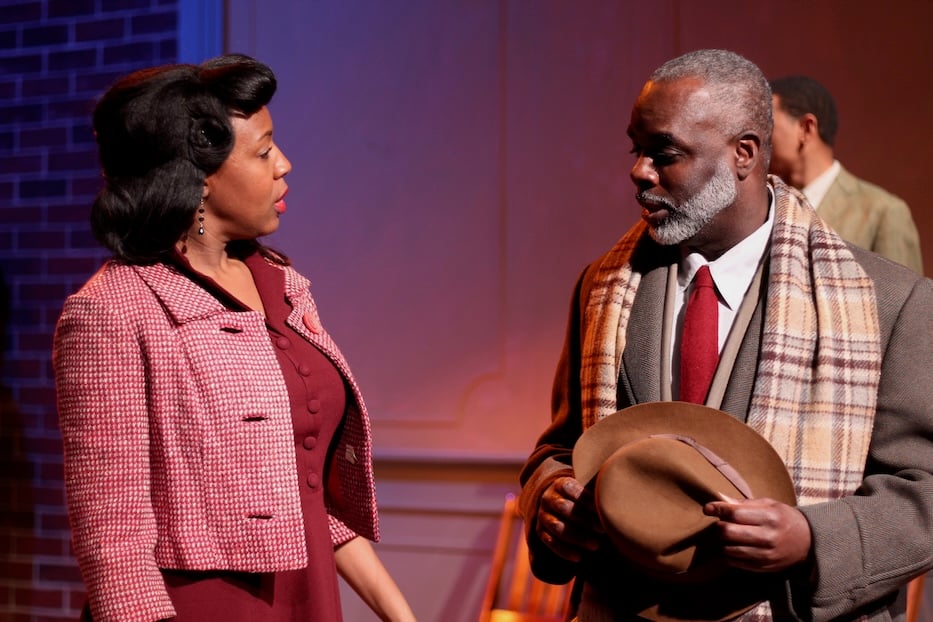
Pettway and Eaddy.
Pettway is—as she has always been on the CCT stage—a dynamo, and half of the acting here happens in her body language and resonant, rafter-raising voice alone. Already, she knows that the only chaos in Chaos In Bellville is that which is folded into storyline, from broken, chewed-up and splintered language to the mother she plays, who will send her son into the waiting, too-eager hands of white law enforcement if the alternative is lynching. From the moment she is in front of an audience, Pettway’s Wiletta is mesmerizing, from eyes that hold whole, sorrowful worlds of hurt to a building anger that slowly boils over, and then bursts into a brilliant cloud of smoke and flame.
“It [CCT] feels like home!” said Pettway, who last graced CCT’s stage in March of 2020, during a run of Dominique Morisseau’s Skeleton Crew in Erector Square that was an early casualty of the Covid-19 pandemic. When she’s performing Wiletta, “I think of the women in my family—anyone who's had the heart and the guts to truly hold onto what’s near and dear to them without being afraid of the penalty."
She’s far from alone: this large ensemble has lively, sometimes electric chemistry, and actors build off of each other in a way that is so true to life that sometimes it’s hard to parse out where one stage ends and the other begins. When she becomes Millie, Karim is immediately the witty friend you want in your corner, who will make you laugh because the alternative is crying. When she takes a seat early in the play, it’s as if a viewer can see a physical load coming off, however temporarily.
“Last show I was in, I wouldn't even tell my relatives. AlI did was shout, ‘Lord, have mercy!’ for almost two hours every night!” she says to Wiletta as the two compare notes on the characters they’ve played, a laundry list of flower names and gem tones that are all no more than stereotypes of the full, vibrant Black women they are. It’s a reminder that often, the only way white artists, directors, and consumers of culture know how to work with Black people is through a lens of oppression and trauma.
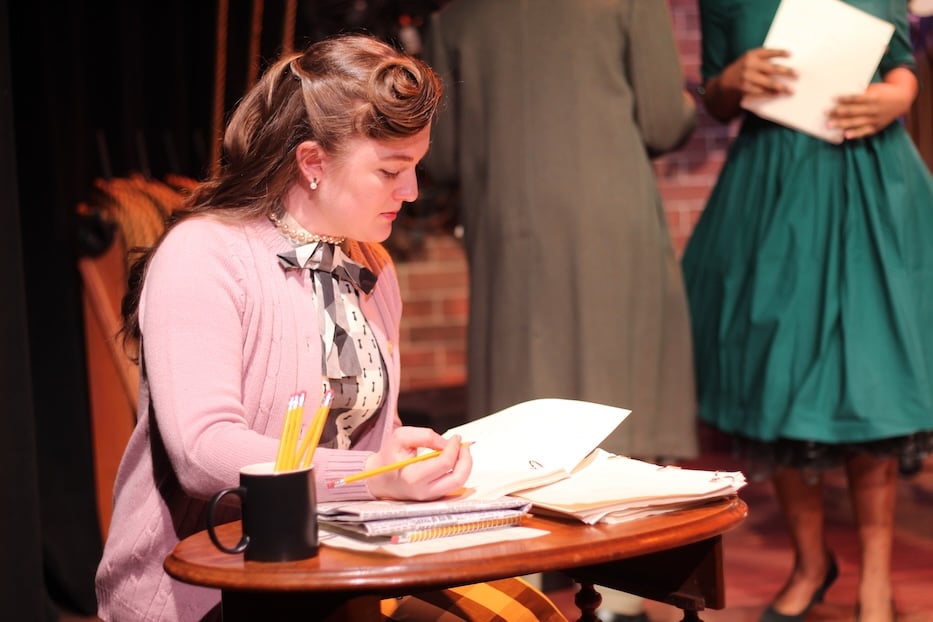
Elizabeth Finn as Judy Sears.
Bill and Judy, two very different sides of the same coin, cancel each other out in both their on and off-stage personae (as an aside, Finn nails playing the chipper, doe-eyed ally who wants to help, but doesn’t always have the skills or gumption to do so). As the mild-mannered Sheldon, Eaddy gradually reveals his own approach to survival in the field, with a moment of clarity that becomes a foundation for Wiletta’s own dramatic climax. Nevins, still wet behind the ears (fittingly, it’s Justin Villard’s first show at CCT) bounces between their morsels of information, taking their cues as he ingratiates himself to Manners, and the other white actors on the set.
In his performance, the audience realizes they are not just watching a play within a play, but a play within a play within a play, with layers of code-switching and vivid acting built in before anyone ever picks up a script.
Eaddy’s magic, here, is layered and subtly physical: he’s quiet, understated except for when he’s not, creating a surprising sense of presence for everyone else on the stage. He can lean forward and command the space, with stories that are as interesting to Nevins, the newcomer, as they are to pros like Wiletta and Millie. He, like Pettway, creates a real sense of rapport and community onstage, making it all the more dramatic when it is upended.
In a scene that feels like it could have been written this month, Sheldon breaks character, telling the story of a real-life lynching that he witnessed as a boy. “I seen one,” he says quietly as Manners encourages the cast to “allow your imaginations to soar,” making clear that he cannot fathom the reality that is outlined in the script (neither can the playwright, which is part of the problem). On the stage, it is as if time has stopped, and Sheldon winds back the clock to tell the story. By the time he has finished, he has laid his trauma out on the floor.
“When I hear of barbarism ... I feel so wretched, so guilty,” Manners says, as if to clean his conscience of what he has heard. But moments later, he has moved on, with an insistence that it would never happen in their city or time. It smacks of a specific ignorance and assuredness that perhaps only white people can have, whether it’s a New Yorker turning a blind eye to de facto segregation in the North, or a Mississippi sheriff ruling Demartravion Reed’s death a suicide after he was found hanging from a tree earlier this year, or audience members leaving “Seven Last Words of the Unarmed” clutching their pearls, and then driving home to the suburbs.
This is what makes Trouble In Mind so moving: it is highly specific to a time period, and also so stingingly fresh that it could have premiered this year. The mid 1950s, when the show ran Off Broadway, saw organizers working to desegregate civic and educational spaces, just as the U.S. Supreme Court had laid out in Brown v. Board of Education. They saw efforts to ensure safer voting processes for Black people, who despite the 15th and 19th Amendments were subject to horrific violence and intense voter suppression efforts, especially but not only in the American South.
Before the decade was over, Lorraine Hansberry had made history with A Raisin In The Sun, which opened at the Shubert Theatre in New Haven, and then went on to Broadway in 1959 (a “first” that in another universe might have belonged to Childress). Four years later, Martin Luther King’s “Letter From A Birmingham Jail,” warned of white moderates holding back vital racial and economic justice work, summoning the Al Mannerses of the world in a single paragraph.
And in 1965—exactly a decade after the show’s run Off Broadway—President Lyndon Johnson signed the Voting Rights Act into law, striking down measures like poll taxes, identification requirements and literacy testing that were all in place to keep Black people (and brown people, immigrants, and women) from the voting booth.
Six and a half decades later, here we are, watching Congress debate the SAVE America Act, a fancy voter suppression bill that has anti-trans measures folded in just for Republican sport. In New Haven and across the country, our neighbors are being rounded up by secret police, family members trying to hold on to each other for dear life. Black women are losing their livelihoods at an unprecedented rate, and their lives too, in a healthcare system that does not listen when they say they are in pain.
There are so many Wilettas among us. When will we start listening to them?
In that sense, Childress, who died in 1994, is a prophet: she didn’t live to see the country’s furious backtracking, but she predicted it all the same, with a piece of artwork that feels Baldwinian in nature and scope. Or as Villard said at a recent tech rehearsal, “it holds up so well today,” so much that its echoes are chilling.
What the audience may not expect, meanwhile, is how dryly funny the play often is. Childress, using humor as a balm, cuts through the mess and din of racism to show how ridiculous white characters can be, particularly the more they feel inconvenienced or uncomfortable. Her gift is how quickly she can move from that humor to something else entirely, so that all of her landings have sharp edges, and the audience must stay in the moment to see where she goes next, and whether they can come away unscathed.
As the cast circled up on the stage, holding hands before a tech run, it was clear to see Childress’ bright spirit in the room, carrying the work forward. Pre-show music drifted from the sound booth down through the theater. Lights made the stage glow in soft pinks and purples, as if it was sunset inside Bregamos. Around the actors, a half-full coat rack, curtain crank, exposed brick wall and sign for a stage door made the space feel real.
“We’re just gonna pass the pulse,” Nelson said. “Deep breath in.” The soft, whooshing sound of breath, inhaled slowly and sharply, filled the theater. “And let it out.” A group exhale. “Deep breath in.” Another breath. “And let it out.”
Actors opened their eyes and took in the room around them. In the show, Wiletta takes a stand because she believes that another world is possible. Back in the theater, actors were about to do the same, in a political climate that has made free speech feel precious and risky all at once.
“Very nice, very nice,” she said. “I love you. I’m already proud of you. Let’s do this for Alice.”