
Culture & Community | Downtown | Arts & Culture | Visual Arts | Yale University | Sculpture
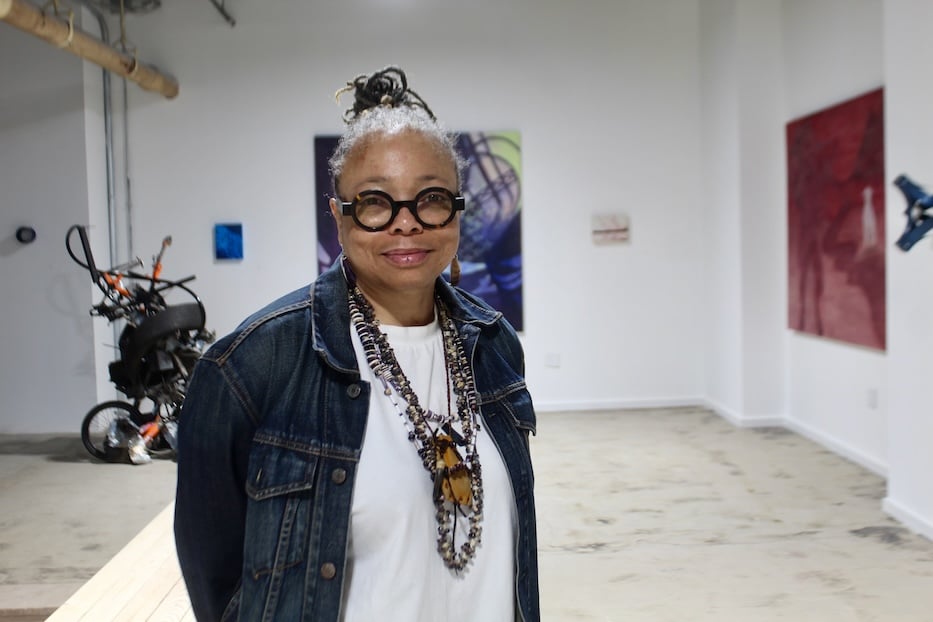
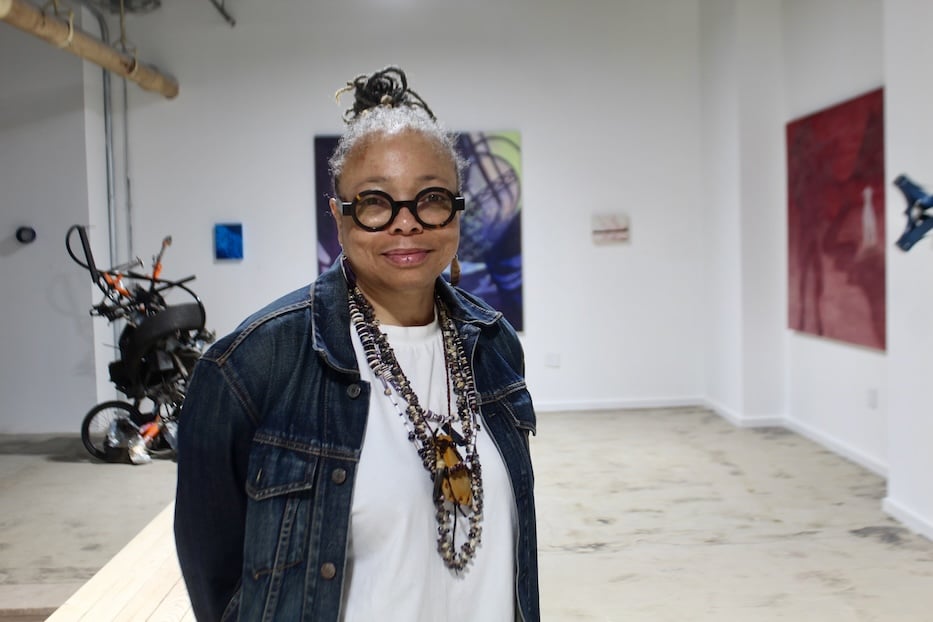
Kim Weston, with work by Mark Anthony Wilson, Jr. , Hazel Özgür, and Shanique Emelife behind her. Lucy Gellman Photo.
The bathroom wasn’t finished yet, not even close. The co-working space was still just a cluttered desk, with a sleeping laptop, piles of paper and a sheet draped over a corner of exposed plumbing. The HVAC was busted and the ADA requirements had yet to be met.
But when two artists straddling town and gown asked Kim Weston to rent her still-unfinished Court Street gallery space—and install the show on what would have been her late mother’s 81st birthday—she didn’t hesitate. She knew how to recognize a sign from the universe when she saw one.
Weston, an artist, curator, and educator whose work dives deep on spirit, identity, indigeneity and the thin, porous places between life and death, is the founder, owner and creative director of Wábi Gallery, a years-in-the-making dream at 124 Court St. that she has been working on since 2021. This month, she has opened it early to curators Moshopefoluwa Olagunju and César López for Afterdark, a group show that runs through April 30.
The gallery is open by appointment only; folks can email inquiries@wabi.gallery. Weston hopes to more formally open the gallery to the public in August, pending renovations and HVAC repairs that are still outstanding.
“This is a full-circle moment for me,” Weston said during a walkthrough of the show last week, before a trip to visit family in Philadelphia. “It’s been such a community effort to create a safe space for artists of color, for up-and-coming artists, and for the BIPOC community. I really wanted to open up these doors and say these things through visual communication.”
Artists featured include Shanique Emelife, Bryan Fernández, López, Inkpa Mani, Olagunju, Hazel Özgür, Lucía Reissig, Kika Serna, and Mark Anthony Wilson, Jr. All of them are MFA students at the Yale School of Art excluding Reissig, who López met while doing work in New York. All of them also share histories of migration, with work that sometimes lives between one home and another.
The space itself, and perhaps parts of the exhibition too, has been in the works for at least half a decade. Seven years ago this week, Weston’s mom, Christine Weston, passed away, leaving her with both a small inheritance and 75 acres of land in small-town South Carolina. Weston, who for years has lived and worked in greater New Haven, realized it could finally be her chance to open up the educational space she had dreamed about for decades.
As a teen, she had learned photography for the first time at the Jamaica Center for Arts & Learning, a short distance from where she and her family were living in Queens. As an artist who is also Black, Indigenous, queer, and a mother—and lives fully at the intersection of all of those identities—she also knows firsthand how rare those safe and inclusive spaces can be. Now, she had the resources to build that out in New Haven, and didn’t miss a beat.
In addition to Wábi, which launched its FOCUS Fellowship for young photographers in the fall of 2021, she found and purchased a Court Street property in downtown New Haven that could become a gallery. Even that, she remembered, felt like fate: someone else had put a bid in on the space, and then backed out. Wábi Arts formally purchased it in May of that year for $84,500, according to New Haven property records.
Then, Weston got to work. By late summer, she was working with Westville-based architect and designer Eric Epstein, and selling some of her own artwork to make renovations possible.
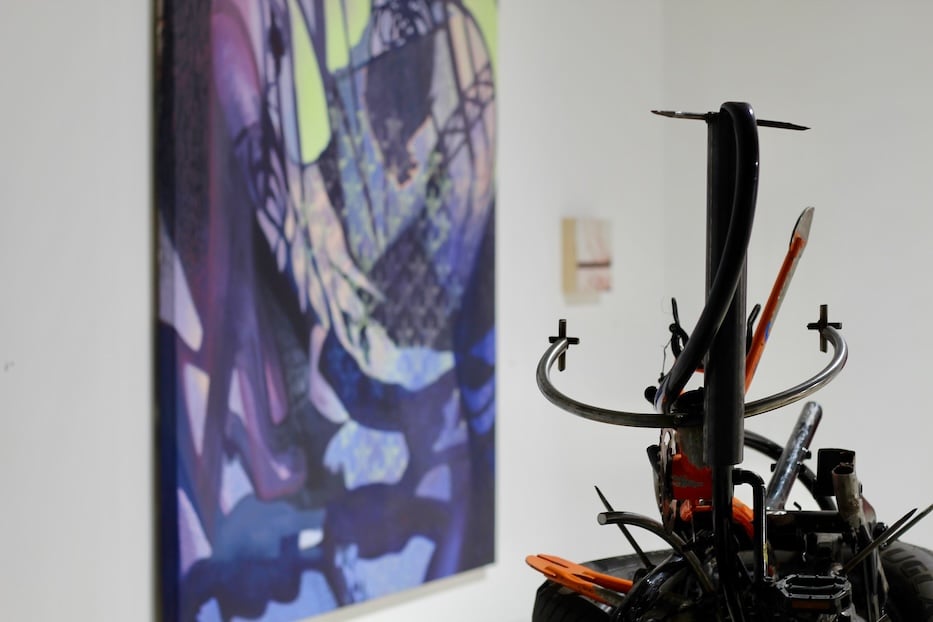
Hazel Özgür's I Want To Melt Into The Ground and Mark Anthony Wilson, Jr.'s Interstate Juju.
As she began building it out, she collaborated with local partners including Lotta Studio, the Ely Center of Contemporary Art, KNOWN Coworking, and the New Haven Free Public Library to keep exhibiting her work, and the work of artists she represented. In addition to several individual donors who have supported that work, she had high praise for both William Graustein and the Pincus Family Foundation, who have made both the physical space and the continuation of the FOCUS Fellowship possible. Read more about the latter here, here, and here, and here.
In 2021, the gallery was a raw, unfinished space, with exposed pipes, stacks of cardboard boxes, rough-edged concrete and an orange ladder that stood in the middle of the room, as if it was waiting for someone. Floor plans, printed out on huge sheets of paper, seemed like the only artwork that would ever be on display. Industrial fans whirred and hummed to combat the busted HVAC, which five years later is still on Weston’s to-do list for the space.
But Weston had a vision, and as she shared it with the community, it came together. In addition to Epstein, she worked closely with Bethany-based contractor William Bowens (the father of salsera Alisa Bowens-Mercado, in a sign of just how small this town is), who did the finishing work and added stairs and benches. She received work from longtime New Haven beloveds like Noé Jimenez and newer arrivals to the city like Amartya De. She still intends to add drop ceilings, which will cover the pipes (for now, she likes the industrial feel, she said).
“My mother was tenacious, and this has been a tenacious effort,” Weston said.
Around her last week, her excitement felt contagious, even and perhaps especially in pieces that demanded close-looking, deep reflection, and a curiosity and openness that comes with more conceptual, abstracted, and multi-media work. Although the space is still technically unfinished, she was very open to the idea of an exhibition when Olagunju and López first approached her earlier this year. She and Olagunju, who runs Omola Studio, had worked together previously, and she was excited to join forces again.
“[I] thought the space would be ideal,” particularly given Weston’s lens on inclusion, Olagunju said. “We were all enthusiastic to work together and started looping in other artists.”
As Weston spoke about the gallery last week, her words filling the whole space, it was easy to see a shared vision coming to life. Behind her, Shanique Emelife’s 2026 Untitled, bathed in different shades of red, asked a viewer to come in closer, with a scale and deep, glowing hue that gave it an umbilical kind of pull.
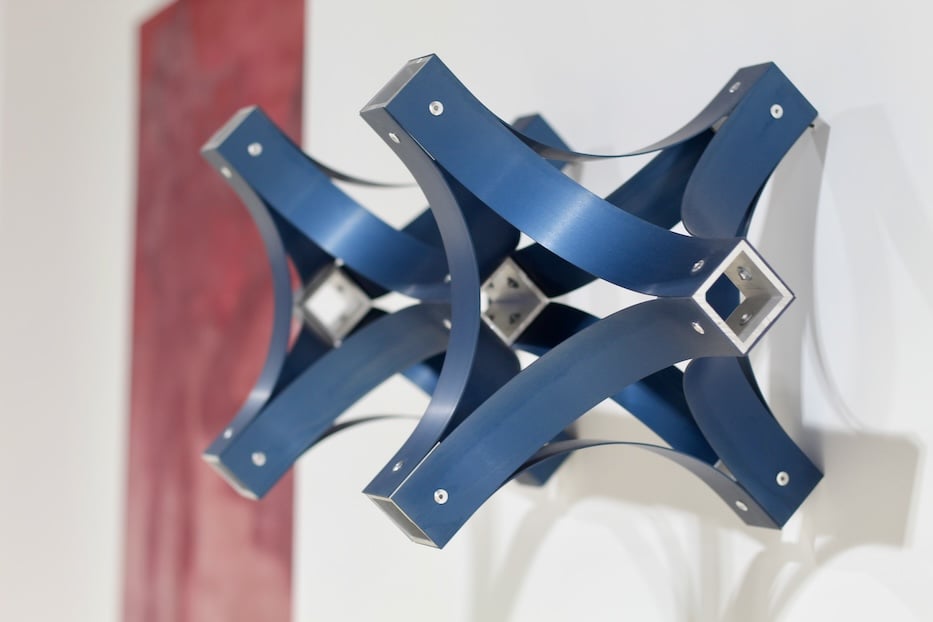
César López's work, which is installed in addition to the artist's role as a co-curator.
In the work, which is acrylic on linen, a figure moves through the foreground in profile, delineated enough to appear sturdy, human, and yet abstracted enough to feel spectral at the same time. With both arms, they lift a rod to their lips, knees bent gently as a garnet-colored river splits the canvas in half. On the other side, a lamb looks out toward the viewer, a tender shock of white in this scarlet- and wine-toned landscape. Small, skeletal trees rise in the background, and beyond them, mountains that nearly touch the sky.
There’s something here that feels Biblical (like, the end times), as though a strange haze has descended over a familiar place, rendering it unrecognizable. The longer a viewer looks, the more details reveal themselves: the figure’s small, open and discernible mouth, pointing to something beyond the frame, dozens of conifers that are ghosts of themselves, mountains that contain undulating, gentle hills along their sloping sides.
Emelife, in this way, is not simply asking a viewer to look closely: they are all but demanding it. The artist’s choice to leave the work untitled makes it feel even more evocative, a scene that hangs between this unstable and endangered present that we are in—even in the shelter of a downtown gallery—and the dream-like sequences that flood one’s subconscious.
The sense of expansive storytelling fills the gallery, working its way into every corner. Not far from Emelife’s Untitled, Wilson’s Interstate Juju and a trio of Özgür’s works seem to be having a whole conversation, their torqued and abstracted forms at once mechanical and deeply of this world. In Wilson’s sculpture, industrialized parts—steel and tire rubber, absented of their original function—wind around each other, messy and yet sculptural at once.
The more time a person spends with it, the more it reveals the extent of Wilson’s labor: many of the distinct parts have been welded together, in a kind of making that is also a deliberate unmaking, or rather a remaking. As it rises up, nearly meeting Özgür’s 2025 I Want To Melt Into The Ground, it seems to speak, sharing one artist’s story of journeying with another.
“By blending past and future technologies, my goal is to foster tools of liberation that unify Black people,” Wilson writes in an artist’s statement, and it sings here, surrounded by the work of immigrant artists who are all figuring out the different ways to share their stories. “My mission is to encourage active participation in the creation of our collective future.”
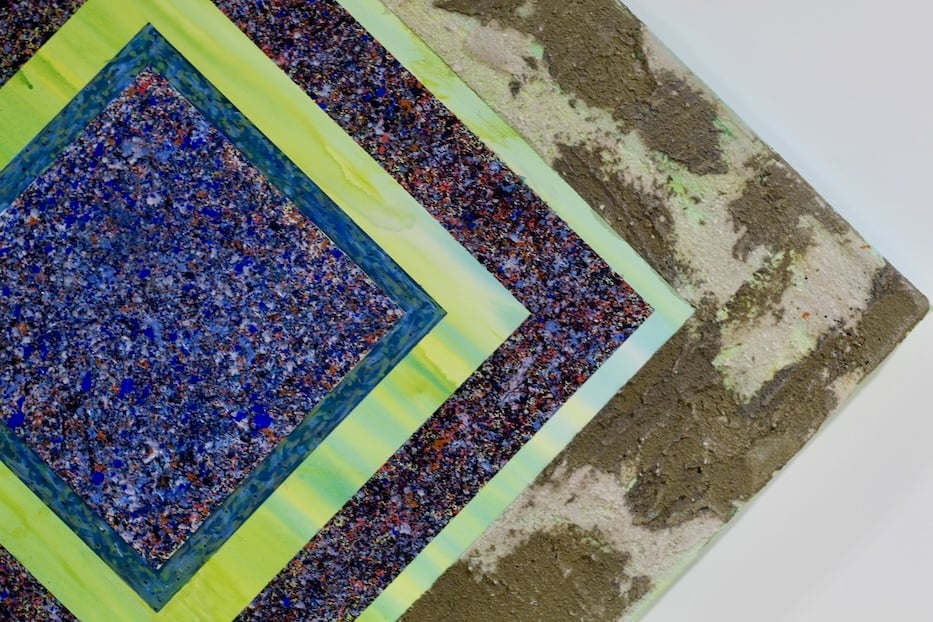
Detail, Inkpa Mani, Maka Tunpi Kin: The Formation of Earth. Stone Dust, Micacious Glitter, Iridescent Pigments, Sand, Crushed Quartz, Acrylic on Canvas.
This, of course, is the point of opening up this space: these pieces are meant to be viewed in person, at full scale, rather than in a cursory mid-afternoon scroll on social media. Together and apart, they share histories: of migration, both forced and voluntary, of generational histories and inheritances, of biological and chosen family, of belonging and not. It feels—as it often does in these spaces—like an unexpected gift that viewers get a chance to exist with the work, even for a little bit.
“Time is so truncated when you’re in the [Yale MFA] program,” López said in a phone call Wednesday, adding that he’s grateful for the time and space to be in community with both fellow artists and New Haveners. “The program is very fast, so I have been trying to slow things down.” The show, as well as some of López’s new work that seeks to make his story more visible, is part of that.
Across the gallery, that visibility also comes in many forms, which is part of what makes it so meaningful. In Fernandez’ 2026 Tempo With Mamá, for instance, the artist invites a viewer into an intimate scene, in which one woman fusses over another in the kind of interior space that seems sacred because it is well lived in.
In a chair, the other woman—presumably the matriarch—closes her eyes, hands clasped at her lap. Over a protective cape that covers her shoulders, a woman dons gloves and works lovingly on her hair, a ceramic bowl of deep red dye incandescent on a table nearby. Beside it, a candle flickers among the lush green leaves of indoor plants. Tucked beneath, three wine bottles sit untouched. Beyond it, the curtains are gem colored, with a burst of almost-fluorescent green that feels like summer.
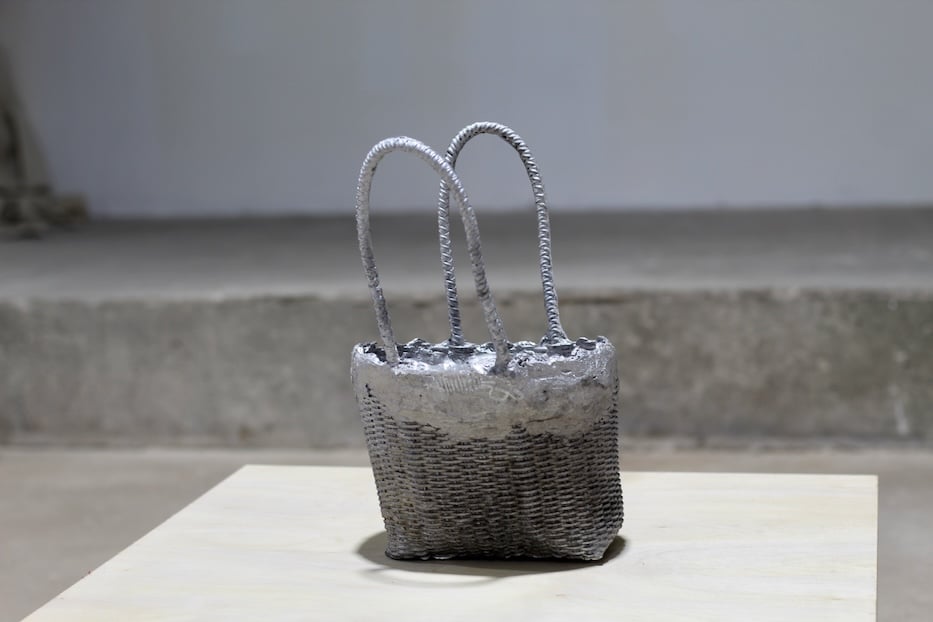
Work by Lucía Reissig.
López, meanwhile, tells a story of DACA, migration, belonging and in-betweens through sculptures like Component Z and Structural Form, with precise, geometric structures made of curved, interlocking and anodized aluminum. López, who came to the U.S. from Guatemala when he was 13, is subtle here: he uses dyes one would see not in common industrial aluminum products, but in his first homeland, creating a memory that is also a bridge.
Reissig, who is a kindred spirit in this sense, literally weaves it into her work, with a cast aluminum basket that is a matryoshka doll of generational histories, and asks a viewer to look twice (or three, or four, or ten times) at both its craftsmanship and medium. Mani, who grew up between Mexico and Minnesota, uses both conventional mediums (canvas, acrylic paint) and found, reclaimed, salvaged and (wo)man-made objects (wood, stone, earth, and fabric, as well as large knives and the bright, woven rebozos often used to carry babies) to amplify, interrogate and broaden the artistic and cultural boundaries of what American, Indigenous and diasporic art can look like.
When Weston steps into the gallery, she can sense all of that—and savors the stories that now fill the space, however temporarily. On a walkthrough last week, she explained that she thinks of the generations from which she springs, and those she’s now able to educate as they go into the wider world. Constantly, she added, she thinks of her mom, and how she’s present in the space.
“I feel like she’s right with me, right with me,” Weston said. “She helped me open these doors. I couldn’t have done it without my mom, without the community, without the creator. You know how people say, ‘I’m full?’ I’m full of joy.”