

Culture & Community | Long Wharf | Long Wharf Theatre | Arts & Culture | Theater | History | Canal Dock Boathouse
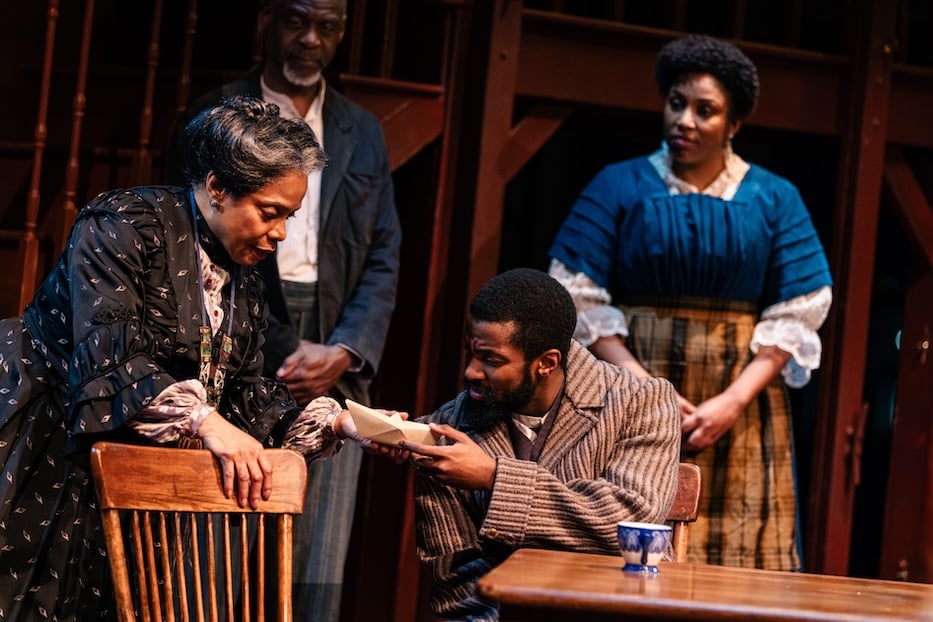
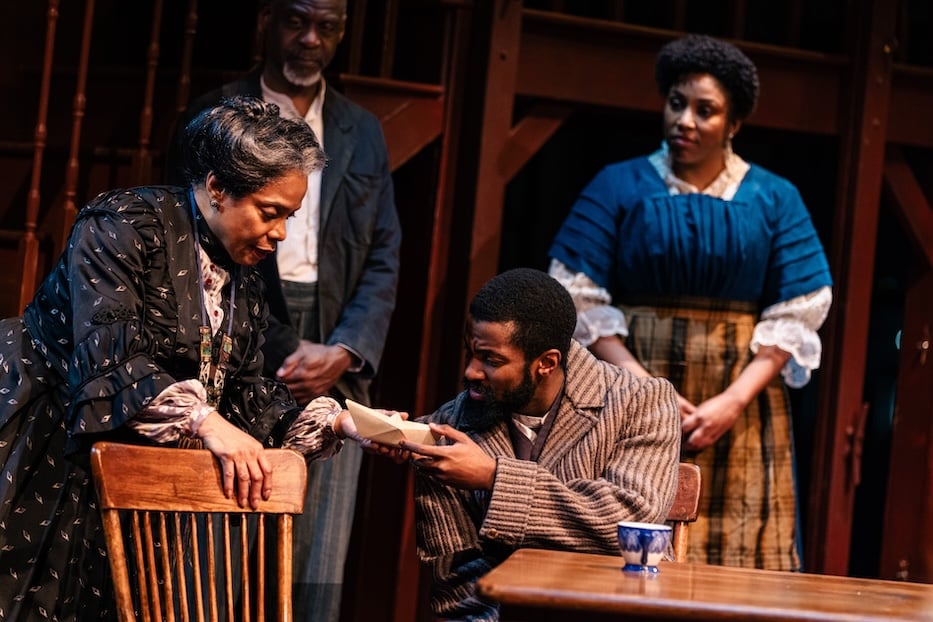
Denise Burse as Aunt Esther and Matthew Elam as Citizen Barlow in Gem of the Ocean. Marc J. Franklin Photo.
Aunt Esther looks out toward something in the distance, beyond the man standing still beside her. Her hands flutter upwards, slicing the air around them. Her eyes are the eyes of someone who has seen empires rise and fall. Behind her, the house stretches out, full of stories, and beyond that, the blue-black water of the Long Island Sound.
“I dreamed you had a ship full of men and you was coming across the water,” she starts, her voice steady. She is ancient and regal. “Had that stick and you was standing up in this boat full of men.” Her voice deepens. “You come and asked me what I was doing standing there. I told you I wanted to go back across the ocean.” Drums roll and her voice echoes through the theater, as big and broad as the water itself.
That collapsing of space and time, and the knowledge that a body can hold centuries, is at the core of August Wilson’s Gem of the Ocean, produced by Long Wharf Theatre and running at the Canal Dock Boathouse through March 15. Directed by Cheyenne Barboza with a powerhouse cast and crew, the work is a powerful meditation on race, racism, and the people we carry with us, a weight that is sometimes too heavy to bear.
In using the Boathouse for a second time—and working with New Haven artists like Terrence Riggins, Dr. Hanan Hameen Diagne, Assistant Director Steve Driffin, musician Eric Rey and Barboza—Long Wharf has found a powerful and propulsive artistic voice, fusing form and function for a piece of theater that takes the viewer on a journey that is otherworldly, and still rooted in New Haven.
Tickets and more information are available here. Almost all of the productions are completely sold out, thanks in part to close to a dozen community partnerships and a celebration of Wilson’s life and work that is still ongoing. While seven of Wilson’s 10 American Century plays have run at the Yale Repertory Theatre, this is the first time Gem of the Ocean has come to New Haven.
“My biggest takeaway as someone who walks with my ancestors every day is the feeling of connection to the spirit,” said Barboza shortly before a tech rehearsal. “What is so mystical about 1839 Wylie Avenue? We hear, over and over again, ‘This is a peaceful house.’ What does it look like to bring the house to life?”
Written in the early 2000s but set in 1904, Gem of the Ocean tells the story of Citizen Barlow (Matthew Elam), who has left his home in Alabama in search of opportunity in the North. In Pittsburgh, he arrives at 1839 Wylie Avenue in search of peace, although from what the audience must wait to find out. There is a hunger in his eyes and hollowed-out cheeks, a frenetic energy that radiates through him. As he begs for his soul to be cleansed, a viewer can tell that he is desperate to put down the load that he is carrying.
Inside, 285-year-old Aunt Esther (Denise Burse) has created a sanctuary, in and out of which her caretaker Eli (Thomas Silcott) and Solly Two Kings (Terrence Riggins) enter and exit, sometimes accompanied by friendly itinerant salesman Rutherford Selig (Mike Boland). It is, as multiple characters note, “a peaceful house”—made more so by the care that Black Mary (Grace Porter) takes as she tends the stove, cleans the rooms, and weighs how much of Esther’s history she can carry in the years ahead.
Outside, Pittsburgh is still very much a tale of two (or three, or four) cities, cast into sharp relief when characters speak about the steel mill where many of the city’s Black residents—overexploited, underpaid—must work to make ends meet. Nowhere is that clearer than in the character Caesar Wilks (Bjorn DuPaty) , who sees the law as a guidebook from which he can get ahead, including at the expense of other Black city residents.
What makes him so dangerous is that we all know him in the real world, and often don’t realize he’s both a viper and a pawn until it may be entirely too late.
Marc J. Franklin Photo.
Dates and numbers are important to this show: 1839, the address in which the show unfolds, is the same year that enslaved Africans aboard the Amistad rebelled, and that the ship docked at New Haven’s Long Wharf, the prelude to a trial that made global history. The year 1904 is still within a period many historians refer to as the Nadir, a time of deadly race relations and immense social and economic disenfranchisement of Black Americans that followed the American Civil War and Reconstruction.
There’s also 1619, which is the year that 285-year old Aunt Esther was ostensibly “born,” and the year that the first ship carrying enslaved Africans arrived in Point Comfort, Virginia. In that way that is so Wilsonian, it’s a reference (one of many) to enslavement, racism, and the stain of white supremacy on this country, delivered in a way that is both crushing and nuanced enough to be a pain point that throbs throughout the show.
In a play in which stories of waterways, forced migration, and journeying are all central, both the Boathouse and the set that it contains are unspoken characters, part of the magic and the memory (and certainly, the sorrow too) baked into this show.
From the jump, Long Wharf’s artistic vision brings the show to life in ways that a viewer can’t imagine when they walk into the theater, itself a space that has been completely transformed. On the stage, every square inch of 1839 Wylie Avenue is deliberate: the plush, well-loved armchair at stage left, the always-warm stove at stage right, the door to the house, which swings open and shut with an arrhythmic heartbeat. There’s a wood table that is a de facto meeting space, and a flight of stairs that leads to a second story. The audience never sees the rooms up there, but they never have to either: Wilson’s language, a mix of deep lyricism and fast conversation, conjures them in their entirety.
To suggest that this space has good bones feels inadequate: it holds centuries of memory, with nooks and crannies meant to ensure characters’ survival (a nod to set designer Omid Akbari, and assistant scenic designer Anthony Robles) and conceal the secrets they need to shed. When, halfway through the show, it comes to life before the audience’s eyes, its walls dissolving into the ocean as its floors rotate into sharp, heaving hulls, it feels like a revelation and a natural transition all at once, the history alive in the people who call it home.
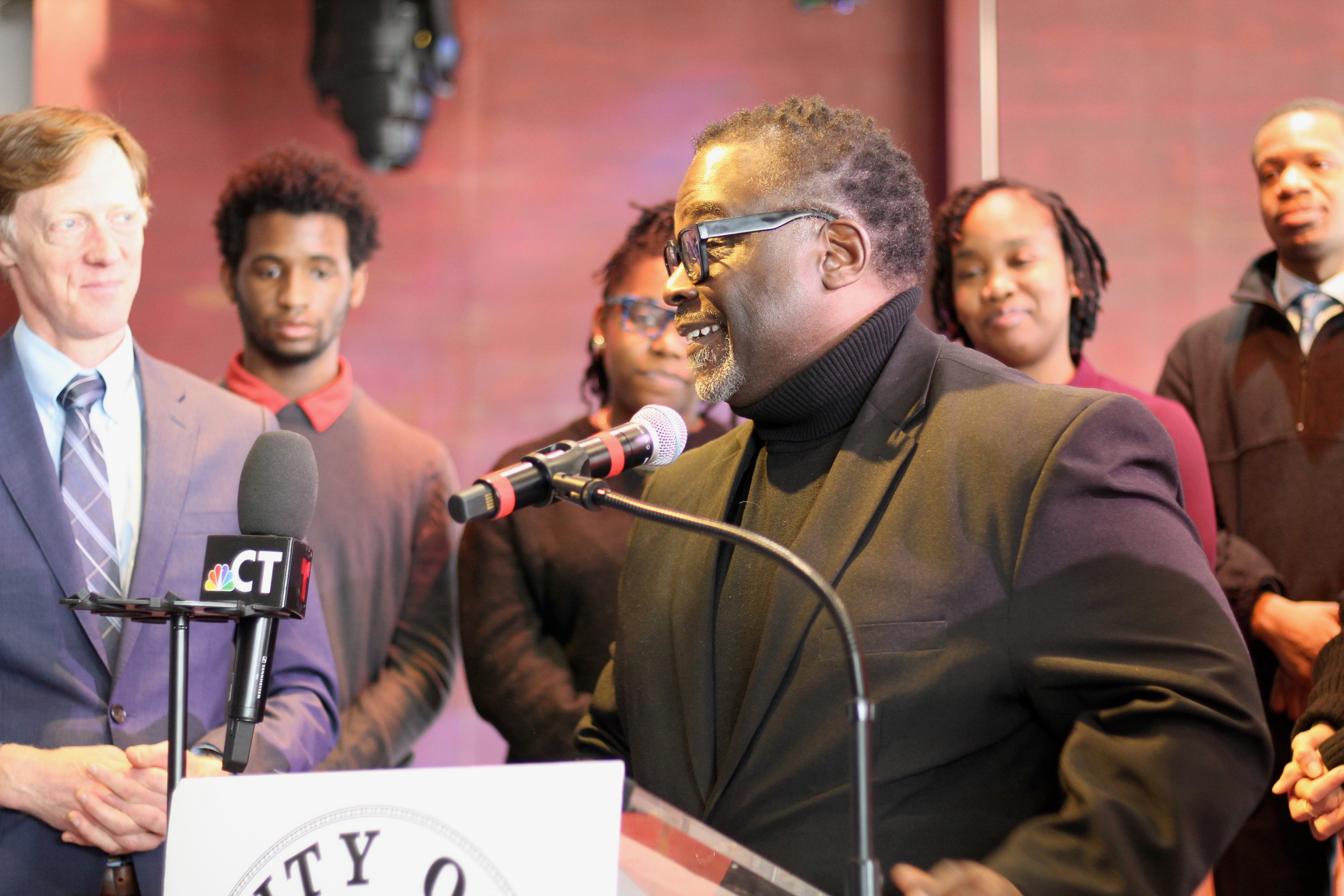
Assistant Director Steve Driffin, who noted the role of Wilson's work in his own life before a recent tech rehearsal. "I read his plays long before I could go to the theater," he said. Lucy Gellman Photo.
As they make it their own, actors give a performance that carries an audience back to 1904, but also through centuries that preceded it, and arguably centuries that will follow. In one moment, early in the second act, Solly Two Kings is turning back the clock, reimagining what Emancipation could have been. He stands, and his presence fills the room, chest broad, shoulders squared. His voice is full, gravelly; it catches every few sentences, as if the breath has left and then reentered his body. As he sees it, freedom is a slippery thing, clear as he announces “I say I got it, but what is it? I’m still trying to find out.”
In another, Caesar strides into 1839 Wylie like he owns the place, his hunger for power there in his puffed-out chest and his jangling pockets. He tries to size up Citizen, describing his own rise to economic success in the process. He declares “I got to play the hand that was dealt to me,” and all a person has to do is look at Elam’s face to know it's an incomplete truth.
DuPaty commits to the role, showing the audience how vastly white supremacy (and the systems of capitalism and patriarchy with which it is intimate bedfellows) hurts all people, including those who pretzel themselves to fit its confines. In the process, he also raises valuable questions for his audience, particularly around his own internalized anti-Blackness, and the way his rise to power relies on the myth of self-sufficiency and the economic exploitation of people who look like him.
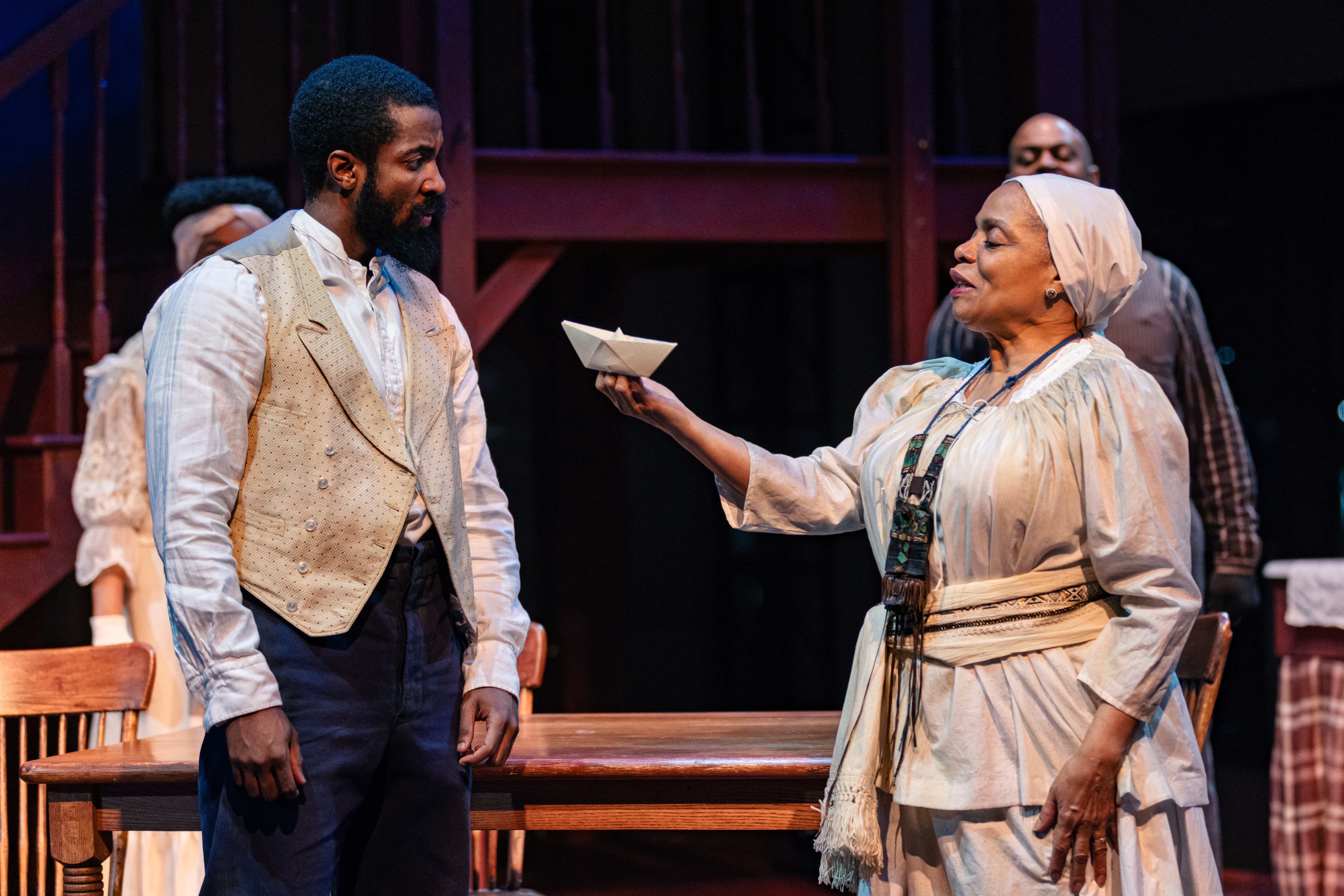
But nowhere is this clearer than in Aunt Esther’s journey to the City of Bones, a nod to history that is at once completely surreal, and painfully rooted in the past. As percussion floats over the stage, heartbeat-like and grounding (a nod to Rey, who also worked with Barboza and Riggins on Unbecoming Tragedy last year), characters begin to move, suspended between this world and one an ocean away. Their bodies loosen, pulled in by the call and response of the drum. They step forward, and the house is suddenly all breath and footfalls, a whisper of what is to come. A paper boat rests in one of Citizen’s hands, so delicate that at one point, it looks as if it could be a bird.
In the audience, a person can feel their heart squeeze in their chest, aware of the weight and power of this moment. The house, transforming, is suddenly not a house at all, but a ship that Citizen must survive. This is 1904, and 1619, and 1839, and 1965, and 1793, and 2026, all at the same time. It is William Lanson, a formerly enslaved New Havener, building out the city’s Long Wharf and dying penniless. It is the horrific conditions of the Middle Passage and the fact that hundreds of years later, vigilantes, some dressed as members of law enforcement, are still lynching Black people and calling it within the confines of the law.
It is holding all of those histories, and listening to the voices of ancestors, that they might guide the way. Or as Aunt Esther says, “That’s the center of the world. In time, it will all come to light.”
“We really tapped into the culture and the spirituality of people throughout the Maafa,” said Hameen Diagne, who served as both movement and fight director for the show, on blocking the scene for Burse and members of the cast. “How do they connect with the spirit realm, the realm of the creator? What connects us all? It’s that mitochondrial DNA.”
In this peaceful house, nobody misses: Elam is nervous and fidgety enough to make it clear that Citizen feels culpable of something, with a kind of yearning in his whole body that is palpable even from the last rows of the intimate theater. Porter, as a protege of Esther who taps into a fire that the audience doesn’t necessarily see coming, finds her own footing, and it is most exciting to watch as she does.
As Solly, a formerly enslaved person who guided 62 people to freedom as a conductor on the Underground Railroad, Riggins becomes a thunder-voiced mentor whose kindness and big, barking laugh is matched only by a simmering rage, as if there is an open, festering wound on his soul (and how, after the cruelty he has witnessed, can there not be?). It is a joy to watch him interact with everyone on this stage, but none so much as Burse, with whom he seems to have known before time itself, and Silcott, in whom he finds a friend and comrade close enough to be a brother.
Just as her centuries-old character in the show, Burse is the glue that holds this cast together, the beating heart of the production and of 1839 Wylie Avenue.
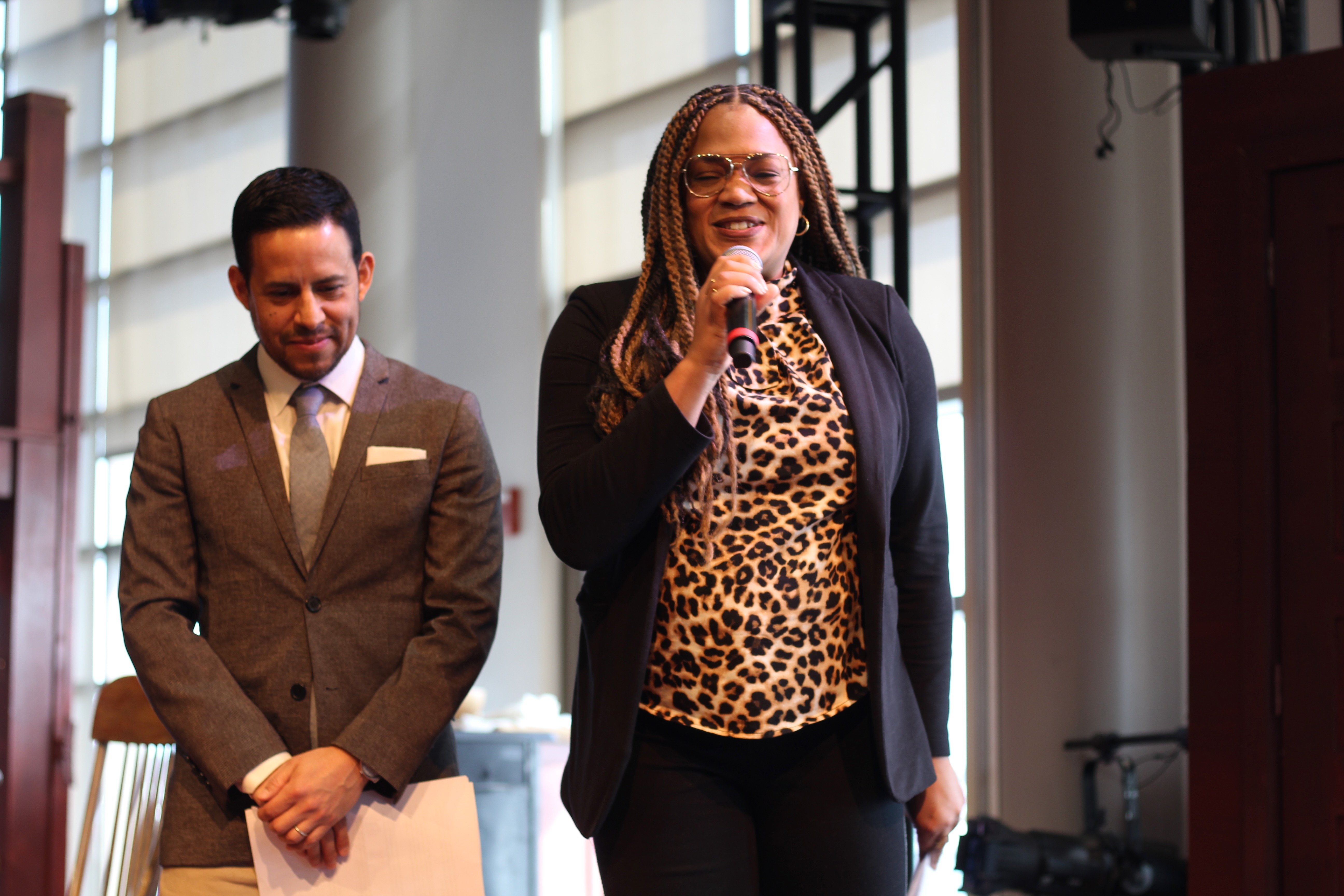
LWT Artistic Director Jacob Padrón and Managing Director Meredith Suttles. Lucy Gellman Photo.
Thanks to its cast and creative team, this Gem of the Ocean is also an adaptation that becomes a love letter to New Haven past and present, a city where Wilson himself wrote and workshopped so many of the American Century plays. While it is set at the Boathouse, Gem is part of a months-long, citywide August Wilson Celebration that began in September, and continues next week at the Canal Dock Boathouse and the LAB at ConnCORP, before concluding in April at the Mitchell Branch of the New Haven Free Public Library.
For Barboza, it marks something of a homecoming, particularly after a production of Riggins’ Unbecoming Tragedy through Long Wharf and Collective Consciousness Theatres last year. Born and raised in Waterbury (she now lives in Middletown, although she travels to Philadelphia as a production manager at the Painted Bride Art Center), Barboza jumped into the arts early in her life, thanks in part to programs like the after-school Granville Academy, and later the Waterbury Arts Magnet School.
By the time she was a young adult, she had seen Wilson’s Radio Golf on Broadway, where it opened in 2007 after a premiere at the Yale Repertory Theatre in April 2005, just months before Wilson died at just 60 years old. So when Long Wharf—where she directed a pandemic-proofed Passing Strange in 2021 and Unbecoming Tragedy last year—tapped her to direct Wilson’s work, she was thrilled. That rehearsals began at the Eugene O’Neill Theater Center, once a creative touchpoint in Wilson’s life, made the experience doubly meaningful.
“It feels so good to be back,” she said, adding that she’s excited to collaborate with artists including Riggins and Rey for a second time.
So too for Riggins, whose Solly Two Kings marks a return to Wilson’s work after 17 years—and a kind of love letter to the playwright that he’s been writing since reading Joe Turner's Come and Gone while in prison in Los Angeles.
In 2009, Riggins played Harmond Wilks (yes, the same Wilks family, in the way that Wilson knits these lives across generations) in a production of Radio Golf at the Denver Center Theatre Company. Three years before that, during the birth of his daughter, Riggins had played Gem’s Caesar Wilks under the direction of Israel Hicks at the same company. Returning to the show, and the language, feels like home.
“Being part of this production, and the artistic relationships that it’s formed, for me it’s rich on so many levels,” he said in a phone call. Two years ago, Riggins met Elam when both of them were working on a production of Josh Wilder’s Marty and the Hands That Could in Baltimore. Fast forward to the present, and Gem of the Ocean is Elam’s first Equity production (that’s shorthand for Actors' Equity Association). It reminded Riggins of a moment so many years ago, when he got his equity card during a run of King Hedley II in Denver.
In those years, the actor who played a 2006 Solly Two Kings, the late Charles Weldon, took Riggins under his wing. During his life, Weldon was the artistic director of the New York based New York theater troupe the Negro Ensemble Company. Riggins, who recently joked that he’s embraced acting his age, has tried to do the same for Elam.
“This is the cycle of life,” he said. “It’s just wonderful on so many levels.”
He added that watching Barboza grow as a director has made his spirits soar, as has coming back to Wilson’s work. In the show, he plays both Solly and a gatekeeper to the City of Bones, donning a mask and making his movements grand and fluid as the ocean itself. It’s that writing that has fueled years and years of his own work, including most recently Unbecoming Tragedy. In that play, his character’s own journey is influenced by Citizen’s trip to the City of Bones, and the way he must hold his past to live his present.
“I don’t know where I would be without that ritual and that tradition that August Wilson created,” Riggins said, adding that the playwright is the largest single employer of Black actors that the 20th century (and now, likely, the 21st) ever saw. “It’s rich. It’s wonderful.”
And certainly, Gem feels as much a part of New Haven as it is Pittsburgh’s. It is impossible to watch this production and not think of Lanson, who built out New Haven’s Long Wharf and part of the Farmington Canal, but for centuries went without any sort of recognition, and is still not widely taught in the New Haven Public Schools (thanks to artist Dana King, a sculpture of Lanson now stands on the Farmington Canal).
In the Boathouse, Long Wharf has smartly used an outside deck as a staging area, so that audience members see actors walking in from the outside, the water of the Long Island Sound stretching out behind them. It’s a reminder of all the things it has been: a natural resource that was for years stewarded by the Quinnipiac and Wappinger peoples; an unwitting instrument of violence that allowed the forced migration of millions of people; a vehicle for trade and commerce manipulated by the needs of industry and greed.
New Haven, meanwhile, may not have an Aunt Esther, who Wilson invokes in both Two Trains Running and King Hedley II, but it is still mourning the loss of several Black matriarchs who could step onto a stage, and travel through centuries of history without ever moving their bodies out of the spotlight. Among them, still so recently departed that it hurts, is Aleta Staton, a theater-maker and educator who passed away in 2024, after a heart transplant.
During her life in and beyond New Haven, Staton wore many creative hats, including staging performances across the city, helping students with the August Wilson Monologue Competition, and doing community engagement at the Arts Council of Greater New Haven, Long Wharf and later the International Festival of Arts & Ideas. Along the way, she was a mentor to many, including Riggins.
“I’m thinking a lot about out dearly departed Aleta Station this afternoon, whose love of New Haven, whose love of theater, and whose love of August Wilson is with us in this space as we gather,” said LWT Artistic Director Jacob Padrón, who announced in October that he plans to step down at the end of the current season, at a press conference before previews began. “Aleta would be so proud of us right now, as would all of our ancestors.”
“Because of their 20th-century focus, Wilson’s 10 plays have collectively come to be known as the Century Cycle, and because nine of the 10 plays are set in the historically Black Hill district of Pittsburgh, Pennsylvania, the plays are also remembered as the Pittsburgh Cycle ,” added Dr. Jonathan Howard an assistant professor of English and Black Studies at Yale University. “But as we celebrate the legacy of August Wilson in this city … we are also celebrating what might be justly called the New Haven Cycle. The story of Wilson’s cycle begins right here in New Haven.”
“The cycle was set in Pittsburgh, but it was largely crafted and staged in New Haven,” Howard continued, tracing Wilson’s connection to the Yale Repertory Theatre and close working relationship with the late Lloyd Richards. “It’s in New Haven that Black theater lifts up its voice and sings.”
Performances of August Wilson’s Gem of the Ocean run at the Canal Dock Boathouse in New Haven, 475 Long Wharf Dr., through March 15. Tickets and more information are available here. Partners include the Yale Schwarzman Center, Creative Arts Workshop, ConnCORP, W.A.B. Studio and Conservatory, the New Haven Free Public Library, and the Elements of Abundance among others.