

ConnCAT | Culture & Community | Dixwell | Arts & Culture | Community Heroes | ConnCORP | History
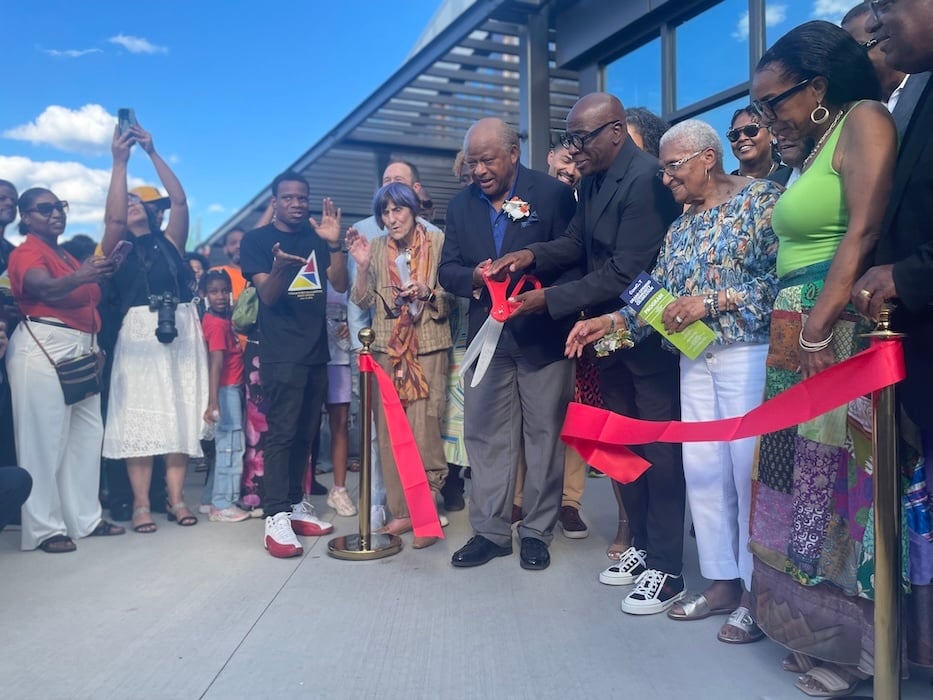
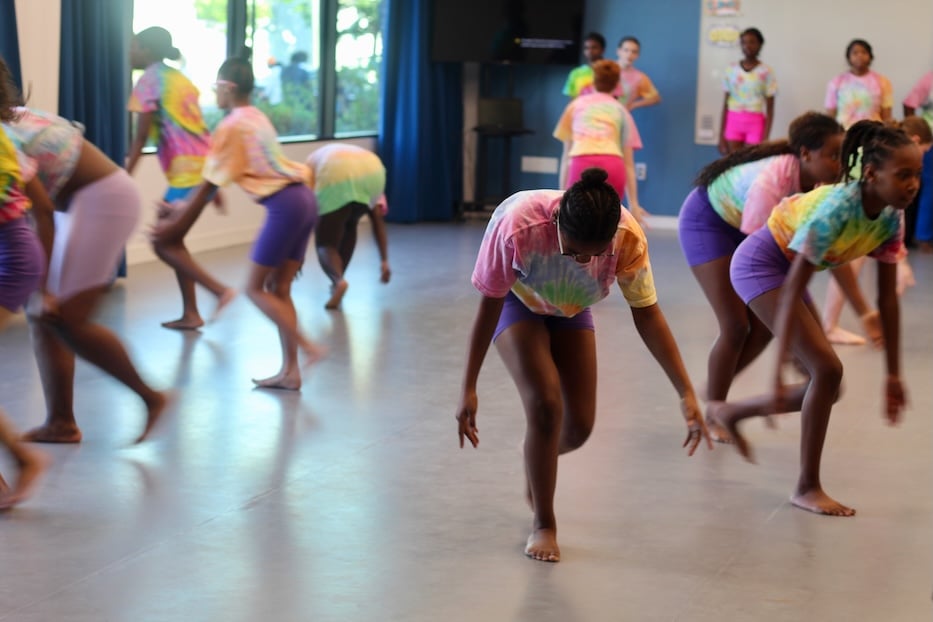
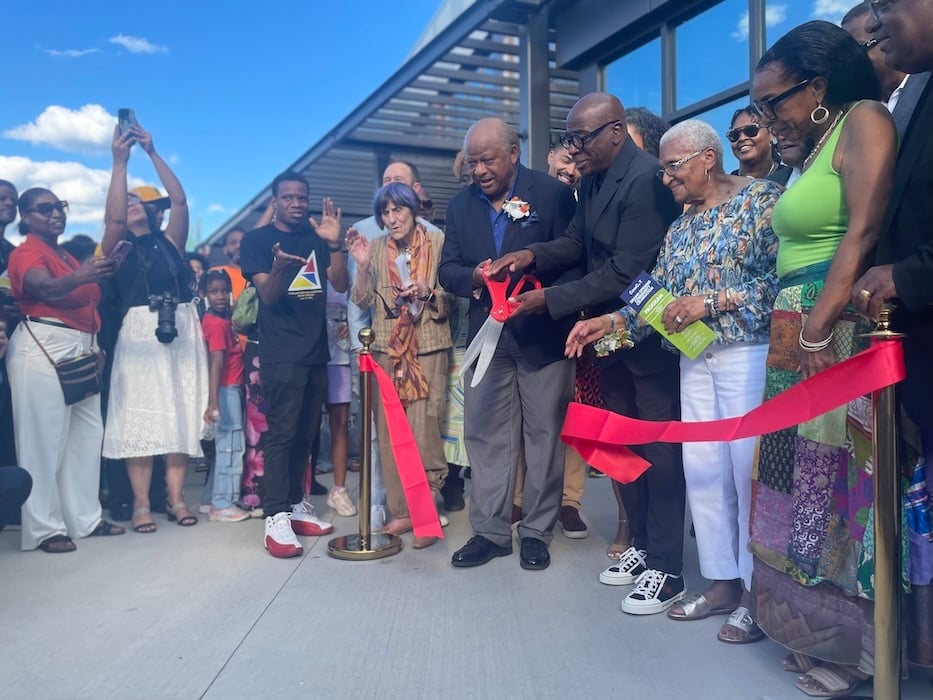
Top: The moment so many New Haveners gathered to witness. Bottom: Students from Betsy Ross Arts & Design Academy (BRADA) dance to "Brand New Day" from The Wiz. Lucy Gellman Photos.
Inside a gleaming, pristine dance studio just off Dixwell Avenue, the future was so bright that it seemed to be already unfolding, one step at a time.
At the center of the room, dancers raised their arms and kicked up their legs, limbs gliding through the air. They moved just a step to the left, then took flight all at once. They crouched, rolled forward, and sprang up all over again. On each of their shirts, a starburst of tie dye seemed to glow. Everybody be glad / 'Cause the sun is shining just for us! Diana Ross belted through a speaker.
After years of community conversations and painstaking renovations, that “Brand New Day” came to 150 Dixwell Ave. Friday afternoon, as First Haven in Dixwell opened its doors to hundreds of New Haveners during a ribbon cutting and grand opening that fell on Juneteenth. Amid glowing remarks, never-ending hors d’oeuvres, and joyful conversation that filled the building, speakers and neighbors alike framed it as part of a historic neighborhood’s revival.
The 65,000-square-foot, $200 million project, brought to fruition by HGA Architects, has been at least six years in the making and is made possible by both the Connecticut Center for Arts & Technology (ConnCAT) and its for-profit subsidiary, the Connecticut Community Outreach Revitalization Program (ConnCORP). The latter will continue to operate its 496 Newhall St. space, the LAB at ConnCORP, as a hub for entrepreneurs and artists, in Hamden.
“We did it,” said Erik Clemons, CEO and president of ConnCAT and CEO of ConnCORP, to a wave of cheering and applause. “I’m just so grateful to each and every one of you, because each and every one of you has had a collective part in this story. It is we. It is us.”
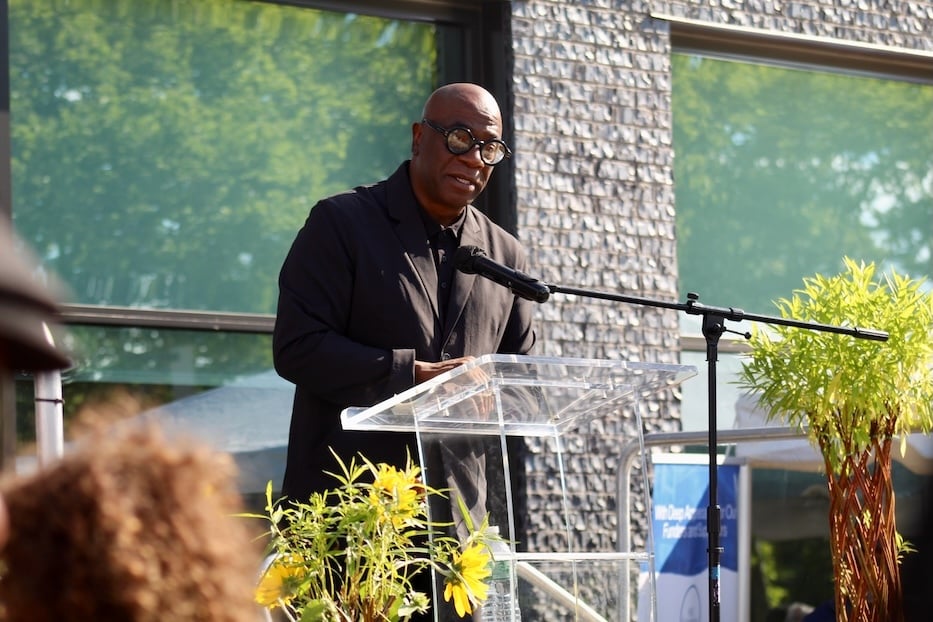
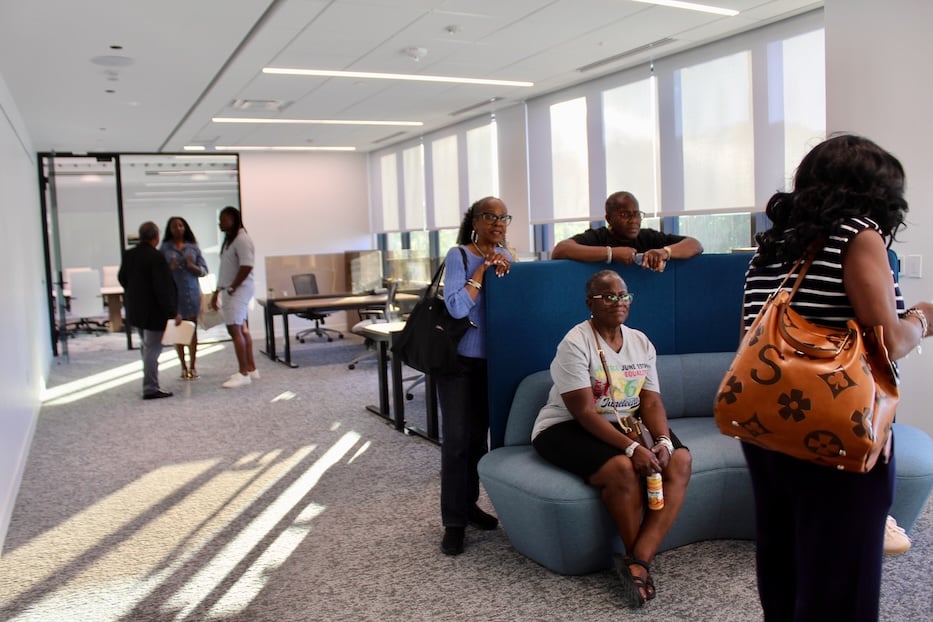
Top: Clemons speaks before cutting the ribbom. Bottom: Attendees check out the second floor of the building.
As it opens its doors, First Haven is home to a new arm of the Cornell Scott-Hill Health Center, a daycare run by the Friends Center for Children, and a new home for ConnCAT, which provides training in the culinary arts, phlebotomy, biotechnology, and construction, as well as arts-themed after school and summer programs for youth. Prior to this month, ConnCAT ran its programs out of a building at 4 Science Park, where Clemons and ConnCAT Founder Carlton Highsmith built up programming based on Bill Strickland’s Manchester Bidwell model, which seeks to address unemployment and underemployment through job training and professional development.
On the second floor of the building, 14,000 square feet of space remain unfilled, although Ian Williams, senior vice president of real estate at ConnCORP, said that “the bait is in the water and we have some nibbles.” A second, “phase two” of the development will include mixed-use housing, a grocery store with fresh and nourishing food, and a performing arts center. Throughout the process, ConnCORP has framed the project as bringing back the vibrant and historic soul of Dixwell as it was a century ago, when it was a self-sustaining Black business district humming with economic activity and buzzing with jazz.
“Today is a new day for Dixwell,” said Tyisha Walker-Myers, president of the New Haven Board of Alders. “When everybody else was saying no, God was saying yes. We takin’ Dixwell back.”
“Freedom is not a word,” added Alder Troy Streater, who represents sections of Dixwell, Newhallville, and Prospect Hill. “Freedom is something you build. Don’t just admire this place … use it.”
And indeed, that was the vibe. From an 80-minute, sun-soaked ribbon cutting to sweet, soulful jazz and live dance performance in and outside the building, the mood remained jubilant throughout, paying homage to the past while focused squarely on the present and future. As Highsmith took the mic, he wound the clock back to 2009, when Will Ginsberg, then the president of the CEO of the Community Foundation for Greater New Haven, first approached him about ConnCAT.
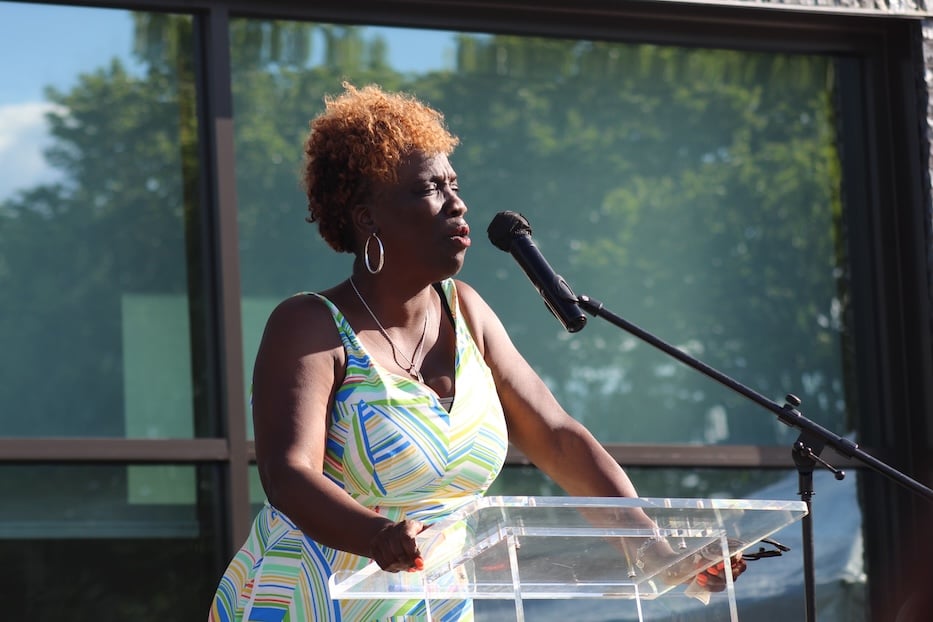

Top: Alder Jeanette Morrison. "Welcome home," she said. "My dad used to tell me all the time, in the 1950s, Dixwell was the spot. We're gonna continue to dream. We're gonna continue to fight. And we're gonna continue to push." Bottom: Some of the sleek new architecture on the second floor.
At the time, Highsmith knew he was taking a leap of faith, and “I cast a wide net in New Haven” to find an advisory committee that would do it with him, he remembered. Years later, many members of that committee are still on ConnCAT’s board, or have remained close to the organization. It’s one of the reasons that he’s so confident in the mission—and has stayed with it for almost two decades. “Today, we are not simply opening a building, we are opening a door,” he said.
It’s a door that comes with centuries of history attached to it, he acknowledged. Echoing the Rev. Dr. Frederick Jerry Streets, who for years led the congregation at Dixwell Avenue United Church of Christ, Highsmith pointed to the rich history of the Dixwell neighborhood, from the writers, artists and thinkers who once walked its streets to the faith leaders, elected officials and business owners who have carried it through the present.
He nodded to figures like Ms. Hannah Gray, a Black laundress who in the nineteenth century took in fellow women, so that they could age in place, and Dr Edward Bouchet, the first Black man to receive a doctorate from Yale University. He thanked State Rep. Toni Walker and her father, the late Rev. Dr. Edwin Edmonds, who during his life was a steadfast champion of civil rights and led Dixwell UCC for a transformative 35 years.
“We owe so much to so many,” Highsmith said. “Today we stand here not as self-made people,” but on the shoulders of those historical giants.
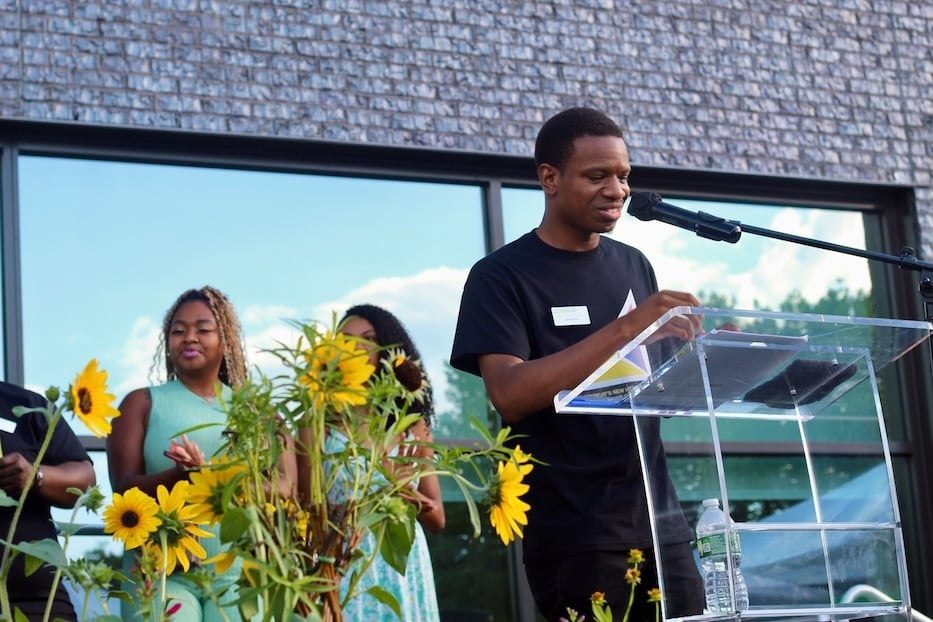
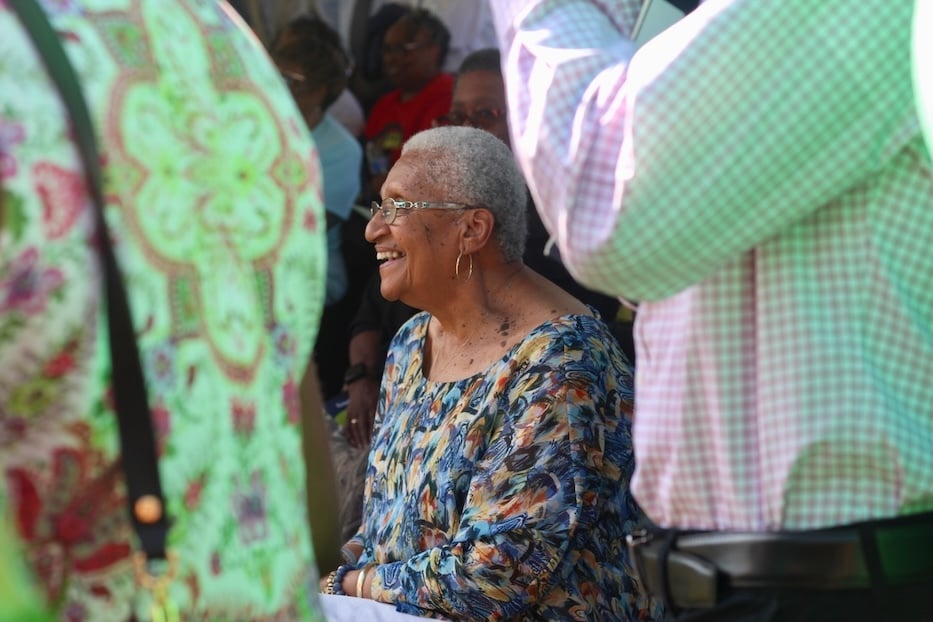
Top: Daniel Hunt, now a community liaison at ConnCORP and a beneficiary of the housing the group has expanded in the community. "My story is just one example of what happens when ConnCAT invests in community," he said. Bottom: The one and only Jackie Bracey.
Clemons, who stewarded the vision through several contentious neighborhood meetings and hard-fought negotiations, even in the midst of devastating personal loss, also stressed the importance of that history and its keepers. Lifting his gaze to the front row of seats beneath a wide, airy tent, he acknowledged Stetson Branch Manager Diane Brown, self-proclaimed “Dixwell girl” Jackie Bracey, and Ms. Ella Smith, all pillars of the Dixwell community who have cheered him on, asked guiding questions, and opened doors during the process.
Brown, he explained, helped broker a deal with the owners of Dixwell Plaza’s various properties that made the project possible (read more about that here and here). Bracey, who had at first offered ConnCAT a cautious welcome, sat down with Clemons for three hours at her kitchen table, asking questions that helped shape Clemons’ vision. One, “why is it that in order to build something new, the old had to die?” stayed with him through every step of the process, and ultimately “became the motivation for how we would be in community,” he said.
And Smith, a bird-boned matriarch who raised generations to love and know the neighborhood, texted Clemons every weekend, “just to say how proud she is of us and how much she loves me,” Clemons said. “When that text comes through, it lifts me up.”
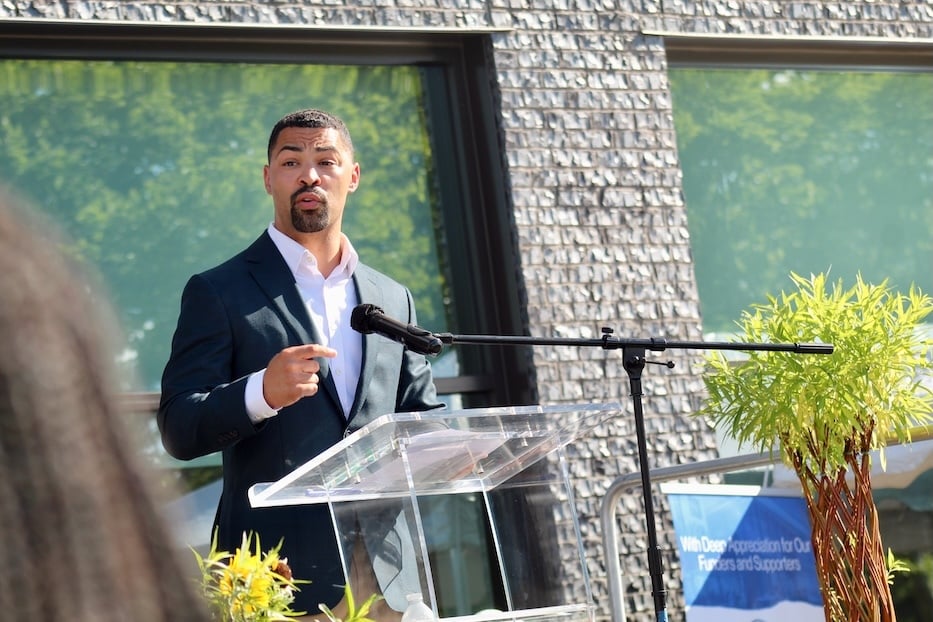
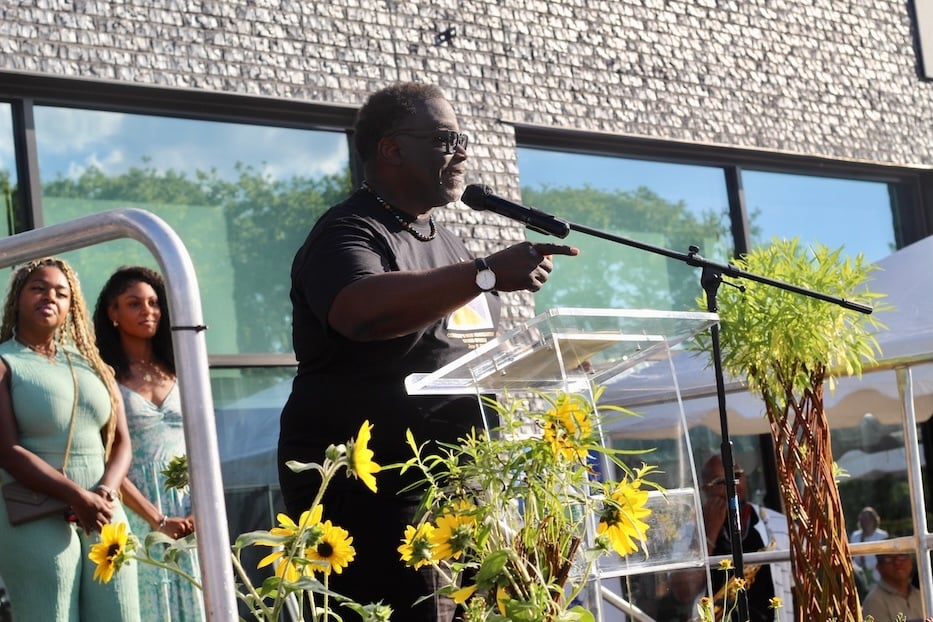
Top: Russell. Bottom: Driffin.
Other speakers focused on the power of ConnCAT and ConnCORP’s vision in a neighborhood that has suffered from chronic disinvestment, including and especially on a municipal level, redlining, and harmful “slum clearance” and urban renewal policies of the last century. State Treasurer Erick Russell, who grew up in New Haven, praised the ConnCORP team for rebuilding wealth in the neighborhood, for residents of the neighborhood.
“We can accomplish really big things” with a model like First Haven’s, he said. He remembered growing up between Congress and Dixwell Avenues, where his parents, Harold and Karin, owned a convenience store and People’s Choice Deli, which still stands just beyond Bassett Street today. When he sees First Haven’s model, he thinks of the families he got to know while working in those stores, and the generations that the space will lift up as it grows its mission.
“People had a vision of hope, a vision of promise, and a vision of rejuvenation,” added State Sen. President Pro Tem Marty Looney, noting that First Haven was one of the first projects to receive $10 million from the state’s Community Investment Fund (CIF), a program of the Connecticut Department of Economic and Community Development (DECD), in 2022. Now, it’s a joy for him and other members of the New Haven delegation to watch it come to fruition.
But it was ConnCAT and ConnCORP staff, students, and graduates who made the weight of the moment come alive, both inside the building and out across its sprawling patio and lawn. Poet and playwright Steve Driffin, the longtime director of programs at ConnCAT and an architect of its youth enrichment opportunities, praised First Haven’s origins—and its future—in a poem that made clear the space was not an extension of Yale University.
“You’re the seed planters and the waterers,” he added of ConnCAT’s team, which in addition to operational staff includes educators like Nikki Claxton, artist Jasmine Powell, and musician William Fluker in addition to Youth Programs Assistant Rachel Graziano. He pointed to the 1800 adults, including over 700 graduates, that ConCAT has welcomed in its 15 years, as well as the 1,000 youth he’s been excited to work with year after year, as the program grows its commitment to multi-media artwork and social and emotional development.
Ashlynn Savannah, a graduate of Hamden High School who is now a student at Georgia State University, remembered first coming to ConnCAT when she was in the fifth grade, unsure of what she wanted her next steps to be. Driffin took her under his wing, giving her the skills to learn photography and film work, and later bringing her behind the scenes on projects where she could grow her creative wheelhouse.
Years later, she works in sports production—a statement that itself received cheers and applause from the crowd. “I would not have known my path were it not for ConnCAT,” she said. “ConnCAT laid the foundation.”
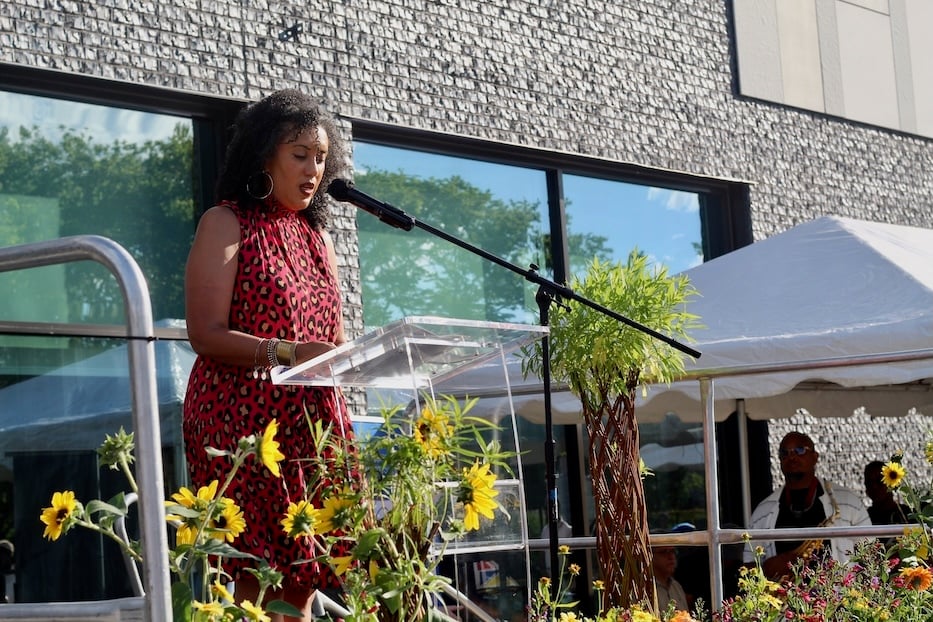
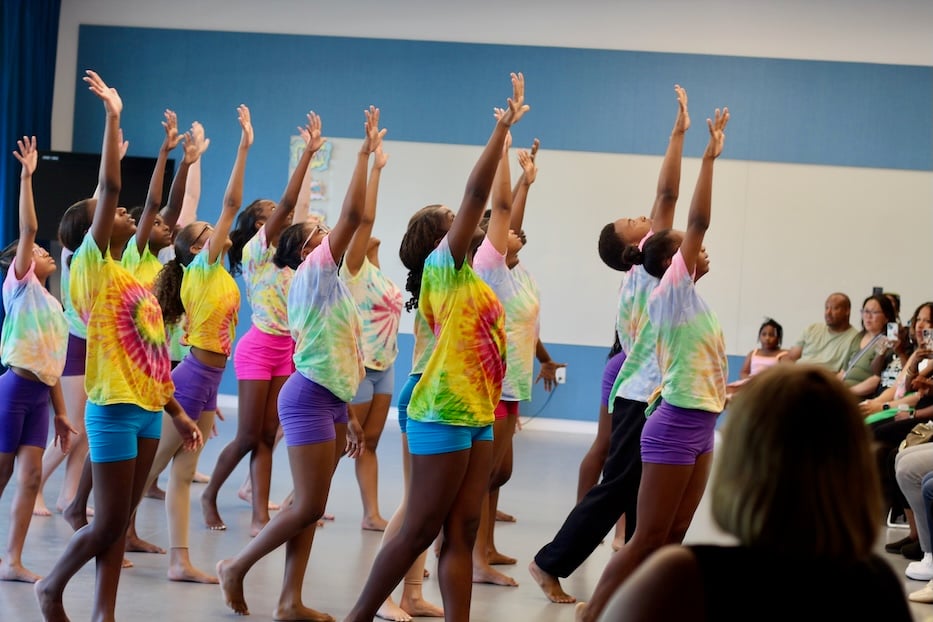
Top: Dr. Karen DuBois-Walton, president and CEO of the Community Foundation for Greater New Haven. Bottom: Young dancers bring performance into the space.
Inside the building, which includes sleek new tech equipment, a lab space, sparkling industrial kitchen offices, pristine meeting rooms, and a new arts studio with mirrors and curtains, a person can see that foundation in real time. In addition to an atrium that features local artists (kudos to BLDG FUND principal nico w. okoro, who has done the curation), there is a multi-media timeline dedicated to Dixwell history, and several large windows, through which a person can see Dixwell Avenue as cars and buses rumble past.
In the kitchen, Isha Hilton-Dabney prepared palm-sized containers of mac and cheese and delicate red velvet whoopie pies that would soon make their way out into the bustling building. Born and raised in the city’s Hill neighborhood, she said that she was thrilled to help with the grand opening, as she does with many of ConnCORP’s events.
As he buzzed around the kitchen, fellow chef Stanley Hair, who graduated from ConnCAT’s first culinary cohort in 2016, said that the program helped him grow “a lot,” with skills that he continues to use both in and well beyond the kitchen. When he started at ConnCAT, he was working in a job at Jordan’s Furniture that felt like a dead end. A decade later, he’s done “a lot of work in a lot of different kitchens,” with an interest in teaching the culinary arts to young people.
“It really feels full-circle,” he said. Nearby, fellow ConnCAT graduate Jamilia James, who runs the social media channel 4EVATV and performs as a gospel musician, agreed.


Top: Isha Hilton-Dabney and Jamilia James. Bottom: Inside the building, where the walls seem to breathe with art.
“I think it’s just a big opportunity to give, to create, establish, to uplift our community,” she said. “This door is open for you.”
“Chicago has the Obama Library, but New Haven has First Haven!” Dr. Karen DuBois-Walton, president and CEO of the Community Foundation for Greater New Haven, had said 20 or so minutes before the doors opened, and the words came to life around every corner and in every nook and cranny.
Back in the arts studio, five dancers prepared to cross the floor one last time, this time to dance through decades and centuries of Black history to Bobby McFerrin’s “Sweet In The Morning.” In her seat, Bracey remembered growing up just across the street, at 141 Dixwell Ave. when the Elm Haven housing projects were brand new (that corner is now home to Monterey Place).
That was in the 1940s, she remembered. In high school, she and her family moved up the avenue to 374 Dixwell, which sits just beyond Munson Street. She lived there for years, as a third generation New Havener, before ultimately making the move out of New Haven. While she’s now in Hamden, it’s the Dixwell neighborhood that has her heart. So when she heard about ConnCAT and ConnCORP’s work in the neighborhood, she made sure to let Clemons know exactly what was on her mind.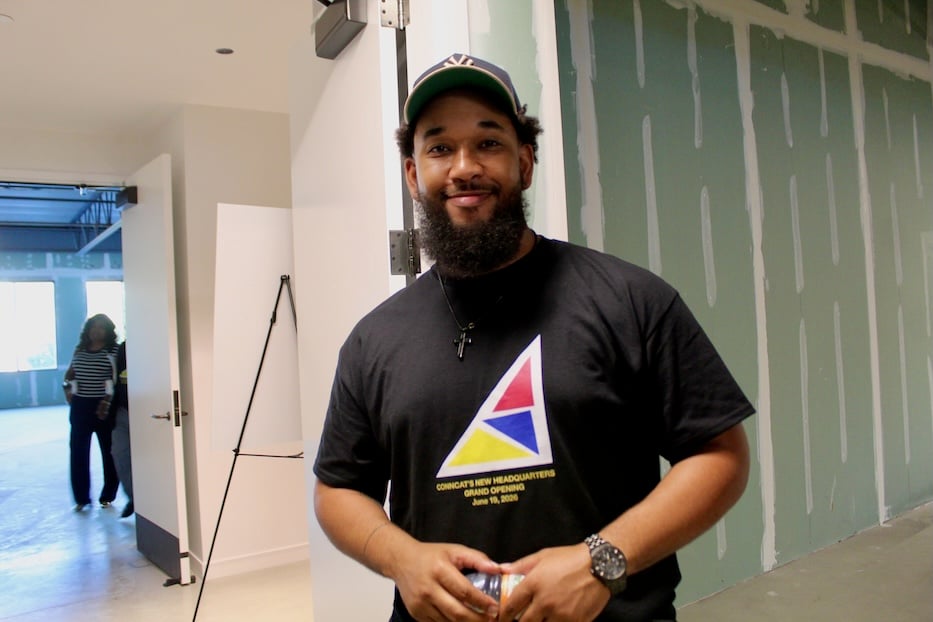
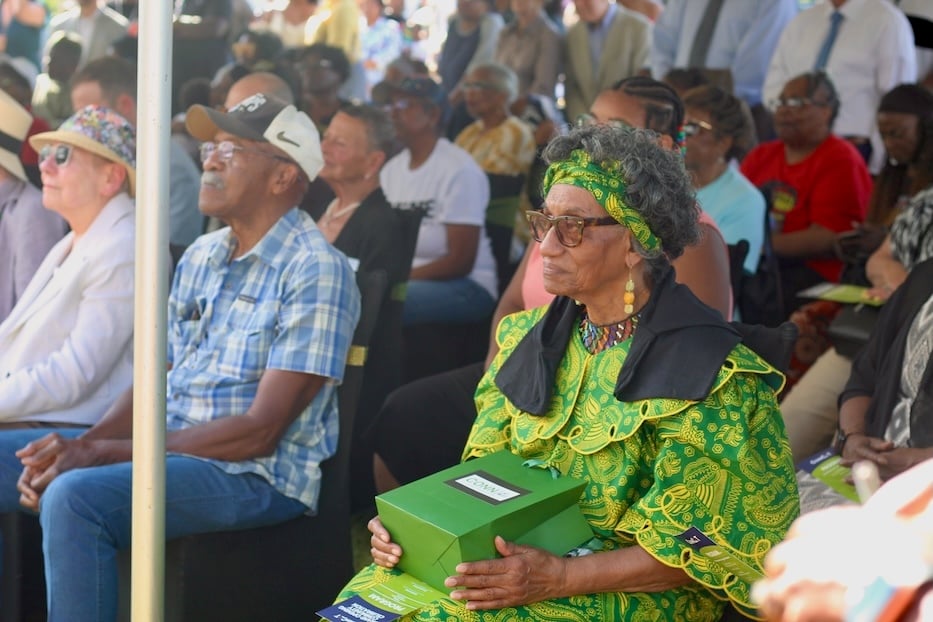
Top: Christian Brandon Smellie, one of the first graduates of ConnCAT and ConnCORP's new construction academy. He described it as "kind of like a family." Bottom: Ms. Ella Smith.
“Oh no, we got a lot to do,” she said when asked if she felt a sense of completeness with the project. “Dixwell has always been a vibrant community and it will always be a vibrant community.”
Claxton’s voice, firm and steady, came from a speaker on one side of the room. On the other, the dancers—all students at Betsy Ross Arts & Design Academy—prepared to tell a story of pain and resilience, of holding onto the bitter and the sweet.
“Be proud of who you are,” the voiceover urged, and it seemed to meet the moment, the building, the ribbon freshly cut outside. “We will not be erased.”