
Culture & Community | Arts & Culture | New Haven Free Public Library | Literacy | Possible Futures
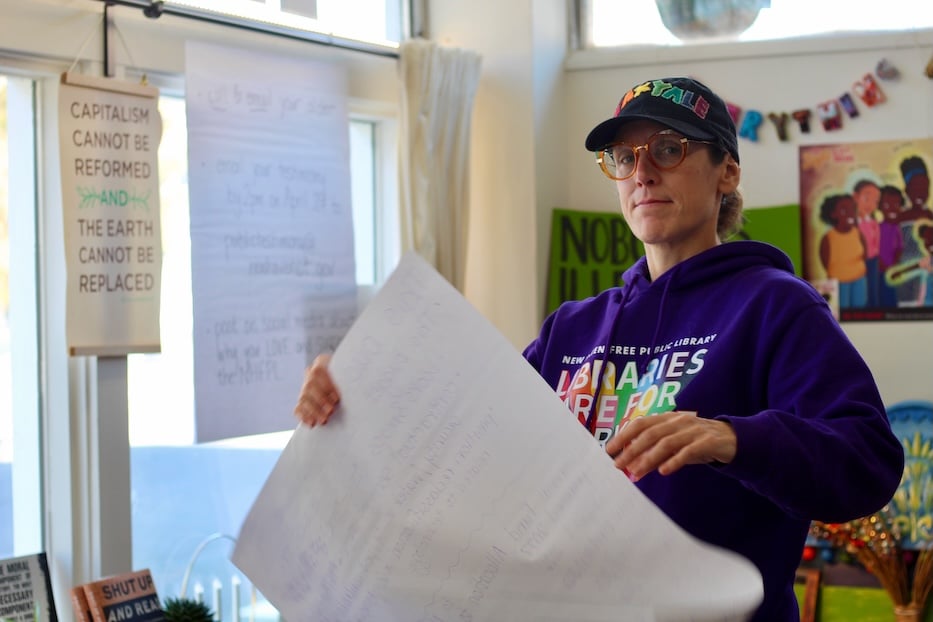
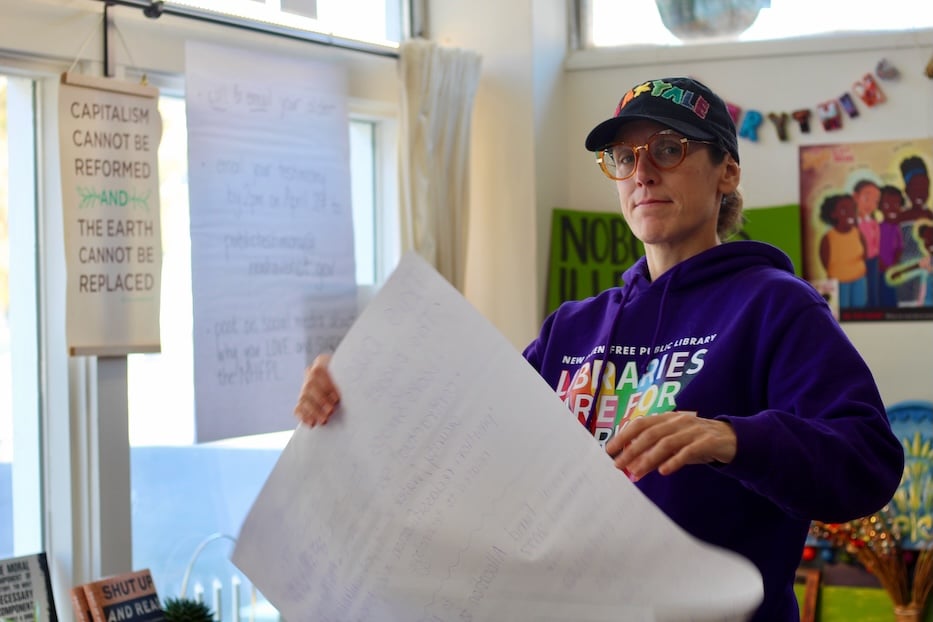
Lauren Anderson, who runs Possible Futures. Lucy Gellman Photos.
P. Paramita wrote her first book, Appetite, surrounded by the hum and buzz of the Ives Main Branch of the New Haven Free Public Library. In the very same building, Ana Reyes learned that a teen center, with its trusted librarian at the ready, could be a safe and beloved third space. Esther Chiang met two of her closest comrades—and got a book that changed her life—during a book talk at the Stetson Branch on Dixwell Avenue.
And on Samm Leska’s birthday this year, the afternoon wasn’t complete without a stop at the Mitchell Branch Library on Harrison Street, where all of the librarians know her and her daughter by name.
Wednesday afternoon, all of them joined forces at Possible Futures bookspace on Edgewood Avenue for a testimony writing party in support of the New Haven Free Public Library, which this year is on track to receive 0.76 percent, or $5,598.561, of Mayor Justin Elicker’s proposed $733.3 million general fund budget. The amount falls 0.24 percent short of the 1 percent that, in 2020, Elicker’s transition team championed as a priority during his first term.
While the library budget has technically continued to grow during that time—it’s 38 percent higher than it was in 2020, outpacing the overall city budget, which has grown by 32 percent—advocates have continued to push for more funding, which would support everything from daily services to deferred maintenance to programming.
In the meantime, all five branches have become de facto community centers, social service hubs, and rare third spaces, each with their own distinct personality.
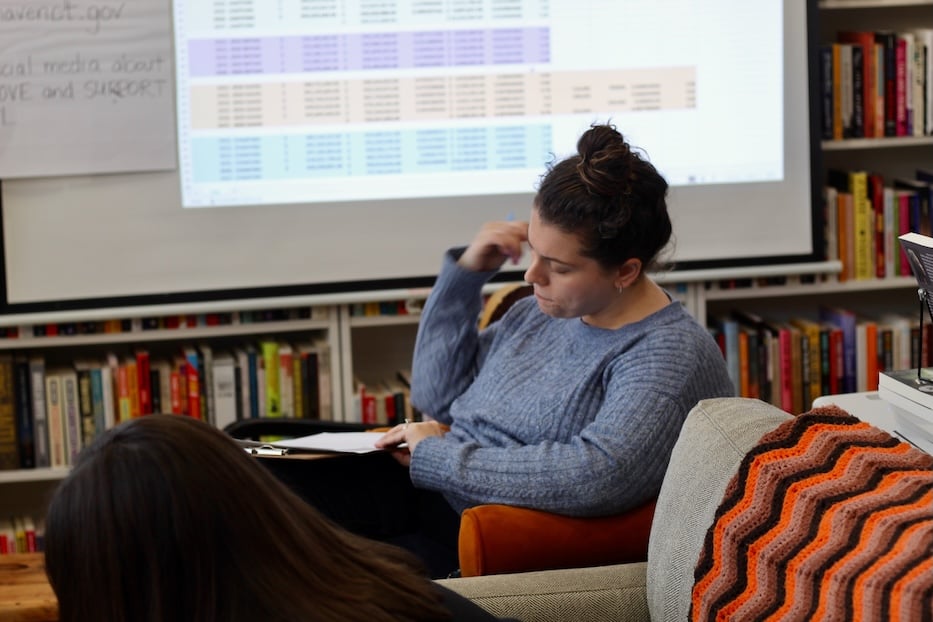
Leska, who goes to the Mitchell Branch in Westville at least once every other week.
“I just think the library is one of the last places you can just be for free,” said Leska, a teacher at Elm City Montessori School who visits the Mitchell Branch with her young daughter, Cici, and sees firsthand how the NHFPL cuts across racial and socioeconomic lines. “There’s something really magical about that … it’s really an investment in community at the end of the day.”
It’s an investment in the community that is already stretched. As the library’s overall allocation in the city budget shrinks, its impact continues to grow: on any given day, a branch of the library may double as a storytime spot, warming and cooling center, workplace development hub, U.S. Passport office, makerspace, teen gaming room, continuing education classroom, movie theater, or unexpected gallery.
Through partnerships with organizations that range from Long Wharf Theatre and the New Haven Pride Center to Liberty Community Services, patrons can also access everything from free theater tickets to case management services that they desperately need. Last year alone, across its five branches, the library welcomed 420,000 in-person visitors, with another 530,000 who accessed digital resources. In a phone call Wednesday, City Librarian Maria Bernhey said the goal is to get that number to 1,000,000, which the library likely will in the next year.
Around Possible Futures on Wednesday, that love for the library—and belief in its role as an essential public good—was contagious. On plush couches close to the window, self-proclaimed bibliophiles P. Paramita and Emily Ide spread out with blank sheets of paper, cell phones and computers balanced carefully on their laps. Sugar, the beloved bookstore dog, padded through the front area in a pink bandana. From outside, the familiar, comforting thunk of a basketball on the sidewalk became a kind of soundtrack.
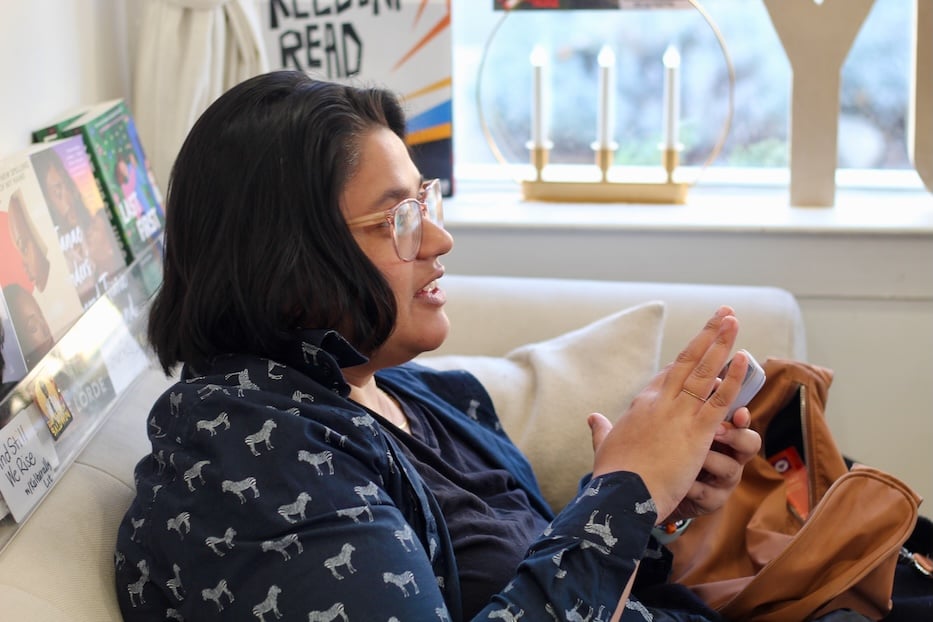
Paramita, an author and educator who teaches at Southern Connecticut State University, jumped into the conversation instantly when asked what role the library plays in her life. As a writer and a professor, she’s often at the Mitchell Branch Library in Westville, checking out books that range from fiction to essays to criticism, with a goal of reading at least 150 by the end of the year. (Mac Crane’s I Keep My Exoskeletons to Myself: A Novel, her favorite so far this year, was a library find).
When she’s not reading a physical book, she’s often listening to an audiobook, which means that services like Libby are trusty companions on her walks around New Haven. Even prior to her time in New Haven, libraries were a kind of safe and welcoming space: she worked in her high school library, and then became a student library manager during her time at Wellesley College.
When she’s not reading or teaching, she’s writing—including among the stacks and bright, sunlit open tables in Mitchell, and before that, at Ives. She wrote her first book, which comes out this summer, partly at the Ives Branch, which was a free and welcoming space to work when she lived closer to downtown.
“It’s just a really nice place to stop by,” she said of Mitchell (her new neighborhood branch), where she’s become friendly with all of the staff members—and where a tight budget year and stretched staff means less programming, like one less children’s storytime per week with librarian Sarah Quigley (or as she is known and loved by hundreds of kids, simply "Ms. Sarah").

Emily Ide.
Nearby, Ide had just started her testimony, eyeing a monitor where bookspace founder Lauren Anderson was tracking budget numbers for the public library systems in other Connecticut towns and cities. In the first few columns, cities like Bridgeport, Hartford, New Britain and Stamford all showed up with larger budget allocations, from 1.54 percent in Bridgeport to 1.42 percent in Stamford. Anderson, who had gone through all of their city budgets, encouraged attendees to imagine what the library might look like—from deferred maintenance to expanded services—with twice the funding it currently receives.
Around it, she had turned the small space into a crash course in civic engagement. On the building’s wide, street-facing windows—which themselves were once part of an NHFPL microbranch—sheets of paper gave a wider context for the city budget, from the role that Yale plays in taking property off of the tax rolls to a recent history of library funding, which in the past 25 years has shrunk from 72 full-time employees to just 49 (the NHFPL also currently has 34 part-time employees and seven vacancies).
As she made her way through the space, past snugly packed shelves of poetry and fiction, Anderson noted that 2001 was also the last year in recent history that the New Haven Free Public Library had Sunday hours. Now—and despite momentum for Sunday hours a few years ago, under the late City Librarian John Jessen—neighborhood branches are each open five days per week, while the downtown main branch is open Monday through Saturday.
“At this moment in history, places where all different kinds of people can gather are critical,” she added Thursday, in a phone call after the event. “We need those places shored up, not stretched thin.”
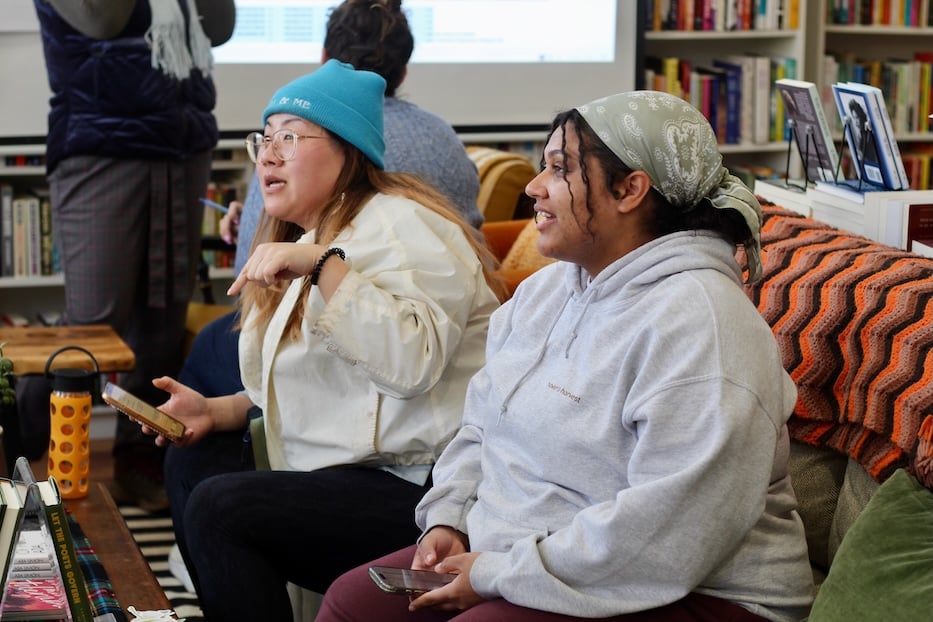
Ester Chiang and Ana Reyes.
As they came inside and took a seat on the couch, both Reyes and Chiang echoed Anderson’s call for a more robustly funded library, where all patrons—whether or not they are employed, housed, or financially stable—are welcome.
Reyes, who grew up in New Haven and attended Common Ground High School, remembered visiting the Ives Main Branch every day after school, just across the street from where the 243B bus dropped her off downtown. Not only was the library a safe third space where she and her friends could hang out: she soon realized that librarians knew the name of every person who walked through the front doors, including and especially patrons who were unhoused.
“They knew people by name,” Reyes remembered. She was just a teenager, and it became a lesson on how to show up in the world. “I don’t think I knew any librarian who didn’t treat everybody with dignity and respect.”
Chiang grew up going to the Acton Memorial Library in Acton, Mass. (“It was the best,” she said, beaming, remembering writing little book recommendations as a young volunteer.) She said that she can already identify gaps in service that additional city funding could fix. As an avid e-book user, she’s often frustrated with Libby when she can’t find the titles she wants or needs.
To remedy it, she uses other library accounts, from Acton to Princeton University to the Philadelphia Public Library. She’d love to get to a point where the NHFPL is her first and only stop.
Chiang still loves the library, she added: she met two of her closest friends and co-conspirators, educator Jennifer Heikkila Díaz and poet Michelle Phương Hồ, during a discussion on Thi Bui’s The Best We Could Do at the Stetson Branch in 2024. Because the book was part of the NEA Big Read, held through the International Festival of Arts & Ideas, she also walked home with a free copy.
“What That Could Be”
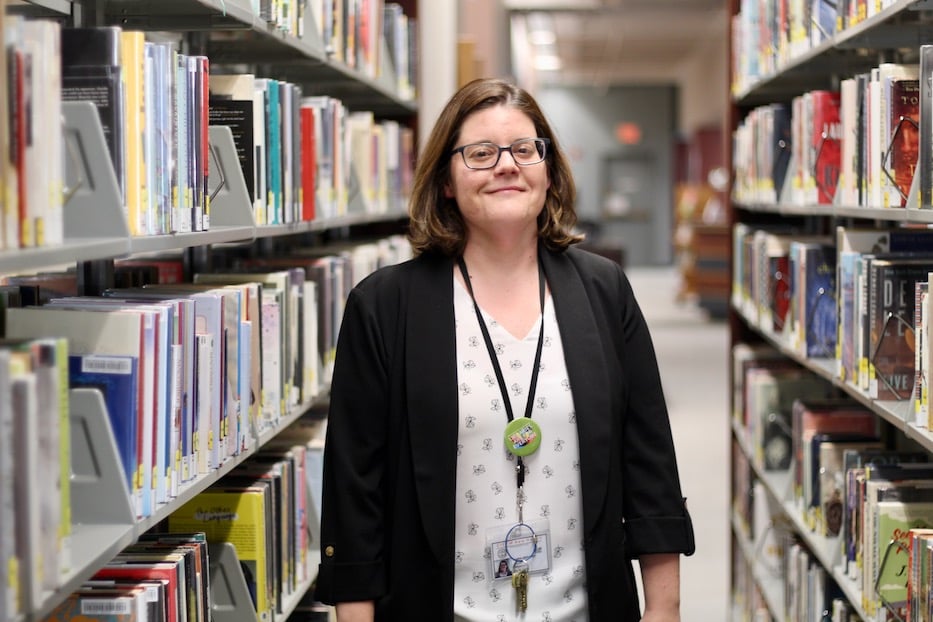
City Librarian Maria Bernhey photographed at the Ives Main Branch in 2023. Thanks to capital improvement funding last year, the branch was able to replace the carpet in this photo, which was from 1989.
In a phone call Wednesday afternoon, Bernhey spoke directly to the services that the library currently provides—and the gaps that it is simply unable to fill without a bigger budget.
Of the $5,598,561 allocated in the proposed city budget, $4.4 million will go towards personnel and staff salaries, and $1.2 million will go toward non-personnel contracted services. That leaves funding for the library’s other services and programs largely in the hands of grants, and the New Haven Free Public Library Foundation. Last year, foundation dollars—roughly $30,000, Bernhey said—covered over 2,600 NHFPL programs that brought in over 41,000 participants.
“You think of all the amazing things we do now, and what that could be,” she said, nodding to the sheer and miraculous value of human interaction and individualized attention that patrons get when they walk into the library. “Of course the library looks for ways to best support our residents. We’re trying to do it within capacity and within our budget as it currently exists. We get a little bit creative as we do that sometimes.”
She’s learned how to stretch a dollar and build strategic partnerships across the community. In addition to free, all-ages programming across all five branches—like daily storytime in English, Spanish, and Mandarin, teen gaming after school, and opportunities for computer literacy—the NHFPL has grown its partnerships with several social service organizations, including the NewAlliance Foundation, Collective for Immigrant and Refugee Wellbeing (CRIW), Liberty Community Services, Yale University, and Elm City COMPASS to make sure that patron needs, from tax help to case management, are met more often than not.
“The library means something different to everyone, and I think it just continues to evolve,” Bernhey said. The difficulty, she acknowledged, is that it can only evolve so much without more funding. Currently, the library has several deferred maintenance issues, only some of which were addressed with $500,000 in capital building funds last year.
At the Fair Haven Branch, for instance, an elevator installed in the 1980s is reaching the end of its life. When it broke down earlier this year, contractors were able to provide a temporary fix, with a part that was difficult to find because it’s no longer in production.
Reached for comment Thursday afternoon, Elicker pushed back on the suggestion that his administration has not made good on the promise to get funding to one percent, calling the percentage “a very arbitrary number.” He pointed to the 38 percent by which the library budget has grown to $5,598.561 this year, up from $3,988,359 in his $569.1 million general fund budget in 2020.
“Choosing a percentage point goal is not a good way to budget because a percentage is a very arbitrary number,” he said, adding that he’s balancing the city programs and agencies he would like to fund more robustly with the reality of ballooning pensions and debt service, which receive roughly $94 million and $72 million respectively.
He added that choices like that are difficult for him not just as a mayor, but also as a New Havener and a dad himself.
“I tell my daughters we’re going to the library, and they literally say ‘Yesssss!’” he said. “It’s like a kid in a candy shop but the candy is books … We love using the library. It’s a really important part of our lives.”
The final public hearing on the city budget is April 29 at 6 p.m. at New Haven City Hall. To submit testimony before that, email your remarks by 2 p.m. on the 29.