

Culture & Community | Juneteenth | Arts & Culture | New Haven Green | History
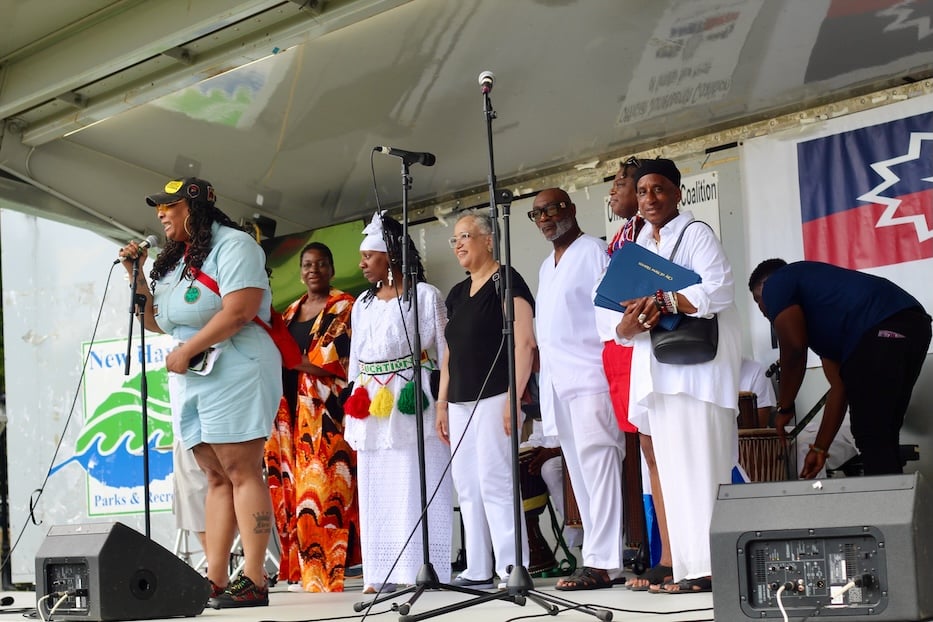
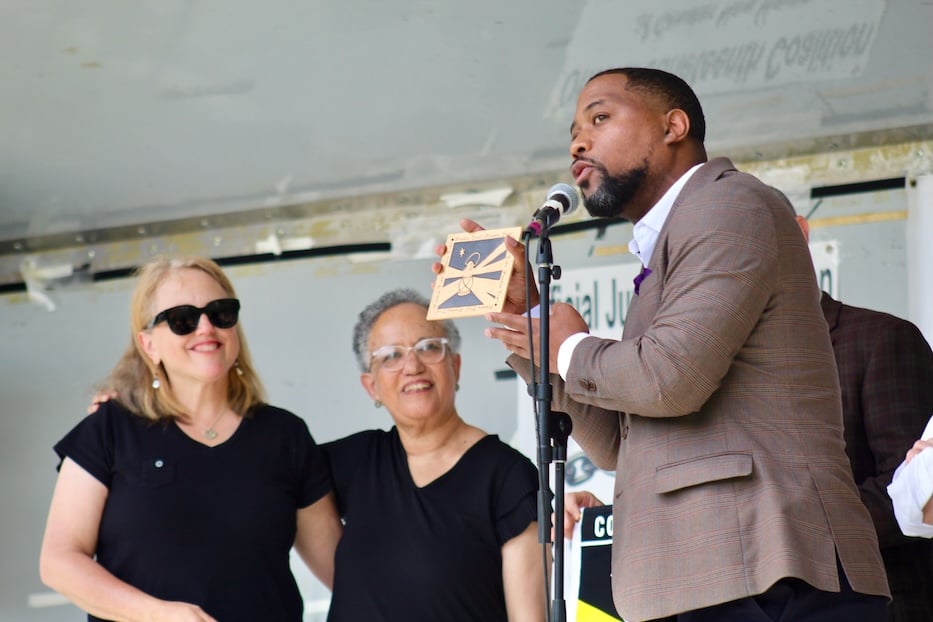
Top: Geri Mauhs, coordinator of Trinity Church's Friends of the New Haven Green Program, with author and historian Jill Snyder and Charles Warner, Jr., president of the Connecticut Freedom Trail, as he presents a marker recognizing the Green as a new Freedom Trail site. Bottom: Sun Queen (at the mic) with Official Juneteenth Coalition of Greater New Haven members Bug Mench (behind Sun), Shayla Streater, Dr. Hanan Hameen, Jill Snyder, MarceyLynn Teague, and Iman Hameen. Lucy Gellman Photos.
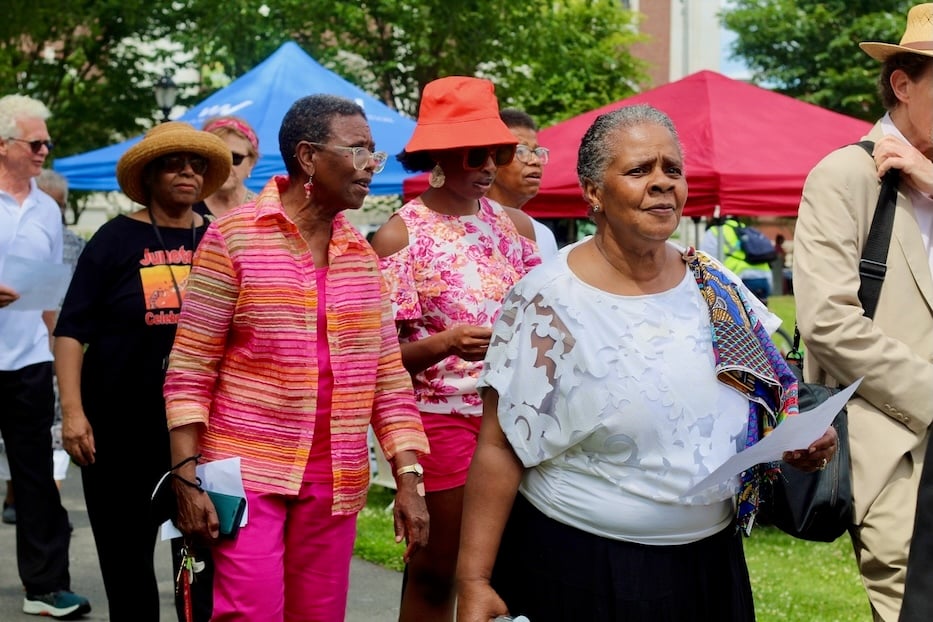
Author Jill Snyder took one step forward, and then another, and then another, a dozen voices floating through the warm air around her. “We are mar-ch-ing in the light of God / We are marching in the light of God,” people sang, the sound overlapping in rich, layered tones.
In their voices was a history of struggle, of coordinated resistance and resilience, and of liberation. And Snyder, who has spent decades teasing its threads apart, was excited to share it.
Snyder brought that history to the New Haven Green Friday afternoon, as she remembered and honored the lives of Lucy and Lois Tritton, a mother and daughter who were the last enslaved people to be sold on the New Haven Green on March 8, 1825. It is a continuation of her decades-long work to do right by the two, including a service of healing and lamentation at Trinity Church last year, and the dedication of a new headstone in the Blake Street Cemetery earlier this month.
Members of the Connecticut Freedom Trail, St. Luke’s Episcopal Church, Trinity Church on the Green, the Official Juneteenth Coalition of Greater New Haven, and several city and state officials also attended and spoke. By the end of their remarks, the Green had been recognized as the newest marker on the Connecticut Freedom Trail—and the Coalition’s 13th annual Juneteenth Jamboree, a collaboration with the International Festival of Arts & Ideas, felt officially ready to begin.
“I’ve spent a lot of time with Lucy and Lois Tritton,” Snyder said, tracing her research from the 1990s to the present. The question she keeps coming back to is “what does it teach us?”
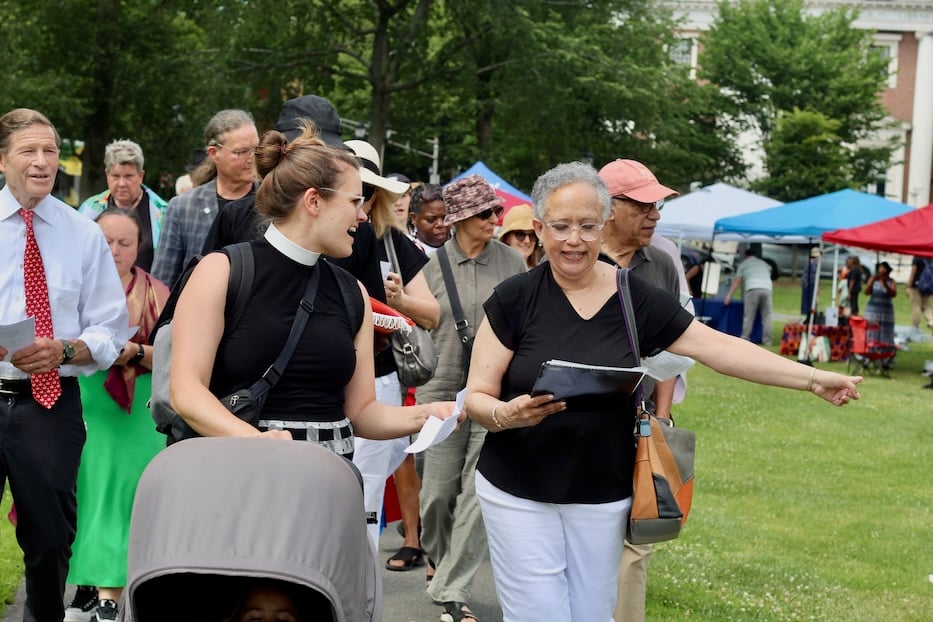
Snyder (right) with the Rev. Heidi Thorsen, the assistant rector at Trinity on the Green.
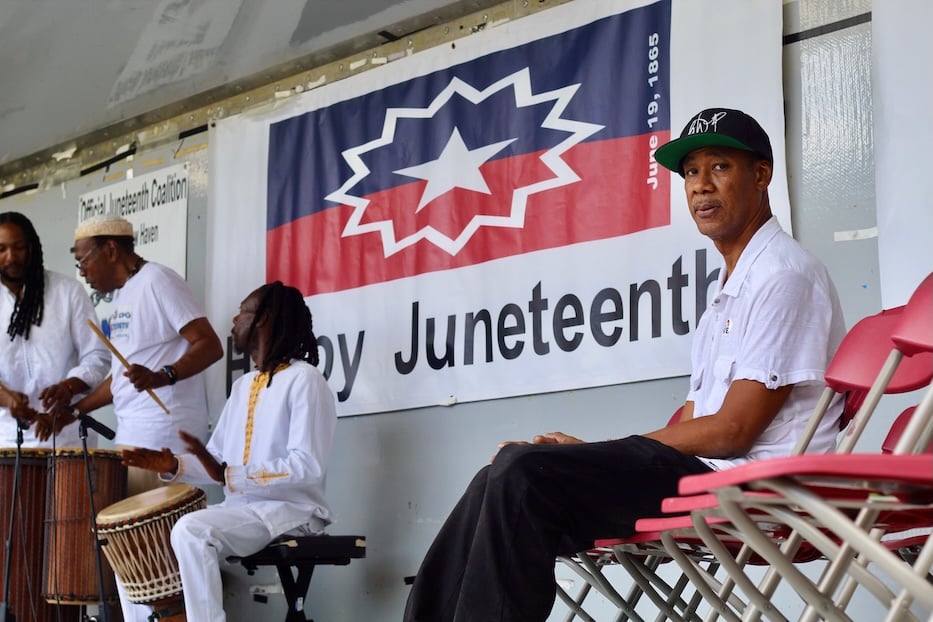
Juneteenth recognizes the emancipation of enslaved Black people in Galveston, Tex. on June 19, 1865, a full two years after President Abraham Lincoln signed the Emancipation Proclamation. The date marked the formal end of chattel slavery in the United States. It did not mark the end of the economic enslavement and disenfranchisement of Black Americans, which continues today.
The story of Lucy and Lois Tritton begins long before that, Snyder said Friday. In the second half of the eighteenth century, Lucy was kidnapped and stolen from her home in West Africa—likely Ghana, Snyder said—with her father and mother. Enslavers brought her to St. Thomas, where the Danish West India Company operated a slave depot in the port city of Charlotte Amalie through the mid nineteenth century.
Records show that enslavers sold Lucy and her father to a General R. Tritton, a ship captain who lived in London with his family. At some point in the late eighteenth century, the Tritton family moved from England to Nova Scotia. That's where, in 1799, Lois was born. Snyder said that she was recorded as the "enslaved ‘mulatto’ child' of Mrs. Tritton," a sobering reminder of the treatment of people as property that followed the creation of race and racism in the sixteenth century.
Or as Snyder said Friday, a wounded and tired edge to her voice, “she was part person, part possession.”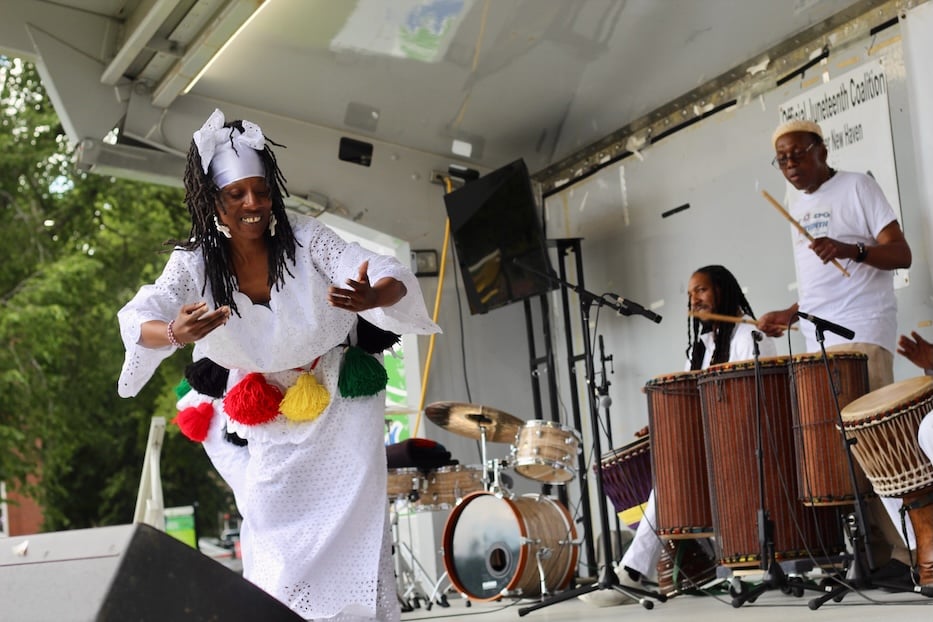
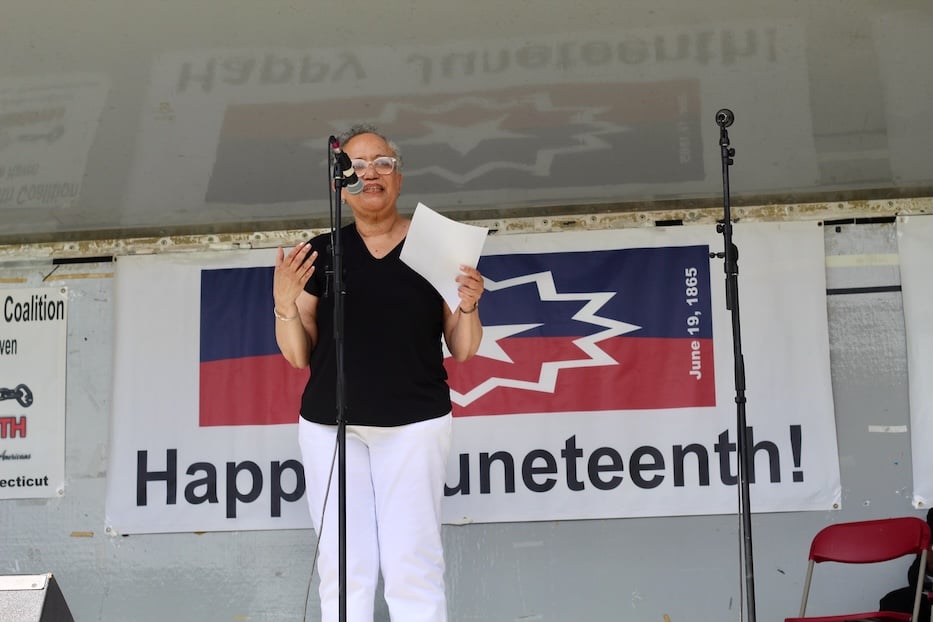
Dr. Hanan Hameen prepares to honor elders, of whom Snyder (bottom photo) is one.
By then, Tritton had drowned at sea; his ship sank during a storm in 1790. But the Tritton family maintained their connections to New Haven, where they owned a second home and attended Trinity Episcopal Church. In the years that followed Tritton's death, his widow Sara used the mother and daughter as collateral for a loan, which traded hands multiple times before the mid-1820s. Then in 1824, New Haven’s sheriff announced an auction on the New Haven Green, at which the two would be sold.
“This should never have happened,” Snyder said, addressing a crowd that had begun to grow. By that time, she explained, there were at least two state laws on the books that should have granted both women their freedom. One, from 1774, ended and forbade the import and transfer of enslaved Black and Indigenous people—who were still treated as property—in Connecticut. The second, passed 10 years later, was a gradual abolition act meant to emancipate enslaved women who were 21 and older. The age for men was 25.
But it did happen, she pressed on. The two were forced to march from Broadway Avenue to Temple Street, and then on to State Street and around the Green. “Part of the process was for them to be marched around the New Haven streets while the sheriff shouted ‘Slaves for sale,’” she remembered at a Juneteenth flag raising earlier this month. “This happened on a cold March day in 1825. Just imagine the humiliation that they would have suffered just from that experience.”
Over two centuries later, Snyder planned the commemorative walk—shortened for elders in the community who wished to march along—in honor of the two. As attendees gathered at a far end of the Green, looking out at the closed public library, many seemed to take stock of the moment, a reclamation that also felt unbelievably heavy. As a historic site, the Green holds centuries of history, from its use as a burial ground to a civic space for the Black Panther Trials in the last century, and the Black Lives Matter Movement of the present.
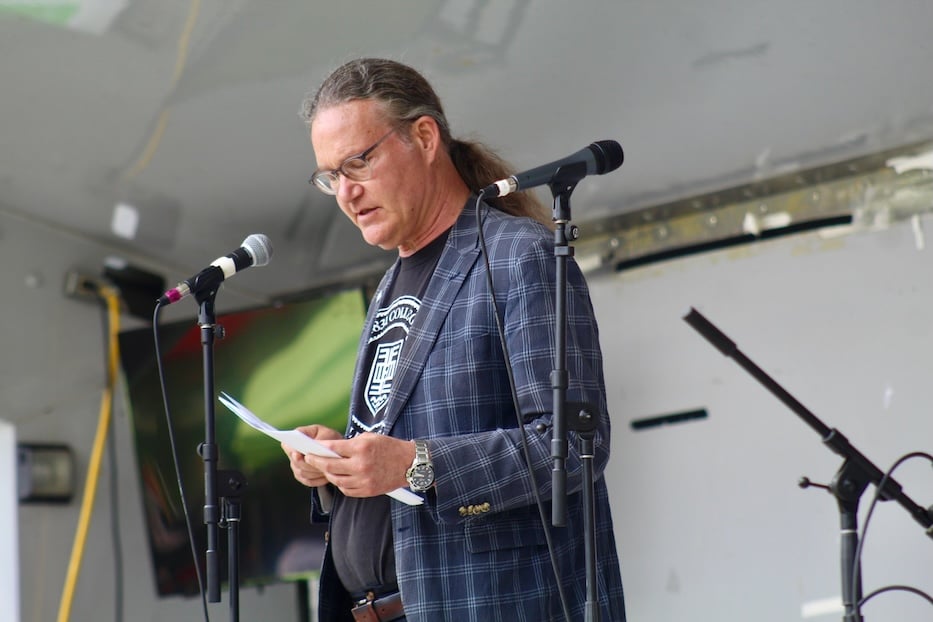
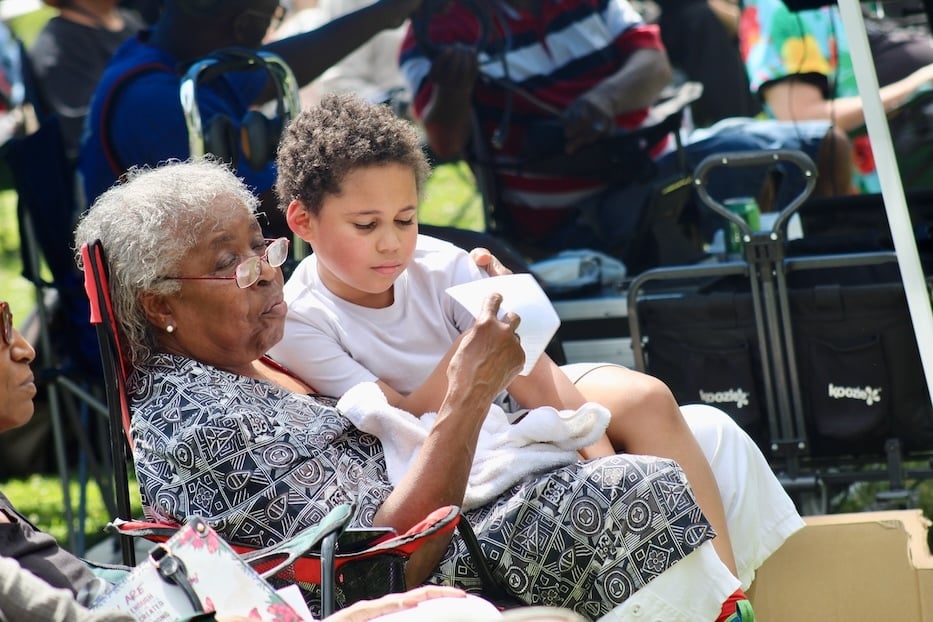
Top: City Historian Michael Morand. Bottom: Joy Donaldson and her grandson, William.
Back in March of 1825, Lucy and Lois became the property of a Mr. Anthony Sanford, an ostensible abolitionist who purchased the women for $10 each. At the time, according to records in the New Haven Museum, Sanford issued freedom certificates to Lucy and Lois, which would have granted them emancipation (New Haven, by this time, had a sizable community of free Black people, notable among them engineer and entrepreneur William Lanson).
And yet "Lois, in her many interviews, never mentioned receiving a freedom certificate," Snyder recalled last year, during a service at Trinity Church. Instead, she was forced to work for Sanford for several additional years as a laundress, eventually buying her freedom for $600.
What astounds her, Snyder said Friday, framed by a Juneteenth backdrop as she looked out across the Green, is how Lois never seemed bitter. It would have been understandable—more than understandable—if she had been hardened by a world that treated her as less than human. Instead, she became the narrator of her own story, so that no one else could tell it for her.
“In all of her interviews, she exudes joy,” Snyder said, explaining that Lois shared her story over and over and over again, to newspapers in Boston, New York, Connecticut and as far away as Ohio. “She was resilient. That’s what we can do [in her memory] … don’t carry the pain of the past.”
From the moment they gathered on the Green Friday, both attendees and speakers pointed to the significance of the moment, and the urgent and pressing need to remember, retell, honor and face the full breadth of New Haven history. The Green, after all, is many things, including a public gathering space that has seen centuries of protest. When walkers who had assembled began to sing the words “We are marching in the light of God”—lyrics that became popular during the fight against Apartheid in South Africa—it seemed that many of them carried all of that with them.
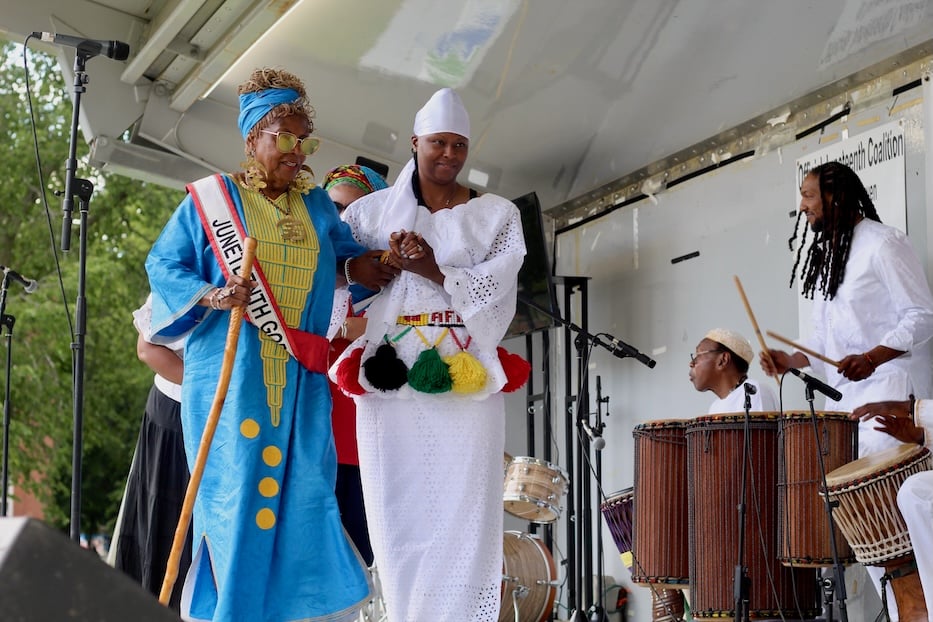
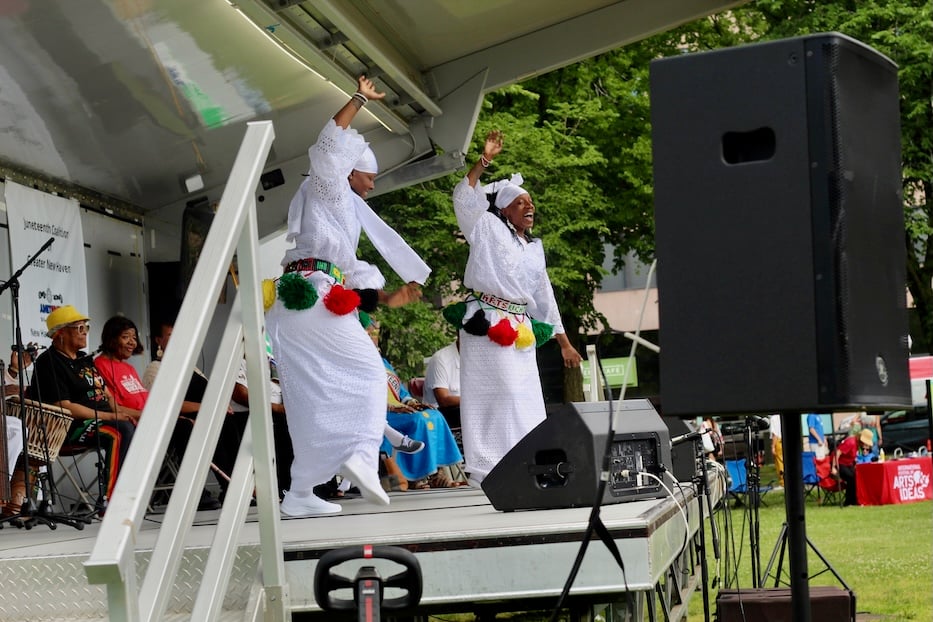
Top: Cynthia Howard Griffin, sometimes called the Godmother of Juneteenth in Connecticut, crosses the stage with Professor Shani Collins, professor of dance and director of Africana Studies at Connecticut College, before the elder honoring ceremony. Bottom: Collins and Hanan Hameen welcome in the ceremony.
“This place, this moment, is part of a long story, and we still have work to do,” said Connecticut Freedom Trail President Charles Warner, Jr. As he presented an official Freedom Trail designation, he added that “we are rejoicing, and we dedicate the Green to this [history] on this Independence Day.”
That history is long, and still evolving. City Historian Michael Morand, director of community engagement at the Beinecke Rare Book & Manuscript Library, urged attendees to remember Lark, a Black man enslaved by the Townsend Family who tried to escape four times from the family’s residence at Elm and College Streets.
He turned the clock back to October 1790, when a Black man named Joseph Mountain was hanged publicly on the New Haven Green, and then sprinted forward to 1831, when hundreds of white, land-owning men—some of whom also saw people as property—voted overwhelmingly against the creation of a Historically Black College in their city.
Morand asked attendees to study, learn and pass on the histories of Bias Stanley, William Lanson, William Grimes, and Lucretia and John Cram—as well as Charles McLinn, the first Black person to serve on city council in New Haven. McLinn was first elected in 1874, only 26 years after the formal abolition of slavery in Connecticut, and not even a full decade after the first Juneteenth in Texas.
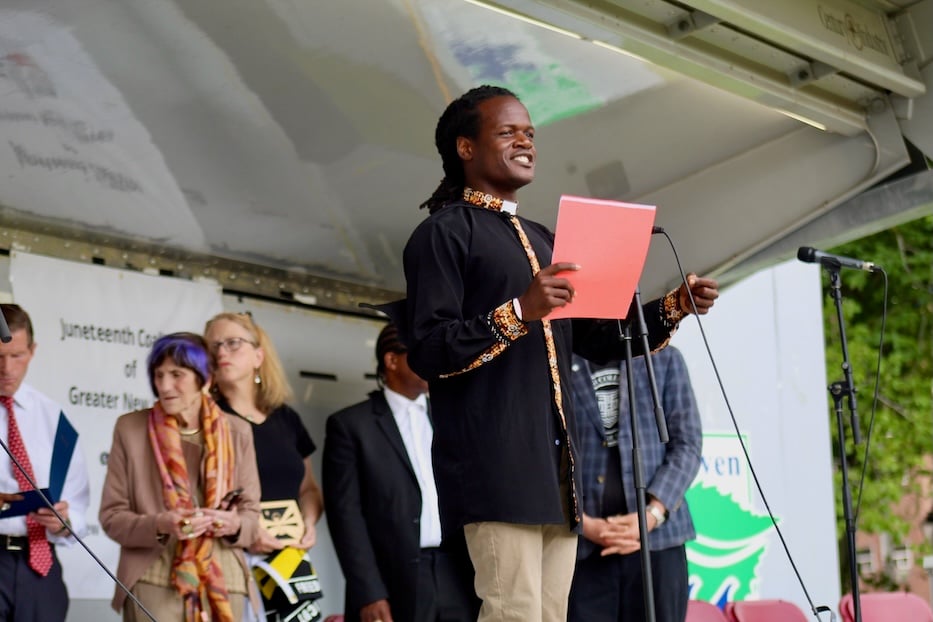
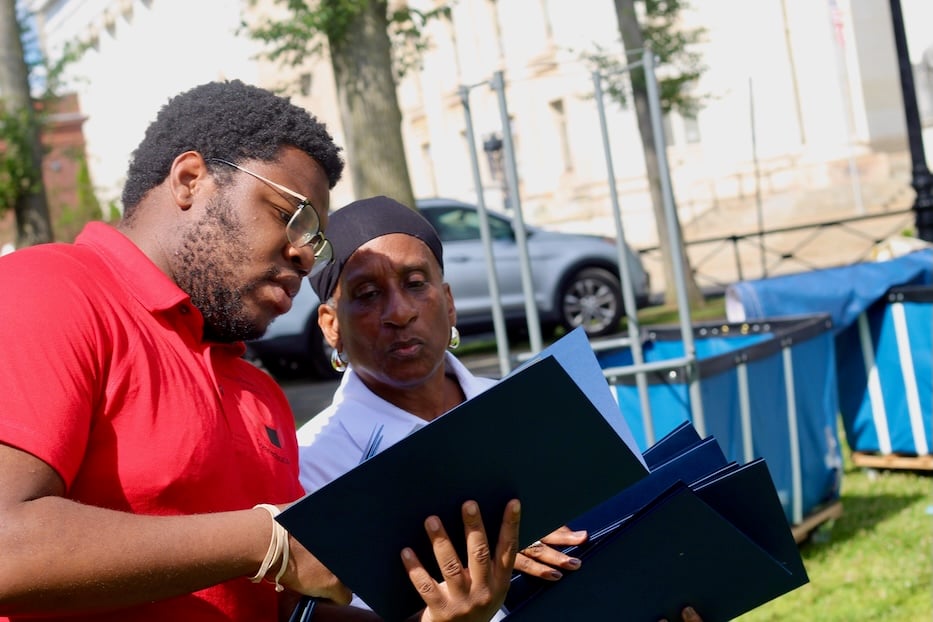
Top: The Rev. Cecil (Ngoni) Tengatenga. Bottom: Chizindu Igo-Amadi, interim operations manager at Michelle’s House, and Iman Hameen. Igo-Amadi later presented the award to Rawlings posthumously.
New Haven has only recently begun to reckon with that history, with initiatives like the Witness Stones—based on the German Stolpersteine—at Trinity Church and the Pardee Morris House, where enslaved people once lived. Just three years ago, city officials passed a motion to rename the corner of Elm and Orange Streets in honor of Lucretia Cram, thanks to the steadfast dedication and in-depth research of Dr. Ann Garrett Robinson. Last year, Snyder helped organize a service of healing and lamentation for the Tritton matriarchs, bringing the congregations at Trinity and St. Luke’s Churches together with fellow parishioners and clergy.
“We are standing in a space rich in history,” said Todd Levine, coordinator for the Connecticut Freedom Trail. “We experience history in a more visceral manner when we are on the site of a historic place … Our history is a part of who we are. To deny it, we deny our own humanity.”
As he and Warner presented a historic marker to Snyder, who has shepherded so much of that history, both speakers and attendees echoed that sense of reverence. Storyteller Joy Donaldson, who had brought her 6-year-old grandson William, called it a moment years in the making that she won’t soon forget.
In the mid nineteenth century, Donaldson’s great, great grandmother was enslaved, and then freed, in North Carolina. It’s a history that stays with her on all days, and particularly on Juneteenth. When she found a set by the stage, Ben Haith’s Juneteenth Flag flapping on the flagpole behind her, William crawled into his grandmother’s lap and listened.
“It’s wonderful,” she said. “He [William] is both of European and African descent, and I so want him to know [his full history] … In America, they only teach the history of Europeans in America. They don’t teach the history of everyone in America. So it’s a matter of trying to get him to understand that there are two sides to his DNA.”
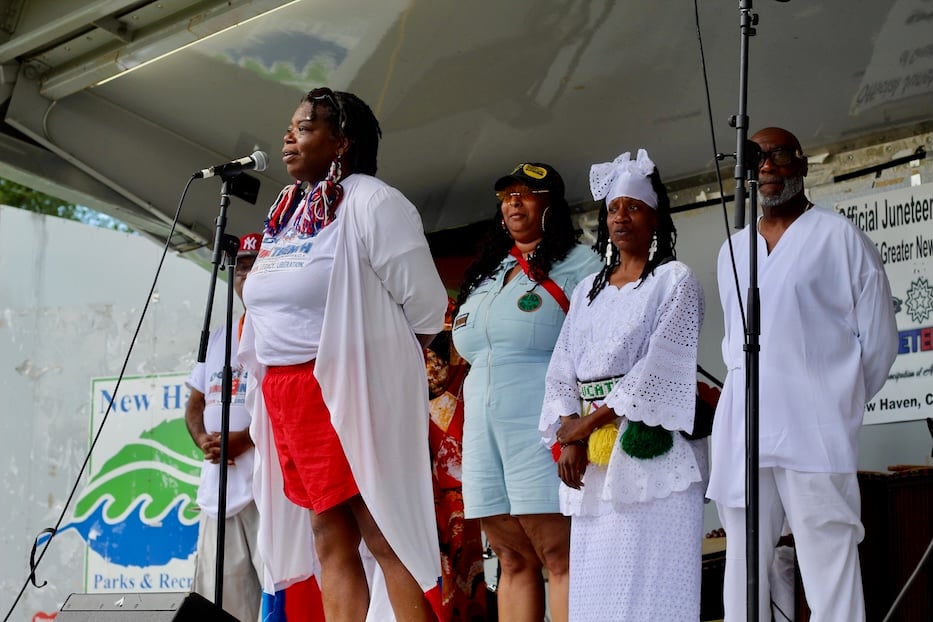
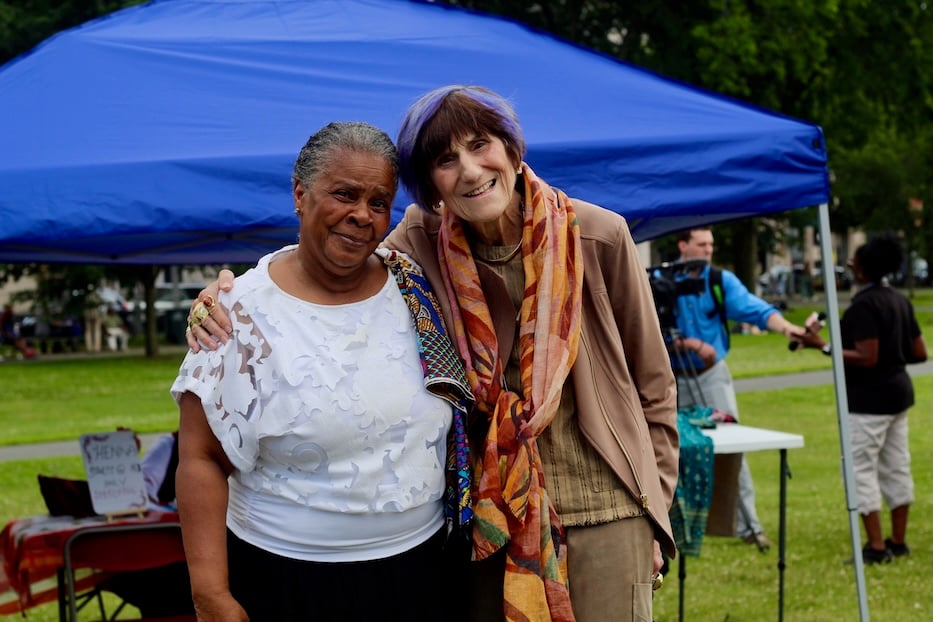
Top: Teague speaks. Bottom: Pat Solomon, a longtime supporter of the coalition and city employee, and U.S. Rep. Rosa DeLauro. U.S. Sen. Richard Blumenthal also attended Friday's event.
Back onstage, the Rev. Cecil (Ngoni) Tengatenga brought the story of Lucy and Lois fully into the present, showing firsthand how the history of enslavement, and legacy of anti-Black racism and dehumanization, persist still today. He pointed to the life-threatening and deadly outcomes that Black people, particularly Black women and mothers, face in the American healthcare system; to a literacy crisis that is higher in Black and Latine communities; to an educational system that lets Black children, and especially Black boys, slip through the cracks.
He stressed how cyclical, how intertwined, and how insidious poverty, racism, and the lasting and traumatic impacts of enslavement on Black people are. It never ceases to shock him, for instance, that the average income for a Black family in the U.S. is a small fraction of a white family’s average income in the same country. It’s for that reason that he reminds people as often as he can that Jesus was “a Palestinian Jew, a brother who sought refuge running from Roman occupation to Africa, in Egypt.”
“This is the legacy of Lucy and Lois, to remind us that injustice anywhere—in your purse, on the street, in your pews, is injustice everywhere,” he said. “The fight that brought Lucy and Lois to the Green has not changed. The systems that oppress Black people have not changed. They have taken different forms.”
As attendees listened, many nodding as if they were already in Sunday services, Official Juneteenth Coalition of Greater New Haven organizers Hanan Hameen, her mother Iman Hameen, and members of the Keepers of the Culture dance company prepared to honor elders across the community, as they do faithfully each year.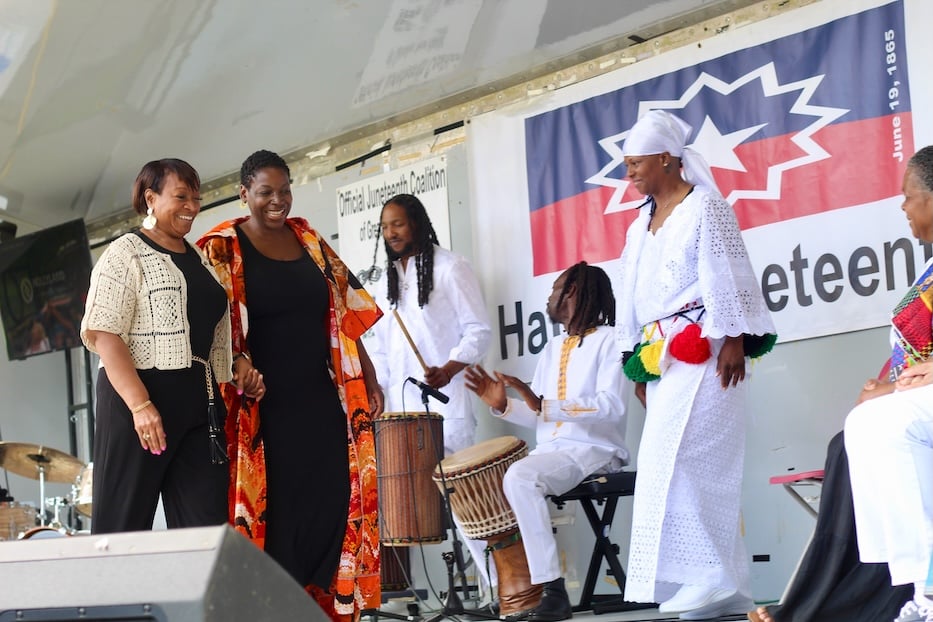
Top: Marcella Monk-Flake and Shayla Streater. Bottom: Artist B*Wak Comfort.
In addition to Snyder, who the Iman Hameen gently instructed to stay onstage, this year’s honorees included Delores Edwards, an outreach specialist and patient advocate at the Sickle Cell Disease Association of America Connecticut (Michelle’s House); human rights champion James Rawlings; Betty Hamlett-Jones, a longtime paraprofessional in the city’s public schools, working in special education; Cynthia Howard Griffin, who founded Bridgeport’s Juneteenth parade; the Langley family, including artist and musician Rahsaan Langley; and the Monk Family. Marcella Monk-Flake, who founded and runs the Monk Youth Jazz and STEAM Collective.
“Mantle” awardees—those are not-yet-elders who are already carrying the work forward, and teaching Black history and culture to younger generations—included the poet and activist Sun Queen, artist and storyteller Shayla Streater, who runs the series “Breaking Bread,” and former Elements of Abundance members Arden Santana and Hafeeza Turé, and artist Edmund B*Wak Comfort, who became a double amputee last year, and almost immediately got back into the studio so he could keep making art and mentoring future generations of creatives.
Rawlings, who ran Michelle’s House as president of the Connecticut chapter of the Sickle Cell Disease Association of America, received the award posthumously; he passed away at the age of 81 in May 2025. During his life, Rawlings championed both civil rights and health equity for decades, from work at Yale-New Haven Hospital to several years as president of the Greater New Haven NAACP.
“Let’s enjoy this moment,” coalition member MarceyLynn Teague had said minutes before, and the words remained in the air, round and resonant, for a moment. “We weren’t promised this moment. We weren’t promised this day.”